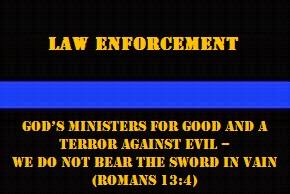
“For he is God’s minister to you for good. But if you do evil, be afraid; for he does not bear the sword in vain; for he is God’s minister, an avenger to execute wrath on him who practices evil.”
(
Romans 13:4
)
With the latest rash of mass killings, there is once again a "hue and cry" from the generally anti-cop (and anti-God) leftists seeking to further restrict the 2nd Amendment rights of Americans (despite the fact that not all of these events involved guns, but I digress...). Then of course there is the now ever-present attack on law enforcement for having the "audacity" to actually use deadly physical force (or force of any kind, for that matter). So what, if anything, does God have to say to us on this this subject? The short answer is "PLENTY." Let's open our Bibles and find out together!
The central Bible passage for this ministry -- and the one that adorns our apparel and other gear -- is taken directly from
Romans 13:1-4
. Here's our paraphrase:
"COPS -- God's ministers for good and a terror against evil. We do not bear the sword in vain."
Yet many serving in our God-ordained profession (read all of
Romans 13:1-7
) continue to falsely believe (or be falsely told) that we can't be both cops and Christians, or that our lawful use of deadly force goes against God's Word (the Bible) -- drivel usually spread by those who've never actually read it. Friends, let me again assure you that NOTHING could be further from the truth.
First, let's briefly break down the passage:
(1) The Greek word for "
minister
" used here is literally translated as "servant" -- the
serve
part of "serve and protect". Mere accident? I think not!
(2) Who are those the apostle Paul calls "
good
" here? The generally law-abiding public we are called to protect.
(3) Likewise, who are those God (through Paul), calls "
evil
" and whom we (law enforcement, military) are to be "
terror
" against? This refers to the criminal element, the lawless and yes, outright evil we spend so much time dealing with.
(4) Finally, let's look at "...
He does not bear the sword in vain
." The sword
is a reference to deadly physical force (the 1st century "AR"), and including but not limited to capital punishment. In the Roman Empire, criminals were typically executed by beheading with a
sword
(crucifixion was reserved for the worst criminals of the lowest classes). Clearly, there should be no doubt that God's design is for the government (law enforcement, military, state) to employ lawful, righteous deadly force and to carry out the death penalty. And where do we see this today? For starters, in
Proverbs 28:1
inscribed below one of the
lions on our National Law Enforcement Officers Memorial
("
The wicked flee when no man pursueth, but the righteous are bold as a lion
").
Now many will then point to what they wrongly believe is God's prohibition against killing. While I've taught on this many times, the use of the word "kill" in the King James Version of the Bible does not mean what most think it means. On the contrary, the Hebrew word and meaning God gave to us in
Exodus 20:13 (NKJV)
is correctly translated as "
murder
" -- the
unlawful
taking of another's life (and "murder" is the word used in all sound, modern translations) versus the taking of a life in legitimate combat, law enforcement, lawful self-defense or the defense of others.
So with that foundation, let me start by sharing with you a short article on this subject by friend, atheist-turned-Christian and fellow police detective
J. Warner Wallace
, who writes:
Most Christians accept the idea that some uses of deadly force are necessary and justified from a Biblical perspective. Scripture supports this understanding in the following ways:
The Old Testament Advocated the Use of Deadly Force
God did not prohibit “killing” in the Ten Commandments. Instead, God prohibited “
murder
” that involved intentional “malice”. The Old Testament allowed for several forms of justifiable homicide, including homicides committed in self-defense or in the defense of one’s home (
Exodus 22:2
) and homicides committed when trying to protect the life of an innocent third party (
Exodus 2:11-12
and
Genesis 14:14-16
). These two guiding justifications for homicide were employed by God himself as he occasionally directed the nation of Israel, and these two exceptions are still in place across the United States in the Penal Codes of each state.
The New Testament Also Advocates the Use of Deadly Force
Jesus clearly told his followers that His teaching was consistent with the Old Testament instruction that preceded Him (
Matthew 5;17-20
), even as He introduced a new covenantal agreement with mankind related to Salvation. In addition, the New Testament affirms the justified use of force in the following ways:
(1) Jesus Believed in Justifiable Aggressive Action
Jesus was quick to act aggressively to defend what He believed was right (see
John 2:13-16
). Jesus violently turned over the tables in the temple and His actions were warranted by the just nature of His cause.
(2) Jesus Called for the Use of the Sword
Jesus told his disciples to arm themselves with swords (see
Luke 22:36
). At the very least, Jesus called his disciples to prepare themselves for their own defense. And the sword (an instrument that can be used to kill someone) was evidently allowable in the eyes of Jesus.
(3) Jesus and John Never Condemned the Duty of Soldiers
Both Jesus and John shared the same perspective on the appropriate use of force. Maybe that’s why Jesus never commented negatively on any soldier he ever came in contact with (see Matthew 8:5-12). In addition, John the Baptist never scolded the soldiers who came to be baptized (see Luke 3:12-14). In fact, while he admonished them not to extort money or accuse people falsely, he never told them to accept a position of pacifism.
(4) Paul Affirmed the Occasional Need for Deadly Force
Paul recognized the fact that government has the authority to use deadly force as it “
bears the sword
” (see
Romans 13:1, 3-4
) and Paul did not deny the government’s authority to execute him if the government found that Paul had done evil (see
Acts 25:9-11
).
(5) Jesus Will Use Justifiable Deadly Force
With all this in mind, it’s much easier to understand and accept the way that Jesus is then depicted in the Book of Revelation, where he is described as a warrior at End Times (see
Revelation 19:11-21
).
Even though these passages of Scripture advocate the rare but justified use of deadly force, many Christian pacifists have argued that Jesus’ teaching related to “
turning the other cheek
” (
Matthew 5:38-41
) prohibits Christians from using force of this kind. Notice, however, that Jesus talks about being struck on the “right” cheek in this passage in Matthew’s gospel. Many Biblical scholars have noted that such a blow would have to be delivered by an attacker using his right hand in a backhanded manner. In the Jewish culture of Jesus’ day, such a blow was an act of disrespect more than it was an act of physical aggression. In this context, Jesus was simply teaching that we are to restrain ourselves from answering insult with insult. This passage has nothing to do with the justifiable use of force in order to protect oneself or protect the life of an innocent third party.
These two justifications (self-protection and protecting an innocent third party) ought to guide us as we examine our motivations to go to war. This sort of force ought to be rare and carefully justified. While we may disagree on the valid justification for a specific act of war in the past, we can truly recognize our fallen war veterans as heroes when we understand the proper Biblical reasoning for force. Moral decisions of this nature require heroic bravery and thoughtful wisdom.
"But wait, there's more!
" I
n the Bible,
God has given us a set of laws and, with it, guidelines ("policies and procedures") for the enforcement of those laws that form the basis for literally all modern-day statutes. God's makes it clear in His Word that any law is essentially meaningless without enforcement or real consequences for breaking it (sadly, today's growing lawlessness includes lesser and lesser consequences for violating those things God rightly calls evil.
With t
he understanding that while those living during the time in which the Old Testament was written may not have had a police force as we think of it today (it was more akin to a military or federal police force rather than the concept of our "modern" police concept which didn't start until the early 1800s in Great Britain), they definitely had those who promoted justice by enforcing the law. The Bible’s references to "watchmen" (
Ezekiel 33:6
), armed security (
Nehemiah 4:13
), and judges (
Ezekiel 44:24
and the whole book of
Judges
) are in fact just a few examples of law enforcement in the Bible.
God -- the
ultimate warrior
and "Chief of Police" -- is a God of justice (
Deuteronomy 32:4
), and He demands justice: “
Follow justice and justice alone
” (
Deuteronomy 16:20
). This command provides for the necessity of law enforcement. God has always given the responsibility of enforcing the law and protecting those who can't protect themselves (and thereby maintaining justice) to us -- the peace officer. For example, in
Psalm 82:3-4
He exhorts us (the police) to, “
Defend the weak and the fatherless; uphold the cause of the poor and the oppressed. Rescue the weak and the needy; deliver them from the hand of the wicked
”.
Ultimately, a Christian involved in law enforcement is doing a good and godly (biblical) thing. The police officer who enforces the just law of the land should consider himself or herself as God’s servant and, toward the lawbreaker, an "agent" of God’s wrath sent to keep the peace and carry out justice. One of the most important jobs of every police officer is the restraint of evil in society, making ours a dangerous profession but one that is wholly congruent with God's biblical plan for justice and righteousness.
My hope is that this short study will serve as a huge, wholly biblical dose of encouragement for officers (don't ever let anyone tell you that our use of force -- including deadly force -- is wicked). Moreover, part of my own mission here (and the mission of every true Christian as well) is to be used of God to lead the unsaved officer to faith and thus infuse our profession with genuine Christian officers who will serve in accordance with God's standard. As God clearly reveals to us in this study, ours is a God-ordained profession of arms but also one in which most who wear the badge are not saved (ours is in fact a true mission field). But imagine the difference we could make in our sin-sick nation today if we filled government (including our police agencies) with born again servant-warriors who would govern, serve and protect from a biblical worldview.
So is that you? If not, it can be! Scroll down to the "
Know God?
" section below!
_____________________
KNOW GOD?
(1) Do you still falsely believe that you can "earn" or otherwise "badge" your way into heaven and escape hell because you consider yourself to be a "
good
" cop or "good" person? That you can be "good" enough without God? Take the
Good Person Test
and see how you do!
(2) Jesus' first recorded words in His earthly ministry were and remain, "
Repent and believe in the Good News
" (
Mark 1:15
). To
repent
is a "180" -- a complete,
radical
change of mind and heart as it relates to our sin (as God defines it). To "believe" (
pisteuo
in the original Greek) as Jesus intends it here is to wholeheartedly trust and
surrender
your life to Him in faith in the same way we have "faith" that our body armor will do its job against the rounds it is intended to stop; that a well-maintained weapon will function properly when used in defense against criminals intent on destroying us or others; or that our parachute will open when it is supposed to (we stake our very lives on it)! For more, see
What does it mean to believe in Jesus?
(3) This same concept of "
believe
" (the saving kind) is further revealed in
John 3:1-21
where Jesus says, "
... you must be born again
." Again, note our Lord's emphasis on the word "
must
" (not "may" or "should" or even "someday"): this is ultimately the life-saving AND life-changing personal relationship (and NOT "religion") with Jesus Christ that I stress here every week (see
What does it mean to be a born again Christian
? [hint -- there is no other kind]).
(5) Need more? Then check out this powerful, short video message from police servant-leader
Travis Yates
:
Cops and Salvation
(6) Have you now said "yes" to Jesus as Lord and Savior but are wondering what to do next? The "now what" is also an important part in dealing with the issues that can lead to suicide and sin in general. Click on,
Now what?
MC