|
Dear Brothers & Sisters in Christ,
All Souls’ Day (the Commemoration of All the Faithful Departed) observed on November 2nd is a day of prayer and remembrance for all the dead, especially those believed to be undergoing purification before entering heaven.
The practice of interceding for the deceased is far older than the feast. It has roots in Jewish tradition (notably 2 Maccabees 12:43–45) and appears in early Christianity. Second-century tomb inscriptions show Christians praying for the departed, and the third-century writer Tertullian refers to the custom. In the early Church, the names of deceased brethren were often entered in diptychs (liturgical lists) so they could be remembered at the Eucharist.
Local commemorations developed in different places and on different dates. Benedictine monasteries in the sixth century held special remembrances of deceased members around Pentecost. In seventh-century Spain, St. Isidore of Seville (d. 636) knew of a Mass for the departed on the Monday after Pentecost or a related day. In Germany around 980, there was an established custom of praying for the dead on October 1.
The fixed date of November 2 and its near-universal observance in the Western Church are due to St. Odilo, fifth abbot of Cluny (c. 962–1049). Around 998, he ordered that all monasteries of the Cluniac congregation observe a special day of prayer, Masses, and almsgiving for all the faithful departed on the day immediately following All Saints’ Day.
A popular medieval legend, recorded by his biographers, tells of a pilgrim who, after a shipwreck, met a hermit. The hermit described hearing the groans of souls in purgatory and the complaints of demons that the prayers and alms of the Cluny monks were freeing many of them. The pilgrim reported this to Odilo, who then instituted the annual commemoration. Whether the story is historical or pious legend, it reflects the strong medieval belief that the living could aid the dead through prayer and good works.
Odilo deliberately linked the day to All Saints’ Day: after celebrating those already in heaven, the Church turns to those still being purified. The enormous influence of the Cluniac network (hundreds of monasteries across Europe) caused the observance to spread rapidly among other Benedictines, the Carthusians, and then to secular dioceses. The diocese of Liège adopted it early (under Bishop Notger, d. 1008). By the thirteenth century, it was widely established in the Western Church; Rome itself adopted it somewhat later (recorded from the fourteenth century in some accounts).
The feast, therefore, grew from ancient practices of intercession for the dead, and has continued as a major expression of the communion of saints—the living aiding the dead through prayer, Mass, and charity.
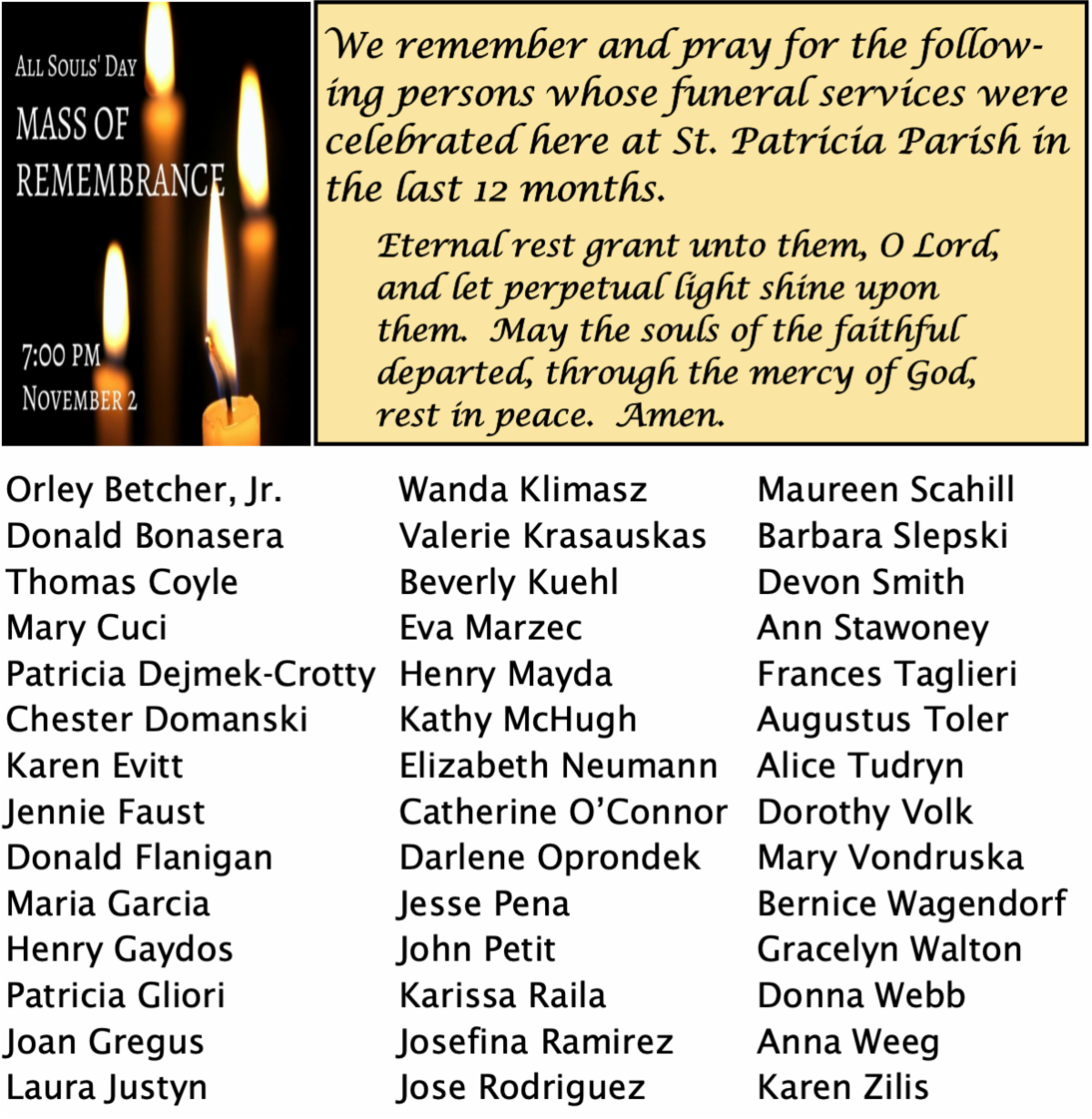
That is a beautiful and meaningful tradition. At St. Patricia, our Mass of Remembrance at 7:00pm on All Souls’ Day (November 2nd) is a powerful way for the parish community to come together, light candles, and pray specifically for those from the parish family who have returned to the Lord over the past year.
May God bless you,
Father Andrew, Pastor
|