September 3, 2020
Top stories
Safety for journalists has taken on a renewed sense of importance as newsrooms grapple with the convergence of hostility toward those in the field and systemic racism that pervades even the most revered journalistic institutions. It seems journalists have more reason than ever to be allies for each other as the industry confronts itself while serving conflicted communities. 

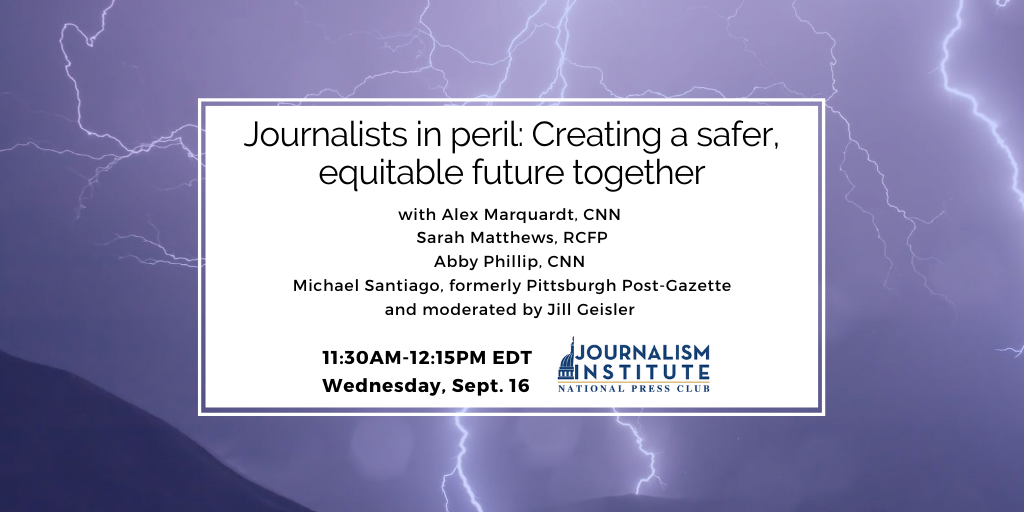
This program will be moderated by Jill Geisler, who will join Alex Marquardt, Sarah Matthews, Abby Phillip, and Michael Santiago to discuss “Journalists in peril: Creating a safer, equitable future together,” drawing on their experiences at CNN, the Pittsburgh Post-Gazette, Reporters Committee for Freedom of the Press and their knowledge of journalism, allyship and equity. 

Registration is open for this program, which will take place from 11:30 a.m. to 12:15 p.m. Wednesday, Sept. 16, 2020. 
The National Press Club Journalism Institute offered a “what if” workshop examining the top threats facing the 2020 election on Thursday featuring four election experts in contested election results, election interference, mail-in ballots and voter suppression. FEC commissioner Ellen Weintraub delivered the opening remarks.

Among her insights:

On litigation

Weintraub: We're nine weeks out from the election and there are about 200 lawsuits that have been filed around the country, some seeking to expand the opportunities to vote, some seeking apparently to contract them.

On big picture concerns

Weintraub: I worry about our democracy. I worry that we are jeopardizing the American people's faith in our democratic process, in our entire system of governance. This is a faith and a system of trust that has been built up over hundreds of years. And I fear that we're about to blow it, and if we destroy faith in our institutions, if we destroy faith in our very democracy, in our very system of how we choose our leaders and our and our government, that trust is going to be exceedingly difficult to build back up again. 

On the role of journalism

Weintraub: Facts matter. Truth matters. Facts are not partisan. And the media again needs to play a strong role in holding people to account when they are not truthful. I'm not talking about, you know, standard puffery that all politicians engage in. But if there is disinformation out there from foreign or domestic sources, we rely on the media to do fact checks. And to create a system where, at the end of the day, people will trust the results, people will understand that we need the time to count the votes. And once we count the votes, we will know the results.
Following the Commissioner’s remarks, election experts offered their guidance on the top election issues. 

On contested election results

Rick Hasen, Chancellor’s Professor of Law and Political Science at the University of California at Irvine, said that journalists today can push for transparency in coverage by reporting on what systems are in place now to ensure integrity.
 
On election interference
 
Maria Barsallo Lynch, executive director of the Defending Digital Democracy Project, said that we may not know if it is disinformation or misinformation or whether the coverage is intentionally false or unintentionally shared but it is still journalists’ responsibility to address it.
 
On mail-in ballots and US Postal Service readiness
 
David Becker, executive director and founder of the Center for Election Innovation & Research, said that journalists can help push back against the narrative that you can have your vote or have your health. For a lot of people, voting in person is going to be the best option, and votes that are made in person before and on Election Day are the first ones counted. 
 
On voter suppression, polling access and Election Day pandemonium
 
Sylvia Albert, director of voting and elections at Common Cause, said that journalists are part of the process, so as they report, there is an effect. Provide context and perspective on polling problems and suppression efforts so that people understand their vote has value. 

Advice from Jill Geisler,
Bill Plante Chair in Leadership & Media Integrity, Loyola University Chicago
Freedom Forum Fellow in Women’s Leadership

I had a talk recently with an editor I respect. She’s leading ambitious and ever-expanding coverage of the coronavirus on multiple platforms. Her staff is serving the public’s insatiable appetite for trustworthy news.
 
But the editor worries that she’s letting her hard-working team down. She can’t keep up with the feedback they deserve. 

On what once were her days off, she reviews great chunks of the week’s output. She wants to provide people worthwhile messages about their work; specifics, not generalities. But that commitment leaves her little time to recharge her own depleted batteries.

I know she’s not alone in dealing with these dueling goals – one that says “Lead the bigger picture for your team,” while another says “Deliver detailed feedback.”

It’s easier to juggle those goals when a crisis isn’t creating a tsunami of stories. It’s an ever- growing problem for managers today.

Let me offer two modest solutions:

  • Grow the grapevine
  • Go ahead and brag

The grapevine consists of everyone — in all parts of the organization – who consume the product. So often, we read, watch or listen to something our colleagues have created and really enjoy it. We might even remember to compliment them on it, if we’re friends. But if we’re not close, we may keep our thoughts to ourselves. And it’s even less common that we’d respond to anyone’s good work by telling their bosses about it. That act is reserved for big problems.

Let’s change that.

Now is the time to “rat out” the good stuff to management. It doesn’t have to be an in-depth review, just a quick note with a nugget or two of detail that proves it’s for real. It doesn’t have to be for superstar performance. Darn good is sufficient. Just pass the message to management – or cc a manager in the note you send to your co-worker.

With this simple move, we can provide leaders a present they can shamelessly re-gift to staff.

What about the other solution?

Go ahead and brag will be an awkward transition, especially for anyone whose family raised them to let their good work speak for itself. (“Self-praise stinks,” as my Granny used to say.) 

We don’t want to look arrogant or needy by calling attention to our own work.

We’ve never assumed it’s on us to ensure our bosses know when we’ve done something noteworthy. We’ve always thought it was their job to pay attention and acknowledge it on their own.

But they can’t do it on their own right now – and maybe not for a long time to come. 

They need some help. They want it.

So go ahead, brag about your work to the boss. Make it a simple “FYI – happy to share this with you” message.

Grapevine the good work of others. Be a catalyst for the boost that comes from recognition and appreciation.

It would be easy to dismiss feedback as a luxury right now, as something strong, smart people should just forego. But when they’re doing so much extra under such tough conditions, let’s not give up on the one free incentive that need not be in short supply. We just need to re-tool the supply chain.

Don’t worry about how your manager learns about your efforts. It’s the clarity and sincerity of their feedback that makes those messages meaningful.

This article was previously published on April 6. Click here to read Jill’s previous posts.
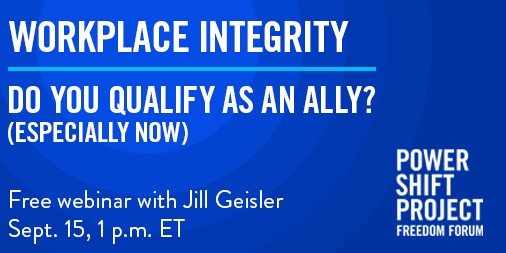
Do you qualify as an ally? Join Jill for the next Freedom Forum Institute Power Shift Project program on September 15 at 1 p.m. EDT. Registration is now open.
Two left feet? Sure, you could release some stress at the end of the day watching the latest season of “Dancing With The Stars.” But why not take center stage in your own living room? 

Studies show that dancing lowers stress and can boost happiness. Mentally focusing on dance moves and the physical activity itself are powerful tools to shake out stress. 

Whether you groove to your own beats, jump on the latest TikTok dance challenge, or move to your favorite movie soundtrack (hello, Mamma Mia dance routines), you’ll stimulate stress-fighting activities in the mind and body. 

Whatever your dance skills, here’s how you can work in some movement: 

  • Try learning a classic or modern dance move using YouTube videos. 
  • Take an organized class, virtually. Many studios and dance experts have moved their courses online and offer free trials. 
  • Learn a routine to your kiddo’s favorite tunes, or help them with their routines. With online learning, turn P.E. or recess time into a dance fest. 
  • Pick a song that gets you moving, and set an alarm to listen to it at some point during the day — out of your chair.
  • If your colleagues and manager are game, set up a short group dance Zoom room once a week, and rotate who picks the song. (Yes, the giggles are also part of self-care.)

Read on for more self-care tips, or share how you are taking care of yourself right now.
The National Press Club Journalism Institute, the National Press Foundation, and the RAND corporation are offering journalists a new way to prepare for the unexpected in Election 2020 news: Gaming your coverage plan.

Registration is open for this free program, which will be held on Friday, Sept. 25 from 5-7 p.m. ET. 
RAND gamemaster David A. Shlapak will present players with scenarios based on current and likely events, and each team will make coverage decisions, not knowing what the next roll of the dice will bring. 

The game will surface journalists’ assumptions and test decisions as reporters and editors balance competing goals, commit limited resources, and assess tradeoffs. The game’s timeline will begin in September, continue through Election Day, and end on Inauguration Day. 
Resources
National Press Club news
This newsletter is written & edited by the National Press Club Journalism Institute staff: Beth Francesco, Holly Butcher Grant, and Julie Moos. Send us your questions and suggestions for topics to cover.

Get this from a friend? Subscribe, and view the archives.