The AIA Long Island Chapter and the Women in Architecture Committee
invite you to:
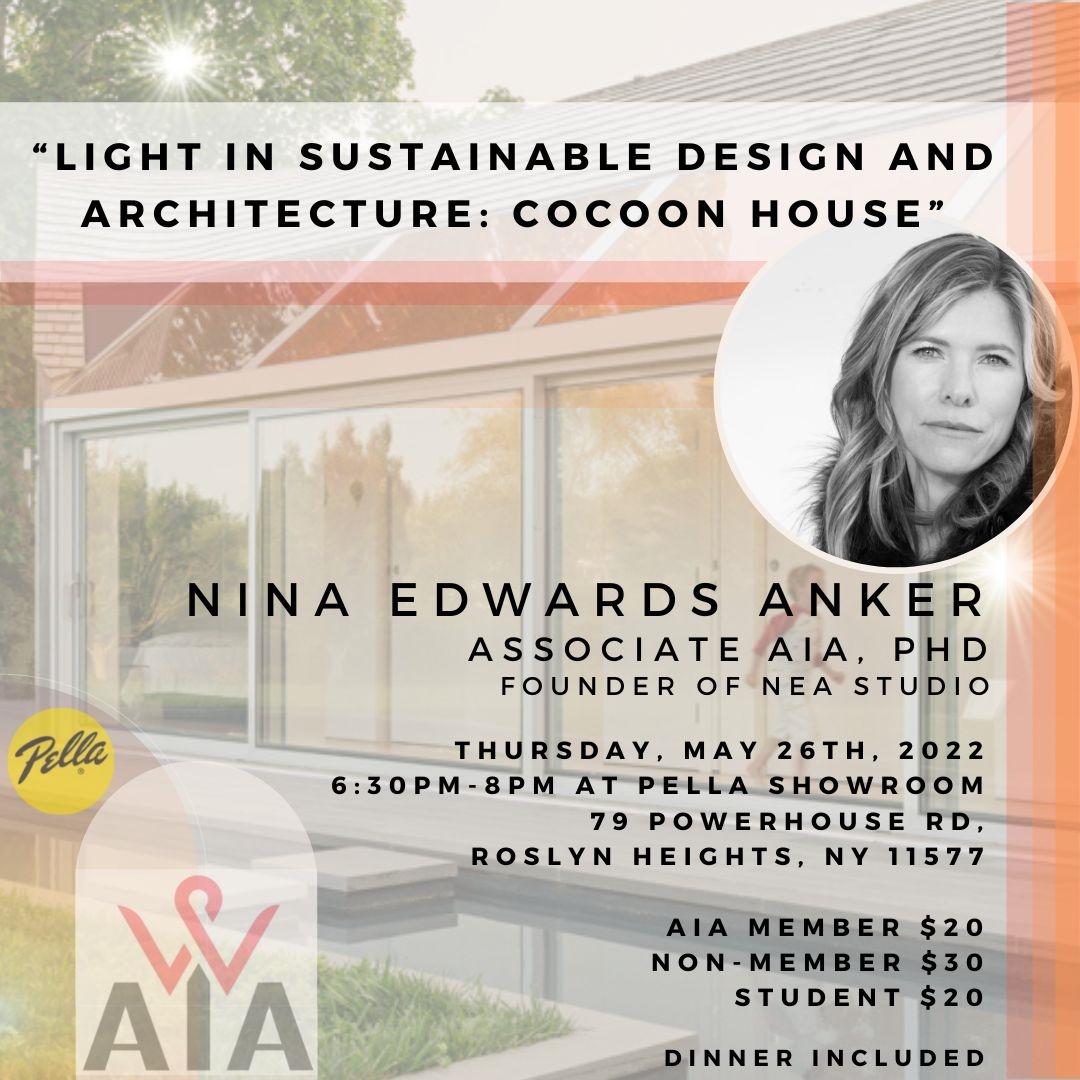
“Light in Sustainable Design and Architecture: Cocoon House”
1.5 LU/HSW
The lecture will focus on the light in sustainable architecture and design. LEED-certified technologies, strategies, and materials can revolve around sunlight, both design-wise and energy-wise. By connecting with sun rhythms, solar architecture and biophilic design can serve the wellness of both human beings and the planet.
Speaker: Nina Edwards Anker, Assoc. AIA, PhD
Founder, nea studio
Established in 2006 by Nina Edwards Anker, Assoc. AIA, PhD, nea studio specializes in architecture and interior design, with a focus on sustainability. The award-winning practice operates in an environment in which project management and implementation take place in parallel with model-making, prototyping and experimentation with ideas, materials, and manufacturing processes.
Nina Edwards Anker is an architectural and interior design professional who has taught at Pratt, Parsons, the Oslo School of Architecture and Design, Sotheby's Institute, and New York University Gallatin. Formerly, she worked at the offices of Pei, Cobb, Freed, Owen & Mandolfo in New York; in Oslo, Norway, she worked as an architect with MMW Arkitekter and a-lab. In practice, Nina’s work has been widely published and exhibited. She won the Good Design Award of the Chicago Atheneum Museum of Architecture and Design for furniture, the A’ Design Award for solar lighting, the Architect’s Newspaper Best Product Award, Domus Best Houses award, and the AIA Award for Sustainable Residence. Nina is also Design Director at Terreform One and a founding member of New Lab at the Brooklyn Navy Yard. She holds a PhD from the Oslo School of Architecture and Design and an M.Arch. from the Harvard Graduate School of Design. She currently teaches Design at Pratt Institute.
Learning Objectives:
● Learn how to define biophilic design and explain how is linked to sun rhythms - circadian health, de-cluttered space, furniture, and lighting designs.
● Discuss the principles essential to biophilic design.
● Apply lessons learned from a residential case study where principles of biophilia and well-being are used.
● Understand how to implement Water catchment techniques and LEED compliance landscaping into biophilic design.