ASN Nutrition Notes
Monthly Member
e-Newsletter
March 2019 Edition
|
|
In This Issue:
(scroll below for details)
- Sign up for Nutrition 2019 by March 15
- Listen to the Nutrition 2019 Preview Podcast
- Nutrition 2019's Scientific Program and Schedule Now Available
- Nutrition 2019 Travel Awards and Family Support Grants
- ASN Members make up a majority of the 2020 Dietary Guidelines Advisory Committee
- 2018 ASN Predoctoral Fellowship Recipient Interviews
- ASN Health and Policy News
- Subscribe to Nutrition Today
|
|
Sign Up for Nutrition 20
19
by March 15!!!
Nutrition 2019 will convene over 3,600 professionals from around the world that make up the multidisciplinary field of nutrition, June 8
‒11 at the Baltimore Convention Center.
REGISTER by
March 15th to save up to 30% off full registration rates– and take your pick from the widest variety available of hotels and ticketed events.
RESERVE your hotel accommodations at one of the six official Nutrition 2019 hotels. All hotels are within walking distance of the meeting, offer a variety of amenities, and range in rates from $155 to $239.
REVIEW the Program Schedule to start planning your time in Baltimore!
|
|
|
|
Nutrition 20
19
Preview Podcast
Did you know that Baltimore has a wealth of history in nutrition and its research discoveries?
To learn more about Baltimore’s rich history of nutrition and for a preview of the
Nutrition 2019 education program, listen to the
Nutrition 2019 preview podcast.
Episode #1 features a conversation with
Dr. Keith West,
Nutrition 2019 Scientific Program Committee member and George G. Graham Professor and Program Director of Human Nutrition, John’s Hopkins Bloomberg School of Public Health.
|
|
Nutrition 20
19
’s
Scientific Program and Schedule is Available!
Nutrition 2019 will feature more than 100 sessions covering 6 tracks so you can get the knowledge and skills you need on the topics you want.
• Hear experts weigh in on hot areas such as nutritional microbiology, big data analytics, nutrition-related health effects of cannabis, animal protein sources, meal timing and circadian rhythms, omics in nutrition, delivery of micronutrients to populations and much more in our featured symposia.
• Explore our preconferences and sponsored satellite programs spanning content from sports nutrition to sustainability of the food supply.
• Drop in to the
From Research to Practice clinical programming track to hear the latest on practice-changing science.
• Network with leaders from federal agencies in our
Connect with the Fed activities.
• Brush up on skills in one of our professional development workshops.
|
|
Nutrition 20
19
Travel Awards
Are you a student or early career professional? The
Nutrition 20
19/FASEB “Diversity Resources for Enrichment, Access & Mentoring” (DREAM) Mentored (formerly called MARC) Travel Award offers up to $1000 in travel support. For full eligibility details, please
click here.
To be considered, you must:
|
|
Nutrition 20
19
Family Support Grants
Deadline for Applications:
April 1, 2019
Nutrition 2019 aims to be a family friendly environment and ASN is offering small grants to help off-set caregiving expenses to enable scientists with dependent children or family members to present their research in Baltimore. The Nutrition 2019 Family Support Grant is a reimbursable allowance up to a maximum of $750 towards eligible funding scenarios. Provision of these grants is part of a study to assess and evaluate conference attendance feasibility; through this effort we will gather feedback about preferences and barriers to conference attendance.
For full eligibility guidelines, please
click here.
Special thanks to the
National Dairy Council and
The Sugar Association, our supporters of the Family Support Grants.
|
|
ASN Members Make Up A Majority of the Announced 2020 Dietary Guidelines Advisory Committee
ASN applauds the selection of 20 highly qualified scientists to serve on the 2020 Dietary Guidelines Advisory Committee, and is pleased to note that 16 of the 20 appointees are members of ASN, including President-elect Richard Mattes, PhD, MPH, RD; past Presidents Sharon Donovan, PhD, RD, and Teresa Davis, PhD; and Board member Heather Leidy, PhD. All of the professionals selected bear outstanding credentials in their respective fields, and are recognized by their peers for their scientific expertise and service in their professional communities.
The independent advisory committee is formed in advance of development of each new set of Dietary Guidelines for Americans (DGA), released every 5 years. The committee members are appointed by the U.S. Secretary of Agriculture Sonny Perdue and the U.S. Health and Human Services Secretary Alex Azar, and are tasked to review scientific evidence on topics and questions identified by the departments. Their resulting report, along with public and agency comments, will be returned to the secretaries and will help inform the development of the 2020-2025 DGA.
The full list of ASN members selected for the 2020 Dietary Guidelines Advisory Committee includes:
- Jamy Ard, MD
- Regan Bailey, PhD, MPH, RD
- Lydia Bazzano, MD, PhD
- Carol Boushey, PhD, MPH, RD
- Teresa Davis, PhD
- Kathryn Dewey, PhD
- Sharon Donovan, PhD, RD
- Steven Heymsfield, MD
- Heather Leidy, PhD
- Richard Mattes, PhD, MPH, RD
- Elizabeth Mayer-Davis, PhD, RD
- Rachel Novotny, PhD, RDN, LD
- Joan Sabaté, DrPH, MD
- Barbara Schneeman, PhD
- Linda Snetselaar, PhD, RD
- Linda Van Horn, PhD, RDN, LD
|
|
2018 ASN Predoctoral Fellowship Recipient Interviews
The recipients of ASN's 2018 Predoctoral Fellowships, Andrew McLeod, Majid Mufaqam Syed-Abdul, and Monica Pasqualino, spoke with ASN about their research and their interests in nutrition science. The recipients of the 2019 ASN Predoctoral Fellowships will be announced at Nutrition 2019 in Baltimore, MD.
|
|
|
|
Andrew McLeod received his M.S. in Human Nutrition from the
University of Illinois at Chicago
and is currently working as a Research Assistant at the University of Illinois at Chicago Lab of Dr. Lisa Tussing-Humphreys. Andrew has been a member of ASN since 2016.
1. How did you first get involved in nutrition science and research?
I first got involved when I decided I would follow what I was passionate about as opposed to what I thought I was supposed to do. I was working a temp job as a paralegal in intellectual property litigation and realized...
|
|
1. How did you first get involved in nutrition science and research?
As a practicing pharmacist, my interest in nutrition grew out of my concern for patients. Compared to pharmaceuticals...
|
|
|
|
|
1. How did you first get involved in nutrition science and research?
I became interested in nutrition science and research while completing my practicum during my Master’s program...
|
|
ASN Health & Policy News
New Dietary Reference Intakes for sodium and potassium
The National Academies of Sciences, Engineering and Medicine
released
new Dietary Reference Intakes
(DRIs) for Sodium and Potassium. In the
report
,
a National Academies committee reviews the current evidence and updates the DRIs for potassium and sodium that were established in 2005. The committee also applies recommendations from the
Guiding Principles Report
for establishing a new category of DRIs based on chronic disease, called the Chronic Disease Risk Reduction Intakes (CDRRs). There remains insufficient evidence to establish sodium or potassium DRIs for adequacy as Estimated Average Requirements (EARs) and Recommended Dietary Allowances (RDAs). The updated Adequate Intakes (AIs) for potassium increased for 7-12 month olds, and decreased for other age groups 1 year of age and up. The AIs for sodium stayed largely the same since 2005, at 1,500 mg/day for ages 14 and up.
First 2020 DGAC Meeting Announced
The U.S. Departments of Agriculture (USDA) and Health and Human Services (HHS)
announced
that the 2020 Dietary Guidelines Advisory Committee (DGAC) will hold its first public meeting on March 28 and 29, 2019. Starting
March 19, 2019
the public will be able to register at
DietaryGuidelines.gov
to attend the meeting in person or via webinar.
|
|
|
|
Visit ASN NutriLink today
ASN NutriLink
is the ASN members-only community forum. Post discussions, browse resource files, and search for a mentor - all in one place! It is also
home for all RIS and Council communities
. ASN NutriLink is the official way for RIS leaders to communicate deadlines, plan events and share other information specific to the group. Use
this guide
to adjust your email frequency. Contact the
ASN NutriLink Community Administrator
with any questions.
|
|
|
|
Nutrition 20
18
On Demand
If you missed Nutrition 2018, or attended a session you’d like to see again, you're in luck! Nutrition 2018 session content is available now on
ASN on Demand
for purchase.
If you signed up for ASN on Demand at registration, your access instructions were sent to you via e-mail. To view the presentations, you may need to add access to your account on
ondemand.nutrition.org
using the access code sent to you. For assistance email
asnondemand@nutrition.org
.
|
|
|
|
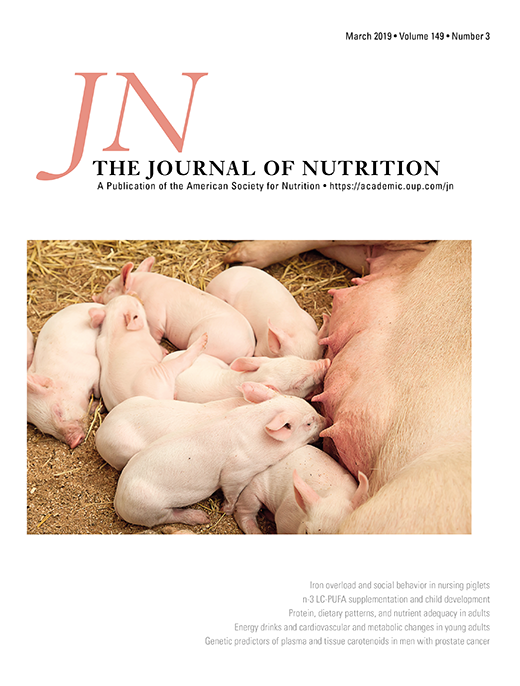
The Journal of Nutrition
(JN)
March 2019, 149(3)
Featured Articles:
- Can obesity be reduced by choice of calories and spermidine supplementation? A study fed mice 1 of 3 different diets for 30 weeks to test the impact of diet, activity, and spermidine supplementation on sucrose- and fat-induced change. The results suggest that spermidine has the potential to augment physical activity-induced beneficial effects, particularly for sucrose-induced obesity. Schipke J, Vital M, Schnapper-Isl A, Pieper DH, Muhlfeld C. Spermidine and voluntary activity exert differential effects on sucrose- compared with fat-induced systemic changes in male mice. J Nutr 2019;149:451‒62.
- Cardiovascular health benefits associated with high‒oleic acid oils used to replace trans unsaturated fatty acids in processed foods. Results of a study suggest that replacing sources of saturated fatty acids with high‒oleic acid and/or conventional canola oils is an effective strategy to reduce atherosclerotic cardiovascular risk. Bowen KJ, Kris-Etherton PM, West SG, Fleming JA, Connelly PW, Lamarche B, Couture P, Jenkins DJA, Taylor CG, Zahradka P, et al. Diets enriched with conventional or high‒oleic acid canola oils lower atherogenic lipids and lipoproteins compared to a diet with a western fatty acid profile in adults with central adiposity. J Nutr 2019;149:471‒8.
- Adverse impacts of energy drinks cannot be attributed to a single ingredient. Researchers concluded that a single high-volume intake of energy drinks caused adverse changes in blood pressure, ventricular activity, and insulin sensitivity in young, healthy individuals, but the effects cannot be easily attributed to a single component of caffeine, taurine, or glucoronolactone. Basrai M, Schweinlin A, Menzel J, Mielke H, Weikert C, Dusemund B, Putze K, Watzl B, Lampen A, Bischoff SC. Energy drinks induce acute cardiovascular and metabolic changes pointing to potential risks for young adults: a randomized controlled trial. J Nutr 2019;149:440‒51.
|
|
|
|
|
|
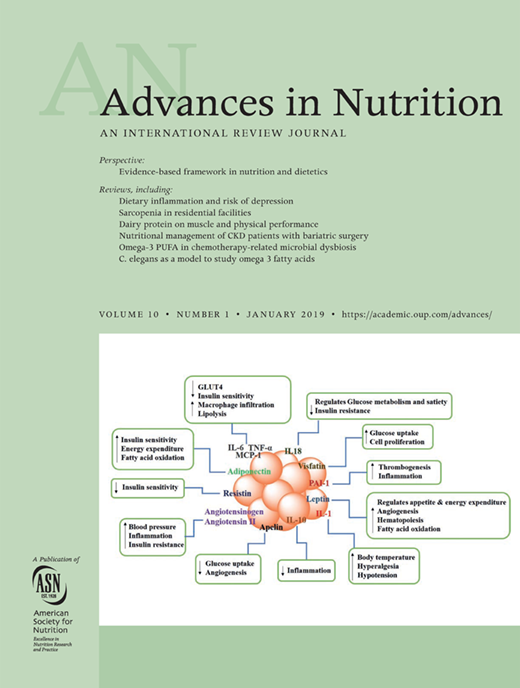
Advances in Nutrition
(AN)
January 2019, 10(1)
Featured Articles:
- Yue Zhang et al. concluded that “omega-3 polyunsaturated fatty acids (n-3 PUFAs) could be capable of reverting chemotherapy- or radiotherapy-related intestinal microbial dysbiosis, attenuating intestinal inflammation and reducing oxidative stress in the gut. Therefore, administering n–3 PUFAs should be an option in these patients.” Research is, however, needed to determine the optimal formula and dose. Zhang Y, Zhang B, Dong L, Chang P. Potential of omega-3 polyunsaturated fatty acids in managing chemotherapy- or radiotherapy-related intestinal microbial dysbiosis. Adv Nutr 10(1):133–47.
- We are all susceptible to sarcopenia as we grow older. Nivine I. Hanach et al. believe dairy products are particularly well suited to help prevent the onset or the progression of sarcopenia, noting that “the present systematic review provides evidence of the beneficial effect of dairy protein as a potential nutrition strategy to improve appendicular muscle mass in middle-aged and older adults.” Hanach NI, McCullough F, Avery A. The impact of dairy protein intake on muscle mass, muscle strength, and physical performance in middle-aged to older adults with or without existing sarcopenia: a systematic review and meta-analysis. Adv Nutr 10(1):59–69.
|
|
|
|
|
|
Current Developments in Nutrition
(CDN)
Advance Access
Featured Article:
- Initiatives to promote healthy eating remain largely ineffective, with individuals struggling to adhere to dietary recommendations. Recent studies have, however, indicated that an approach that focuses on eating pleasure rather than health to promote the consumption of healthy foods may be effective. Caroline Vaillancourt et al. compared the potential effect of pleasure-oriented vs. health-oriented messages to encourage healthy eating among a group of French-Canadians. The results of their study may help healthy eating advocates construct more effective messages by focusing on the pleasurable experience of eating healthy foods in order to successfully instill more healthy eating patterns. Vaillancourt C, Bedard A, Belanger-Gravel A, Provencher V, Begin C, Desroches S, Lemieux S. Promoting health eating in adults: an evaluation of pleasure-oriented versus health-oriented messages. Curr Dev Nutr 2019 [Published ahead of print]
|
|
|
|
Highlights from Other Journals
|
|
Give Today - Support Tomorrow
Donate to support the next generation of nutrition scientists.
|
|
|
|
|
|
|
|