|
Learning... it's not just for kids
Learning about Resources
| |
|
"Education is the most powerful weapon
which you can use to change the world."
~ Nelson Mandela
| |
|
|
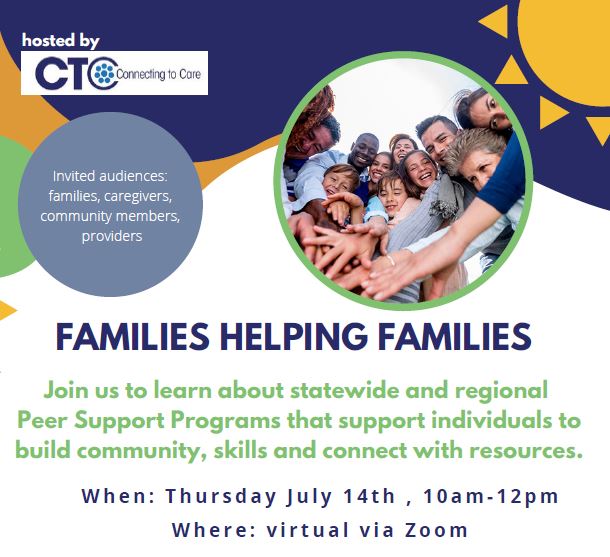
Connecting to Care Holds Successful Families Helping Families event
Peer support services are crucial for families and individuals to feel heard, seen and connected while navigating the behavioral health system.
In July, Connecting to Care hosted a well-attended virtual Families Helping Families event which featured statewide peer support service organizations. Presenting organizations included FAVOR, Inc., Advocacy Unlimited (AU), CT Parent Advocacy Center (CPAC), CT Community for Addiction Recovery (CCAR), National Alliance on Mental Illness (NAMI) Connecticut, CT Family Support Network (CTFSN) and Beacon Health Options.
Peer support services help individuals to build community, practice self-advocacy, and connect with resources. Presenters shared important information about the state's behavioral health system, personal experiences with services, and the positive difference these have made in their lives.
Stay tuned as additional events are being scheduled.
| |
|
Graduation Smiles
Written by Gennie Busse, FAVOR Family Peer Support Specialist
The return to in-person learning was a welcomed relief for most families but easier said than done for some. Post-pandemic statistics concerning school attendance problems (SAPs) indicate this continues to be a persistent problem for many schools in Connecticut. [...] Students can experience serious physical symptoms related to social anxiety such as headaches, fatigue, eating disorders, disrupted digestion and panic attacks. These symptoms are extremely frustrating for the student, family and school staff. [...]
| |
|
What does Wraparound Care Coordination* look like in real life?
This is the story of a family and youth who used Care Coordination, and the positive outcomes they experienced.
My name is Gina and I am a Care Coordinator. I had the pleasure of working with John who came to Care Coordination with trauma which had an impact on the way he viewed himself and others. John was self-referred to Care Coordination by his mother as a 9-year-old boy with a huge love of soccer. John was always a leader on his soccer teams, and also enjoys reading non-fiction and going to the gym with his mother. At the time of his Care Coordination intake, his parents were going through a divorce and John was residing with his mother, younger brother and their dog. John came to Care Coordination with difficulty regulating his emotions and had witnessed some traumatic events between his parents. [...]
*Care Coordination helps families identify and meet their needs through the use of high fidelity “Wraparound.” The Wraparound process is designed to be culturally competent, strengths based and organized around family members’ own perceptions of their needs, goals, and vision. A Wraparound facilitator, called a Care Coordinator, helps families build a team of natural, informal, and formal supports using the Wraparound process. This is called the Child and Family Team (CFT).
The family learns how to use the strength-based empowerment model to help their child improve functioning in home, school, and community. The team helps guide the family toward meeting their needs and ultimately achieving their shared Family Vision through help, healing and hope.
| |
|
Did you know?
The statewide Connecting to Care initiative understands that in order to move toward achieving racial justice across child- and family serving systems, the services that children and families might benefit from must be racially just and culturally and linguistically appropriate. As part of this effort, the statewide Culturally and Linguistically Appropriate Services (CLAS) workgroup has dedicated significant time and effort to identifying and disseminating strategies that aim to help child-serving organizations increase their organizational capacity to work within communities that they serve and to implement effective, culturally responsive, linguistically appropriate, and racially just services for populations facing disparities.
Highlighting CLAS Programming by local providers
| |
|
Southwest Community Health Center was a participant in Connecting to Care CT Culturally and Linguistically Appropriate Services (CLAS) Standards training Cohort in 2021, and the CT’s Community and Clinical Integration Program (CCIP) in 2019. Through these programs, we learned to use granular data to identify cultural, language, and social factors that are barriers to care; and address these barriers through community linkages.
As a result, we have integrated the following:
- Use of Community Health Workers as front-line referrals to connect patients to needed resources and monitor the outcomes.
- Increased cultural competency training and Sexual Orientation and Gender Identify (SOGI) and LGBTQ training.
- Building staff competency on how to ask patients about race/ethnicity.
- Annual healthcare assessments of Social Determinants of Health (SDOH) risks, health literacy, learning needs, etc.
- Integrating within the patient records, patient access to social services and the barriers to accessing services.
- Positioning of a new Electronic Health Record (EHR) system, EPIC, to enhance, track, and record pertinent patient data.
- Translating essential signs and documents (using a fifth-grade literacy level) into our top three languages (English, Spanish and Portuguese) and adding other languages as needed.
- Use of the Language Line when a patient’s preferred language is other than English.
If your organization is interested in receiving free assistance and support in developing and/or enhancing a Health Equity plan or training on the National Enhanced CLAS (Culturally and Linguistically Appropriate Services) Standards, contact Lisa Palazzo lisa.palazzo@beaconhealthoptions.com
|
|
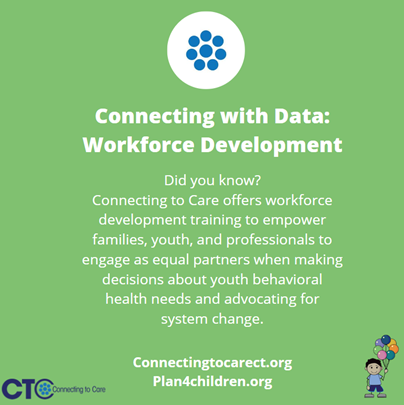
Connecting to Care Data Stories are short, easy-to-read reports that tell a story about information collected during the Connecting to Care initiative. They are designed to share data with interested community members, families, youth and professionals to help facilitate a collective understanding of aspects of the network of care. Data Stories are created by The Consultation Center at Yale, our evaluation team for the Connecting to Care grant.
| |
Data Story Highlight: Workforce Development | |
|
How many people got trained?
In Fiscal Year 2022 (July 2021-June 2022) 1037 individuals participated in WrapCT trainings to learn about the Wraparound process.
Additionally, 604 families and youth were trained by FAVOR, Inc.'s Learning and Leadership Academy in various topics including Network of Care- Agents of Change and Persuasive Storytelling. Plus 125 DCF staff were trained in family engagement during pre-service training.
| |
|
Feeling stressed, anxious, alone?
Let's take care of ourselves and each other!
| |
|
The Children's Behavioral Health Advisory Committee (CBHAC) meets on the first Friday of the month, from 10am-12pm. The next meeting is September 9, 2022 due to the Labor Day holiday.
CBHAC's mission is to promote and enhance the provision of behavioral health services for all children in Connecticut. Appointed members and community guests attend monthly meetings to address these needs across the state. This committee must submit an annual report that provides recommendations concerning behavioral health service delivery.
| |
CBHAC is open to the public. If you are interested in attending or receiving email communications from CBHAC, please Join Our Mission.
If you would like to receive this newsletter directly to your email, you can easily sign up by clicking on the Join our Mission below.
| | |
|
Watch the video to learn more about Connecting to Care. | | | | | |