- What are Gas Ported Piston Rings and how they work?
- How can my Porsche engine benefit from using Gas Ported Piston Rings?
- Engine Performance Expo - meet industry’s leading manufacturers, suppliers and engine builders online!
|
|
When it comes to maximizing horsepower in an engine, it ultimately boils down to efficiency. One goal of every internal combustion engine is the seal created between the piston ring and the cylinder wall, especially during the compression and combustion cycles. Instead of trying to overcome the cylinder pressures, why not use it to your advantage?
That’s where gas porting comes in. Gas ported pistons are nothing new. The practice of drilling holes (ports) into pistons to allow the cylinder gas pressures of over 1,800 PSI above the piston to get behind the top piston ring, which helps seal the ring against the ring groove and cylinder wall, has been around at least since the 1970’s.
|
|
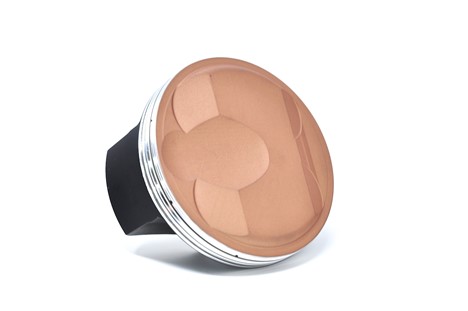
LN Engineering has used lateral gas ports to improve ring seal using combustion gases, as shown above on one of our 9A1/MA1 pistons, on both air-cooled and water-cooled Porsche engines. In the past, we have chosen lateral gas ports over vertical gas ports that can quickly get plugged by carbon. Lateral and vertical gas ports apply added pressure to the rings at several fixed locations depending on where the ports are drilled into the piston. The tradeoff of using gas ported pistons is increased cylinder bore wear in areas corresponding to where the gas ports are located in the pistons. Depending on where the gas ports are machined, this machining can weaken that area along with the ring land itself. As a result, we’ve typically only used gas ported pistons on race engines that will be torn down and rebuilt after a fixed number of hours.
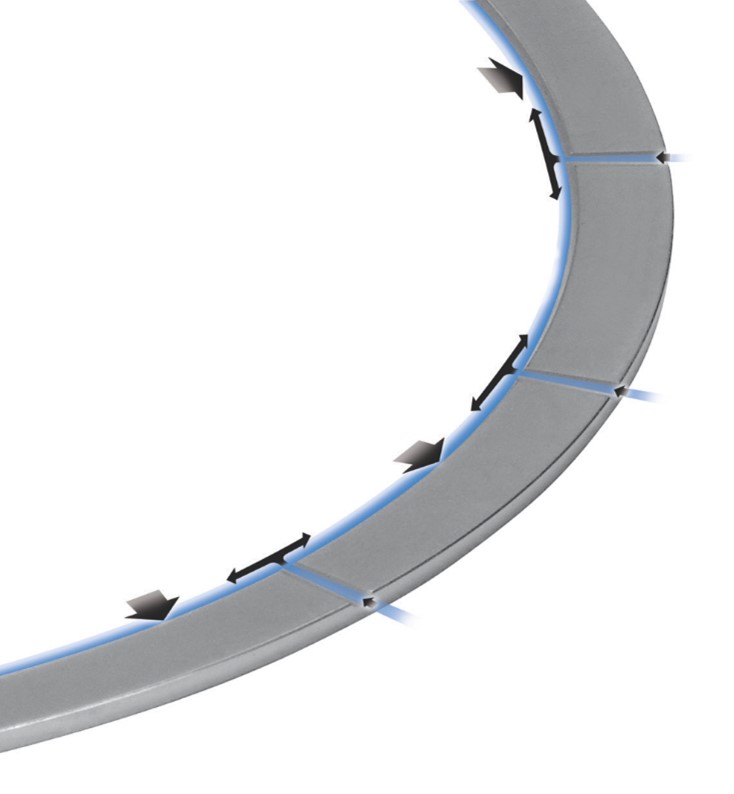
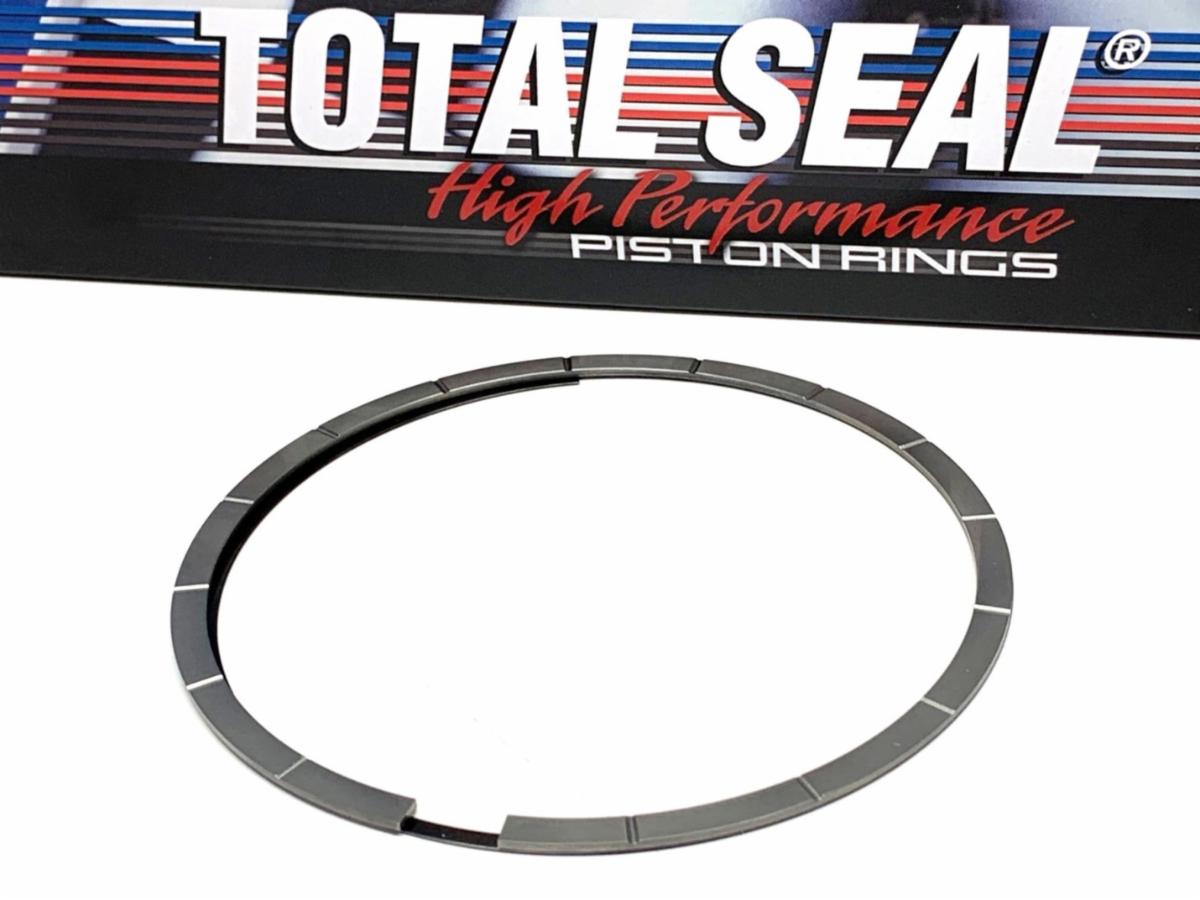
What is new are gas ported piston rings. Both gas ported pistons and gas ported rings allow gas pressure above the piston to get into the ring groove and exert outward and downward force on the piston ring itself. Total Seal’s Gas Ported Rings feature unique horizontal slots machined into the top of the ring. These slots direct combustion gases to a bevel behind the ring to push the ring out towards the cylinder wall and improve the seal. This technology stems from the use of gas ported pistons which have been available for a number of years, yet porting the pistons has a number of downfalls. Instead of drilling holes into the piston, slots are cut into the piston ring. As the top ring rotates in the piston during normal operation, using a gas ported top ring allows for even cylinder bore wear. An added benefit over gas ported pistons is that the gas ported ring is self cleaning and doesn’t get plugged with carbon. Rather than weakening the piston, adding gas ports to the top ring makes the most sense. Total Seal Gas Ported Top Rings can be made from ductile iron, carbon, or stainless steel and can include wear resistant PVD coatings for long-lasting performance. This makes a gas ported top piston ring the logical choice where improved ring seal is desired in a high performance Porsche street or race engine.
|
|
Again, the theory is that the extra force increases ring seal and reduce blow-by, which in turn should increase engine efficiency (i.e. Horsepower). This is especially important in an air-cooled Porsche engine, as aluminum cylinders grow significantly as the engine warms up. Gas ported rings should provide even and consistent pressure for the ring against the cylinder bore, leading us to expect faster break-in and better ring seal for Porsche engines with Nikasil bores and can be paired with Total Seal’s Total Conform or Gapless ring technology.
As such, we are very interested in seeing the benefits of Total Seal’s gas ported top rings for both air-cooled and water-cooled Porsche engine rebuilds first hand. In fact, we are currently building an air-cooled Porsche 911 2.7 engine and will be using Total Seal gas ported top piston rings. We are also using them in our air-cooled VW Type 4 and water-cooled Porsche M96 SUMEbore development engines, which we’ll share more about in the future. We are very excited for the results and expect them to perform well in our Porsche engine rebuilds, just like the Total Seal Gapless top and second piston rings we have used and recommended for years with our Nickies cylinders and JE, CP, or Mahle Motorsports pistons.
|
|
Where can I get Total Seal Piston Rings
for my Porsche engine?
|
|
Testing Gas Ported Piston Rings |
|
To put this theory to the test, Shaver Specialty racing engines in Torrance, California developed the following test protocol to measure the effect of the location of gas ports on piston ring seal. You might be asking, “How do you measure ring seal?”
Well, let’s think about what poor ring seal produces – blow-by. When a piston ring doesn’t seal well against the piston ring groove and cylinder wall, the gas pressure above the piston leaks past the piston ring, which pressurizes the crankcase of the engine.
Knowing that fact, the guys at Shaver’s utilized two different tools to measure the amount of gas pressure escaping past the piston rings. The first was a blow-by meter which measure the amount of air going out through the breather on the engine (in cubic feet per minute). The second was a crankcase pressure transducer, which measured the amount of atmospheric pressure in the crankcase. Combined, these two measurements provide accurate readings on the amount of blow-by, which indicates ring seal performance.
|
|
Test Facility: Shaver Specialties Racing Engines
Test Equipment: Superflow SF-3000BW Dynamometer
Test Cell: Dyno Room #2 (Air handling system produces .5 inches of atmospheric pressure, contains in room weather station)
Test Engine: Small Block Chevy, 383 Cubic Inch (23 Degree Edelbrock Heads, Comp Cams Flat Tappet Valvetrain, Single 600CFM Carb, Wet Sump)
Used Oil Analysis: Speediagnostix (Wear Metals, Fuel Dilution, Viscosity and Additive Analysis)
|
|
Baseline Package – No Gas Ports
Rings: .7mm / .7mm / 2mm Diamond Finish ring package (.110 radial wall top)
Clearance: .0007 side clearance, .007 back clearance
End Gaps: .032 / .032
Pistons: JE 9.5:1 Dished, No Gas Ports, No Accumulator Groove
Oil: 5.5 Quarts Driven BR40
Timing: 32 degrees, 91 Octane fuel – Mobil Supreme
Gas Ported Ring
Rings: .7mm / .7mm / 2mm Diamond Finish ring package (.110 radial wall top) with 15 ports
Clearance: .0007 side clearance, .007 back clearance
End Gaps: .032 / .032
Pistons: JE 9.5:1 Dished, No Gas Ports, No Accumulator Groove
Oil: 5.5 Quarts Driven BR40
Timing: 32 degrees, 91 Octane fuel – Mobil Supreme
Gas Ported Piston
Rings: .7mm / .7mm / 2mm Gas Ported, Diamond Finish ring package (.110 radial wall top)
Clearance: .0007 side clearance, .007 back clearance
End Gaps: .032 / .032
Pistons: JE 9.5:1 Dished, 12 Lateral Gas Ports, No Accumulator Groove
Oil: 5.5 Quarts Driven BR40
Timing: 32 degrees, 91 Octane fuel – Mobil Supreme
|
|
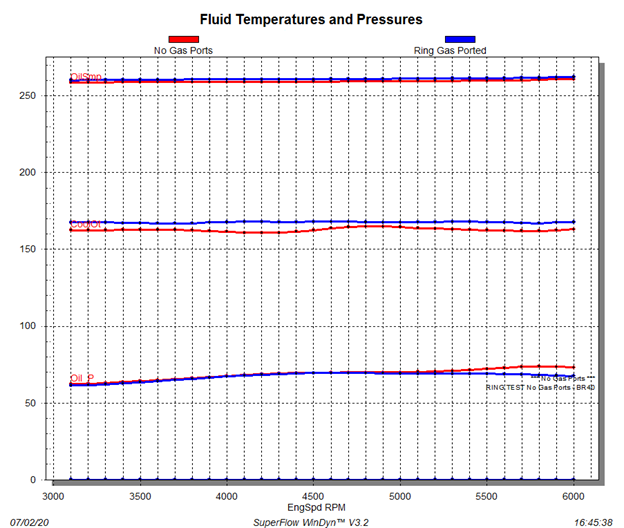
The test began by running the engine with the baseline package. Shaver utilizes the following break-in procedure: 30 minutes at 22% throttle and 12% load. On this engine, that equated to 2,600 RPM and 85 Lbs. Ft. of torque. After the 30 minute run-in period, three consecutive 3,000 to 6,000 RPM sweep tests were performed. The engine was stopped and allowed to cool down. After cooling down for 30 minutes, the blow-by meter was connected, the engine was restarted and warmed up for 10 minutes at 22% throttle and 12% load. This method produces an operating water temperature of 165F and oil temperature of 260F. Beginning at those temperatures, three consecutive 3,000 to 6,000 RPM sweep tests were performed.
The final two seep tests were averaged to create the baseline results.
The engine was then removed from the dyno, stripped down and re-honed (Not oversized, just cleaned up with 280 grit followed by 400 grit brush). The non-gas ported ring set was removed and replaced with the gas ported version of that same ring set. The engine was reassembled and returned to the dyno.
The engine was refitted to the dyno, refilled with BR40 (from the same drum), primed and restarted. The dyno crew utilized the same break-in procedure of 30 minutes and 22% and 12% load, and repeated the same series of sweep tests. Again, the final two sweep tests were averaged to create the gas ported ring results.
Once more, the engine was then removed from the dyno, stripped down and re-honed (Not oversized, just cleaned up with 280 grit followed by 400 grit brush). The non-gas ported pistons and the gas ported rings were removed and replaced with gas ported versions of the same pistons and non-gas ported rings. The engine was reassembled using the same cam, lifters, rockers, and bearings for all three tests.
Again, the dyno crew at Shaver’s refitted the engine to the dyno, refilled it with 5.5 quarts of BR40 and repeated the 30 minutes break-in procedure and subsequent series of sweep tests. Again, the final two sweep tests were averaged to create the gas ported piston results.
In addition, both visual inspection and used oil analysis samples were taken throughout the testing to monitor the overall health of the engine.
The disciplined testing procedures followed by Shaver’s team increases the confidence level in the results from these tests. Once again, the goal of the test program was simply to compare the blow-by between no gas ports, gas ported piston rings and gas ported pistons and determine any performance differences.
The following graphs present the results of the test program.
|
|
Blow-By:
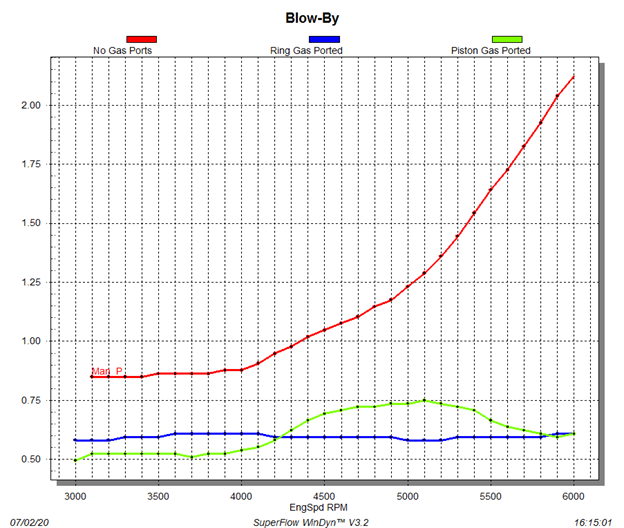
The digital pressure transducer to measuring crankcase pressure provided the ability to graph the results of each test. As clearly indicated, all three configurations produced distinctive blow-by results relative to engine RPM.
|
|
Both gas ported combinations reduced blow-by relative to the baseline combination without gas ports. Interestingly, the gas ported ring produced a consistent amount of blow-by across the RPM range, which indicates the blow-by was only due to the ring end gap. On the contrary, the no gas port combination shows a dramatic increase in blow-by relative to RPM. This indicates reduced ring seal with increasing engine speed due to two factors – cylinder pressure and interia.
Let’s focus first on cylinder pressure. Peak torque equals peak cylinder pressure. As torque begins to drop, cylinder pressure begins to drop. Less cylinder pressure means less gas force to hold the ring on the ring groove in the piston and seal the face of the ring against the cylinder wall. Clearly, without the aid of gas ports to direct as the remaining cylinder pressure to assist the ring, blow-by increases with engine speed.
Which brings us to the next factor, inertia. As engine speed increases, so does inertia, which makes the piston ring act heavier. The greater the mass, the harder it is too slow it down, so at TDC a heavier ring comes off the ring groove easier. Unfortunately, unseating the ring increases blow-by. Not only is a gas ported ring lighter, it also allows the gas pressure to act as an “air-brake” at higher RPM. Combined, those properties of the gas ported ring enable the lower blow-by at higher RPM as observed in this test.
An interesting corollary was also observed. When the non-gas ported combination exhibited the spike in blow-by (as recorded by the increase in crankcase pressure), the oil pressure also increased.
|
|
The increase in oil pressure was due to the increase in crankcase pressure. The opposite happens when engines run in crankcase vacuum.
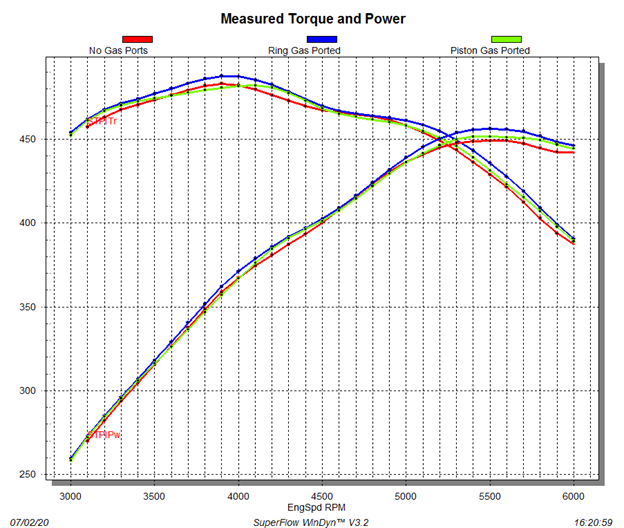
As expected, the differences in blow-by and oil pressure impacted the measured Horsepower and Torque output.
|
|
The results in blow-by closely predicted the power numbers, especially at higher RPM. The no gas port combination produced an average of 390.5 HP from 3,100 to 6,000 RPM. In comparison, the Gas Ported piston produced 391.7 HP (average over the same range), and the gas ported ring yielded 394.3 HP.
Since this engine has been utilized for component and oil testing in the past at Shaver’s, we compared those tests (same oil, fuel, timing, pistons, rings and clearances) to these tests, and we observed the results overlaid each other with very close precision.
As such, we have a high level of confidence that these results prove the theory that gas ports improve ring seal, which reduces blow-by. The correlation to improved horsepower due to reduced blow-by was also observed, especially with the gas ported ring in this particular configuration.
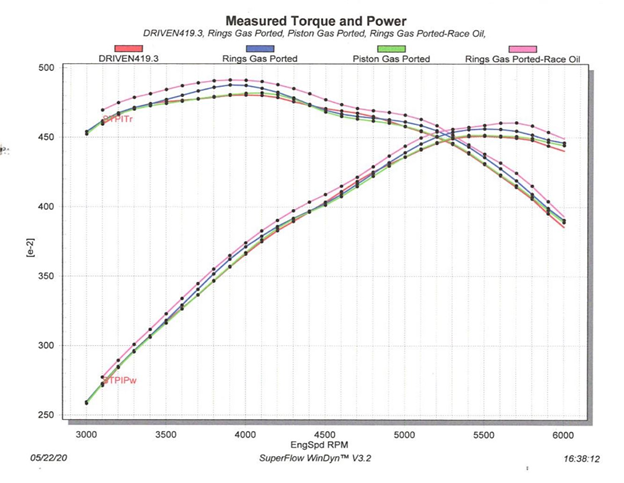
An addition set of tests were carried out with the same V8 engine, this time comparing gas ported pistons to gas ported rings. The test started by running the engine with the baseline package. After a 30 minute run-in period, a few 3,000 to 6,000 RPM dyno sweeps were performed and compared to previous break-in runs done when the pistons, rings and hone were new (Driven 419.3). Those tests overlaid each other with very close precision.
After the baseline runs, the engine was disassembled, re-honed with the same process as before (280 grit, Brush - 3 stokes). The engine was reassembled with new pistons (no gas ports) and new rings (with gas ports). The same cam, lifters, rockers, and bearings were used for both tests.
The goal of the test was simply to move the gas ports from the pistons to rings to determine any performance differences.
After the engine was put back together, it was refitted to the dyno and the same 30 run-in period was completed. Shaver made a few sweep to ensure the rings were bedded-in, and then we made the 2 comparison runs at the same water and oil temperatures.
After the test runs on the break-in oil, they drained the oil and filled the engine Driven XP9 10W-40 Racing Oil. As a side note, XP9 is the same oil we recommend for Porsche Boxster, Cayman, and 911 engines that will be tracked. XP9 has the same viscosity as the BR40 break-in oil that was used earlier in the test. Following a run-in period, sweep tests were performed on the race oil at the same oil temperature as done during the previous tests.
|
|
The above graph show the Torque and Horsepower comparisons for a gas ported piston with conventional rings versus a conventional piston with gas ported rings using Driven BR40 break-in and XP9 race oils.
Although these tests used a V8 engine and not a horizontally opposed Porsche engine, the results are very important and clearly indicate less blow-by and improved horsepower with the gas ported ring in this particular configuration.
We expect great things from Total Seal’s Gas Ported Top Rings.
|
|
Want to learn more about available Total Seal gapless and gas-ported piston rings for your air- or water-cooled Porsche engine? |
|
Meet Lake Speed Jr. of Total Seal and other industry leaders and performance experts online.
--- FREE WEB EVENT ---
|
|
Shop LN Engineering Online Store by brand: |
|
|
|
|
|
|