Active Learning Training Opportunities
|
|
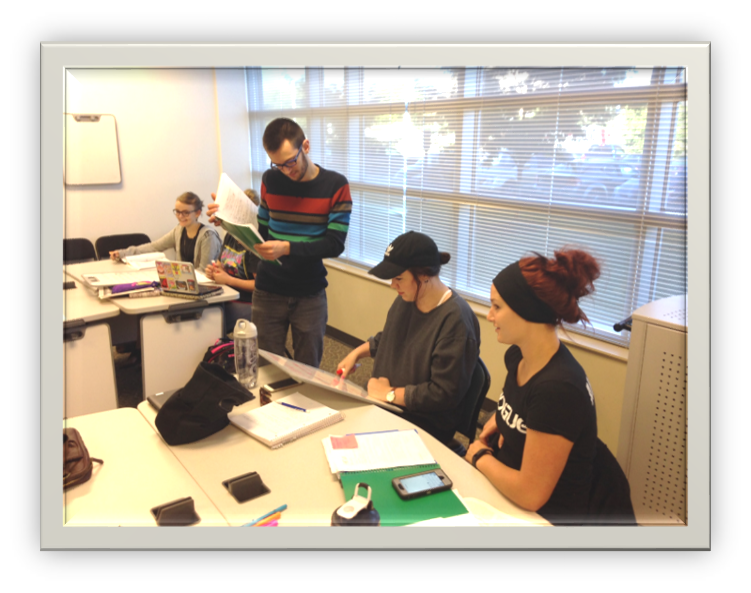
Gateway Community & Technical College is offering a unique Active Learning opportunity to our regional educators, participants will engage in a two-part learning series to explore the pedagogy and how it fits within their own classroom.
|
|
Series 1
-
What is My Perspective?
will be held in Spring 2020
The first series will provide 12.5 hours on the foundational understanding of Active Learning. The learning will:
- Give faculty depth and understanding of the philosophical parameters of Active Learning.
- Ensure faculty changes the classroom dynamic from teacher-centered to student-centered.
- Provide faculty with brand new strategies for how to implement the initial tenets of Active Learning in the classroom.
|
|
What is My Perspective?
Turn on any news broadcast, open any major newspaper, and you will find some commentary about how American Education does not produce a critical-thinking, innovative, and independent workforce. Those in education – from Pre-K to 16 – jump on the easy to blame bandwagon: state testing and an unrealistic culture of accountability and return on investment. The thing is – testing and governmental interference is an oversimplification of a highly complex problem. Experts in just about every discipline can offer possible “reasons” for why our students are graduating under prepared. But it really doesn’t matter how many “reasons” exist when we are ultimately responsible for one end result: finding solutions.
It does not matter how much we want to blame state testing, a deconstruction of community, unrealistic expectations, and politicians. The problem still exists. And, if we do not stop focusing on who or what is the cause of this situation and start to find solutions, education will fall even further behind. We need to take action and provide our country with a dynamic workforce that is equally articulate and engaged in their profession. And, educators need to stop assuming that students automatically “get” the engaged part of a career. Instead, we need to model a dynamic classroom environment that asks students to engage and contribute to their own learning.
Let’s face it. No faculty member, no matter how talented, can “learn” a student. Students must learn on their own. No magic switch goes off in an 18 year old’s brain the moment they graduate from High School. The symbolic moving of the tassel from the left to the right does not signify an instantaneous maturity and wisdom. Those tassels are not light switches. Or, if they are, the light bulb is not screwed in tightly. I guess this means tightening that bulb is
our
job.
We will never be able to tighten that 100 watt LED bulb with our traditional approaches to teaching – lecture, midterm exam, lecture, paper/ project, lecture, final exam. It is not enough for us to tell students to bend and learn the way we want to teach. Instead, we must reinvent ourselves and meet our students’ half-way. The best part? Through this reinvention
we
can find new life in our classrooms.
Come and explore the philosophy of Active Learning and where it’s roots began.
Find out how Active Learning:
- Inspires faculty to use a series of intentionally planned activities to provide continuous feedback to students on their cognitive development and problem-solving skills.
- Experience 12 hours of carefully scripted Active Learning protocols to explore Active Learning
- Begin to understand how to develop your own classroom based upon your personal vision of Active Learning.
At the end of the training, participants will be able to…
- understand the underlying principles of Active Learning;
- discuss quantitative data and success stories associated with Active Learning;
- examine how Active Learning aids student development of skills for a 21st century workforce;
- design content specific active learning strategies to meet the cognitive learning structure of bloom’s taxonomy
Who Should Attend:
- Faculty
- Academic Leadership
- Instructional Coaches
- Professional Development faculty/staff
|
|
Technical classes see improvement in pass rate for students in active learning classrooms!
by Steve Popple
|
|
The latest data involves a comparison of class retention and pass rates for classes taught by instructors utilizing active learning techniques and not utilizing active learning techniques from spring of 2016 through spring 2019.
Those comparisons involved instances where active learning and non-active learning instructors taught the same class-subject and class-subject number in the same semester.
Retention rates were similar; however, passing rates in nearly every instance where technical class-subject comparisons occurred, the pass rate for students in active learning classrooms was higher than the pass rate for those students in non-active learning classrooms. While class enrollment in non-active learning taught technical classes is too small to conduct further statistical analysis, there is information to indicate more technical faculty utilizing active learning techniques may increase student success!
|
|
Cost: $100 per session (12.5 hours of training) - choose your session below
Spring 2020 Options for Part 1 - What is My Perspective?
Session #1: 12.5 Professional Development Hours (must attend both days)
- Thursday, January 9, 9 a.m. – 3:15 p.m., Boone Campus, Room B202
- Friday, January 10, 9 a.m. – 3:15 p.m., Boone Campus, RoomB202
|
|
Session #2: 12.5 Professional Development Hours (must attend both days)
- Saturday, February 8, 9 a.m. – 3:15 p.m., Boone Campus, Room B202
- Saturday, February 15, 9 a.m. – 3:15 p.m., Boone Campus, Room B202
|
|
Session #3: 12.5 Professional Development Hours (must attend both days)
- Wed., March 11, 9 a.m. – 3:15 p.m., Edgewood Campus, Room 106
- Thurs., March 12, 9 a.m. – 3:15 p.m., Edgewood Campus, Room 106
|
|
Session #4: 12.5 Professional Development Hours (must attend both days)
- Wednesday, May 20, 9 a.m. – 3:15 p.m., TIE Campus, Room UB401
- Thursday May 21, 9 a.m. – 3:15 p.m., TIE Campus, Room UB401
|
|
Meet the instructor:
Dr. Kerri McKenna is starting her tenth year at Gateway. She is an Associate Professor who teaches English, Education, and First Year Experience courses for the college. Additionally, Kerri serves as the Director of Gateway’s Teaching and Learning Center. In this role she organizes and provides professional development opportunities for faculty, assists with curriculum development, conducts classroom observations, and provides individual coaching to faculty and staff to maximize work performance.
Prior to Kerri’s time at Gateway, she cut her teeth in education as an alternative HS English Teacher in NYC. She taught in her school for 10 years before being recruited to work at an affluent school in New Jersey. Kerri’s teaching was quickly recognized in this district and she was selected by Princeton University to coach faculty in Active Learning at the #2 Pharmaceutical program in the country, Rutgers University.
For those of you familiar with the Big Bang Theory, she met many Sheldon Coopers in her work. Kerri played a key role in turning their program into an Active Learning program through professional development sessions and individualized coaching. After 3 years with JP Stevens and Princeton, she returned to her home state, Ohio, and began working with Gateway in 2009.
Gateway turned to an Active Learning philosophy in 2015, when Kerri and their grants office won one of 25 First in the World Federal Grants to fully implement an Active Learning Program at their college. Over 500 colleges and universities applied for this grant, and Gateway was the only Community College Selected for the award, which provided them with $3.2 million to implement active learning pedagogy, active learning environments, and the implementation of a learning commons at the college.
|
|
Session 2
-
I am the Expert!
Future dates to be determined in summer/fall 2020 (look for the email)
This session assists participants as they apply Active Learning to their own classroom. This is also 12.5 hours of training.
The learning outcomes from this culminating training is to help design active learning curriculum.
* You
must
complete Session 1 before taking Session 2.
|
|
|
|
|
|
|