Instagram  Facebook

I. From the Desk of the Rev. John Hager, Priest-in-Charge: Sermon for the Twenty-Second Sunday after Pentecost, October 25, 2026

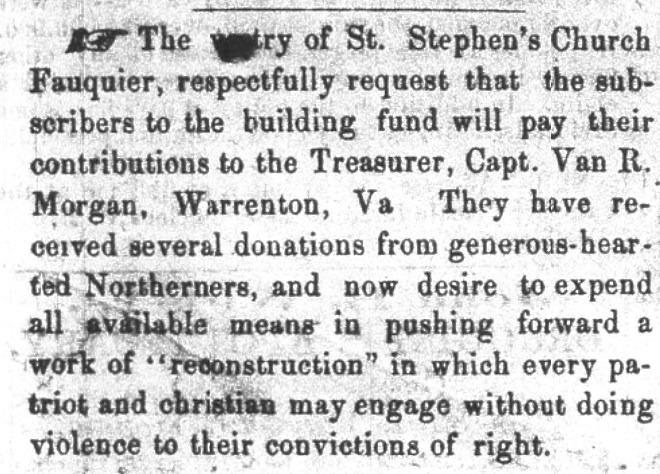
On May 30th, 1868, a Warrenton newspaper ran the following advertisement:

undefined

The Civil War had been utterly destructive to the region around St. Stephen’s. Skirmishes, raids, and the constant movement and encampment of troops had all left their mark on the land, the people, and the church building of Cedar Run Parish. [1]


We know troops were encamped at the old St. Stephen’s Church. 


We know that the old St. Stephen’s Church was eventually destroyed in the war. 


We know that it was a lengthy and tiresome process to rebuild.  


And we know the rebuilding project was not limited to people who lived in the area. 


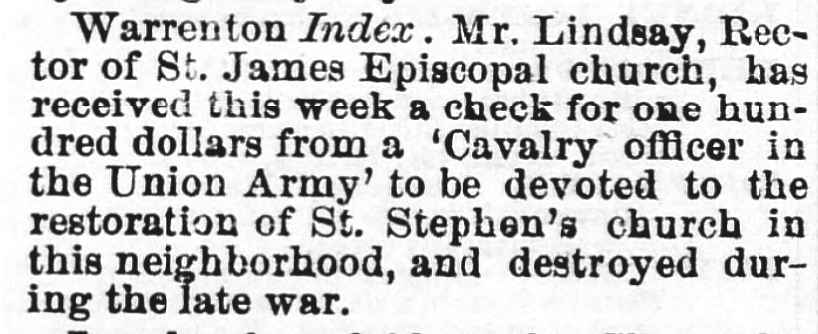
Another newspaper announcement [2] from 1878—ten years after the first advertisement and the new church had still not been completed!—read:

The women of the parish, too, were especially involved in the raising and giving of funds to rebuild. 


We don’t have any letters or sermons or otherwise any insights into what the people of St. Stephen’s felt as they toiled through over a decade of raising money, hiring an architect, and garnering support far and wide. 


But we can imagine what it was like: The importance—the spiritual importance—of rebuilding this church. It was about much more than wood and stone (though those things are important). It was about rebuilding a community. 


I cannot help but think of the 90th Psalm when I hear about the ruin, then the long work of reconstructing, the feelings of uncertainty about the future that the people of St. Stephen’s must have felt, in that decade after the war. 


Perhaps some of the people of St. Stephen’s also thought about the 90th Psalm. 


I have no doubt many of them would have known well 

and had sung the great paraphrase of the psalm by William Croft,

to that noble old tune, “St. Anne”

that we sang just moments ago:  


“O God, our help in ages past,

our hope for years to come,

our shelter from the stormy blast,

and our eternal home.” 


The third verse seems especially palpable here in the country, 

surrounded by fields, 

flocks and herds, 

and the Blue Ridge not far off:


“Before the hills in order stood,

or earth received her frame,

from everlasting thou art God,

to endless years the same.”


Perhaps, amid all the uncertainty, the people of St. Stephen’s

understood that their effort to rebuild could not ultimately be of their own power.  


There was hope, but that hope had to be in God’s time. 


That hope was in God’s hands. 


Long before any St. Stephen’s church ever existed, long before the fields and hills around the parish, there was—and is—God for whom a thousand ages are like an evening gone. 


There was the pain and the death of the aftermath of the war to attend to. There was fundraising to do. There was a budget to secure (the new church, this church, would cost around $2,200!) There was the need to pay off any debts before the church could even be consecrated. 


But through all of that, the people of this parish could not—and I think did not—lose sight of God’s power and God’s ageless presence. 

Even as they did not always know where their efforts would lead them. 


Yes, God works through us—and we cannot sit idle when there is work to be done. 


But the 90th Psalm imparts a sense of humility to any work that we are called to. 


We do not always where know the work will lead us. We belong to God, who has been around longer than anything we do. 


At last, in June of 1882, Bishop Whittle consecrated the new St. Stephen’s Church. 


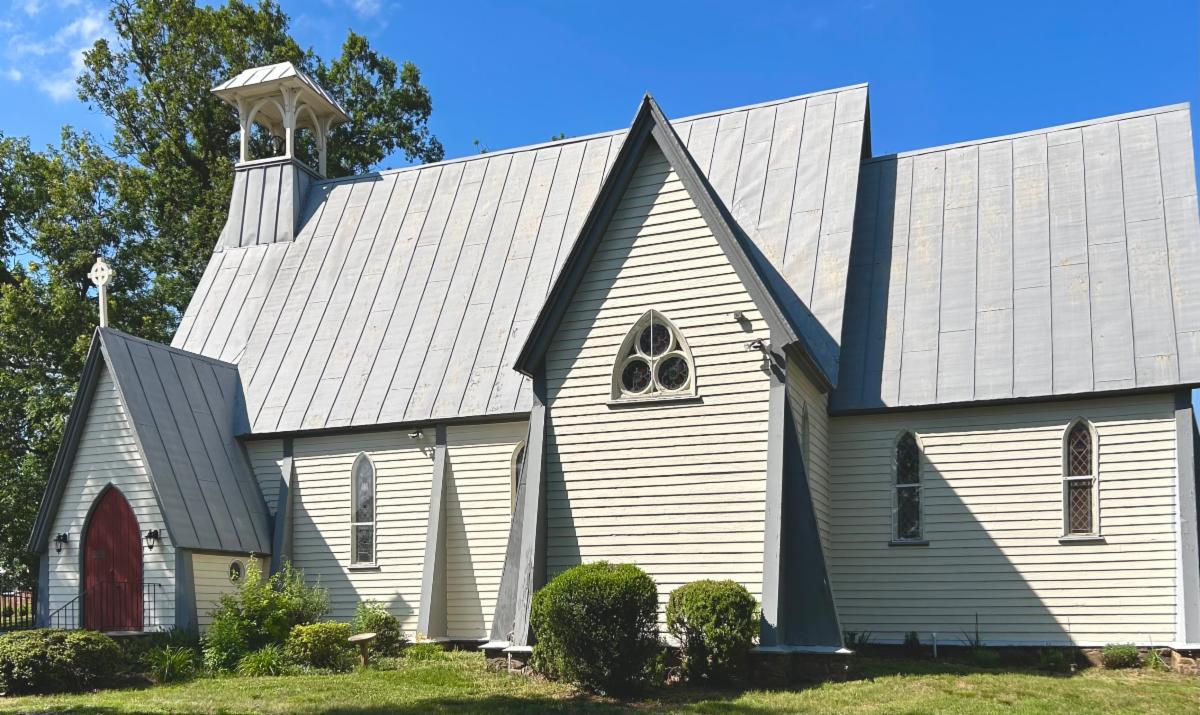
The church in which you and I now find ourselves. 


The church was described as ‘commodious and handsome, erected on the site of one which was destroyed during the war.’ [3]


On that day, the Holy Communion was celebrated, and three persons were confirmed.


Surely, the faithful people gathered in their new church felt both a sense of exhaustion and of gratitude.


Look around you. 


Look at the names in the window glass—some of which are only initials. 


I suspect some of the early stained glass in this church was given by those generous-hearted northerners that the newspapers had described. 


Look at the altar, the lectern, the pews. 


At the Holy Communion, look at the silver. 


And look at the building—its beams, its floorboards, its doors— 

all around you. 


It is a handsome church, to use the Bishop’s words. 


And the stained glass, the furniture, the silver, this very building—these things all testify to the witness, the dedication, the love, of God’s church in this place in those years of uncertainty after the war and in the many years since that faithful people have given to this holy place. 


But the material gifts are not the end—nor are they the ultimate point—of the story. 


The church is the people who gather here. 


The people who, from one generation to another,

have worshipped God in the Sacrament of His Body and Blood,

who have prayed,

who have come here in patience and exhaustion,

who have come here in joy and love. 


And all this whether or not there was even a building standing. 


We come to this holy place with our own uncertainties, our own burdens, our own memories of the past, and our own hopes for the future.


The circumstances in which we find ourselves are not those of building a new church destroyed in the Civil War. 


But you know something of the challenges that come with sustaining a parish from one generation to another. And you know the joys and gratitude and blessings of sustaining a parish from one generation to another. 


I know this about you. I have seen it. 


We know there is work to be, resources to be cared for, people to care for. 


But the future will not be ours to command. 


The 90th Psalm does not teach us that our church will always look the same, it does not teach us that our labor will always bear the fruit we expect. The 90th Psalm opens us to something else entirely: 


“Before the hills in order stood, or earth received her frame, from everlasting to everlasting, thou art God.”


The God who was God before this church was built is God now.


The God who sustained the people who gathered here amid the devastation of war is the God who gathers us here today.


And the God to whom we commend the generations yet to come is not diminished by the passing of our own generation.


We cannot see the end of every undertaking. 


We cannot know what this church will look like in ten, fifty, a hundred years from now. 


Even so, we worship the God for whom a thousand ages are like an evening gone, and under the shadow of His wings

we pray, 

we roast pigs, 

we make music, 

we tend to the garden, 

under His wings we come and give to this place week after week. 


We do these things trusting that the God who has been our refuge from one generation to another will continue to be our refuge in the generations yet to come—God whose presence is sometimes so palpable, and other times so mysterious.


And His presence in our work matters not because we posses our future, but because we give it to God. 


And it is in that knowledge that we sing:


O God, our help in ages past,

our hope for years to come,

be thou our guide while life shall last,

and our eternal home.


***


[1] The True Index. Warrenton, Virginia. May 30, 1868: p. 4.


[2] The Staunton Spectator. October 15, 1878: p. 3.


[3] Journal of the Eighty-Seventh Annual Council of the Protestant Episcopal Church [...]. Richmond, 1882: p. 161.

II. Art

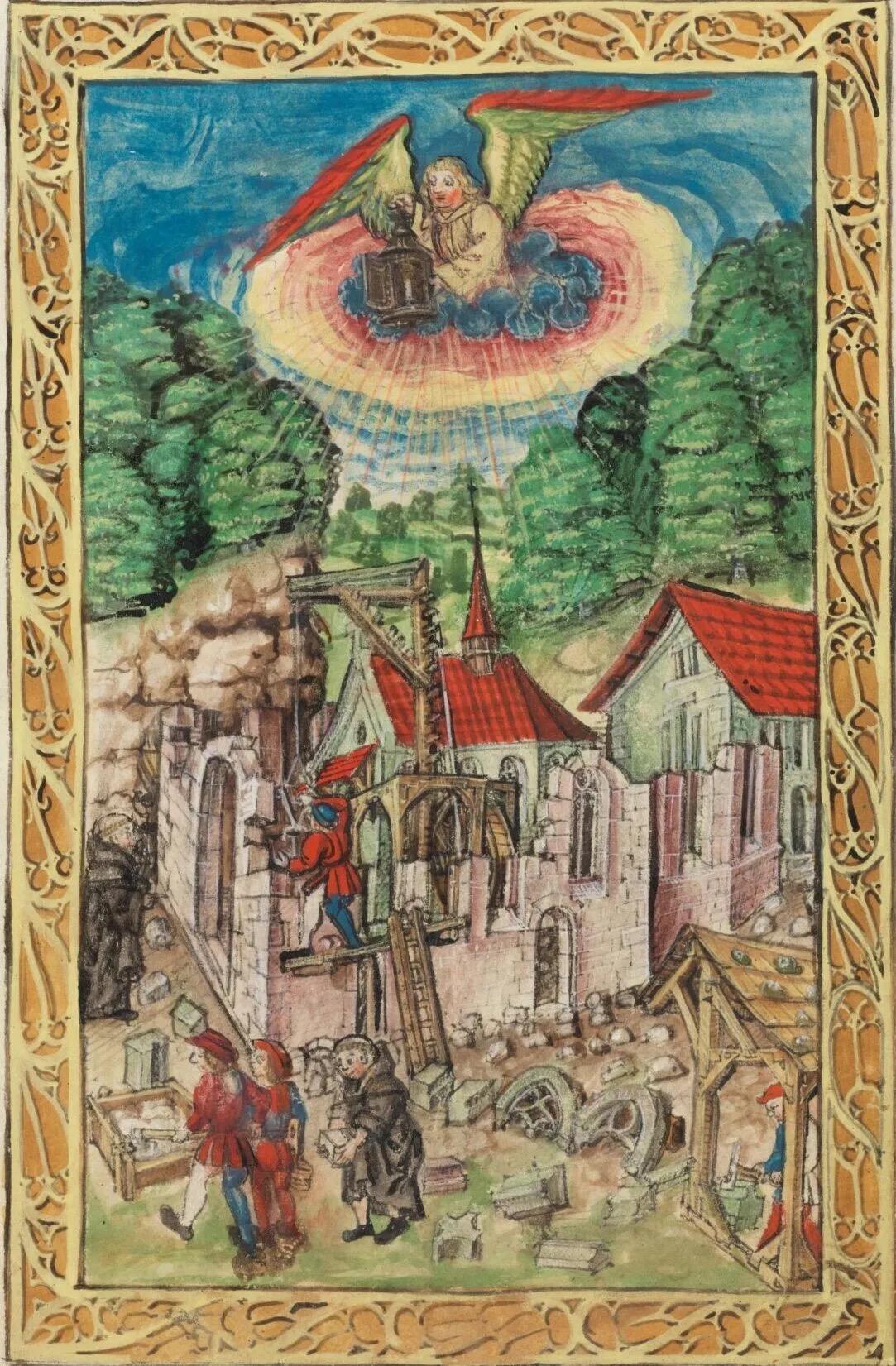
Building a church. Illumination from the so-called Luzerner Schilling. Swiss, 1513.

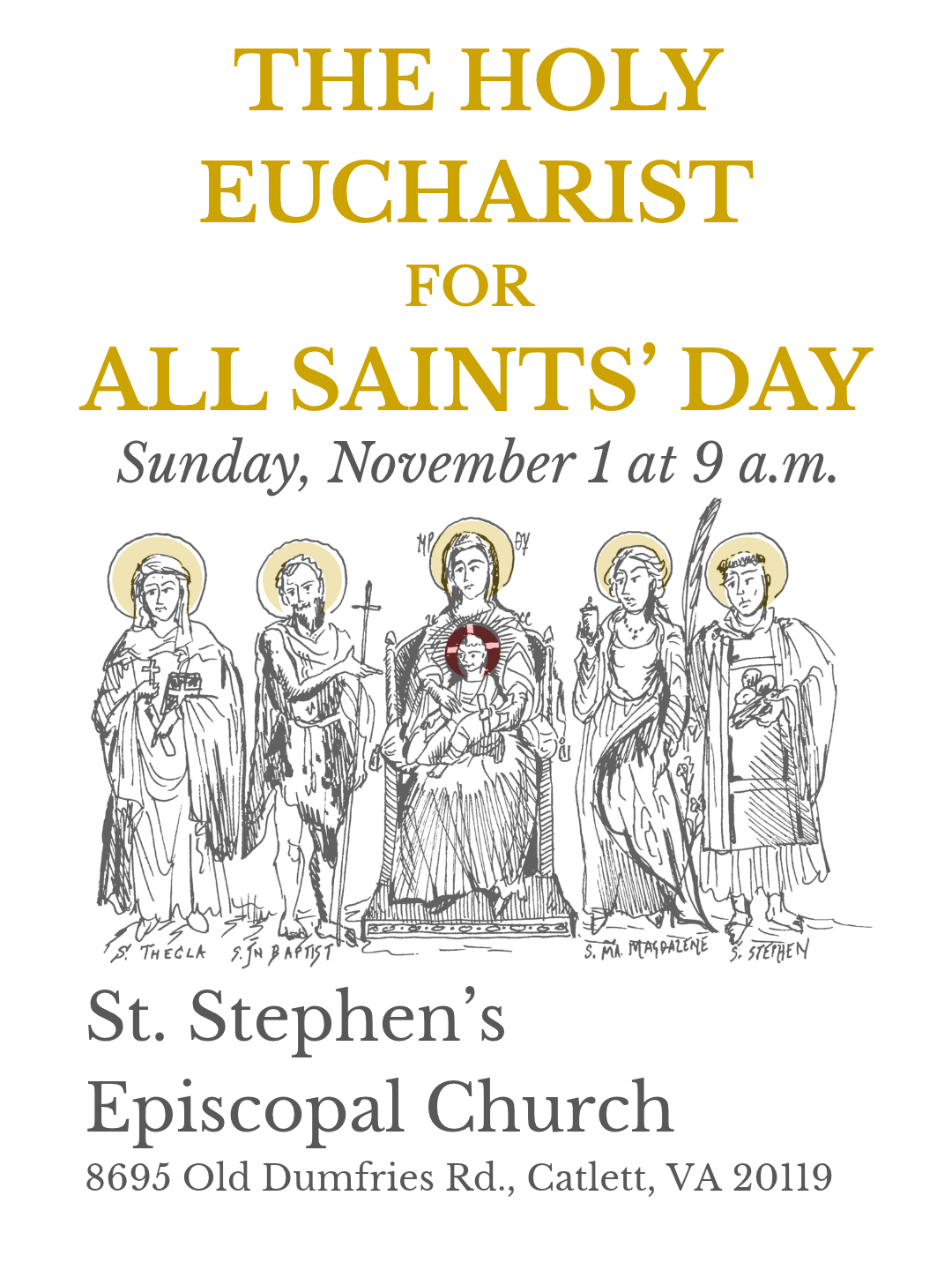
III. SUNDAY, NOVEMBER 1 AT 9 A.M. ALL SAINTS' DAY THE HOLY EUCHARIST AND THE BLESSING OF THE CIVIL MARRIAGE OF GREGORY MCKINNEY AND COURTNEY BOUTTE. Festive parish brunch follows.

SUNDAY, NOVEMBER 15 AT 5 P.M. CHORAL EVENSONG FOR THE EVE OF ST. MARGARET OF SCOTLAND, QUEEN

IV. Parish Prayer List

For the repose of the souls of Carol Ann Halvorson Miller and Linn Power. May they rest in peace and rise in glory.


For the special needs and concerns of this congregation, especially for Charlotte, Ed, Carol, Greg and the Miller Family, Giles, Spencer, Susannah, Peggy, Kay, and Greg.


For those in our extended family: for Dottie, Mike B., the Shirley Family, Carol, Tia, Tammy, Jerry, Tamara, Chris, Alex & Alyssa, Lindsey & Family, Bob, Karla, the Spicer Family, David, Theresa, Sarah, Ronald, Rose, and Carol.


We pray for those serving in the military and first responders, especially for Jay, John, Erik, Ayden, Noah, Bryce, Clayton, Lindsay, Clifford, Nick & Elmira, Vincent & Kayleigh, Davey, and Peter.


St. Stephen’s Episcopal Church

8695 Old Dumfries Rd., Catlett, VA 20119

Clergy The Rev. Fr. John E. Hager

Parish Administrator Karen Pickrell 

Parish Office 540-788-4252 (Tues.-Fri., 8 a.m.-1 p.m.)

ststephenscatlett.org


St. Stephen’s Episcopal Preschool 

8693 Old Dumfries Rd., Catlett, VA 20119

Office 540-788-3364