250 Years of Progress: How Public Health Helped Shape the America We Know Today
by Meagan Rico, MSN, RN, CHES
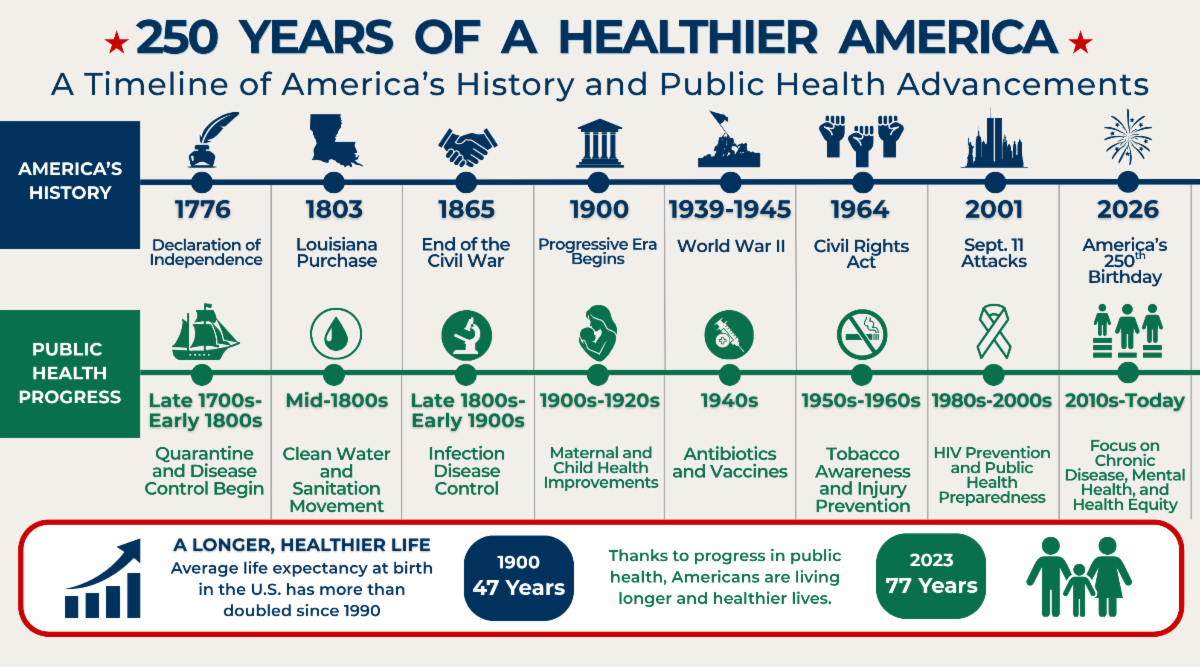
As the United States prepares to celebrate its 250th birthday, we have an opportunity to look back not only at the events and people that shaped our nation, but also on the advancements that have changed what it means to live, grow, and age in America.
Over generations, Americans have worked together to solve problems that have affected entire communities. From improving sanitation to preventing disease, public health advancements were built through cooperation, innovation, and a shared commitment to protecting one another. These changes were made possible by generations of people asking an important question: "How can we prevent suffering before it happens?"
Many of the greatest public health successes are measured not by what happens, but by what no longer happens. One of the earlier and most powerful examples of public health progress is the fight against smallpox. For centuries, smallpox caused widespread illness and death throughout the world. Through coordinated vaccination efforts and disease surveillance, smallpox became the first human disease to be eliminated globally. The World Health Organization declared smallpox eradicated in 1980, a milestone considered one of the greatest achievements in public health history (World Health Organization [WHO], 2024).
Public health improvements have also changed the environments where people live. During the 19th and 20th centuries, improvements in sanitation, sewage systems, and access to clean drinking water greatly reduced illnesses that once spread quickly through communities. These changes helped prevent diseases such as cholera and typhoid fever and showed that protecting health often starts long before someone becomes sick (CDC, 1999).
The 20th century brought additional advancements that reshaped everyday life. Food safety regulations helped protect families from contaminated products. Workplace safety standards reduced injuries. Motor vehicle safety efforts, including seat belts and safer road designs, have prevented countless deaths and disabilities. Tobacco prevention efforts changed public understanding of the dangers of smoking and contributed to significant declines in tobacco use (CDC, 1999).
Public health has also played a major role in helping children reach adulthood. Vaccination programs have reduced illnesses that once commonly harmed or killed children, including polio, measles, and diphtheria. Improvements in maternal and infant health have helped make pregnancy, childbirth, and early childhood safer for millions of families (CDC, 1999).
As public health has evolved, communities have recognized that protecting health requires efforts close to home. Across the country, local health departments have become trusted resources for disease prevention, health education, emergency response, and connecting residents with services. While the challenges have changed over time, the purpose has remained the same: helping communities prepare, respond, and thrive (National Association of County and City Health Officials [NACCHO], 2024).
Today, that same mission continues in communities across the country, including right here in Saline County. Public health is built on the understanding that our health is shaped not only by healthcare, but also by the places where we live, learn, work, and connect with one another.
The challenges facing public health today look different from those it faced 100 years ago. While infectious diseases remain important, many of the leading threats to health are now chronic conditions such as heart disease, diabetes, cancer, obesity, and mental health concerns. According to the 2025 America's Health Rankings Annual Report, the nation has made encouraging progress in several areas. Premature deaths have declined, drug overdose deaths have begun to decrease after years of increases, more people are receiving recommended cancer screenings, and the number of mental health providers continues to grow. At the same time, the report highlights areas where more work is needed. Multiple chronic conditions continue to rise; many Americans still delay medical care because of cost; homelessness has increased; and mental health challenges remain widespread. These findings remind us that improving health is not only about treating disease. It is also about creating communities where people can seek out healthier lives (United Health Foundation, 2026).
The next chapter of America's public health story is still being written. If history has taught us anything over the past 250 years, it is that meaningful progress happens when communities choose to invest in one another. The work of public health belongs to all of us, and the decisions we make today will help shape a healthier America for the next 25o years.
Reference
Centers for Disease Control and Prevention. (1999). Achievements in public health, 1900-1999: Control of infectious diseases. Morbidity and Mortality Weekly Report, 48(29), 621-629
Centers for Disease Control and Prevention. (1999). Ten great public health achievements, United States, 1900-1999. Morbidity and Mortality Weekly Report, 48(12), 241-243
National Association of County and City Health Officials. (2024). Local health departments: The community's chief health strategist. https://www.naccho.org
United Health Foundation. (2026). America's Health Rankings 2025 annual report. https://www.americashealthrankings.org/publications/reports/2025-annual-report
World Health Organization. (2024). Smallpox. https://www.who.int/health-topics/smallpox
|