The Continuum of Patient Engagement: Focus on Experience-Based Co-Design
It’s been 20 years since the US Institute of Medicine, now the National Academy of Medicine, issued the landmark report, “Crossing the Quality Chasm,” identifying patient-centeredness as one of six specific aims critical to improving the 21st-century health care system, along with improvements in safety, effectiveness, timeliness, efficiency, and equity. While we still have far to go to fully realize it’s promise, the cultural shift to patient-centered care continues to gain momentum as patients, health professionals, and health care systems increasingly reap the benefits of sustainable improvements in effectiveness, efficiency and quality of care from adopting this broad approach.
With patient-centered care now widely recognized as a best practice, the role of the patient has experienced an evolution from the traditional, passive order-taker to a much more engaged team member, actively collaborating with health professionals in making care decisions based on their own health needs and valued outcomes. There is now increasing appreciation for the need to extend this partnership with patients beyond direct care into the design of patient-centered policies and services in healthcare settings, with a growing body of research demonstrating the promise of such approaches.
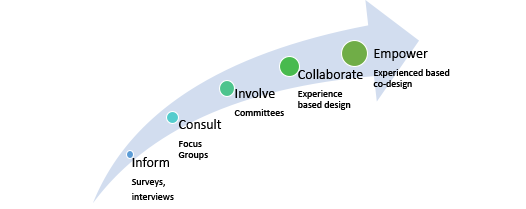
Patient engagement approaches span a continuum of participation ranging from soliciting input through a single survey or interview, through increasingly active processes of consultation and collaboration. Experience-based co-design (EBCD) is one such process, in which health professionals and patients draw upon their own experiences to inform improvement efforts. In EBCD, patients are involved in all phases of quality improvement – not only sharing their experiences – but as active QI partners.
Utilizing a range of methods – e.g., observing the service setting, recording patient stories, interviewing staff - EBCD elevates the patient experience while also seeking to understand the setting and staff experience. Then together, staff and patients identify key areas for service improvement and jointly develop solutions for implementation.
Certainly, EBCD is not without its challenges. It requires health professionals and patients to step out of their comfort zones and develop new roles and approaches as co-designers. However, with the right preparation and support to successfully facilitate these role shifts, EBCD offers a powerful, evidence-based approach to sustainable quality improvement.
To learn more, see: