The American Society of Le Souvenir Français Inc.
Bulletin Mensuel - Vol. II. No 5 - May 2022
|
|
TRIBUTE TO
the Four Americans named
"Compagnons de la Libération"
|
|
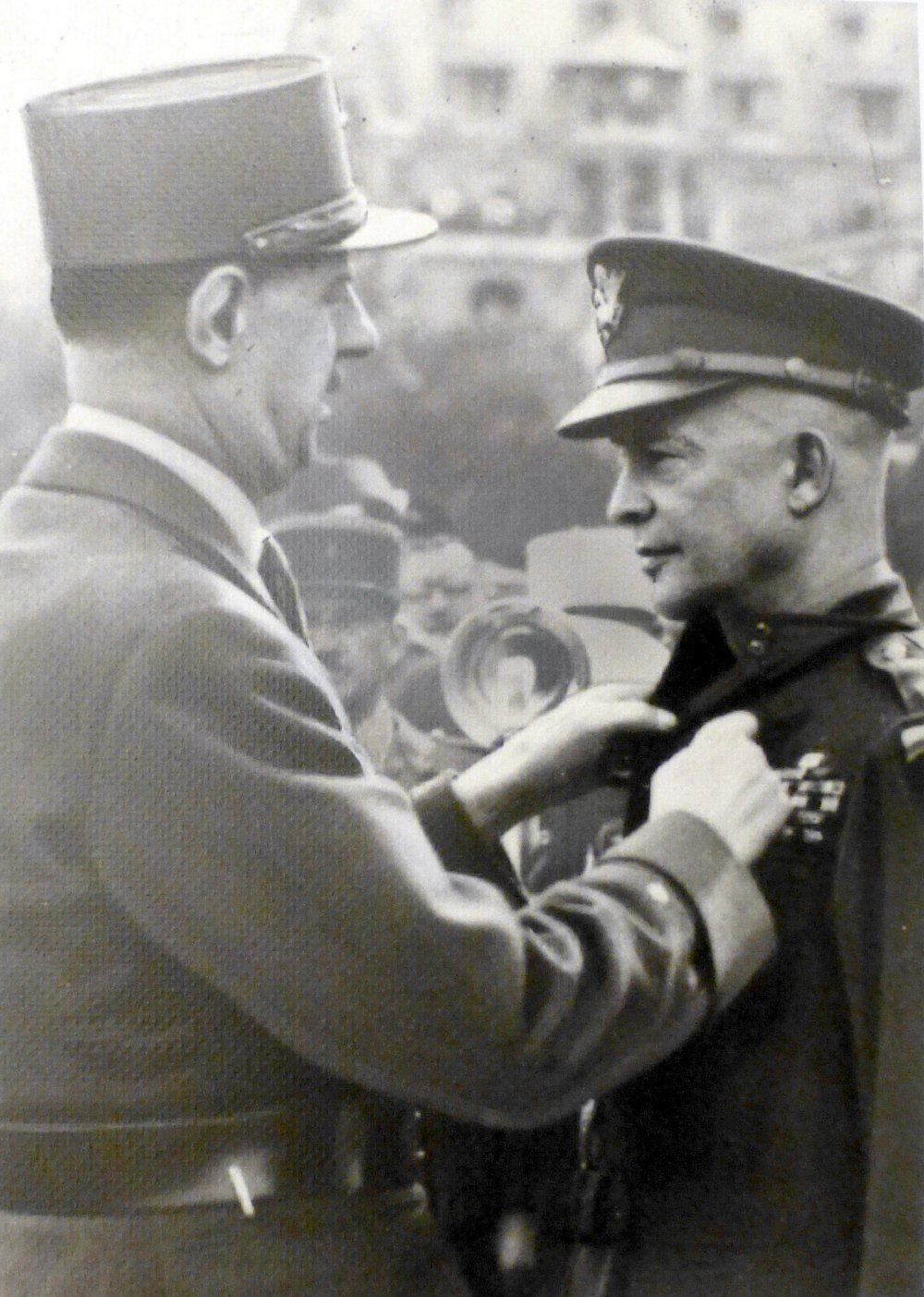
Général Charles de Gaulle inducts General Dwight D. Eisenhower into the "l'Ordre de la Libération", June 14, 1945, Arc de Triomphe, Paris
https://youtu.be/NubLLENd7I4
|
|
EDITORIAL
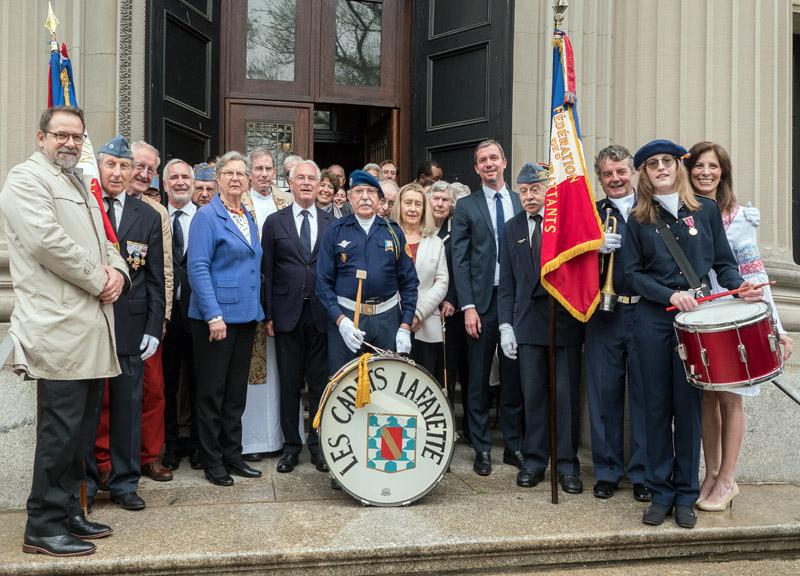
This past Friday, May 6th, at Notre-Dame Church in Manhattan, we honored with a wreath-laying ceremony the 64 Americans who volunteered prior to America's official entry in the two world wars, serving in the American Field Service, and who "Died for France".
A full account of this moving ceremony is provided further below.
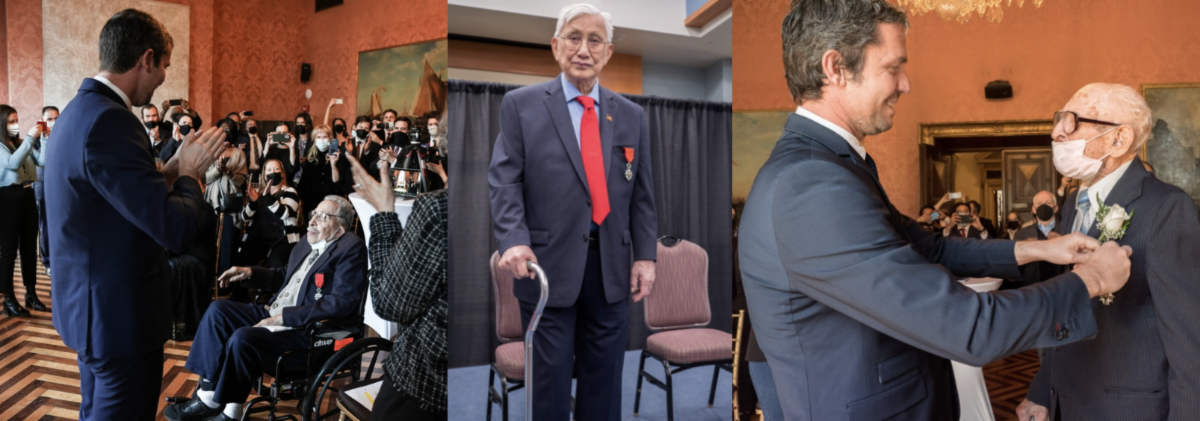
Earlier in February and April, we were privileged to attend at the French General Consulate in New York the award ceremony of the Legion of Honor to American Veterans of WWII, Mr. Osceaola "Ozzie" Fletcher, Mr. Edward L. Chan and Mr. David Lesser. To shake hands with these incredible soldiers, to see the sparkles in their eyes, to observe the sharpness of their wits, to witness the intense emotion of their children and grand-children, and to think that alas, we are now facing the reality that soon, "the Greatest Generation" will be not be around us much longer, prompts us to pause and reflect on the incredible courage, generosity and heroism they, and millions of American soldiers with them, bestowed to France and Europe.
It is therefore fitting that, in the days between "V-E-Day", May 8th, which marked the victory of America and its allies over Nazi Germany, and the upcoming celebration of "D-Day", June 6th, which marks the 78th anniversary of the landing in Normandy, we pay homage in this bulletin to the only four Americans named "Compagnons de la Libération", out of a total of 1,038 individuals ever admitted in this Order.
This little known fact in the long history of the French-American alliance deserves to be more known. The most illustrious of the four is Dwight D. Eisenhower, no less, but the other three also deserve more public recognition here in America, and this is the story we will tell in this bulletin.
Your society is planning to honor each four of them with a bronze plaque in the coming months. We will keep you appraised of our progress.
Thank you for supporting our growing activities with your annual membership, your generous donations, and moral encouragements!
On behalf of the Board of Directors.
Thierry Chaunu, President,
American Society of Le Souvenir Français, Inc.
Poor is the nation that has no heroes, but poorer still is the nation that having heroes, fails to remember and honor them. Marcus Tullius Cicero 106-43 BC
|
|
HISTORICAL CONTEXT:
When everything was seemingly lost...
|
|
It is impossible for young readers to understand the significance of the "Compagnons de la Libération" if a short and basic recapitulation of the tragic events of 1940 is not presented first.
From May 10 until June 25, 1940, after two months of apocalyptic "blitzkrieg" France suffered its most catastrophic defeat in its history. In less than two months of fighting, French losses amounted to some 375,000 dead, missing or wounded, with 10 millions civilians on the roads. Contrary to the popular clichés, the fighting was extremely intense: proportionally, the Germans suffered more casualties per day than in the 6 months of their invasion of Russia, losing a total of 157,621 dead, missing or wounded, and losing some 1,236 planes (which significantly weakened the Luftwaffe for the upcoming Battle of Britain) and 822 tanks (out of 2,445).
The government, and the French population at large, had no stomach to continue the fight and see the country utterly destroyed, especially after the horrors of World War I and the two million dead or missing, and four millions wounded, barely a generation before. Still, the armistice signed in June 1940 was dishonoring and partitioned the country in not two, as is commonly reported, but seven zones...including the collaborationist "Vichy Government", in the so-called "Unoccupied zone"...
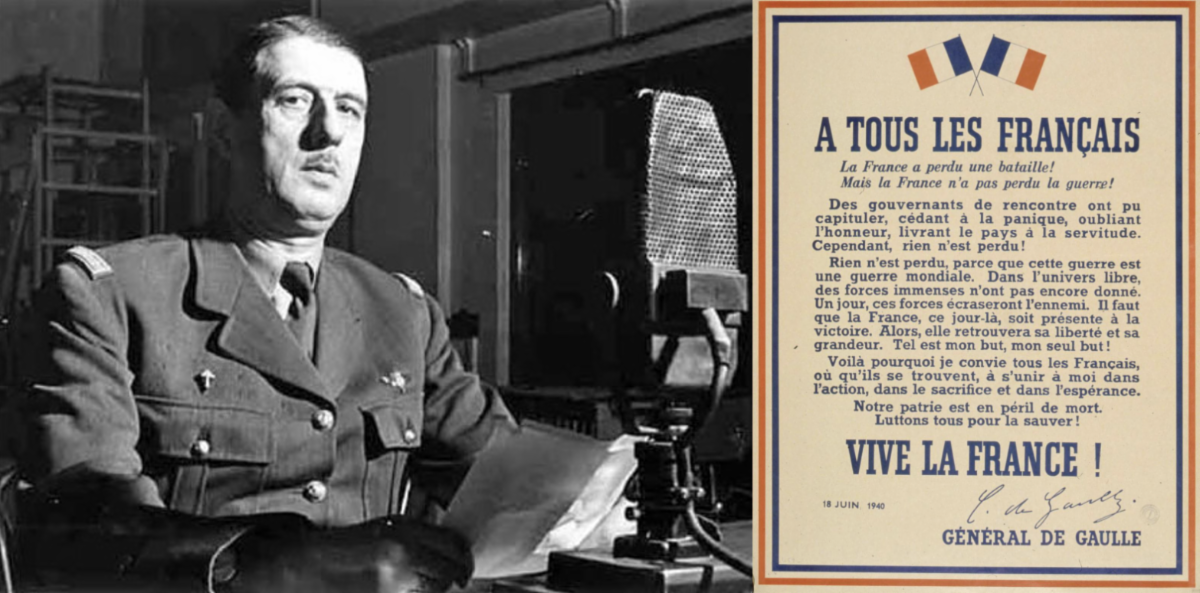
Recently promoted (on a temporary basis!) Brigadier General on the battlefield (one of the rare generals to inflict a tactical retreat to German panzers), known only within military circles for his prescience and theorization on the modern use of tanks - - a strategy opposed by his hierarchy, and brilliantly adopted by the Germans - - General Charles de Gaulle refused defeat and famously called on the French to continue the fight under his leadership.
Alone but resolute, with the visionary support of Winston Churchill, General Charles de Gaulle re-affirmed to the world that since the government in Vichy France was operating under German boots, it had no legitimacy whatsoever, and that the true spirit of France was with him.
He single-handedly created the Free French, and started the French Resistance with his famous "Appel du 18 Juin" (Appeal of June 18) declaring that if France had lost a battle, the war was not over, that it would become a world war, that France still had a vast colonial Empire, and correctly predicting that someday, its historic US Ally would enter the war, and that the industrial might of America would someday, eventually, crush the Nazi war machine and ideology. He invited anyone willing to resist the occupation to join the "Free French".
The liberation of France and Western Europe eventually occurred, thanks to the millions of Americans and allied soldiers, notably British and Canadians, after four long years of immeasurable sacrifice. The memory of the French people and the tributes paid to all those who fought and died on French soil are very much alive everywhere in France, almost 80 years later.
Among the hundreds of thousands Free French and Resistance fighters, while thousands received military war medals and/or the "Médaille de la Résistance", only a very tiny fraction was inducted in an Order created by General de Gaulle, and handpicked by him.
To be exact, only 1,038 individuals became members of this Order, akin to modern chivalry, all personally approved by General de Gaulle.
Among a total 1,038 "Companions", 4 United States citizens were admitted in the "Ordre de la Libération".
|
|
"L'ORDRE DE LA LIBÉRATION":
A MOST CHIVALROUS ORDER
|
|
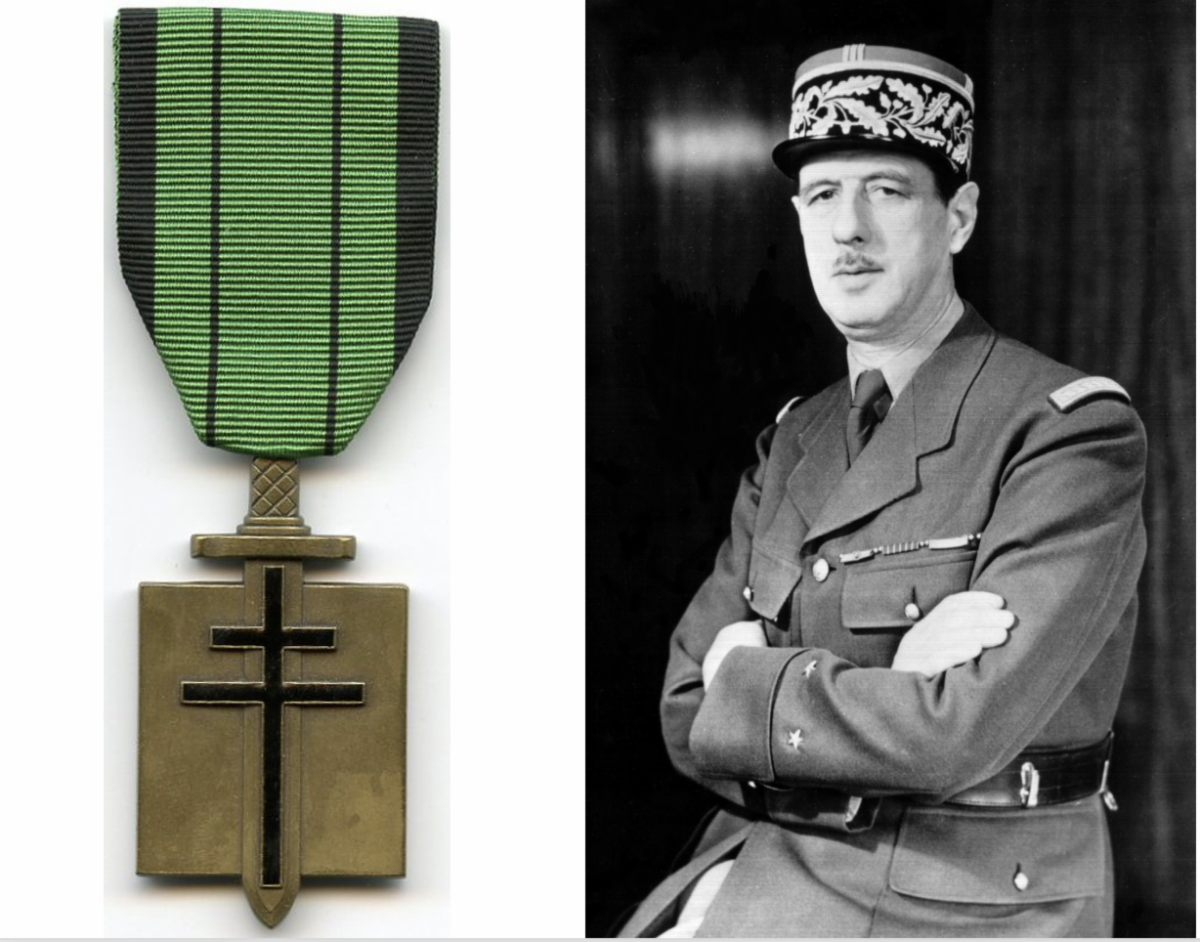
Left: The medal of the Order is called the Croix de la Libération ("Cross of Liberation"). It is a 31 mm wide by 33 mm high rectangular bronze shield bearing a 60 mm high vertical gladius on its obverse. On the blade of the gladius: a black enamelled Cross of Lorraine (symbol of the Free French Forces). The ribbon is green represents hope, while the black stripes represent mourning, symbolizing the state of France in 1940. By Fdutil - Own work, CC BY-SA 3.0, https://commons.wikimedia.org/w/index.php?curid=19854339
Right: A WWII photo portrait of General Charles de Gaulle of the Free French Forces and first president of the Fifth Republic serving from 1959 to 1969.
|
|
The Order of Liberation
During the occupation of France, General de Gaulle felt that he had no right to award the Legion of Honor.
He therefore created, on November 16, 1940 in Brazzaville, then the capital of Free France in French Congo, the Order of the Liberation.
He was the one and only Grand Master, and only one rank was granted: that of "Companion of the Liberation". The object of the Order was to "reward people, of the military or civilian communities, who will have distinguished themselves in the task of liberating France and her Empire"
Very few people, military units and communes were ever awarded this distinction; and only for their deeds during World War II.
This prestigious medal, which in protocol order follows the Legion of Honor, was awarded to only 1,038 members - 235 of them posthumously -, including 5 women, plus 5 martyred cities and 19 combat units.
It was first awarded on January 29, 1941, and last awarded on January 23, 1946 (awards to foreign nationals were made until 1960).
There were no restrictions as to age, sex, rank, origin or nationality; nor any regarding the nature of the deeds, other than their exceptional quality.
General de Gaulle made a point of specifying the exceptional nature of this Order. He wrote: "I am offered candidates who, although very worthy and valiant fighters, do not meet the completely exceptional conditions which justify accession in the Order”.
The Order was usually bestowed by the traditional French military ceremony of "prise d'armes". The recipient was summoned forward by rank and name, and given the insignia while being commended thus: "Nous vous reconnaissons comme notre Compagnon pour la libération de la France dans l’honneur et par la Victoire" (“We acknowledge you as our Companion for the Liberation of France, in Honor, and by Victory”).
|
|
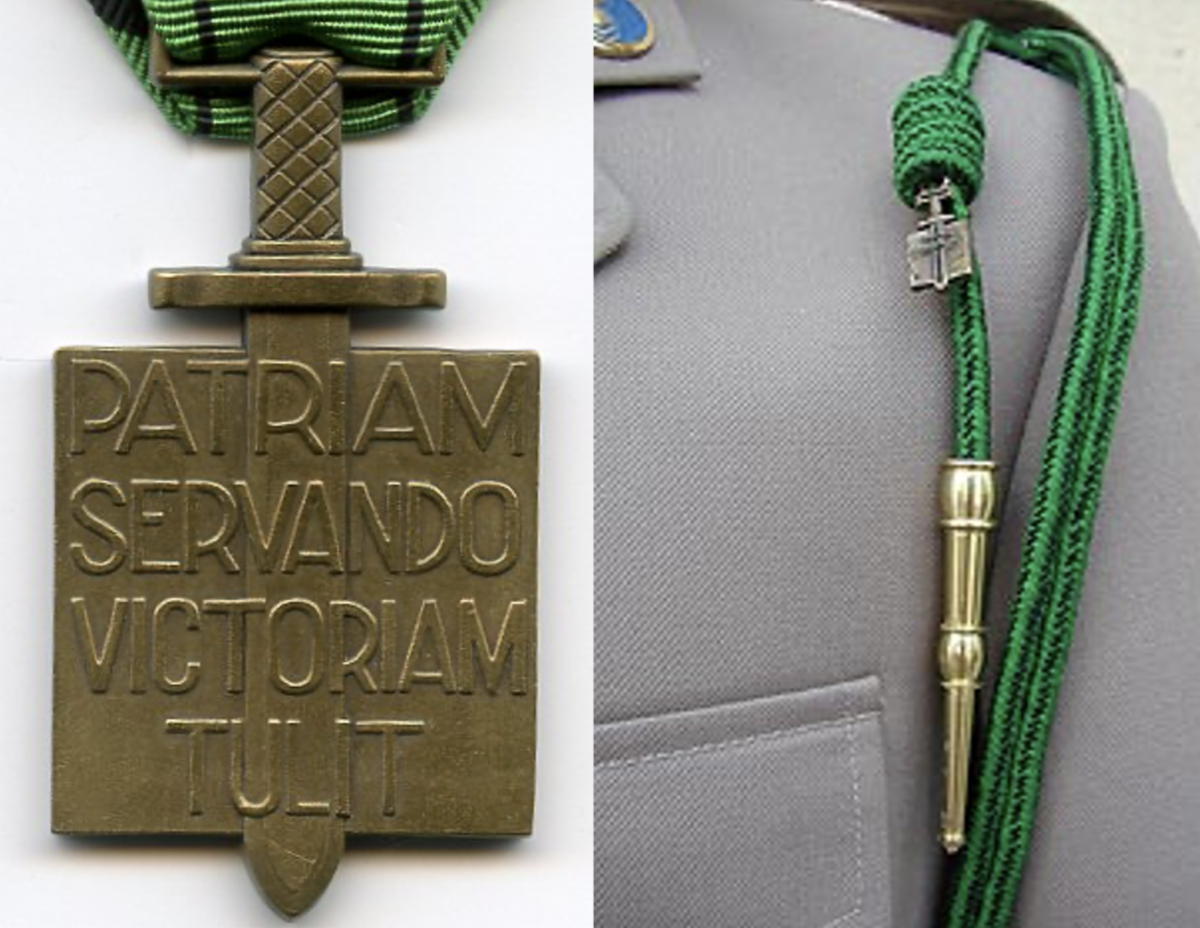
Left: The reverse of the Croix de la Libération. in Latin: a relief inscription in bold letters on four rows, PATRIAM SERVANDO VICTORIAM TULIT ("By serving the Motherland, he/she achieved Victory") By Fdutil - Own work, CC BY-SA 3.0, https://commons.wikimedia.org/w/index.php?curid=19854400
Right: Fourragère of the Ordre de la Libération (worn by 18 military units)
Par aclp — Travail personnel, CC BY-SA 3.0, https://commons.wikimedia.org/w/index.php?curid=4384538
|
|
HONOR TO THE FOUR AMERICANS
"COMPANIONS OF THE LIBERATION"
|
|
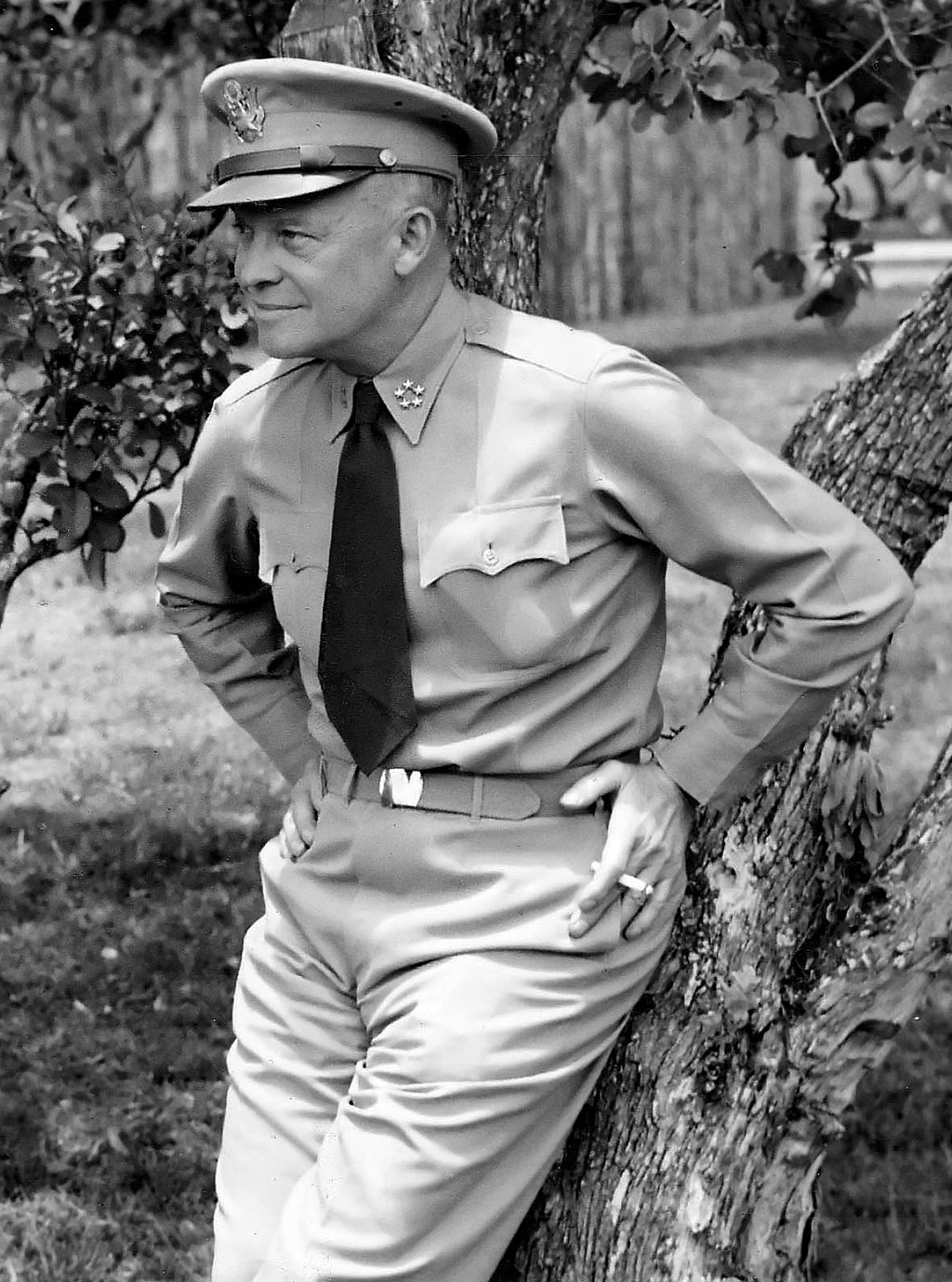
GENERAL DWIGHT D. EISENHOWER
SUPREME ALLIED COMMANDER
"Compagnon de la Libération"
by Decree of May 28, 1945
|
|
Gen. of the Army Dwight D. Eisenhower, 1945, by Signal Corps - US Army, Public Domain, https://commons.wikimedia.org/w/index.php?curid=6926698
|
|
It is not the place here to narrate the entire life story of one of the most illustrious American who ever lived.
Of specific interest to us, who are committed to honor the special bonds of friendship between France and the United States, we will simply highlight a few historical episodes showing the parallels between Eisenhower and de Gaulle, a factual list borrowed from a 2019-2020 exhibit held jointly by The Charles de Gaulle Foundation and the Dwight D. Eisenhower Presidential Library and Museum, in partnership with the Eisenhower Foundation, and the the Musée de l’Armée (French Army Museum). This exhibit was made possible with the generous support of The First Alliance Foundation.
General de Gaulle and General Eisenhower both belong to the common national heritage of their respective countries. Their work is a source of reflection and inspiration for today’s world.
• Both were born the same year:
Dwight David Eisenhower was born on October 14, 1890 in Denison (Texas). Charles de Gaulle was born on November 22, 1890 in Lille, Northern France.
• Both came from a large family: five and four siblings, respectively.
• Both chose a military career: one graduated from West Point in 1915, the other from Saint Cyr in 1912.
• Both were frustrated to be kept away far from the front lines, although in different circumstances:
While Eisenhower was denied service in Europe during WWI, and trained tank crews, de Gaulle was wounded at Verdun in 1916 by a bayonet in hand-to-hand combat, left for dead, captured by German ambulance, and spent the remaining 32 months as prisoner of war in Germany (with 5 unsuccessful escape attempts, leading each time to more severe confinements).
• During the interwar period, both followed a fairly similar military career spent mostly at the general staff headquarters. Both wrote and reflected on the use of tanks. Eisenhower spent a year in France to write a "Guide to American Battle Fields in Europe". He later recalled, “In this way, I came to see the small towns of France and to meet the sound and friendly people working in the fields and along the roads.” This proved to be a valuable experience twenty years later.
• Both were seen as mavericks by their respective hierarchy. To quote one of the exhibit's panel: "In "The Enemy’s House Divided", de Gaulle published an analysis of the reasons for the German defeat in World War I. His following works, "The Edge of the Sword" (1932), "The Army of the Future" (1934), and "France and her Army" (1938), argued for the modernization of the French military through the widespread use of armored vehicles and the creation of a professional army. His thinking was aimed entirely at enabling France to face a new conflict with Germany, which he considered inevitable and imminent. Both men’s respective hierarchies did not appreciate their ideas about the importance of tanks in future wars. Eisenhower was even threatened with court martial for going against standard infantry doctrine in recommending the use of tanks."
Shortly after the Armistice, a court-martial sentenced in absentia de Gaulle to death, deprivation of military rank, and confiscation of property.
• During World War II, Eisenhower was entrusted with the immense military task of leading millions of soldiers to victory. Eisenhower had to report to the Chiefs of Staff and President Roosevelt (who despised de Gaulle and saw in him an aspiring dictator, and considered France to be permanently diminished as a minor power), while de Gaulle was fighting for the restoration of France in its rights, and was obsessed with reuniting the country, and ensure it would fight alongside its allies and therefore earn the right to be seating at the table of the victors.
• Inevitably, differences of objectives appeared, and the immense talents of the diplomat-soldier that Eisenhower came in full light.
For instance, faced with the stubbornness of the French general who defended the political sovereignty of France, Eisenhower renounced the establishment of AMGOT (acronym for "Allied Military Government of Occupied Territories", which would have administered France as a conquered province).
The Liberation of Paris owes much to General de Gaulle. It was he who succeeded in convincing the American general, Dwight D. Eisenhower, not to bypass Paris. Eisenhower thought that devoting time to liberating Paris would slow down his troops on their way to ensuring Germany’s surrender. In the end, Eisenhower was convinced, Paris was too symbolic, as well as being strategic. He authorized the 2nd DB (2nd Armored Division) of General Leclerc to enter Paris first in August 1944, rushing to the capital shortly after the insurrection of the Parisians had started and receiving the capitulation of General von Choltitz. Paris thus avoided the fate of Warsaw and its destruction by the Nazis.
• Another conflict arose when the powerful German Ardennes counteroffensive (The Battle of the Bulge) threatened Strasbourg, which had been liberated by Leclerc’s men. De Gaulle insisted that a strategic withdrawal was politically unacceptable for the French. Eisenhower, who clearly could have divested forces needed elsewhere, understood what was at stake for de Gaulle and reluctantly accepted, thus demonstrating here again his impressive grasp of political matters.
• While Eisenhower was promoted on December 20, 1944 to five-star general (General of the Army, the second highest rank in the United States Army), de Gaulle was never offered, nor ever asked to have his rank of general made officially permanent, nor did he ever ask to receive his pension.
• Both achieved their wartime goals: less than a year later, Eisenhower obtained the unconditional capitulation of Germany.
As for de Gaulle, he achieved his paramount goals to restore the authority of the French Republic immediately after the D-Day landing, have a full fledged French Army join the fight in Italy and Germany, all the way to the confines of Austria from 1943 to 1945, have France sign among the allied victors the capitulation of Germany and Japan, claim a Permanent seat at the Security Council of the United Nations, and administer a sector of West Germany and West Berlin in the post-war period.
|
|
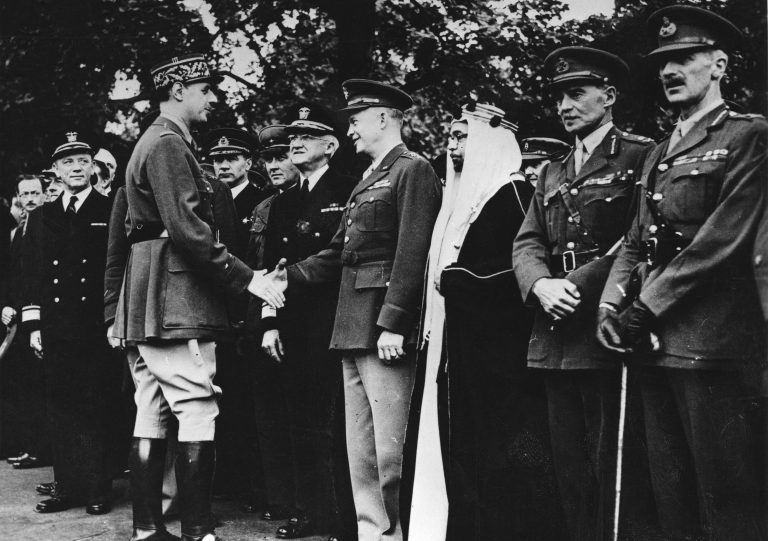
14th July 1942, on Bastille Day: French General Charles de Gaulle shaking hands with Dwight D. Eisenhower Commanding General, European Theater of Operations (ETOUSA), in the Wellington Barracks, London.
|
|
• Both eventually became Heads of States of their respective countries, and both got re-elected. Eisenhower became President of the United States (1953-1961) and de Gaulle after being head of the French Provisional Government (1943-1946), was elected and re-elected President of the French Republic (1958-1969).
• Both held each other in high esteem, not just because of their military competence, but also because of their mutual understanding of what was at stake for the future.
In an interview of August 25, 1964 with journalist David Schoenbrun, Eisenhower recounted that “...I believe that so far as my relations with Charles de Gaulle are concerned, not only during the war, but in SHAPE days and then as President, they were not ever rough or unpleasant in a personal way. This man and I have always been very good friends…”
…”[there was] a good feeling, not only of respect and admiration, but of a very measurable degree of affection. And, as for his family, well, I remember once he came, during the war, to Washington, while I was still in Paris, and, like a friend, he made it a point to call up Mrs. Ike and tell her I was fine. And he had never met her, didn’t know her, but he acted simply and naturally, like a soldier calling up a soldier’s wife to reassure her”...
[to Schoenbrun]: ..."You make it clear that he and I were always friends, even when we disagreed. The disagreements get a lot of visibility, of course, but we got along personally very well and there were a lot of areas of agreement, too. Be sure you put them on the record because that’s part of the whole truth…”
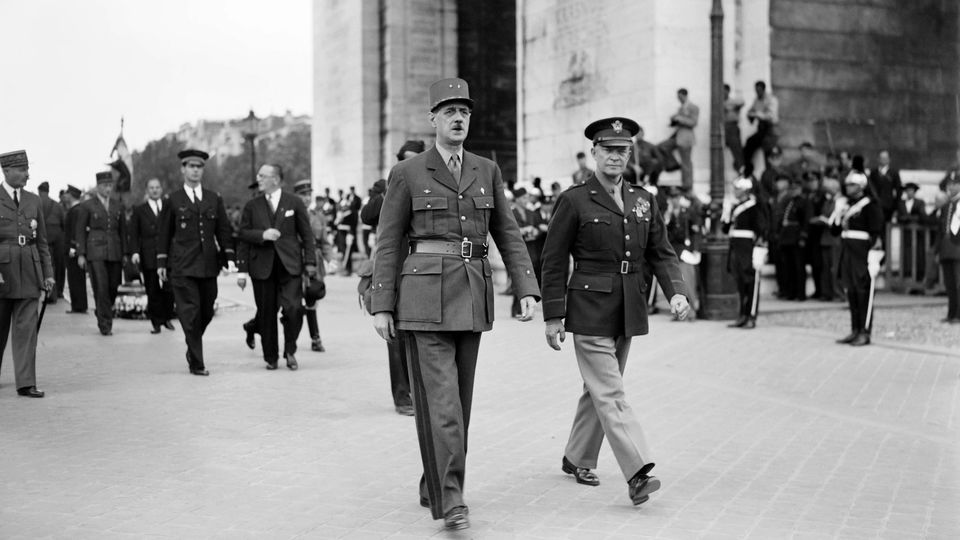
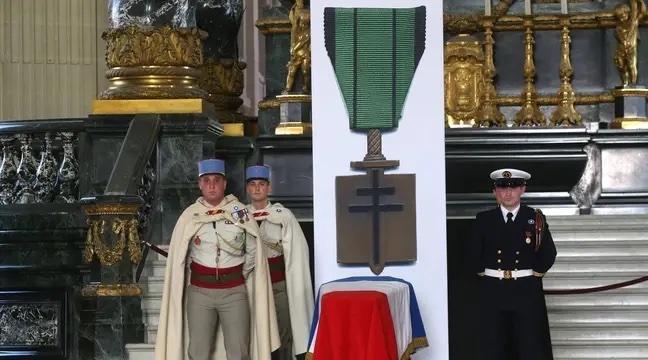
• On June 14, 1945, under the Arch of Triumph in Paris, next to the tomb of the Unknown Soldier, "Ike" was made a Companion of the Liberation by General de Gaulle. Eisenhower was the only Allied military leader to receive this distinction.
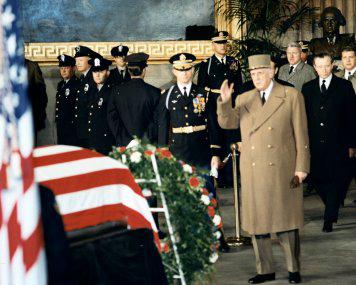
• When Eisenhower died in 1969, de Gaulle flew to Washington to pay his respects to his old "Companion", shortly before he resigned the presidency and died the following year.
• Your society is planning to honor this great American, the mastermind of the D-Day landing, with a plaque.
|
|
Top Photo: Charles de Gaulle and Dwight Eisenhower at the Arch of Triumph, Paris, June 14, 1945.
Photo above: President Charles DeGaulle of France pays his respects to the late General Eisenhower at the Rotunda of the Capitol. March 30, 1969. Photo: US Army
|
|
JAMES WORDEN
"Compagnon de la Libération"
by Decree of March 7, 1945
|
|
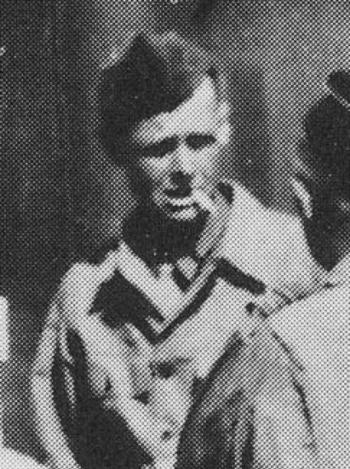
Unfortunately we are unable to find a better quality photo for James Worden.
Little is known about his post WWII career and life. Photo: Ordre de la Libération.
|
|
James Avery Worden (Philadelphia, February 16, 1912 - Princeton, May 14, 2004) studied in Europe and joined Worcester College at the University of Oxford. During a trip to France in August 1939, he joined the American Field Service (AFS) which he helped to organize in the country.
The American Field Service had been established during World War One and its corps of American volunteers provided medical and ambulance help to the front lines in the French battlefields.
During the Battle of France in May-June 1940, it operated with the AFS in the sectors of Amiens, Beauvais, Orléans and Poitiers. After the armistice of June 22, 1940, in collaboration with the American Red Cross, he carried out visits and supplies in French prison camps. In February 1941, forced by the Vichy authorities to leave France, he went to Spain and then to Portugal from where he took a boat bound for the Congo in the company of other Americans from the AFS. Having just landed in Pointe-Noire, he decided to enlist in the Free French Forces and was first assigned to the Hadfield-Spears Ambulance then to the Divisional Sanitary Group#1 of the 1st Free French Brigade (1st DFL).
Engaged in Libya within the framework of the desert war, James Worden is the head of the section of the stretcher-bearers. He distinguished himself during the legendary battle of Bir Hakeim during which 3,600 Free French held off 35,000 German and Italian forces led by General Rommel for several days, giving time to the British Army to prepare for the Battle of El Alamein. At the time of the exit of the French forces on the night of June 10 to 11, James Worden brought aid to the wounded in very difficult conditions, avoiding encirclement and capture, and rejoining the British lines.
He then participated in the Tunisian campaign from May 1943 to January 1943. Landed in Italy in the spring of 1944, he distinguished himself again during the Battle of Garigliano where, on the night of May 17 to 18, he personally rescued many soldiers from the Marine and Pacific infantry battalion caught under enemy fire. He landed in Provence on the following August 16 and took part in the liberation of France, giving his all to ensure the evacuation and care of the wounded soldiers of the 1st DFL.
After the war, James Worden retired to Princeton in New Jersey where he died on May 14, 2004 and was buried there.
We have little information, unfortunately, on his post war career and life. All that we could find on the internet is the following entry:
"James Worden of Princeton. Died May 14. Private services were held. Arrangements were under the direction of Glackin/Saul Funeral Home, 136 Morrison Ave., Hightstown. Published by "The Times, Trenton," on May 22, 2004."
Anyone who has more information or could reach out to his family, please contact us.
Your society is planning to honor him with a plaque.
|
|
JOHN F. HASEY
"Compagnon de la Libération"
by Decree of April 18, 1942
|
|
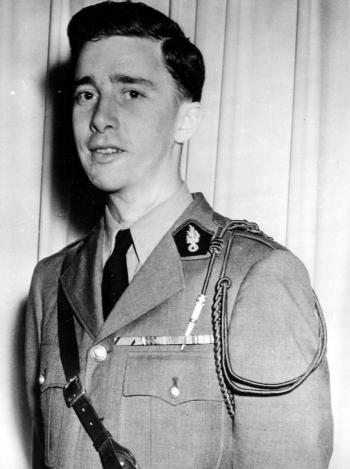
Lieutenant John F. Hasey was the first American citizen to shed his blood to free France from the oppression of the Nazi Regime. Photo: Ordre de la Libération. |
|
John Freeman "Jack" Hasey, born November 3, 1916 in Brockton (Massachusetts), died May 9, 2005. He was a captain of the Foreign Legion in the French army during the Second World War and then a CIA officer.
In 1936, Hasey, the scion of a wealthy New England family, went to France after college, unwilling to start so soon a corporate career. Like Hemingway and many American expats, he enjoyed the high life of the Roaring Twenties in Paris. His good looks, charm, and access to American and British socialites millionnaires attracted the attention of the Cartier brothers who hired him to become a high jewelry salesman. This is how John Hasey sold diamond jewelry to the likes of the Duchess of Windsor, Douglas Fairbanks, Marlene Dietrich, to name a few.
When the Soviet-Finnish war broke out in 1939, Hasey, like many Americans, volunteered. He was detached to an ambulance unit and took part in the Finland campaign, an action for which he received the Finnish "Liberty Cross" in the 1950s. Wounded in February 1940, he was repatriated to the United States. Returning to Europe in June, he joined France to resume his job at Cartier, the Battle of France broke out. Witnessing first hand in Biarritz (where he put his Cartier diamond jewelry samples in a safe) and in Bordeaux the abandon and collapse of all the French institutions, he escaped to Portugal to join England.
There, he contacted the chairman of the board of Cartier in London, Etienne Bellanger, who had provided initial material assistance to General de Gaulle. It is on August 9, 1940 that, at the home of Bellanger in Putney, just outside London, he had dinner with general de Gaulle, his wife Yvonne, and their daughter Elizabeth. The next day, he immediately volunteered to join the Free French Forces.
Assigned as a second lieutenant in the health service of Free France, he took part in the Dakar operation in September, then in the Gabon campaign from October to November 1940. Transferred, at his request, to the 13th half- Foreign Legion brigade in January 1941, he fought in Eritrea against Italian forces.
On June 20, 1941, during the Syrian campaign against Vichy troops, he was very seriously injured at the gates of Damascus by six machine gun bullets, one of which took away part of his face. Treated in Jerusalem and then in the United States from January 1942, he underwent several operations there.
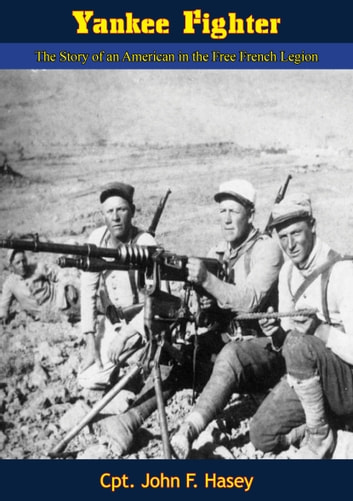
This is when he dictated to Joseph F. Dinneen, a journalist for the Boston Globe, his riveting memoirs (see below), from his hospital bed, "with [his] head bandaged and a tube in [his] throat to control [his] vocal apparatus."
Promoted to lieutenant in August 1941, John Hasey was the first American to be made a Companion of the Liberation by General de Gaulle in April 1942.
In a personal letter Charles de Gaulle wrote to him:
"I have been informed that in spite of the fact that you have been obliged to go back into the hospital for further treatment, there is every reason to believe that you are on the highroad to complete recovery.
While congratulating you on your physical improvement, it is an even greater pleasure to tell you that, just as you were the first American citizen to shed his blood for Free France from the oppressors, so I wish you to be the first American citizen to become Compagnon de l'Ordre de la Libération.
The highest honor which can be bestowed upon a member of the Armed Forces of Free France is the Croix de la Libération. All those to whom it is awarded, from General to Private, become Companions for life.
Since today, as was the case twenty-five years ago, American and French soldiers are fighting side by side, I trust that the complete restoration of your health will make it possible for you to resume your place among us in the very near future."
[signed] Charles de Gaulle
Reformed by the American army, John Hasey again joined the Free French and was assigned, in October 1942, to the West Indies Battalion as an instructor officer.
In August 1943, he was promoted to the rank captain, he became aide-de-camp to General Pierre Kœnig (who commanded the Free French at Bir Hakeim) with whom he remained during his term as military governor of Paris in August 1944.
In 1945, he was demobilized with the rank of reserve captain and returned to his salesman job with Cartier.
In 1950, he joined the CIA and served in 17 countries, until his retirement in 1974.
The value of his contribution to France’s war effort can be demonstrated in these comments from his citations:
“He has the qualities of a man, of a soldier, and of a leader. He has won a place in the hearts of his comrades. Loved and respected by them, as well as by his leaders, Lieutenant John Hasey is the perfect type of foreigner, for whom the love of France is not vain words.”
“In the Battle of the Enghiahat … his Captain and First Lieutenant being wounded, he remained the only officer valid. His absolute indifference to danger inspired and galvanized his men.”
“During the siege of Massawa, he led his platoon with magnificent bravery in an assault upon enemy positions, which he captured along with a large number of prisoners.”
John F. Hasey is buried in Columbia Gardens Cemetery in Arlington, VA.
Your society is planning to honor him with a plaque.
|
|
JACQUES TARTIERE
"Compagnon de la Libération"
Posthumous
by Decree of August 21, 1941
|
|
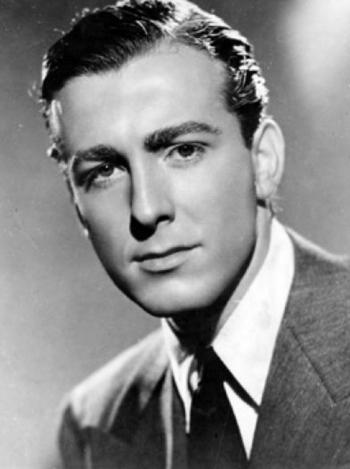
Jacques Tartière became Jacques Terrane, a naturalized American citizen following his father's marriage with an American. Photo: Ordre de la Libération.
|
|
Jacques Terrane, whose real name is Jacques Tartière, was born on August 23, 1915 in Paris, and died on June 20, 1941 in Damascus (Syria).
He was a Franco-American actor and Companion of the Liberation.
Grandson of Georges Feydeau, the famous French comedy playwright, Jacques Terrane spent his childhood between the United Kingdom and France, before becoming an actor and obtaining American citizenship, thanks to his father's remarriage with an American.
In 1937, he met the actress Drue Leyton (real name Dorothy Parsons, born June 12, 1903 in Guadalajara, Mexico) in New York, with whom he left for Europe in February 1938 and married in England in September.
In 1939, Jacques Terrane starred (alongside Michèle Morgan and Charles Vanel in La Loi du Nord (The Law of the North) a French adventure drama film by Jacques Feyder. Jacques Terrane settled with his wife Dorothy in the famous painter's village Barbizon in Seine-et-Marne, near Paris.
At the time of the declaration of war, Jacques Terrane left his vacation home in Cassis, and tried in vain to enlist and fight. Suffering from lung problems, he was declared unfit three times by the French army. His knowledge of English, however, allowed him to serve as a liaison officer with the British troops during the "phoney war" in September 1939.
Eager to participate in the Norwegian campaign, he pretended that... he was fluent in Norwegian!... which earned him to join General Béthouart's expeditionary corps in the Foreign Legion. There, he distinguished himself by ensuring the landing of ammunition under enemy fire near Narvik.
Evacuated to England upon the signing of the Franco-German armistice of June 22, 1940, he enlisted in the Free French Forces and was assigned to the 13th Foreign Legion demi-brigade, before being promoted adjutant on July 1st.
He took part in the failed "Operation Menace" which had aimed to wrestle Dakar and Western Africa from the Vichy forces. During the ensuing Eritrean campaign within the French Brigade in the Orient, he served as section chief of motorcycle scouts, and participated in the capture of Keren and Massawa in Libya in April 1941.
On April 30, 1941, he boarded the Paul Doumer and joined the Qastina camp, in Palestine, where the 1st DFL was formed, for the Syrian campaign.
One of the first to cross into Syria on June 8, he had just obtained the surrender of a Vichy unit on June 18 when, rejoining the free French lines on a motorcycle, he was shot in the back.
He died at Seraphan Hospital in Damascus on June 20, 1941 and was buried in Ramleh Cemetery in Syria.
His half-brother, Philippe Keun, also engaged in the Foreign Legion in September 1939 then as an agent of the Intelligence Service, was hanged at the Buchenwald camp in September 1944.
His wife joined the French Interior Resistance and died on February 8, 1997 in Corona Del Mar, California.
His name is already engraved on a plaque at Notre-Dame Church, Manhattan, among the 462 other names of French conscripts, volunteers and American volunteers who "Died for France".
However, your society is planning to honor him with a similar plaque, like the three other American "Compagnons de la Libération", at a location to be determined, since his grave and his remains are in Syria.
|
|
The last Companion, Hubert Germain, died on October 12, 2021 at the age of 101. |
|
PAST MONTHLY BULLETINS
OUR GOAL: turn the spotlight on a famous, or less famous, episode or historical figure during the long shared history between France and the United States, with illustrations and anecdotes.
You can have access to all our past Monthly Bulletin
since February 2021 by visiting our website:
Since
|
|
Our next Bulletin in June will turn the spotlight on the story of
the frigate HERMIONE and its role in the War of Independence
|
|
Left to right: Mr. Osceola “Ozzie” Fletcher, Mr. Edward L. Chan, Mr. David Lesser. They were made "Knight in the National Order of the Legion of Honor " by the Consul General of France in New York, Jérémie Robert.
|
|
LEGION OF HONOR TO WWII VETERANS
AT THE FRENCH GENERAL CONSULATE OF NEW YORK:
Feb. 10, 2022 – Mr. Osceola “Ozzie” Fletcher received the insignia of Chevalier (Knight) in the French Legion of Honor from the hands of Mr. Jérémie Robert, Consul General of France in recognition of his participation in the liberation of France. Mr. Fletcher, a New York native entered service in the US Army in 1943 at the age of 21, received training in the UK and was assigned to the 254th Port Battalion taking part in the delivery of supplies and mail, the unglamorized but crucial mission of support units. He arrived in Normandy one week after D Day while heavy fighting was taking place. He was injured while wading in the water in performance of his work, received medical treatment and returned to duty. He was wounded again, this time severely when a truck time was struck by a German missile. He was awarded the Purple Heart last year. Returning to civilian life, Mr. Fletcher completed his undergraduate studies and served in the New York Police Department for 24 year. He celebrated his 100th birthday on January 16 was very active until about six years ago.
Consul General Jérémie Robert and Guy Wildenstein, President of the American Society of the French Legion of Honor and Ms. Pauline Fletcher addressed the audience.
The American Society of Le Souvenir Français was represented by its President Thierry Chaunu, the Federation was represented by Alain Dupuis, President, Paul Garabedian, Secretary, Henri Dubarry, Treasurer, André Ferrara, Color Guard and bass drum, Jean Le Gall, Color Guard and Daniel Falgerho, Vice President. Our deep thanks to the Cadets La Fayette and their leader Jacques Letalon for providing brilliant musical accompaniment.
For more photos:
On April 6, 2022 In a ceremony held at Monmouth Community College Mr. Jeremie Robert, Consul General of France bestowed the insignia of Chevalier (Knight) in the French Legion of Honor to Mr. Edward L. Chan, in the presence of Elodie Massaro, Executive Director of the American Society of the French Legion of Honor.
Mr Chan whose parents had emigrated from China in 1905 enlisted in the US Army on his birthday, April 7, 1943 the day he turned 18.
After training as a medical technician, Mr Chan served in front line hospitals, first in Italy where the conditions were severe and then in southern France right after the Allied landing in August 1944 under even more demanding conditions, treating civilians as well as servicemen as the situation required. He was popular for his dedication to helping others in addition to his assigned duties.
After returning to the US, Mr Chan earned a Master’s Degree in Education at Columbia Teachers’ College and taught in public schools for 33 years.
The Federation of French War veterans was represented by Alain Dupuis, our President, Henri Dubarry, Treasurer, Jean Le Gall. Color Guard and Daniel Falgerho, Vice President.
For more photos:
On April 20, 2022 at the Consulate General of France in New York City, the Consul General Jeremie Robert bestowed the insignia of Chevalier in the French Legion of Honor to Mr. David Lesser in the presence of Guy Wildenstein, President of the American Society of the French Legion of Honor. Mr. Lesser enlisted entered the US Army in February of 1944, when he was just 21 years old. He was originally assigned to a Combat Engineers unit but his capacities in Physics and mathematics qualified him for training as a Navigator/Bombardier. Assigned to the 448th Battle Squadron, 321st Bombardment Group of the 12th Air Force based in Corsica, he flew on over 70 missions on B25 bombers as navigator. This number is testament to his bravery, he never refused to fly even when given the choice, if a navigator was needed he went.
The Federation was represented by Alain Dupuis, President, Henri Dubarry, Treasurer, Paul Garabedian, Secretary, Jean Le Gall, Color Guard and Daniel Falgerho, Vice President, and the American Society of Le Souvenir Français by Thierry Chaunu, President.
For more photos:
|
|
HONORING "FRENCH ALLIANCE DAY" ON MAY 1ST AT
WASHINGTON MEMORIAL CHAPEL, VALLEY FORGE, PA.
|
|
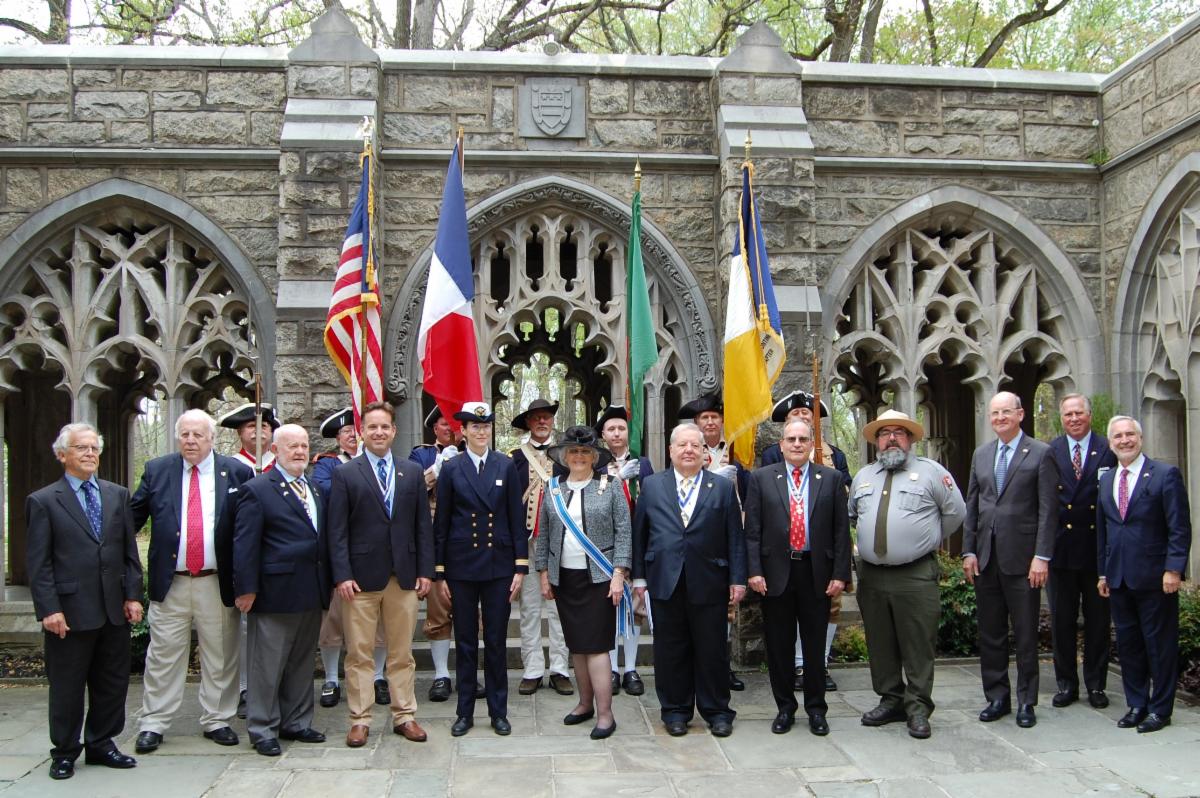
Representatives from several patriotic societies such as the Order of Cincinnati, the Daughters of the American Revolution, the Sons of the American Revolution, W3R, American Friends of Lafayette, our hosts Washington Memorial Heritage, gathered for a group photo after the ceremony. |
|
• The Treaty of Alliance between France and the United States was concluded at Paris, February 6, 1778 and ratified by Congress May 4, 1778. When word of the Alliance and its ratification by the Continental Congress reached Valley Forge in early May 1778, General George Washington issued the following general order: “…Upon a signal given, the whole army will huzza, 'Long Live the King of France.’ ”….
• And he also issued the following General Order: “It having pleased the Almighty Ruler of the universe to defend the course of the United States, and finally raise up a powerful friend among the princes of the earth, to establish our Liberty and Independence upon a lasting foundation, it becomes us to set apart a day for gratefully acknowledging the Divine goodness, and celebrating the important event which we owe to His Divine interposition.” (General Orders, May 5, 1778)
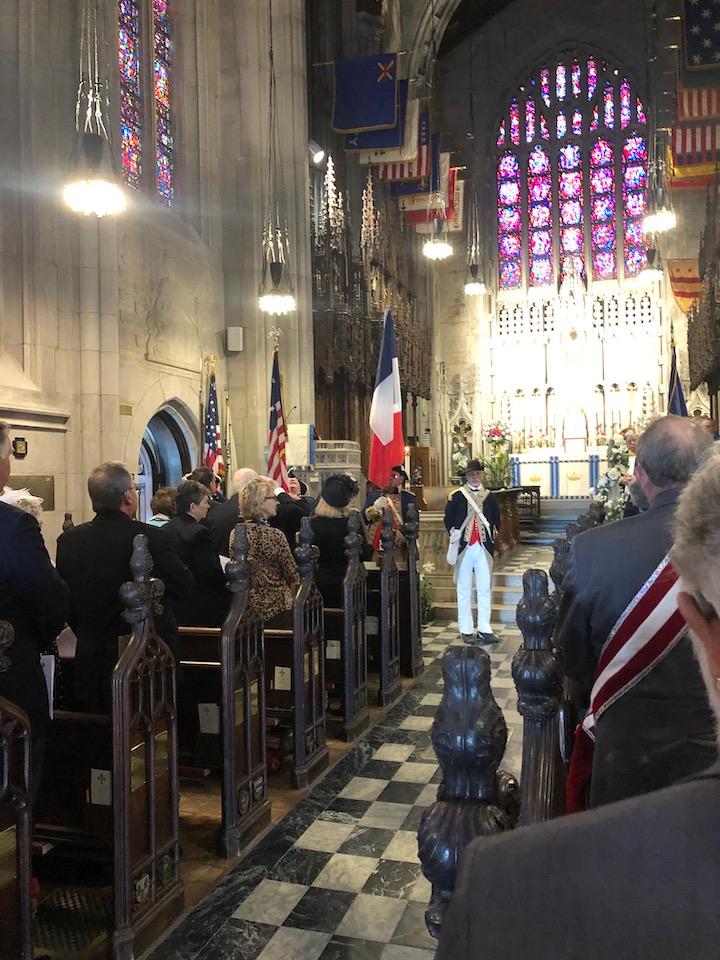
• Therefore, every year, on the first weekend in May, Washington Memorial Chapel at Valley Forge, in accordance with Washington’s instructions, commemorates the Treaty of Alliance with France.
• This ceremony is organized by the Washington Memorial Heritage and the Washington Memorial Chapel with the participation of numerous American patriotic societies dedicated to the recognition and perpetuation of French-American friendship. The French side is represented by the Association of French Reserve Officers in the United States (ACREFEU), the Federation of French War Veterans, the American Society of the Souvenir Français Inc., the Honorary Consul of France in Philadelphia Mr. Michael Scully and the Embassy of France who was represented by Lieutenant Lauriane Piré of the Délégation Générale pour l'Armement.
• Our deep gratitude and thanks to the members of the Washington Memorial Heritage, David Lauhoff, president, Gardiner Pearson, past president, Father Tommy Thompson, Rector, Pat Nogar, Warden, all the distinguished members of patriotic associations, and all the re-enactors, for their warm welcome.
|
|
VISIT OF NATHALIE AND PHILIPPE DE GOUBERVILLE
TOUR OF ODELL HOUSE - ROCHAMBEAU HEADQUARTERS
FUNDRAISING DINNER AT THE FRENCH GENERAL CONSULATE
MAY 5, 2022
|
|
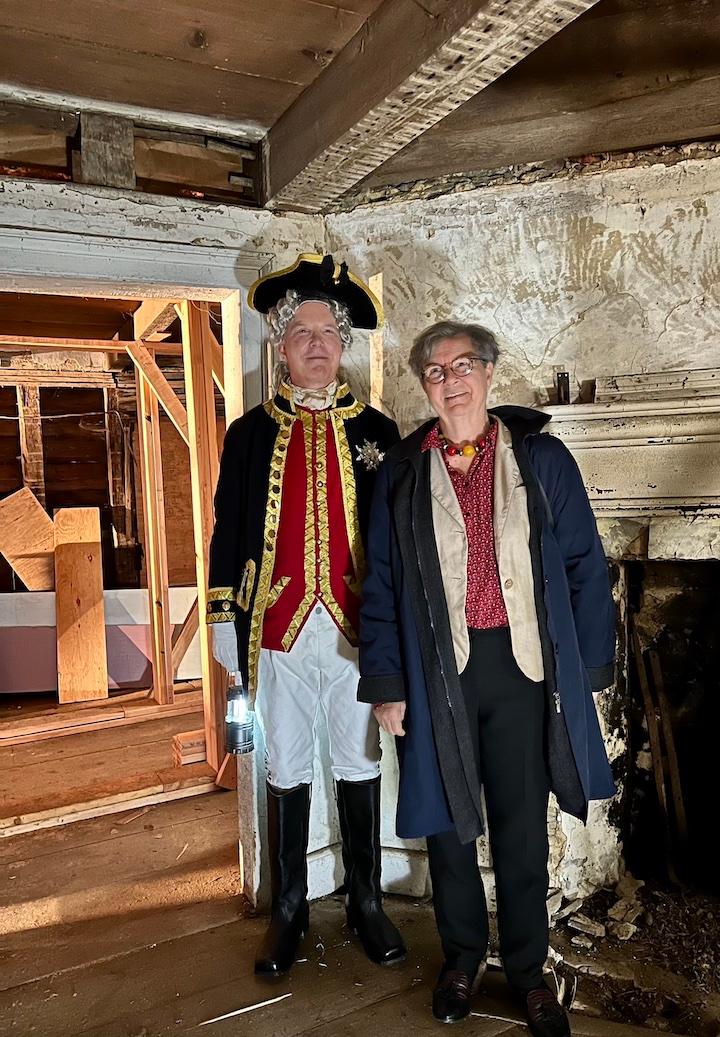
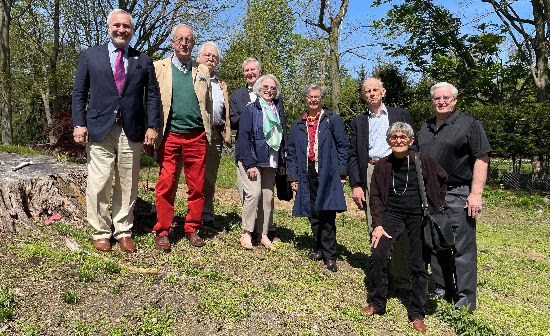
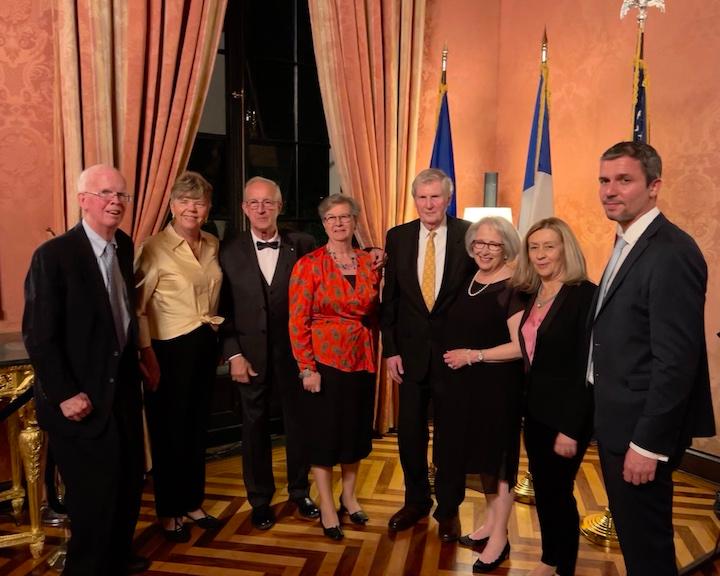
• We were honored to welcome in New York Mrs. Nathalie de Gouberville, direct descendant of Rochambeau, and her husband Philippe, Member of the Order of Cincinnati, who presided a fund raising dinner organized by Susan and David Seal, president and founders of the Friends of Odell House - Rochambeau Headquarters.
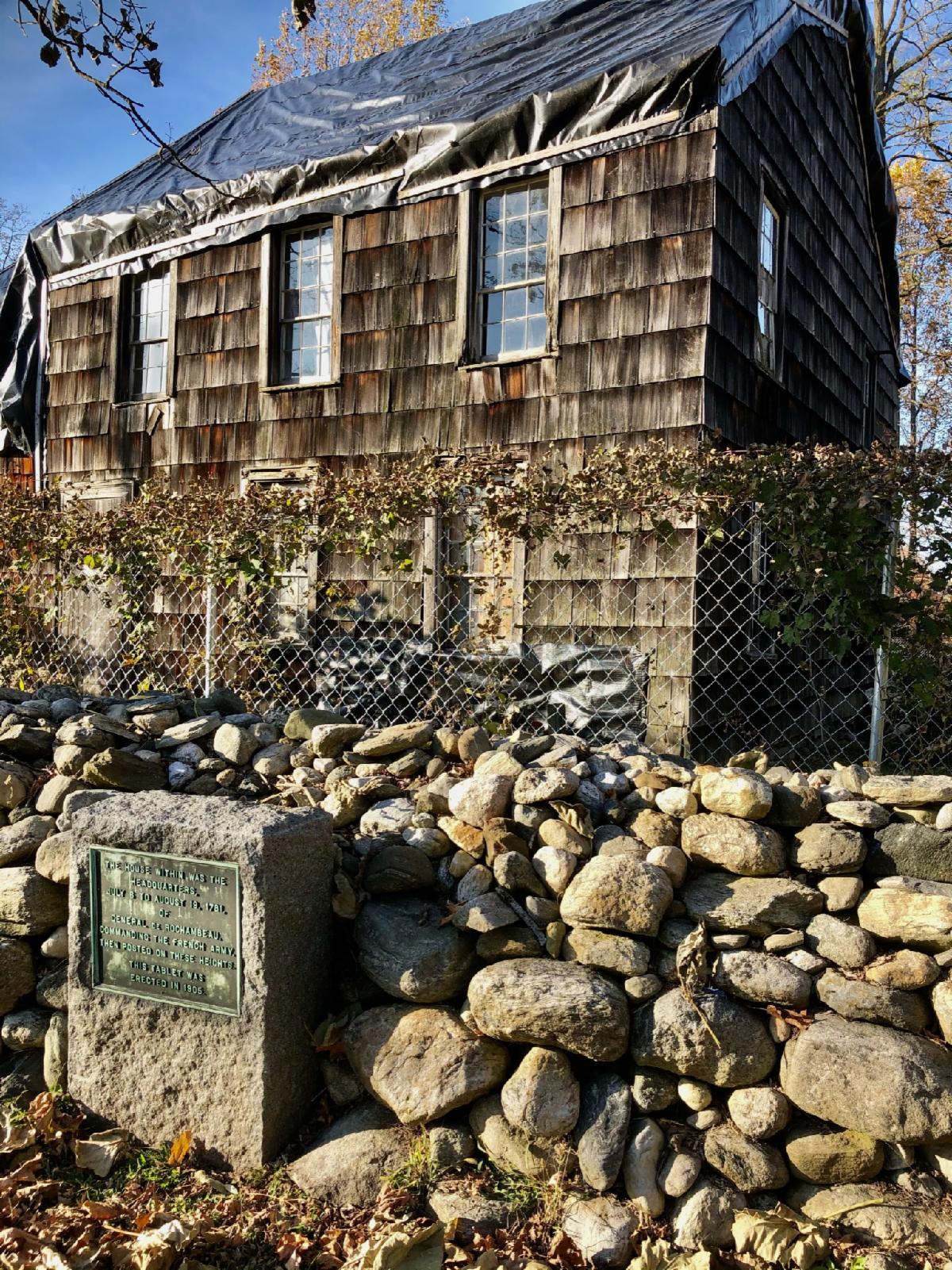
• Located 21 miles north of New York, off I87 and just south of White Plains, this old farm which remained intact throughout two centuries is undergoing renovations led by Susan and David Seal, following the recent acquisition by the City of Greenburgh (Westchester County) for conversion into a museum.
• This site is historically particularly important. This is where General Rochambeau established his headquarters on this farm in July-August 1781 and met with George Washington to develop the strategy which was successful at Yorktown. The French Army and the Continental Army camped all around the area for more than a month.
• Nathalie de Gouberville stood next to the mantlepiece where her direct ancestor General Rochambeau conferred with General Washington...We were feeling tingles in our spines, thinking of the presence of these two historical figures, in a room that miraculously has not changed much since 1781.
• During the ensuing dinner at the General French Consulate, Thierry Chaunu officially announced that the Society would fund the installation of a Memorial consisting of a boulder, bronze plaque, and bench, in the gardens of the future museum, to honor the memory of 4 French Soldiers who died and were interred in the vicinity.
• The exact location on the Museum grounds will be determined upon completion of the archeological search in progress, and the permits associated with the landscaper's proposals.
• A wonderful video "Dear France, Thank You!" was unveiled to the guests. You can view it at:
|
|
VISIT IN NEW YORK OF
Contrôleur Général des Armées (2s)
SERGE BARCELLINI
Président-Général du Souvenir Français
|
|
WREATH LAYING CEREMONY at NOTRE-DAME CHURCH
Friday May 6th, at 11:00AM
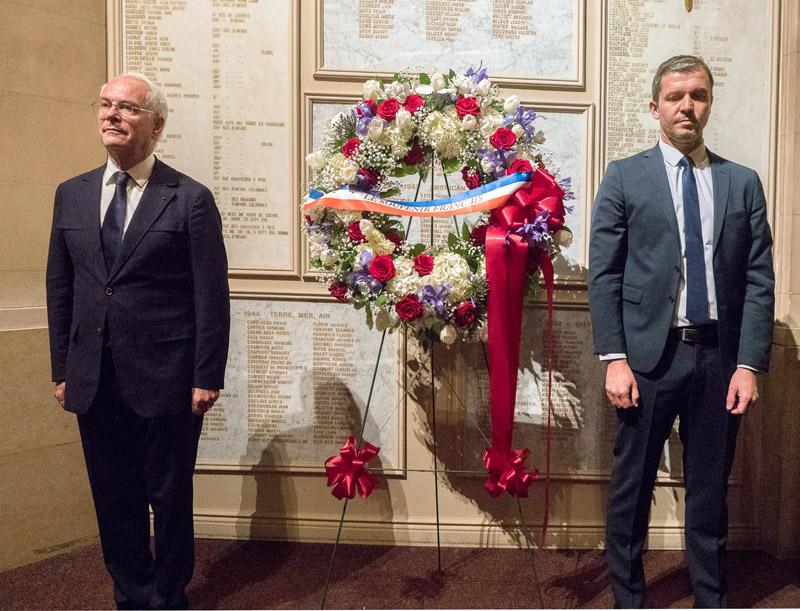
• On the occasion of a visit in New York by the President-General of Le Souvenir Français in Paris, Contrôleur Général des Armées (2S) Serge Barcellini, alongside Mr. Jérémie Robert, Consul General of France in New York, laid a wreath at a moving ceremony at Notre-Dame Church, 405 West 114th Street in Manhattan on Friday, May 6th, to honor the 463 names of French and Americans conscripts and volunteers who "Died for France" in two world wars.
• Chuck Schwam, COO of the American Friends of Lafayette, movingly called each name of the 64 American volunteers of the American Field Service who "Died for France' in two world wars.
• The Consul General of France Mr. Jérémie Robert, the Deputy Consul General, Mr. Damien Laban, Senator of the French Living Abroad Hélène Conway-Mourot, General Roland Margueritte and Colonel Richard Decombe of the Permanent Mission of France to the United Nations, Nathalie and Philippe de Gouberville, the representative of the Consulate of Belgium / Delegation of Flanders Nicolas Polet, honored us with their presence. Our thanks go to Alain Dupuis, president of the Federation of French War Veterans, and the Veterans Henri Dubarry, Daniel Falgerho, Paul Garabedian, and the music of the Cadets Lafayette, led by Mr & Mrs. Jacques Letalon and André Ferrara.
|
|
President-General of Le Souvenir Français in Paris, Contrôleur Général des Armées (2s) Serge Barcellini, alongside Mr. Jérémie Robert, Consul General of France in New York, in front of the plaques, after laying the wreath of Le Souvenir Français. Photo: Daniel Falgerho |
|
NEW YORK SCREENING OF "THE GIRL WHO WORE FREEDOM"
Monday, May 16, 2022
French Institute Alliance Française, Florence Gould Hall
|
|
Dir. Christian Taylor, 2020, United States, 89 min, color
In English and French with English subtitles
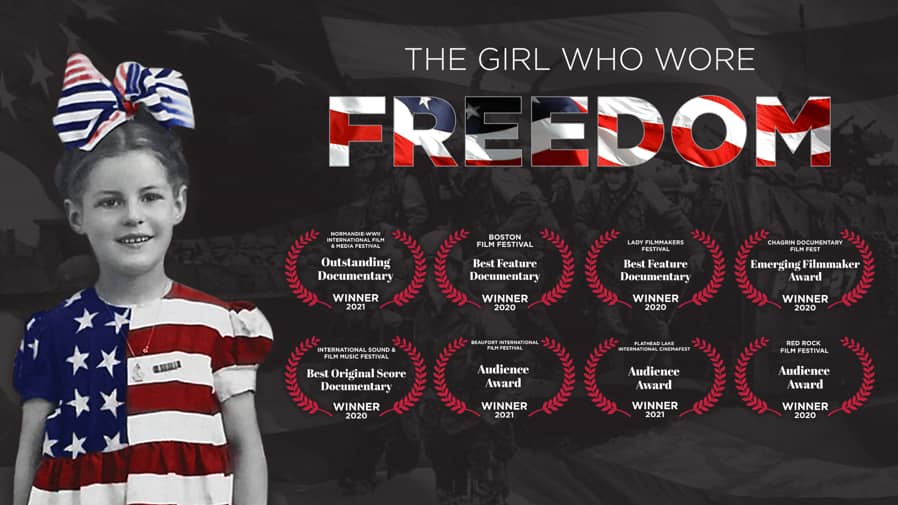
This past Monday, May 16, FIAF presented a special screening of the documentary The Girl Who Wore Freedom, a touching tribute to D-Day and the longstanding French-American friendship.
The documentary unveils the untold stories of D-Day from the men, women, and children who lived through German occupation and Allied liberation of Normandy, France.
Dany Patrix, Maurice Lecoueur, Henri-Jean Renaud, and others who lived through this turbulent time still speak of a love affair that bonds generations of Free French to the American liberators to this day.
One little girl’s story exemplifies how the French saw – and still remember – the bravery and heroism of the American GIs. Her name is Dany Patrix, and she is the thread that weaves us throughout this story.
Dany became "The Girl Who Wore Freedom" when her mother made her a red, white, and blue dress from parachutes, which she wore to honor Allied forces at the first D-Day commemoration.
• The screening was followed by a Q&A with Christian Taylor, Dany Patrix and David Chapman, VP Government and Defense Michelin North America, former Defense Attaché to the U.S. Embassy in Paris.
• We will strive to publicize this important documentary throughout US and French patriotic and cultural organizations, to show the enduring warm generosity and hospitality of the population of Normandy.
• Contact: Mrs. Christian Taylor: christian@documentaryfirst.com or
Thierry Chaunu: tchaunu@SouvenirFrancaisUSA.org for information
|
|
A SPECIAL INVITATION FROM L'UNION ALSACIENNE AT
THE NATIONAL ARTS CLUB
MAY 24, 2022
|
|
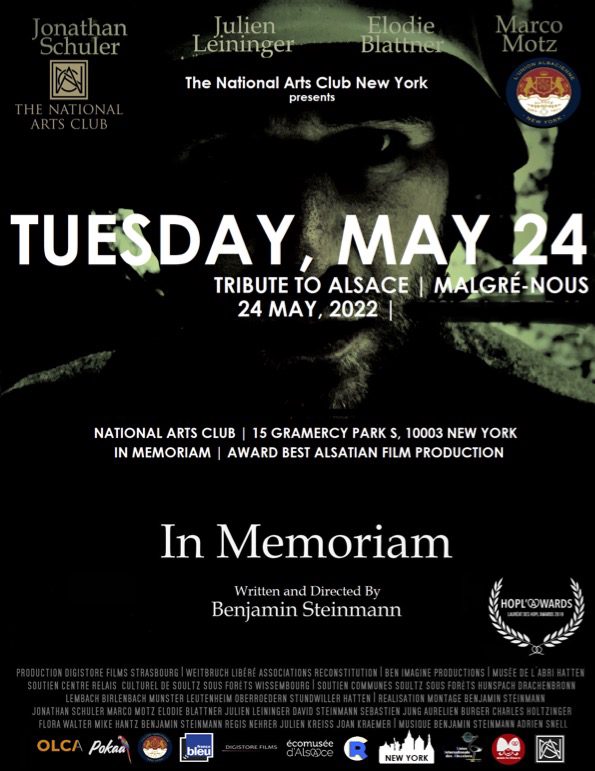
L’UNION ALSACIENNE OF NEW YORK IN PARTNERSHIP WITH NATIONAL ARTS CLUB PRESENTS:
"In Memoriam"
A movie by Benjamin Steinmann
The movie's objective is to raise awareness about the "Malgré-Nous", young men that were forcibly incorporated into the German army during the Second World War.
Synopsis: André Balzinger, a young incorporated Alsatian, decides to desert the Russian front to join the Resistance.
A discussion with Director Mr. Steinmann will follow the movie
Register for this FREE event, click on the link below:
Don’t wait to reserve your seat!
|
|
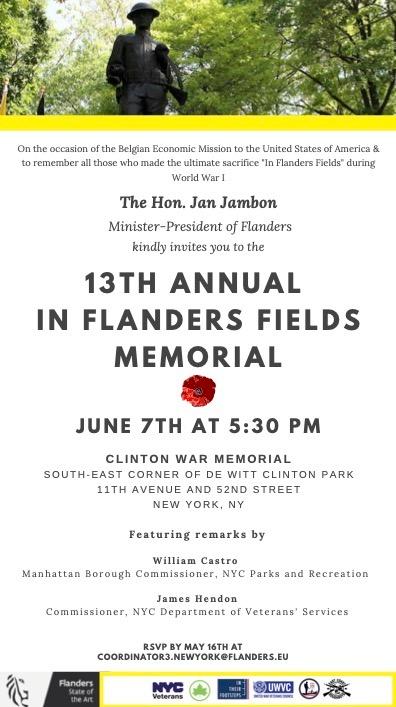
ANNUAL CEREMONY TO HONOR ALLIED SOLDIERS
WHO DIED IN FLANDERS FIELDS
NEW YORK, JUNE 7, 2022
|
|
Upcoming Marker Dedication
• The Lafayette Trail, Inc. is pleased to announce the upcoming dedication of a new historic marker at the United States Military Academy at West Point, NY.
The marker dedication ceremony will take place in front of the Visitors Center located at 2107 New South Post Road, West Point, NY 10928 on The Lafayette Trail, Inc. is pleased to announce the upcoming dedication of a new historic marker in Waterloo, NY.
The marker dedication ceremony will take place at Lafayette Park, located at 1-99 Memorial Day Pl, in Waterloo, New York 13165, on Wednesday, June 8th, 2022 at 3 pm ET.
There will be plenty of free street parking available for attendees.
We are grateful to the leadership of the United States Military Academy at West Point for including the Lafayette Trail marker dedication ceremony as part of its D-Day commemorations.
The program will include the playing of both the French and American national anthems, a presentation of The Lafayette Trail framework, as well as remarks about the significance of Lafayette's two visits to West Point during his Farewell Tour of the U.S. on September 15, 1824, and July 2, 1825.
The event will conclude with a wreath-laying ceremony, a moment of silence, and the playing of "Over There" by the West Point Band to honor the memory of the numerous U.S. soldiers who died on June 6, 1944, on the beaches of Normandy in France, far from home, to defend and preserve European freedom.
|
|
Upcoming Marker Dedication
• The Lafayette Trail, Inc. is pleased to announce the upcoming dedication of a new historic marker in Waterloo, NY.
The marker dedication ceremony will take place at Lafayette Park, located at 1-99 Memorial Day Pl, in Waterloo, New York 13165, on Wednesday, June 8th, 2022 at 3 pm ET.
There will be plenty of free street parking available for attendees.
|
|
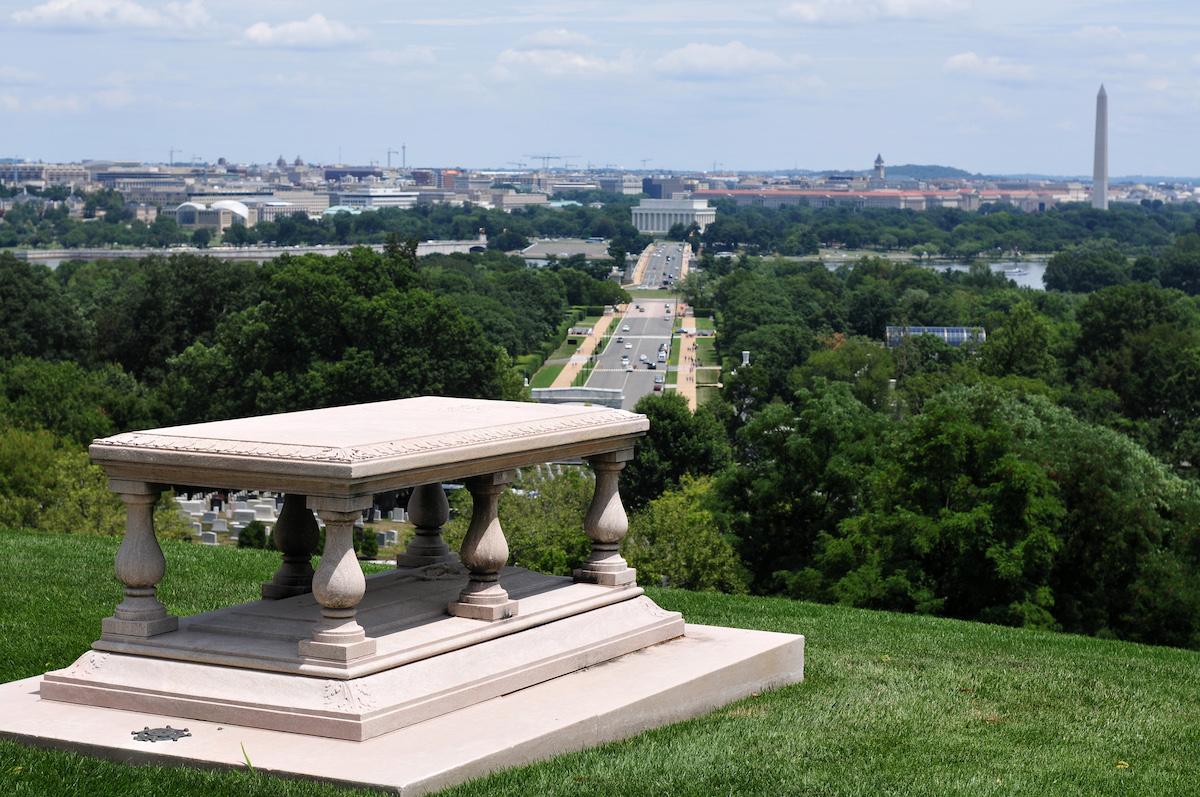
On the occasion of the re-dedication of
Major Pierre Charles L'Enfant's
historical marker
You are invited to attend a
WREATH-LAYING CEREMONY
TUESDAY, JUNE 14, 2022 AT 2:00PM
at
Arlington National Cemetery
Monument of Major Pierre Charles L'Enfant
Arlington House
One Memorial Drive
Arlington, VA 22211
This ceremony will be held in the presence of State, diplomatic, military and cultural representatives of France and the United States (to be announced),
with the anticipated participation of representatives from the following patriotic organizations:
- The Society of the Cincinnati
- The Sons of the American Revolution
- The Tomb of the Unknown Soldier Foundation
- The Society of Honor Guard / Tomb of Unknown Soldier
- The Military Women’s Memorial
- The Washington Memorial Heritage
- The Washington - Rochambeau Revolutionary Route (W3R)
- The American Friends of LaFayette
- The LaFayette Trail
- The Federation of French War Veterans
- The Association of French Reserve Officers in the United States
- TheFrenchWillNeverForget.org
FOR MORE INFORMATION, PLEASE CONTACT:
|
|
SAVE THE DATE
Newport, Rhode Island
Homage to Rochambeau - July 9, 2022
Weekend "Tribute to France" - July 9-10
|
|
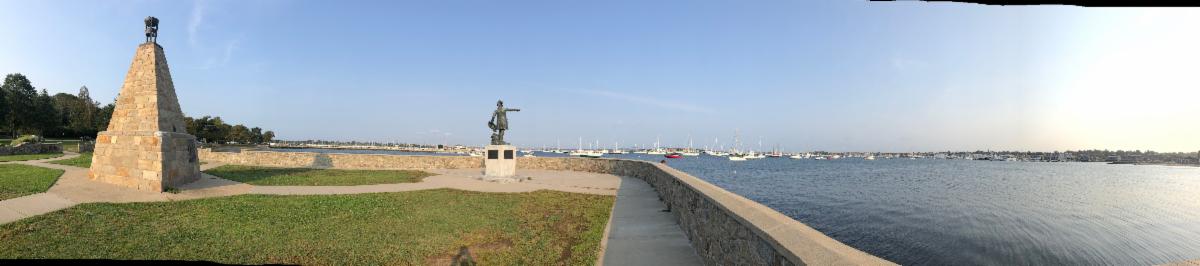
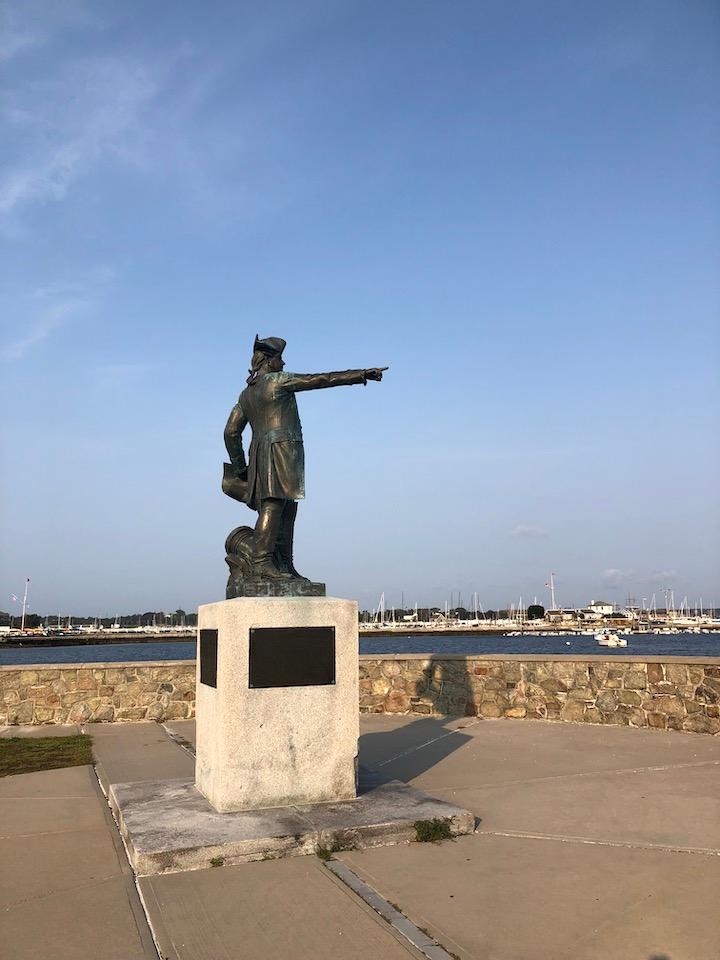
Monument to the French Fleet and Statue of Rochambeau,
Panoramic photo: Thierry Chaunu (2021)
|
|
On Saturday, July 9, 2022 at 4:00PM a ceremony will be held at the Statue of Rochambeau sponsored by Alliance Française of Newport, as part of a weekend of "Tribute to France", under the auspices of the Newport Historical Society, to celebrate the arrival of the French Army led by General comte de Rochambeau in 1780, coming to the rescue of the Continental Army.
Preliminary Schedule
-
Welcome remarks by Mr. Andrew Snook, President of the Alliance Française of Newport
- Reading of a Proclamation or Citation by RI Governor Daniel J. McKee or his representative
- Laying of wreath(s) at the Rochambeau statue/monument by the Deputy Consul General of France in Boston, Ms. Anouk Dumas and/or the Honorary Consul of France in Providence, former Lt. Governor of Rhode Island Mr. Roger Begin.
- Remarks by Jean-Baptiste Donatien de Vimeur, comte de Rochambeau (Newport Historical Society reenactor)
- Firing of cannon from ship(s) at anchor in Newport Harbor, including 91’ Schooner Tree of Life (flying the French fleur de lis flag).
|
|
OUR MISSIONS:
• To preserve the memory of the French soldiers, sailors and airmen who gave their lives for freedom, and who are buried in the United States.
• To honor French Citizens who did great deeds in the United States, or with a strong connection with the United States,
• To promote the appreciation for French culture and heritage in the United States, and the ideals that unite our two nations, in order to pass the torch of memory to younger generations.
• To strengthen the long-standing traditional bonds of friendship between the American and French peoples, and to this end: erect or maintain memorials and monuments and encourage historical research, public presentations and publications in the media.
We are looking to expand our geographic coverage with Regional Delegates in cities such as Austin, or Houston (SouthWest), New Orleans (Louisiana), Savannah, Jacksonville or Miami (SouthEast), Boston or Newport (New England).
The American Society of Le Souvenir Français, Inc. is an independent American corporation, apolitical, established in 1993 in NY, with 501 (c) 3 non-profit status.
|
|
Did you know that a portion of every purchase you make on Amazon can benefit American Society of Le Souvenir Francais Inc, at no cost to you?
Simply go to: smile.amazon.com, designate American Society of Le Souvenir Francais Inc. as your beneficiary, and shop away
|
|
Help us implement several historic commemorative projects celebrating the 244-year-old Franco-American friendship and alliance! |
|
The American Society of Le Souvenir Français, Inc. is a registered NY State non-profit corporation and has full IRS tax exempt 501(c)3 status. All donations are tax deductible.
Contact: Thierry Chaunu, President
697 Third Avenue #341 New York, NY 10017
|
|
|
|
|
|
|