October 16, 2023

Top stories


Press freedom


CRAFT

Why journalists should regularly audit what personal info is online

“Journalists living in the United States are highly likely to have a lot of personal data about them available online in public databases. This may include their address, personal phone number, and the names of relatives. This data is made easily searchable by people finder sites, which abusers can use to locate, contact, and doxx journalists. To reduce the risk of journalists’ personal information being made public and used to harass and intimidate them, they should consider signing up for services that remove their data from such sites. Common services include DeleteMe or Privacy Duck. Online attackers will often go after close family members, so it is a good idea to sign them up too. Be aware that it may take several months for your data to be removed. Review your online profile every three-to-six months to ensure data is being taken down.”


-- Coalition Against Online Violence, “Secure your online data”

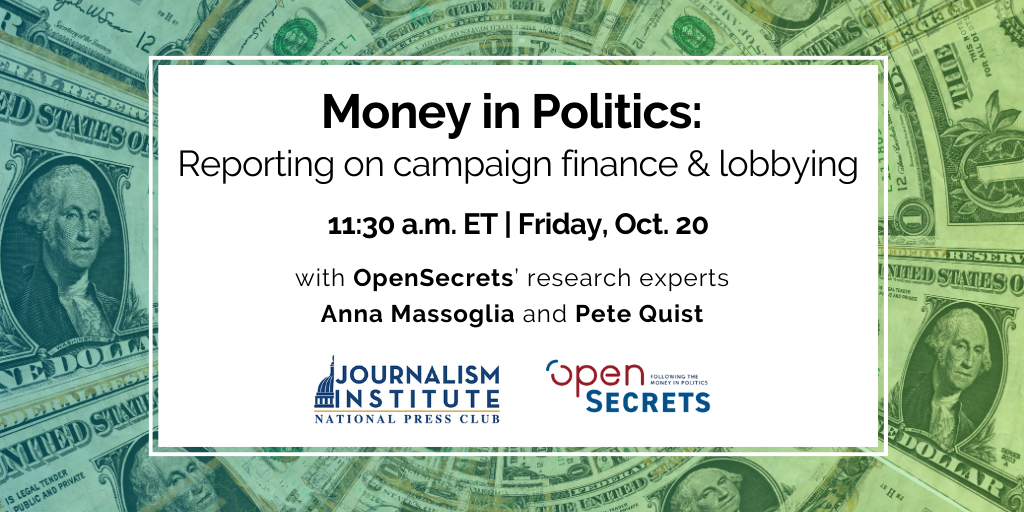
Money in Politics: Reporting on campaign finance and lobbying

Money in Politics: Reporting on campaign finance and lobbying. Webinar from the National Press Club Journalism Institute & OpenSecrets. Oct. 20 at 11:30 a.m. ET.

Political spending is expected to reach record-breaking heights in the coming year.


Journalists will play a crucial role in informing the public about who and what organizations are funding candidates, ballot measures, and policy debates in Washington, D.C., and state capitals across the country. But campaign finance and lobbying laws are complex and often opaque, posing challenges to journalists assigned with tracking money in politics and the lobbying beat.


To help you with your reporting, the National Press Club Journalism Institute and the nonpartisan research group OpenSecrets are hosting a training on the basics of how to cover campaign finance and lobbying. We invite you to join us for this hour-long session that will take place at 11:30 a.m. ET on Friday, Oct. 20.

REGISTER NOW

The training will be taught by OpenSecrets’ research experts Anna Massoglia, editorial and investigations manager, and Pete Quist, deputy research director. Participants will:


  • Learn how to use the OpenSecrets’ national and state databases to identify who and what organizations are contributing to politicians and their campaigns
  • Understand the ways that money is funneled into politics, including candidate advocacy groups, political action committees, dark money, and direct donations
  • Develop skills to uncover which individuals, companies, labor unions, trade associations, and other organizations spend on lobbying
  • Gain story ideas for the national and state politics-in-money angle


All registered participants will receive a copy of the recording.

CAREER


On balancing personal experience and expression


“Your personal experiences cannot on their own disqualify you from covering a story. We start from the presumption that all journalists are capable of upholding our standards of fairness and accuracy, even when they have close ties to an issue. As an individual journalist, if you question your own ability to be fair, discuss this with your supervisor. When sharing your personal beliefs, be aware that they may color the way others perceive your work and the newsroom you represent. Remember, you don’t have to post on social media.”


-- Kelly McBride, SVP and chair of the Craig Newmark Center for Ethics and Leadership at Poynter Institute, “When journalists find demonstrators’ views personally offensive”


COMMUNITY

Resources

This newsletter is written & edited by the National Press Club Journalism Institute staff: Beth Francesco, Bara Vaida, and Holly Butcher Grant. Send us your questions and suggestions for topics to cover.


Get this from a friend? Subscribe, and view the archives.

Facebook  Twitter  Linkedin  Youtube  

The National Press Club Journalism Institute promotes an engaged global citizenry through an independent and free press, and equips journalists with skills and standards to inform the public in ways that inspire a more representative democracy. As the non-profit affiliate of the National Press Club, the Institute powers journalism in the public interest.