|
Friends,
As part of our four-school Spartan Spark series celebrating the academic innovation shaping the future of St. Thomas Aquinas College, today we spotlight the School of Arts & Social Sciences, where the enduring strength of the liberal arts is intentionally aligned with the demands of a rapidly evolving workforce.
In programs such as criminal justice, psychology, communication arts, therapeutic recreation, and the applied humanities curriculum, students develop the communication, critical thinking, and leadership skills employers value most. In today’s technology-driven economy, however, a rigorous liberal arts education must also be future-focused.
That is why SASS is redefining what a liberal arts education can — and must — become. As part of its bold vision for a College of the Future, STAC is launching the SASS Edge, a pioneering 21st-century model that fully integrates academic rigor with career readiness and lifelong learning. More than ever, today’s students need real-world experience, adaptable skills, and meaningful mentorship to lead with purpose in an environment of constant change. The SASS Edge delivers on all three — equipping graduates not just with knowledge, but with personal confidence and marketable credentials.
Our distinguished faculty equip students to thrive in an ever-evolving world. Our curriculum challenges students to think critically about the role of technology — including AI — in art, media, public policy, and society, examining not only how these tools can be used, but how they should be used. This powerful fusion of timeless liberal arts principles with the tools and careers of tomorrow embodies our bold College of the Future vision.
Students experience this vision in action through initiatives such as our upcoming “STAC Your Future Week” for the School of Arts & Social Sciences. Throughout the week, students will engage with industry leaders, participate in resume workshops and networking sessions, and connect with employers at our Job and Internship Fair. These experiences connect classroom learning with real opportunity and help students ignite their passions while preparing for meaningful careers.
A signature panel of the week, “Public Purpose, Real Careers: Government and Nonprofit Pathways”, features leaders from organizations such as Rockland Works and the Center for Safety and Change alongside faculty affiliated with our Master of Public Administration (MPA) program. The panel reflects the same mission that guides our redesigned MPA program: preparing principled, mission-driven leaders for impactful careers in government and nonprofit organizations.
Experiential learning begins early and continues throughout the four years on campus. Faculty-mentored research, internships, and community partnerships connect classroom learning with real impact. Communication Arts students partner with organizations like Meals on Wheels to create outreach campaigns that serve our community while building professional portfolios. Students also gain valuable hands-on experience working with entrepreneurs and small businesses through the Lower Hudson Valley Small Business Development Center (SBDC), located on our campus, further strengthening the connection between academic learning and real-world problem solving.
Beyond the classroom, the School serves as a regional hub for civic, creative, and scholarly leadership. At the Azarian McCullough Art Gallery, students curate exhibitions, manage collections, and learn the business of the arts while welcoming the community to campus. In the Sullivan Theatre, students lead productions, design sets, manage marketing, and perform for regional audiences.
Through the Loyalist Institute, made possible by a $229,000 grant from The Robert David Lion Gardiner Foundation, students engage in hands-on historical research tied to the upcoming 250th anniversary of the United States. Working with original archival documents and digital humanities tools, they collaborate with museums and historical societies while helping bring the history of the American Revolution in the Lower Hudson Valley and Long Island to life for new audiences.
Our Therapeutic Recreation program also demonstrates the strength of SASS, with graduates achieving a 100% job placement rate in a field that continues to grow as healthcare and community organizations recognize the importance of recreation and wellness in improving quality of life. Together, these programs and initiatives demonstrate how the School of Arts & Social Sciences prepares confident communicators, thoughtful problem solvers, and ethical leaders ready to shape their communities and thrive in the careers of tomorrow.
Explore the School’s momentum at a glance here.
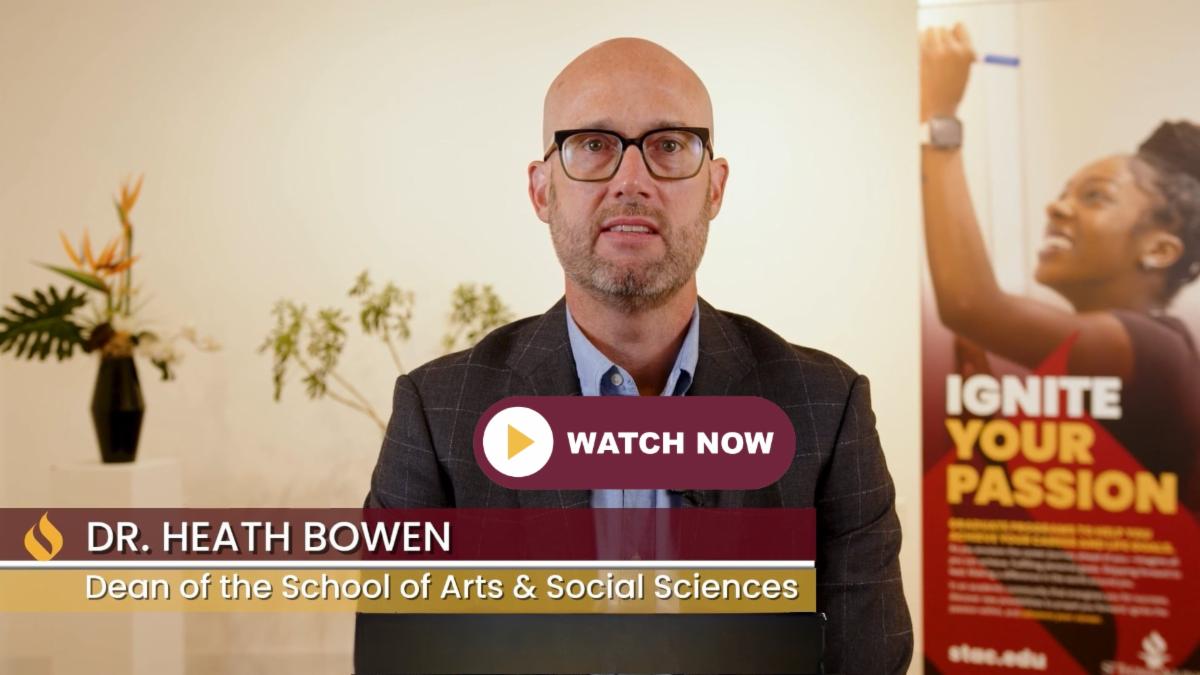
I will close by sharing a message from our Dean of Arts & Social Sciences, Dr. Heath Bowen, part of Ignite What’s Next, as each of our Deans speaks directly to their future students — encouraging them to consider one powerful question: Where will your passion take you?
|