The Capital Stack

June 18, 2026 | BWE Arizona | Putting clients first. Trusted to be part of their future.


Outlier Pricing

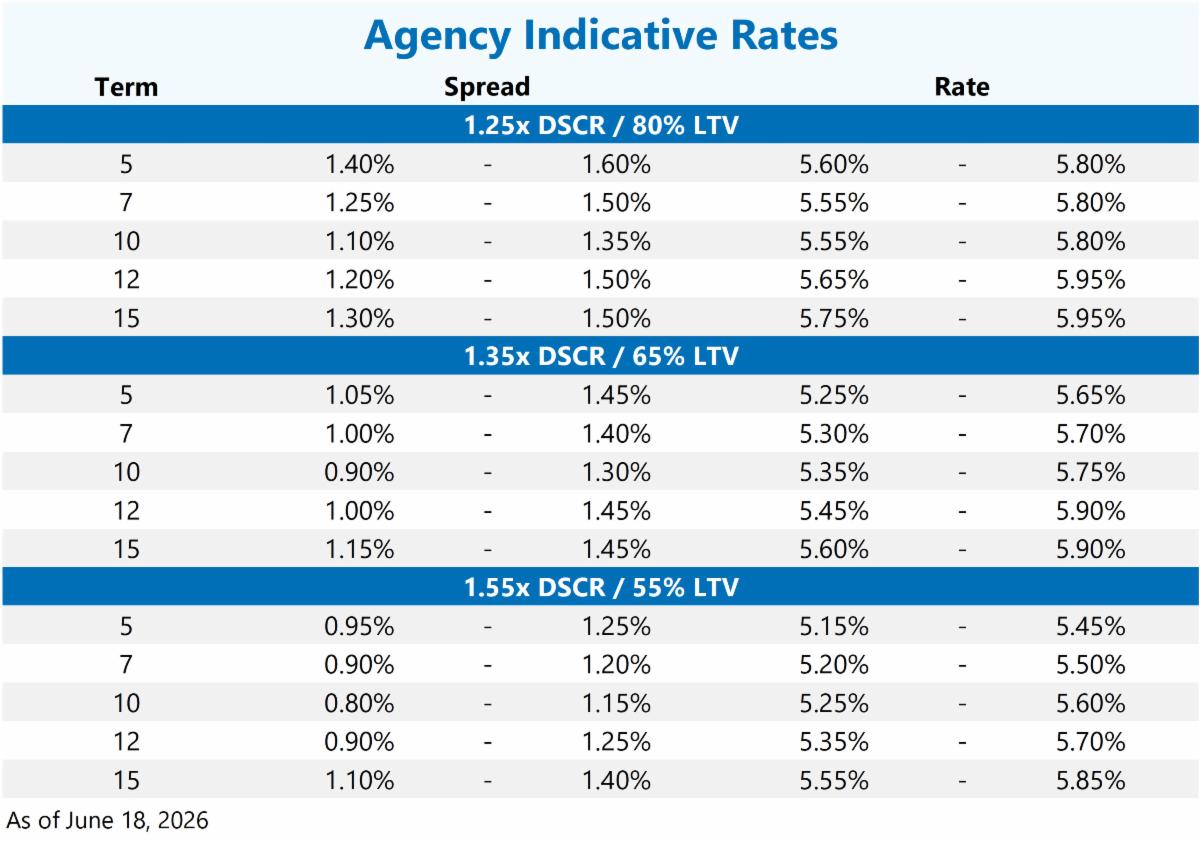
Agency

Life Company

5.25%

0.80% + 10yr UST

Low leverage multifamily refinance

5.65%

1.20% + 10yr UST

Low leverage multifamily refinance


Market Commentary

Key takeaways

The overall capital markets backdrop remains reasonably constructive, but the Fed introduced a more cautious outlook than investors anticipated. The environment remains supportive of well-capitalized multifamily and workforce housing sponsors, but the narrative has shifted from "When will rates fall?" to "How long will rates stay high?" That subtle change is likely the most important takeaway from the June FOMC meeting.


The Fed held rates steady

The Federal Open Market Committee unanimously voted to maintain the Federal Funds Rate at 3.50%–3.75%, as widely expected. However, the meeting produced a notably hawkish message than investors anticipated.


Key observations:

  • Chairman Kevin Warsh's first FOMC meeting emphasized inflation control rather than economic accommodation.
  • The Committee stated that inflation remains elevated and reiterated its commitment to restoring inflation to its 2% target.
  • Updated Fed projections suggest policymakers are increasingly open to additional tightening if inflation fails to improve.
  • The Fed removed much of the forward guidance investors had become accustomed to under previous leadership, signaling a more data-dependent policy framework.


The bottom line is that the June meeting was not a rate-cut meeting. It was a credibility meeting. The Fed's message was clear: inflation remains the primary concern and policymakers are not yet comfortable declaring victory.


Interest rate outlook has become more uncertain

Prior to the meeting, markets began to anticipate additional easing later in the year following several encouraging inflation reports.


Following the FOMC meeting:

  • Treasury yields moved modestly higher.
  • Markets reduced expectations for future rate cuts.
  • Discussions of a potential rate increase later in 2026 have re-emerged.
  • Bond investors are reassessing the "lower rates ahead" narrative that had been building during the past month.


The bottom line is the market is no longer debating when rate cuts begin. It is now debating whether the next move is a cut or another hike. For commercial real estate borrowers that distinction matters. While financing conditions remain stable, expectations for rapidly declining borrowing costs have been pushed further into the future.


Credit markets continue to function normally

Despite increased rate uncertainty, broader credit markets remain constructive.


Key observations:

  • Corporate bond spreads remain relatively tight.
  • Institutional investors continue allocating capital to credit strategies.
  • Construction lenders, bridge lenders and mezzanine providers remain active.
  • Equity fundraising conditions remain challenging but stable.


This suggests investors remain concerned about inflation, but not concerned about financial system stress.


Themes that emerged from the FOMC meeting

  • Inflation is still public enemy number one. The committee repeatedly emphasized that inflation remains above target and pledged to "deliver price stability."
  • The Fed is less interested in providing forward guidance. Warsh intentionally moved away from giving markets a roadmap for future policy decisions. The new approach appears to be, “Watch the data. We will react accordingly."
  • Surprise: A 2026 rate hike is back on the table. While no hike was announced, updated projections and Warsh's comments suggested that several policymakers now view additional tightening as possible if inflation remains stubborn.


Geopolitical risk has moderated (for now)

The U.S.–Iran agreement and expected reopening of the Strait of Hormuz remain constructive developments for global markets. Oil prices have retreated from their recent highs, reducing immediate concerns about an energy-driven inflation shock.


Why it matters:

  • Lower oil prices reduce inflation pressure.
  • Reduced inflation pressure lessens the need for additional monetary tightening.
  • Improved geopolitical stability supports capital formation and transaction activity.
  • While the situation remains fluid, markets are currently interpreting developments as a net positive for risk assets and commercial real estate capital markets.
 

Agency

Floating-rate demand picks up as DUS volumes rebound: Agency CMBS markets continued to see overall light supply volumes last week, though the demand profile remained consistent. New issue Fannie Mae DUS/MBS rate locks picked up to over $880 million last week, more than double the prior week. The volume was led by block-sized transactions of $25 million or more. Smaller transactions, particularly those less than $10 million, were less frequent last week and continued to see less robust demand from investors.


Credit spreads marginally tightened last week, though spreads have been largely flat over the past month. Notably, investors commented that floating-rate paper was drawing increased inquiries from lenders though very few Fannie Mae SARM transactions have been priced year-to-date. A ~$70 million Fannie Mae SARM rate-locked last week, and Freddie Mac issued several floating-rate Multifamily Participation Certificates (Multi PC, a similar product to Fannie Mae DUS/MBS) in recent weeks. Corporate credit spreads across the CDX Investment-Grade 5-year Index and Bloomberg Single-A Industrials 10-year Index tightened 2-3 bps over the week.


Fannie Mae update

  • Fannie has been more aggressive on transitional loans with limited operating history as well as loans in lease up that fit the near stabilization mold. On these transactions, Fannie’s underwritten NOI is higher vs Freddie with solid comp support and borrower budget support.
  • Fannie has been actively pursuing 5-50 unit opportunities under their Duty to Serve in Tertiary Markets at this time. The FHFA is pressing them to grow the servicing book for business that checks this box so expect them to lean in on pricing by 5-10 bps.
  • Fannie is focused on affordable/MAH loans. They are behind on affordable/preservation goals, so expect them to lean in on pricing here as well.


Freddie Mac update

  • Freddie continues to provide strong quotes for larger sized loans (+$20MM) on acquisitions and refinances with stable operating history.
  • Spreads continue to hold strong before buydowns
  • 5 yr = 140-160 bps gross
  • 7 yr = 130-150 bps gross
  • 10 yr = 115-135 bps gross
  • Carolinas abatement issue: Freddie has gone pencils-down on abatement underwriting in NC/SC. Guidance:
  • Loans without affordability restrictions → treated conventional (so, no abatement and full RET).
  • LIHTC → case-by-case.
  • Refinances more likely to be accepted than new applications.
  • Overall, these abatements create a real challenge for new LIHTC loans in those states.


Loan highlights


Fannie Mae manufactured housing community refinance

  • $8.5 million
  • 55% LTV / 1.55x DSCR
  • 10-yr term / 5 yrs IO
  • 104 bps spread w/ option to buy down to 78 bps spread


Fannie Mae multifamily near-stabilization

  • $35 million
  • 70% LTV / 1.25x DSCR
  • 10-yr term / 5 yrs IO
  • 122 bps spread
 

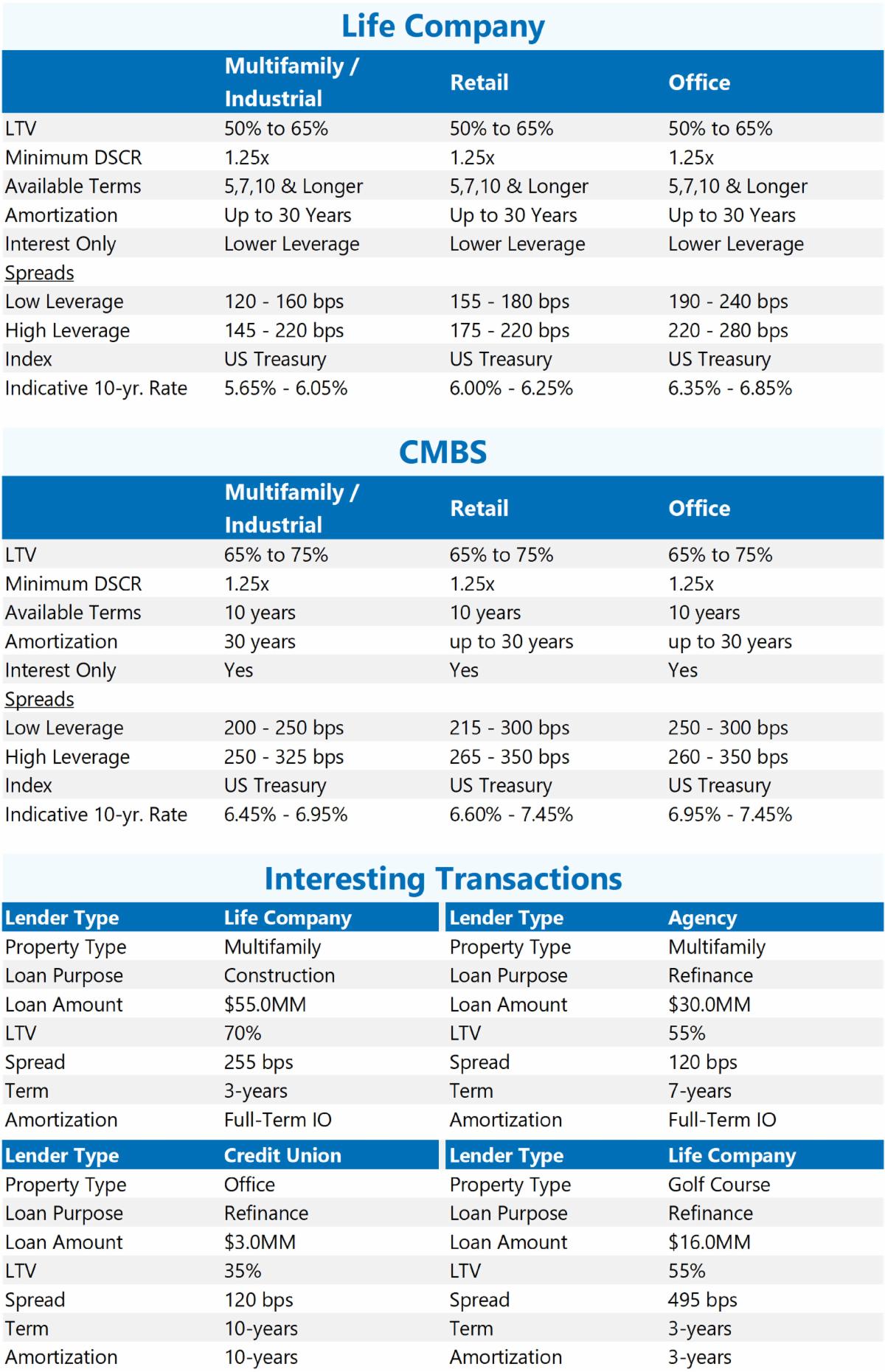
Life Company

Life Company origination activity has held steady over the past two weeks with lenders reporting a consistent inflow of loan requests. Lenders continue to quote opportunities aggressively, with spreads generally ranging between 130–180 basis points for quality properties in good locations.


Outlier pricing for desirable properties in primary markets with strong sponsors continues to come in 20–30 basis points lower. With substantial capital still to deploy, lenders remain willing to improve loan metrics and tighten spreads to win large or highly sought-after opportunities.


Index floors remain in widespread use as a hedge against intra-day UST movement tied to FOMC and geopolitical headlines. Lenders continue to express a preference for 10-year and longer loan terms, though there is abundant capital for shorter-term fixed and floating rate requests.


CMBS

U.S. CMBS issuance has remained steady in recent weeks and now totals approximately $59.0 billion YTD, ahead of the $53.1 billion YoY. Conduit spreads have been largely range-bound with 10‑year AAA spreads currently at 74 basis points over Treasuries, consistent with the trailing 12‑month average of approximately 78 basis points.


Borrower spreads, likewise, have remained range-bound over the past several months. Ten‑year CMBS loans are generally pricing at 200–225 basis points over Treasuries, while five‑year CMBS loans are pricing in the low‑to‑mid 200 basis point range. For high‑quality, low‑leverage transactions, pricing can be as low as 140 basis points over Treasuries.


Multifamily assets continue to attract strong lender demand, with CMBS lenders maintaining a willingness to offer full‑term, interest‑only structures. These loans allow borrowers to maximize proceeds, with underwriting typically supporting a 1.25x DSCR on an interest‑only basis. In addition, several CMBS lenders have secured dedicated B‑buyers for multifamily‑only securitizations, enabling the introduction of “stretch senior” executions. These loans are generally priced at 180–225 basis points over Treasuries and can be sized down to a 1.20x DSCR on an interest‑only basis.


Other property types, including office, have also benefited from the availability of full‑term, interest‑only financing. However, these transactions are subject to more conservative leverage constraints, higher debt yield requirements, and tighter overall underwriting standards compared to multifamily loans.


About BWE

Bellwether Enterprise (BWE) is one of the nation's largest privately-owned real estate financing companies. Its trusted advisors combine innovation, extensive experience and strong lender relationships to optimize a loan's capital stack for commercial and multifamily investors, developers and property owners. For more information, visit BWE.com.


Opinions, estimates, forecasts and all other information contained in this document are those of Bellwether Enterprise Real Estate Capital, LLC (“Bellwether”) and should not be construed as indicating Bellwether’s business prospects or expected results. Although Bellwether attempts to provide reliable, useful information, it does not guarantee that the information or other content in this document is accurate, current, or suitable for any particular purpose. All content is provided on an “as is” basis, with no warranties of any kind whatsoever and is subject to change at any time without notice. Information in this document may not be used without permission from Bellwether. This document is not intended to be an offer to buy or sell or a solicitation of an offer to buy or sell securities, if any, referred to herein.


Bellwether Enterprise Real Estate Capital, LLC (BWE) conducts business through Bellwether Enterprise Mortgage Investments, LLC – Mortgage Banker license #BK-1007784 – the Department of Financial Institutions State of AZ (Fannie Mae transactions), as well as Bellwether Enterprise Real Estate Capital, LLC – Mortgage Banker License #BK-1007825 – the Department of Financial Institutions State of AZ (all other transactions).