Dear Angelenos,
Addressing the housing crisis has been City Planning’s most urgent priority over the last few years. While there is no “quick fix” to a deep-seated problem that has worsened over decades, I am proud to report that we made significant headway on several fronts during 2022.
First, the City adopted our ambitious Plan to House LA, as we call the latest iteration of the local Housing Element. This plan aims to accommodate nearly 500,000 housing units citywide by 2029, more than 40% of which will be reserved for lower-income residents.
We also advanced the Downtown Community Plan Update (“DTLA 2040”) to the City Council. When adopted, DTLA 2040 will streamline the approval process for projects that include affordable units, introduce a Community Benefits Program for income-restricted affordable housing, and double the land area where housing is permitted Downtown.
In addition to creating capacity, the Department has advanced stronger housing protections. Our Mello Act Ordinance institutes protections for affordable units in Los Angeles’s Coastal Zone to prevent displacement. The ordinance is crafted to ensure that every demolished housing unit in the coastal neighborhoods will be replaced by one of the same size and affordability level.
Last December, Mayor Karen Bass made her commitment to housing Angelenos clear by declaring a state of emergency as her first action in office. We look forward to working with Mayor Bass and the City Council to make the housing crisis a thing of the past. Together, we are Planning4LA.
Sincerely,
|
|
Vince Bertoni,
Director of Planning
|
|
|
|
On February 28, the public order on tolling expired. Implemented during the height of COVID-19, the order paused the City’s time to act on most planning entitlements and legislative items and provided individuals with entitlements more time to utilize their existing approvals.
The tolling order was initiated to accommodate the public at a time when in-person meetings and hearings were not possible, due to Federal and State guidelines on social distancing. Under Mayor Karen Bass’ Executive Directive 1, the City’s time to act on land use ordinances, entitlement applications, appeals, and timelines prescribed under the Cultural Heritage Ordinance will begin again on March 1, 2023. The City Council will have until May 12 of this year to act on items prescribed 75 days to act in the Los Angeles Municipal Code (LAMC), while having until May 26 to act on items prescribed 90 days to act in the LAMC.
City Planning has issued a Department Memorandum outlining the implications of the end of the tolling order, including information about time extensions that are available for the effectuation and utilization of qualifying planning approvals.
|
|
|
|
Mayoral Executive Directive 1: Temporary Shelters and Affordable Housing |
Mayor Karen Bass issued Executive Directive 1 (ED 1) to address the housing and homelessness crisis in Los Angeles. ED 1 expedites the processing of shelters and 100% affordable housing, with eligible projects subject to a streamlined ministerial approval process.
Some of the features of the ED 1 ministerial approval process include reduced project timelines and filing fees, simplified procedures, and concurrent review, among other benefits. City Planning, along with the Housing Department and the Department of Building and Safety, produced implementation guidelines to assist eligible applicants.
The ED 1 implementation guidelines outline the steps, procedures, and requirements for projects using the ED 1 ministerial approval process. In the coming weeks, the City will unveil additional information on its website.
|
|
|
|
In accordance with Mayor Bass’s Revised COVID-19 City Updates Memo, Brown Act bodies will resume meeting in person as of March 1. As City Planning staff noted important growth and depth of participation once we began virtual meetings, City Planning will conduct meetings in a hybrid format that preserves the option for remote participation for public comments. Commissioners and board members will attend in person, as will applicants, appellants, and staff members.
City Planning’s Brown Act bodies comprise nine commissions (the City Planning Commission (CPC), the Cultural Heritage Commission, and seven area planning commissions), 21 Historic Preservation Overlay Zone (HPOZ) boards, 12 design review boards, and one plan review board. Of these bodies, only CPC will meet in the City Council chambers in Downtown and Van Nuys, which are outfitted with specialized audiovisual equipment.
While the meetings of the area planning commissions, design review boards, CPC, and HPOZ boards will adopt a hybrid model, please note that the Office of Zoning Administration, hearing officer, and subdivision public hearings will remain fully virtual.
|
|
|
|
Updated Guidance on the Implementation of the Housing Crisis Act of 2019 |
The Housing Crisis Act of 2019 was enacted through Senate Bill (SB) 330 (2019), establishing a statewide temporary housing emergency in order to preserve existing affordable housing, enhance protections for occupants, and increase certainty during the development review process. Following two years of implementing the HCA in the City of Los Angeles, the first major legislative clarification of the HCA went into effect this year under SB 8.
For information on HCA implementation within City Planning processes, contact Planning.HCA@lacity.org. For answers to questions regarding HCA administration for housing development projects not associated with a City Planning application, contact the Los Angeles Department of Building and Safety Plan Check engineer assigned to the project in Plan Check, or email LADBS.AHS@lacity.org about projects not already in Plan Check.
|
|
|
|
Assembly Bill 2097 Implementation |
In December, City Planning issued a memo on the implementation of Assembly Bill (AB) 2097, a State law that prohibits cities from imposing a minimum automobile parking requirement on most development projects within a half-mile of a major transit stop.
AB 2097 was established to reduce housing costs by eliminating expensive parking mandates for homes and commercial buildings near transit, or in neighborhoods with low rates of car use. In California, a single parking spot can add $40,000 or more to a project’s overall construction costs.
In specific instances, local agencies may impose parking requirements on eligible development projects, provided findings are made within 30 days of filing an application. The Department’s web-based mapping tool, the Zone Information and Map Access System (ZIMAS), displays whether parcels are subject to AB 2097 in the “Planning and Zoning” menu.
|
|
Al Fresco Ordinance Public Hearing |
|
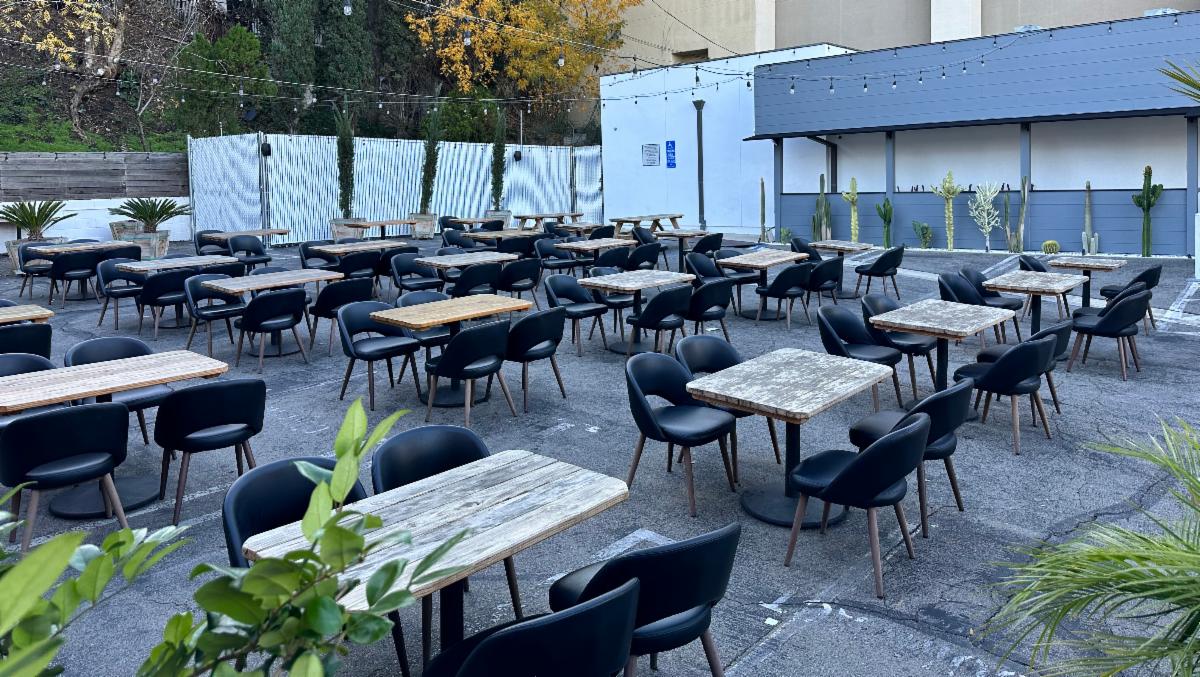
On February 8, the Department held a virtual hearing on the Al Fresco Ordinance to give business and neighborhood stakeholders an opportunity to provide additional feedback. More than 250 participants, including representatives from the business community, attended to voice support for making outdoor dining permanent.
At the beginning of the COVID-19 pandemic, the City enacted temporary emergency orders to support the hospitality industry, which was dramatically impacted by the pandemic’s public health restrictions. These emergency actions established the temporary L.A. Al Fresco program, which authorized outdoor dining areas and temporarily suspended certain Municipal Code regulations. Al Fresco created a lifeline for many local businesses during the pandemic. In an effort to make outdoor dining permanent in Los Angeles, City Planning is proposing an ordinance that would amend existing Zoning Code regulations to provide more flexibility for restaurant operators to offer outdoor dining through a streamlined approval process.
Revisions to the draft ordinance currently underway aim to establish a simple and streamlined process for current Al Fresco participants and create a framework for future participants as well. City Planning anticipates releasing a revised ordinance at the end of March in order to advance a final ordinance to the City Planning Commission later this spring.
|
|
City Planning Meets with the L.A. City Youth Council |
|
This month Chief Sustainability Officer Shana Bonstin met with the Mayor’s Youth Council on Climate Action to share sustainability approaches City Planning incorporates in the workplace. Members of the Youth Council include students from across Los Angeles, each with a shared interest in identifying climate action solutions affecting young people in the City.
During the meeting, Bonstin shared City Planning’s values on sustainability, equity, and community-driven solutions. Some of the tangible ways City Planning has worked toward a more resilient LA include developing policies, such as the Clean Up Green Up Ordinance and the Wildlife Ordinance, and championing environmental justice through the recent passage of the Oil and Gas Drilling Ordinance, which bans future oil drilling and extraction.
Youth council members expressed continued enthusiasm for community-driven decision making, collaboration with tribal governments, and more environmental justice endeavors.
|
|
City Planning Commission Presentation on State Legislation |
|
On January 12, Senior City Planner Matthew Glesne made a presentation to the City Planning Commission (CPC) on behalf of the Citywide Policy team. He reviewed recent State-level legislation on housing and planning and answered commissioners’ questions.
During his presentation, Glesne presented on changes to California’s Density Bonus incentives and described how they will affect local rules. Among other bills, he discussed how AB 2334 expands existing incentives for 100% affordable housing projects to areas with very low vehicle travel; he explained how AB 2334 redefines “maximum allowable residential density,” the calculation which determines a project’s base density and bonus, to be the most generous of the General Plan, Specific Plan, or zoning designations applied to any single parcel of land.
Glesne also discussed State laws offering Density Bonus for non-residential commercial projects, allowing affordable housing construction on sites with new and existing religious uses, in addition to permitting housing in areas that are zoned for retail, offices, and parking.
|
|
OFFICE OF RACIAL JUSTICE, EQUITY, AND TRANSFORMATIVE PLANNING |
|
The Office of Racial Justice, Eequity, and Transformative Planning has been on a mission to improve City Planning’s internal operations and make its workplace practices more equitable. To that end, the Office is working on several internal initiatives to shift workplace culture. It is working to identify cultural sensitivity and leadership training sessions for City Planning staff, develop procedures to address hate speech and other forms of disruptive behavior during public hearings, and create more inclusive outreach strategies. Implementing these internal initiatives will be key to laying the groundwork for a Strategic Framework Plan that will require extensive community engagement to address the legacy of racism that is present in Los Angeles’s land use policies and practices.
In addition to these internal initiatives, the Office has been actively collaborating with policy teams throughout the Department. The Office provided key input on equity considerations related to workforce housing, the citywide Housing Element, the Oil and Gas Drilling Ordinance, and the soon-to-be-released draft of the Deemed Approved Ordinance for alcohol-serving establishments. It will also be working with the Citywide Policy team on cross-departmental efforts to integrate equity into long range planning. In the coming months, the Office will have more to share, especially with respect to its Strategic Framework Plan.
|
|
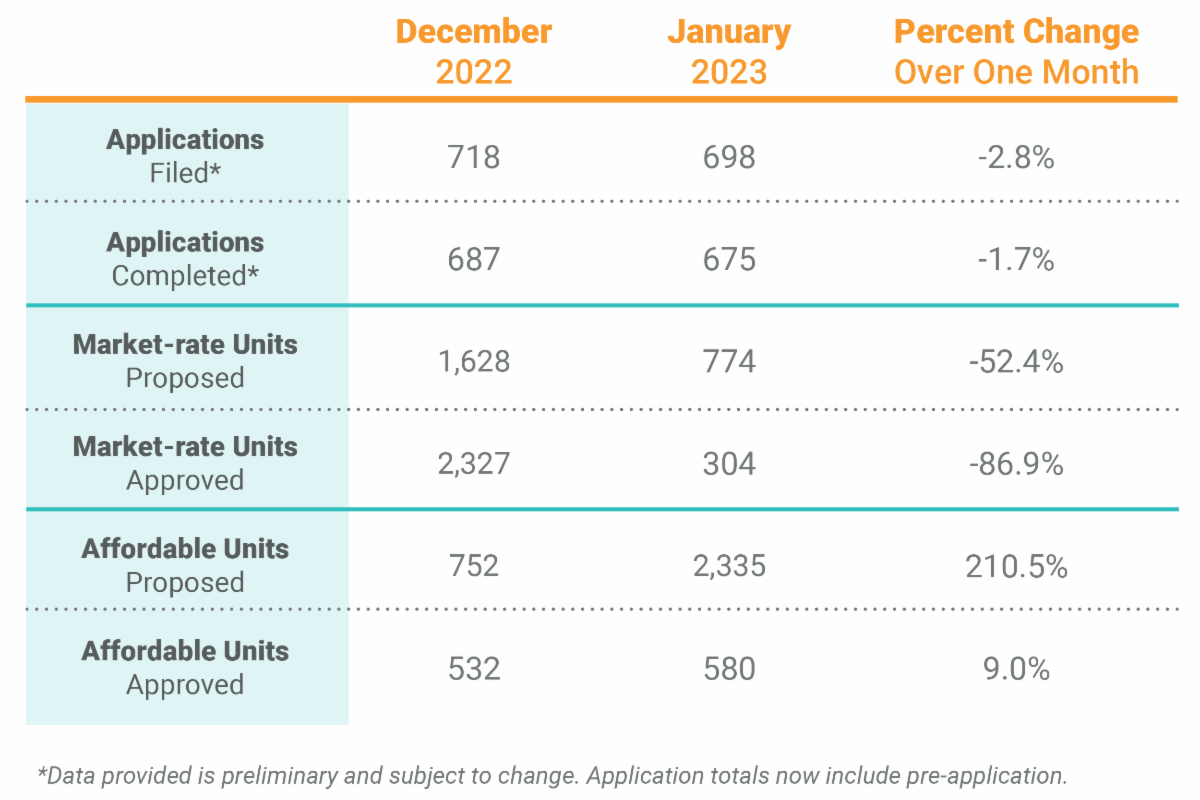
Between December 2022 and January 2023, City Planning processed 698 new applications for planning approval and completed 675 requests for approval. There were 774 market rate housing units proposed in January, representing a 52% decrease month-over-month. However, the number of affordable units proposed increased significantly, jumping from 752 units in December to more than 2,300 units in January. This represents a 211% month-over-month increase, and is a strong indication that affordable housing units are continuing to be added to the City’s development pipeline. |
|
|
|
- Transmitted Letter of Determination, Final EIR (FEIR), and CPC's recommended Community Plan to the Mayor and City Council for adoption on September 27, 2022
- City Planning Commission recommended the plan and new zoning for approval in September 2022
- Released revised materials in advance of City Planning Commission hearing, including Zoning, Plan Text, Land Use Map, and Community Benefits Program, in June 2021
|
|
|
|
- Preparing to finalize Draft Zoning and Draft EIR for the Harbor LA Community Plans Update in 2023
- Harbor LA Plans Virtual Outreach anticipated early 2023
- Released informational New Zoning code video in November 2022 and held Planning Harbor LA Plans Virtual Office Hours Outreach for late fall in December 2022
- Released the Preliminary Draft Plans (updated policy documents) for Harbor Gateway and Wilmington-Harbor City in May 2022
- Released Harbor LA StoryMap with new zoning information in December 2021
|
|
|
|
- Working toward releasing draft General Plan Land Use Map in the second half of 2023
- Conducted outreach for Ventura-Cahuenga corridor in summer/fall 2022
|
|
|
|
- Preparing draft Zoning and EIR for the Southwest Valley Community Plans Update
- Held Virtual Office Hours in June 2022
- Released General Plan Land Use Designations and informative StoryMap with proposed zoning in May 2022
|
|
|
|
- Preparing revised General Plan Land Use (GPLU) Maps, Storymap, Plan Policy Documents, and New Zones
- Preparing to host WCPAG first meeting in April 2023
- Communicated with existing Advisory Group members in November and December 2022 to prepare for upcoming meetings
- Announced the formation of the Westside Community Plans Advisory Group through a letter in November 2022
- Rolled out Westside Community Plan Advisory Group (WCPAG) application in May 2022
|
|
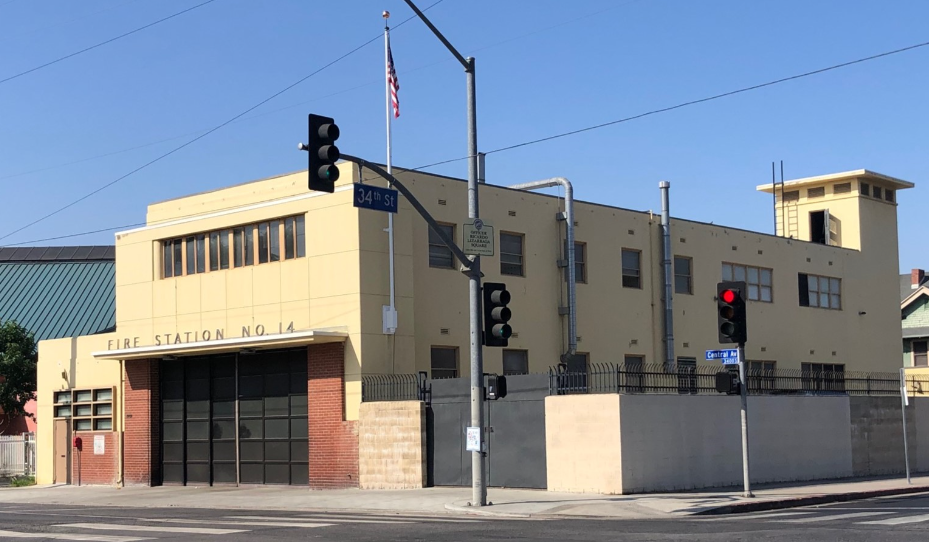
Fire Station No. 14
3401 S. Central Avenue
|
|
Fire Station No. 14 in South Los Angeles housed the second of the City’s two forcibly segregated, all-Black fire companies (the first being No. 30 at 1401 Central). The Los Angeles Fire Department’s (LAFD’s) “separate but equal” policy of strictly limiting African American firefighters to two stations reflected a pervasive culture of systemic racism.
Employment and promotion of Black firefighters were dependent on vacancies at the two stations, and the rank of captain was the highest they were ever able to attain. This system began to change by the late 1940s, when firefighters from Stations 30 and 14, assisted by the L.A. Urban League and, later, the National Association for the Advancement of Colored People (NAACP), began demanding investigations of LAFD’s segregationist practices.
The landmark 1954 Supreme Court decision Brown v. Board of Education increased momentum for integration in institutions nationwide. LAFD was no exception, and by 1956, it began integrating in earnest. A 1974 federal consent decree required LAFD’s personnel to reflect the City’s diversity accurately after it was found that only 3% of firefighters were Black.
|
|
956-966 South Vermont Avenue
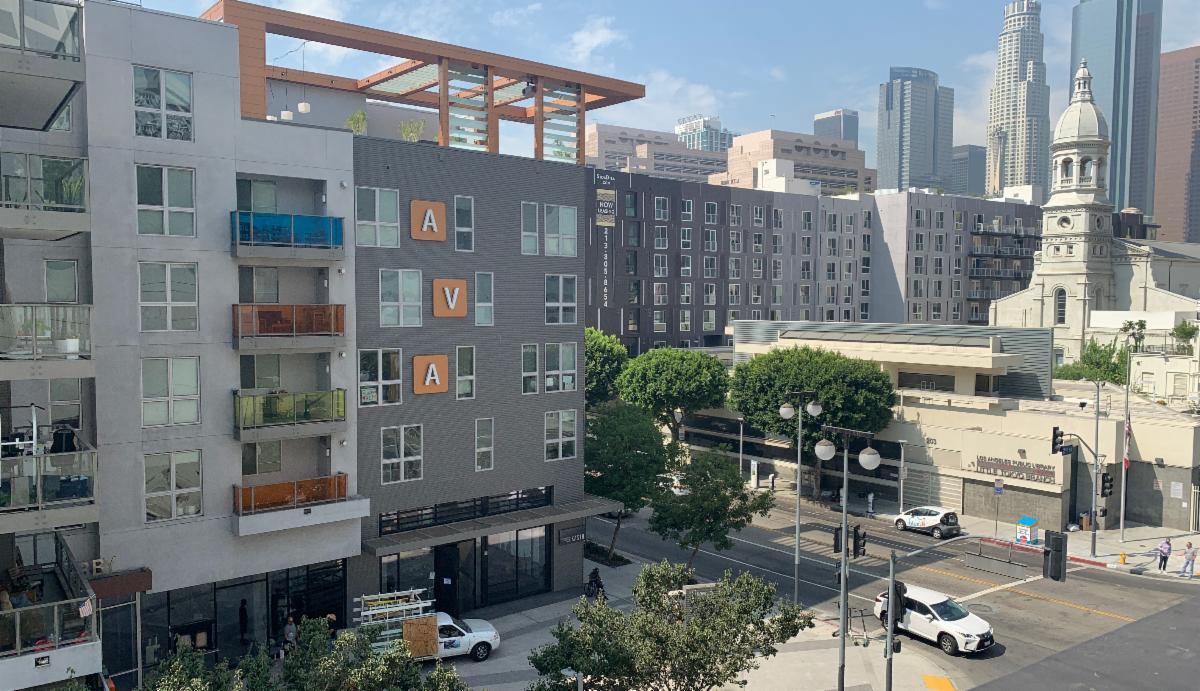
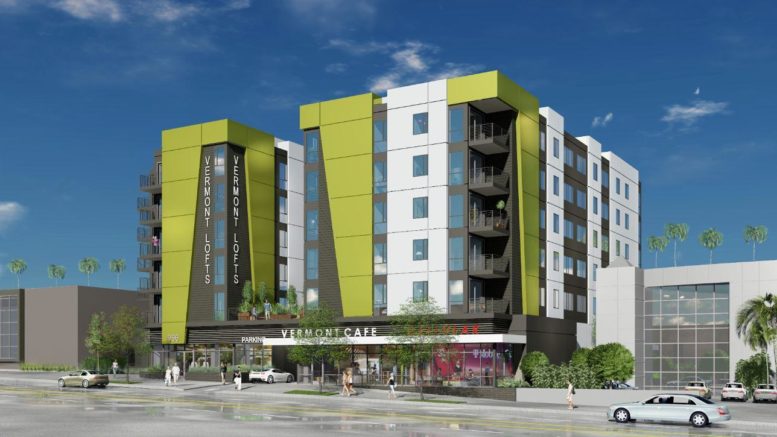
In February, the City Planning Commission approved the construction of a new six-story mixed-use building at 956-966 South Vermont Avenue in the Wilshire Community Plan area.
The proposed project is an eligible Tier 3 Transit Oriented Communities (TOC) project due to its proximity to a major transit stop at the intersection of Olympic Boulevard and Vermont Avenue.
The new development will contain 90 residential units above approximately 2,915 square feet of commercial space on the ground floor, and will provide over 7,200 square feet of open space. Of these, nine units, or 10% of the total, will be set aside for Extremely Low-Income households (households earning upwards of $35,750, for a family of four) for a period of 55 years.
|
|
March City Planning
Commission Meetings
|
|
|
March Area Planning
Commission Meetings
|
|
Central: March 14, 28
South Los Angeles: March 7, 21
South Valley: March 9, 23
West: March 1, 15
East: March 8, 22
Harbor: March 7, 21
North Valley: March 2, 16
|
|
March Cultural Heritage
Commission Meetings
|
|
|
LOS ANGELES
CITY PLANNING
|
|
Sign up to receive citywide planning updates by email
|
|
|
|
|
|
|
|
|