May 27, 2025

Top stories

■ NPR and Colorado public radio stations sue Trump White House (NPR) / ‘The case has been assigned to Judge Randolph D. Moss (DDC), who is already overseeing the Corporation for Public Broadcasting lawsuit.’ (Scott Nover)


■ Freedom of the Press Foundation threatens legal action if Paramount settles with Trump over '60 Minutes' interview (WIRED) 


■ ‘The Washington Post is announcing voluntary buyouts today targeting video, the copy desk, the opinion section, and people who've worked at the company for 10 or more years. ...’ (Ben Mullin) / ‘...They're also offered to ALL opinion section employees as it refocuses on "personal liberties and free markets." ’ (David Folkenflik) / ‘WaPo won't replace its comms chief that departed in March’ (Sara Fischer) / Biden-era racial justice conflicts echo through Washington Post (Semafor) 


■ Bloomberg rethinks diversity programs (Semafor) / Inside the identity crisis in anti-woke media (Semafor) 


■ Democrats urge Rubio, Noem to protect USAGM foreign journalists (Axios) / ‘I am angry most of the time’: Inside a small VOA cohort’s return to work (Poynter) / Steve Herman announces his retirement from VOA and his move to be executive director of the Jordan Center for Journalism Advocacy and Innovation at Ole Miss (Steve Herman)


■ Defense Secretary Hegseth puts new limits on press access at the Pentagon (NPR) / Pentagon Press Association calls Defense Secretary Hegseth’s access restrictions ‘a direct attack’ (CNN) / NPC statement on Pentagon restrictions limiting press access (National Press Club)


■ Trump Media to raise $2.5 billion in capital to buy Bitcoin (Bloomberg) 


■ Guardian grows revenue and reduces losses for year to March 2025 (Press Gazette) 


■ The hidden toll of reporting on the Sudanese civil war (Columbia Journalism Review)


■ US press freedom groups launch Journalist Assistance Network to address growing need for legal, safety, immigration resources (Committee to Protect Journalists) 


■ Knight Foundation appoints new vice president of Community Impact, announces two new strategic roles for AI and research (Knight Foundation) / Lidsky returns to Inc., Fast Company as head of editorial strategy (Talking Biz News) / The Wrap bolsters business and tech coverage, hires Roger Cheng as managing editor for business (The Wrap) / POLITICO names Dan Goldberg as senior White House editor (POLITICO) / Houston Chronicle hires Texas journalist Julián Aguilar to lead immigration coverage (Houston Chronicle) / Business Insider hires Wang as lifestyle & entertainment editor (Talking Biz News) / Ken Dilanian to serve as MSNBC’s justice correspondent and Erielle Reshef to join network as national correspondent (Deadline) 


■ 95 books have come out of this journalism professor’s class (New York Times)


■ What we know about ‘The Paper,’ the upcoming ‘Office’ spinoff (New York Times)

CRAFT

Insights from Bloomberg Law on using AI-driven data analysis in big reporting projects


Last fall, Bloomberg Law set out to track the impact of the Supreme Court’s 2021 ruling in Brnovich v. Democratic National Committee.


Following a months-long investigation, a team of Bloomberg Law journalists revealed that the ruling significantly weakened Section 2 of the Voting Rights Act, making it harder to claim a voting practice is discriminatory. To produce the deep dive, the newsroom relied on AI analysis of large sets of data, as outlined in the “data methodology” section at the end of the story. 


The Institute asked Bloomberg Industry Group Data Editor Andrew Wallender and Investigations Editor Gary Harki to share what they learned about using AI for analysis of large data sets and to shed light on ethical considerations when using this technology.


This interview has been lightly edited for length and clarity.


This deep dive seems like a major endeavor and a somewhat high-stakes use of AI technology. Did your team test out LLM analysis on smaller projects before getting to this one?

Wallender: This was the first project we’ve done like this in our newsroom. So we put a lot of work into testing and validating our methods. We also leaned heavily on experts and academics to vet our approach.


One of the most time-consuming parts of this project was the prompt engineering. We went through several rounds of prompts that we iterated on during several weeks of testing. A major focus was whether to use open-ended responses or binary yes/no responses. In the end, the binary responses were a better approach for this story but meant we had to be real precise with our language.

For instance, it wasn’t enough to ask the LLM to identify “redistricting” cases. We had to define what those looked like and specify that our definition also included challenges to at-large voting districts. Little changes in language could have big effects on the output.


We conducted several validation sessions where we took a random sample of the LLM responses and determined how accurate they were. This testing was an incredibly important part of the process and gave us confidence in our final results.


Although this was our newsroom’s first major AI-assisted investigation, we’re hopeful we’ll have more projects like this in the near future.


What are some of your main takeaways from experimenting with using AI for data analysis in this story? 

Harki: We learned a lot of lessons doing this story, the first of which is that using an LLM to create data from even a small subset of court documents is really challenging. You have to consider the consistency in which documents are filed, how they show up in the court’s filing system and the vagaries of how lawyers draft the documents themselves. It’s doable, but it’s a lot of work, and you really have to think through every step. 


The LLM was very useful, but it’s not going to tell you how a certain court files a certain type of case. You need a reporter for that.

It’s also only going to answer the question you ask it consistently with a lot of trial and error. It’s a tool. It can help with the analysis, but ultimately it can’t write analytical stories like this.


What ethical considerations were made when using a large language model (LLM), GPT-4o, to do this reporting? Does Bloomberg Law have an AI ethics code?

Wallender: We approached this project with a healthy dose of caution. We know AI can hallucinate or misinterpret questions, so we had to be completely confident in the LLM’s output. 


Part of the reason the story took so long was the amount of time we spent repeatedly testing and re-writing the prompts to ensure accuracy. It was a good exercise in being really deliberate with the language we use to define certain attributes. Checking the LLM for accuracy forced us to see our story in a new light by making us break down each definition we used and contemplating how we wanted to categorize cases that didn’t exactly match initial definitions we established.


We set predefined thresholds for accuracy so that we could be confident in the figures cited in the story. We then had a small army of reporters offer up their time to read through a random sample of cases and answer the same questions we asked the LLM, so we could assess accuracy. At least two reporters provided responses for each case. When people disagreed on answers, we scrutinized the responses and rationale to see if there was a mistake or we needed to discuss as a group the correct answer.


Thankfully, our newsroom and company as a whole are no stranger to AI. There are a number of people at Bloomberg Industry Group and Bloomberg LP who have been working with AI for years who offered us advice and best practices. Our company also has an extensive generative AI policy and requires that any use of the technology, including for this story, is approved by a committee of reviewers.


Read the first part of this interview for key takeaways from their investigation.

CAREER
 

Advice for emerging journalists: Finding value in all stories


“Don't expect to write what you love all the time. I've met a lot of early-career journalists who get discouraged because their pitches for long, beautiful features about big ideas — the ones we all want to write — get turned down, and instead they're asked to turn in pieces they're less interested in. That's just part of the job. Sometimes, you have to write pieces that you don't want to write. You might feel like they're beneath you. I get it — I've begrudgingly written hundreds of horrible SEO stories — but try to be humble about it. Those stories have value too: They can be a chance to form a relationship with an editor, to prove to a future employer that you can write flexibly and quickly, or to learn about a new topic that might lead to a new pitch. Take what you can get from them (including the pay), and use what you learn to keep pushing your career forward.”


-- Yasmin Tayag, staff writer at The Atlantic, excerpt from Your First Byline interview


COMMUNITY
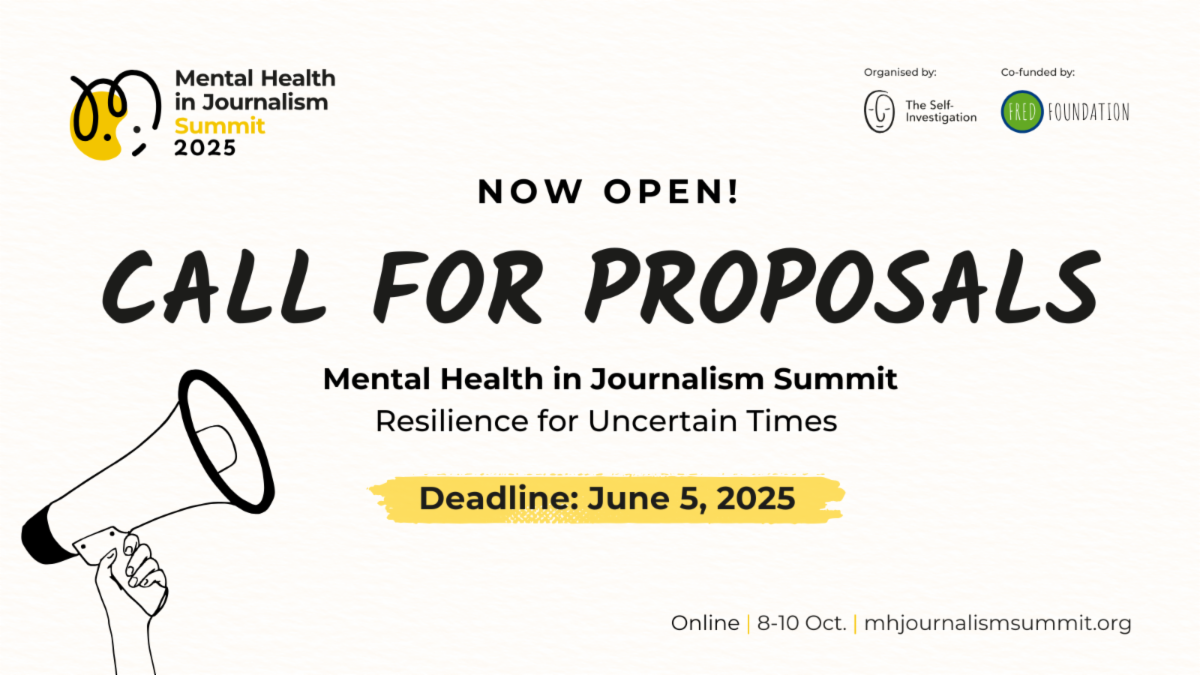
Now open. Call for proposals: The Mental Health In Journalism Summit. Submit your session ideas by June 5.

Call for Proposals: Mental Health in Journalism Summit 2025


The Mental Health in Journalism Summit is now accepting session proposals focused on best practices and innovative strategies for a mentally healthy and sustainable journalism industry. The deadline for proposals is June 5.


Submit your ideas for sessions focused on actionable and practical solutions here.


The Institute is proud to return as a partner for the Summit, an online event (Oct. 8-10) dedicated to building collective resilience during uncertain times. Attendees include managers, editors, reporters, freelancers, academics, and mental health experts. Learn more here.

Resources

This newsletter is written & edited by the National Press Club Journalism Institute staff: Beth Francesco, Holly Butcher Grant, Elliot C. Williams, and Mitch Harle. Send us your questions and suggestions for topics to cover.


Get this from a friend? Subscribe, and view the archives.

Facebook  X  Linkedin  Youtube  

DONATE TO THE INSTITUTE


The National Press Club Journalism Institute promotes an engaged global citizenry through an independent and free press, and equips journalists with skills and standards to inform the public in ways that inspire a more representative democracy. As the non-profit affiliate of the National Press Club, the Institute powers journalism in the public interest. The Institute's tax ID number is 52-1750908.