The Southern Shmooze
October 2023
|
|
Endings and Beginnings
Our Southern Jewish Journeys Continue
|
|
Photo courtesy of Scott Saltzman
|
|
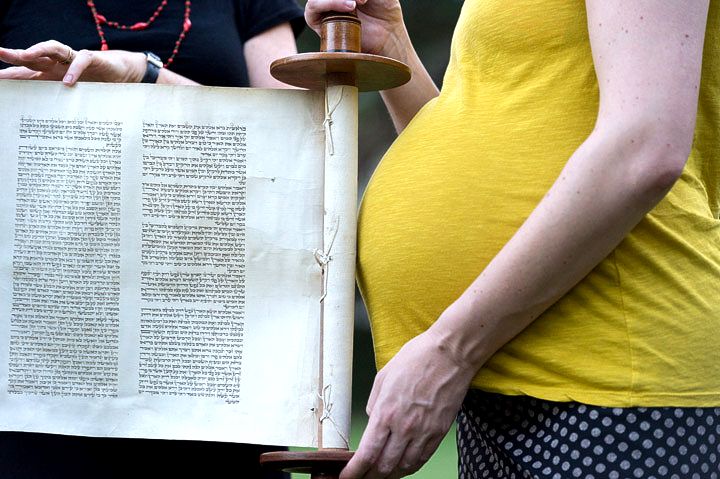
As Jews prepare to celebrate Simchat Torah this weekend, we once again reflect on endings and beginnings. Soon we will restart the annual retelling of our biblical stories, dividing them into weekly portions to be read throughout the year. Jews have done this for millennia, and on Simchat Torah we read the last line of the Torah followed by its first line, without taking a breath. Ending and beginning this yearly cycle of continuity, commandment, and tradition is one of the most joyous days of the Jewish year. It anchors us as a community, even as our communities change, grow, shrink, adopt and adapt.
In New Orleans, members of Touro Synagogue meet in a local park, unroll a Torah standing in a large circle, and celebrate with singing, dancing, and fun children's activities. This park is located just a block away from the JCC, where Southern Jewish life flourishes. But the JCC sits on the site of what was once the Jewish Orphans' Home – a link to the Southern Jewish history of countless families. (Join us later this month for an in-depth look at the history of the Jewish Orphans' Home.)
Southern Jews are a wonderful example of a community with both deep roots in Judaism and its own unique history and culture. At MSJE we are proud to explore those roots, that history, and that culture – the endings and the beginnings. We hope you will find a way in this year to join us on this joyful journey.
✡︎ Chag Sameach ✡︎
|
|
A New Orleans Girl & the Yom Kippur War |
|
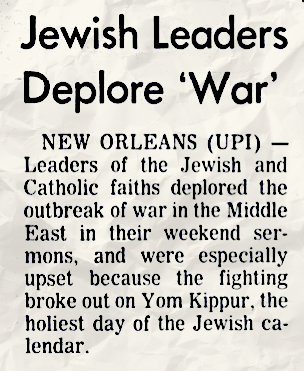
October 6, 2023, marks the 50th anniversary of the Yom Kippur War. When the Syrian and Egyptian armies attacked Israel on Yom Kippur day 1973, Shelley Smolkin, a Stanford University student from New Orleans, had a front row seat. Shelley was participating in Brandeis University's Jacob Hiatt Institute, a six-month study program focusing on social sciences. She and her cohort had arrived in Israel that June, toured the country, and taken an intensive Hebrew language course. She was just about to start college classes when the war began. |
|
|
"There were no cell phones, no internet, and no CNN. So I was at a pay phone in Israel trying to reach my parents via an international operator in New Orleans in the early days of the war. I finally got through to my brother Stuart to let them know I was okay." |
|
Air raid sirens sounded, her neighbors quickly gathered in the hallway to share news, and as darkness fell a truck came by to pick up volunteers to donate blood. Shelley was rejected as a blood donor because of her small size and sent instead to roll bandages. She remembers seeing a group of young Hasidic Jews lining up to give blood, even after they had fasted all day.
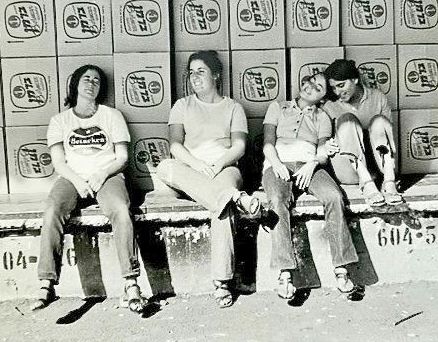
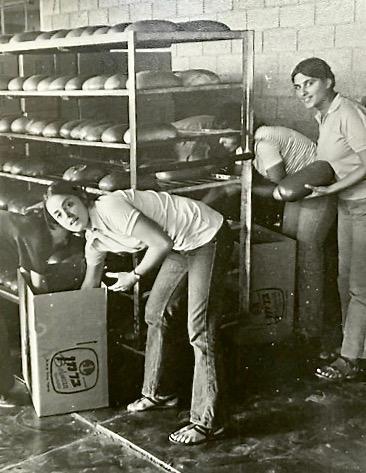
Rolling bandages soon turned into supporting the war effort by taking jobs to supplement a workforce that had gone off to fight. From 4:00am to noon, Shelley and friends worked at the Berman Bakery, which had been baking bread for the people of Jerusalem since 1875, had fed its soldiers through multiple wars, and is still in business today. From noon to 6:00pm, she worked in a nearby pharmaceutical factory boxing up medical supplies. [A tired Shelley, second from the right in the photo above, and center below.]
|
|
"Hot bread burned our hands as we stacked the loaves on racks to be taken out for delivery. Our reward was fresh baked bread for breakfast." |
|
While the fighting was happening on the Golan Heights to the north and in the Sinai Desert in the South, Shelley recalls free concerts held at the Jerusalem Theater for worried families, watching old movies and cartoons on TV with her landlords, and thinking about her group leader, Shaul, who was a paratrooper in the Israeli Army. It was only later that she learned he was one of the first IDF soldiers to cross the Suez Canal into Egypt.
The war ended on October 25, just under three weeks later, with an Israeli military victory. For Shelley, who had lived through Hurricane Betsy in New Orleans in 1965, the weeks seemed much longer. She can only imagine how it must have felt for Israelis. It was in Israel that Shelley decided to become a journalist. She has since shared her memories of the Yom Kippur War in print and in conversations with MSJE. Photos courtesy of Shelley Smolkin Hebert.
|
|
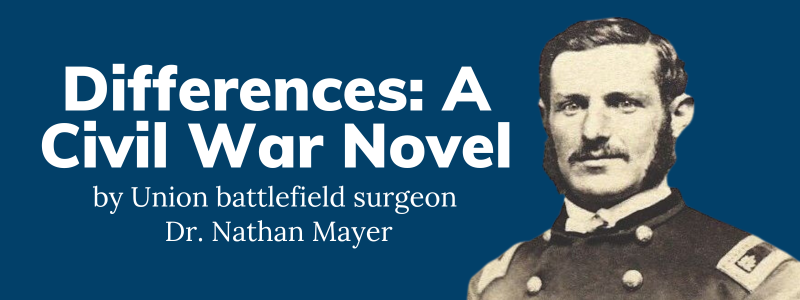
Differences
Civil War Through the Eyes of Dr. Nathan Mayer
Wednesday, October 11th
|
|
Dr. Nathan Mayer was a Civil War-era Renaissance man: a physician and scholar who also fancied himself an author of fiction. His work, Differences, explores his wartime experiences as a battlefield surgeon and sheds light on contemporary Jewish farming life in the South. Join us in virtual conversation with Professor Steven Bowman, who recently edited and republished the little-known novel, until now largely lost to history.
Date: Wednesday, October 11th
Time: 6:30pm Central
Location: Zoom
|
|
Book Launch: Registration Now Open!
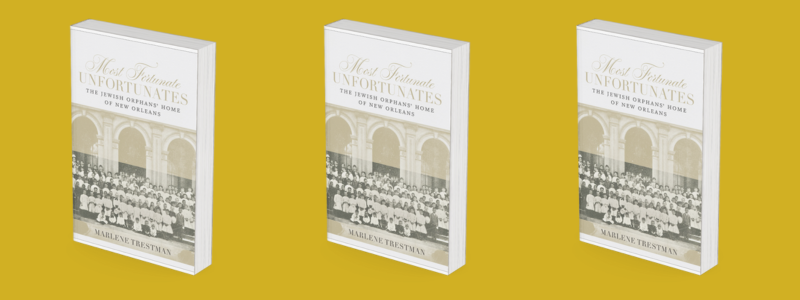
Most Fortunate Unfortunates
with Marlene Trestman
Wednesday, October 25th
|
|
Most Fortunate Unfortunates: The Jewish Orphan’s Home of New Orleans is a nuanced history of the charitable institution that many Jews considered the “pride of every Southern Israelite.” The very first purpose-built Jewish orphanage in America, over its nearly 100-year history, the Home sheltered, fed, and educated generations of Southern orphans and widows. Author Marlene Trestman will officially launch the book at MSJE with an in-person talk, reception, and book signing. The event will also be live streamed for those who cannot attend in person.
Date: Wednesday, October 25
Time: 6:30pm Central
Location: Museum of the Southern Jewish Experience
|
|
Museum Store
New Mugs Have Arrived!
(You Voted – We Listened!)
|
|
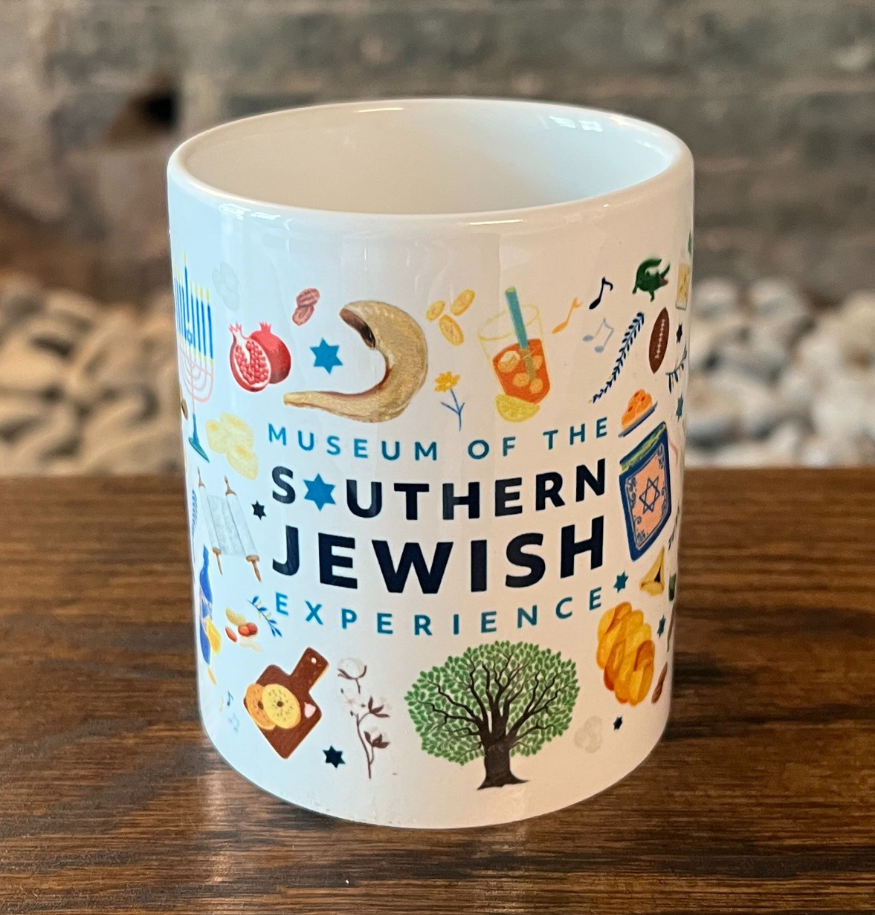
When we asked y’all to vote on our next mug design for the MSJE Store, the answer was overwhelmingly in favor of this celebration of all things Southern and Jewish – so we made it! Featuring the foods, flora, and symbols of both our cultural and our geographical traditions (magnolias and matzoh ball soup, bagels and biscuits, shofars and sweet tea, just to name a few), this mug is THE embodiment of the Southern Jewish Experience. Order yours today!
|
|
The Museum Store is dedicated by Harold Wainer in memory of George & Helen Wainer
and Harriet Wainer Kugler.
|
|
Are you receiving multiple copies of The Southern Shmooze in your Inbox? Please let us know which email address you prefer we use and we'll delete any others. Email kenneth@msje.org.
|
|
This Month in Southern Jewish History |
|
NORTH CAROLINA: October 2, 1981
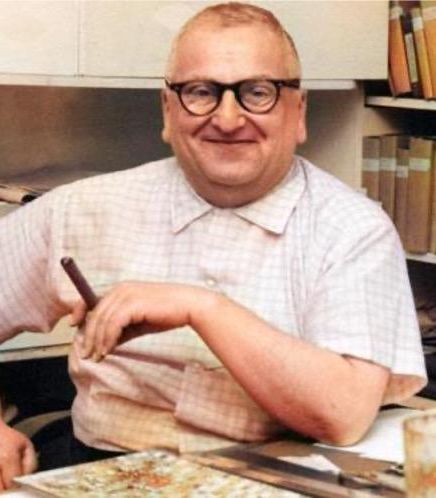
Harry Golden dies at his home in Charlotte. Golden published – and penned the contents of – The Carolina Israelite newspaper from 1942-1968 and counted among his subscribers Harry Truman, William Faulkner, and his good friend Carl Sandburg. Golden was also a prolific writer of often-satirical social commentary, publishing books of his essays, including "Only In America" and "For 2¢ Plain." He once wrote, “The Southern Jew of the city lives in constant fear of someone’s passing an anti-Semitic remark ‘to his face.’”
|
|
GEORGIA: October 12, 1958
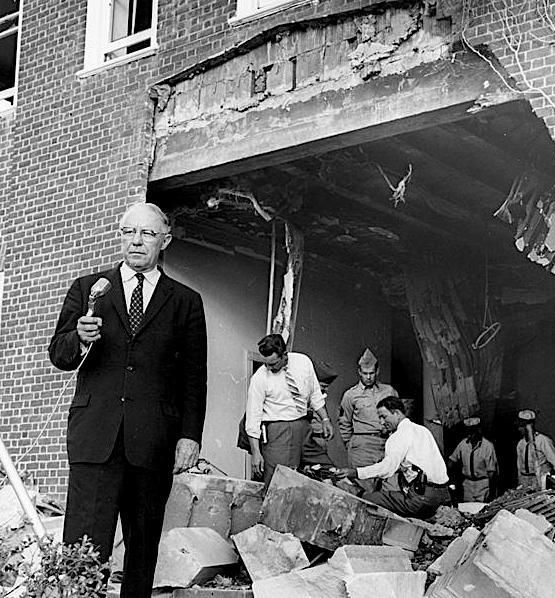
The Temple in Atlanta is bombed. Someone placed enough dynamite against the building to cause $100,000-$200,000 worth of damage. As the explosion occurred at 3:30am, no one was injured. A number of white supremacists were arrested, one was tried, but none was convicted. The Temple's Rabbi Jacob Rothschild, a supporter of Civil Rights, often drew the ire of and threats from militant segregationists. The following day, Mayor William Hartsfield condemned the bombing while visiting the site.
|
|
TEXAS: October 23, 1976
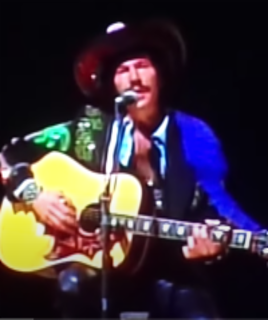
On Episode 5 of the second season of Saturday Night Live, Kinky Friedman performs as the musical guest. Friedman, who grew up in Kerrville where his parents ran a Jewish summer camp, sang the song Dear Abby, by John Prine. Steve Martin was the show's host. One of the evening's skits depicted an episode of Jeopardy from 1999, giving a look at some social changes in the future. Friedman has made a career as a musician, social commentator, writer, and political campaigner. His band Kinky Friedman and the Texas Jewboys made fun of western stereotypes with satirical songs.
|
|
MISSISSIPPI: October 27, 1936
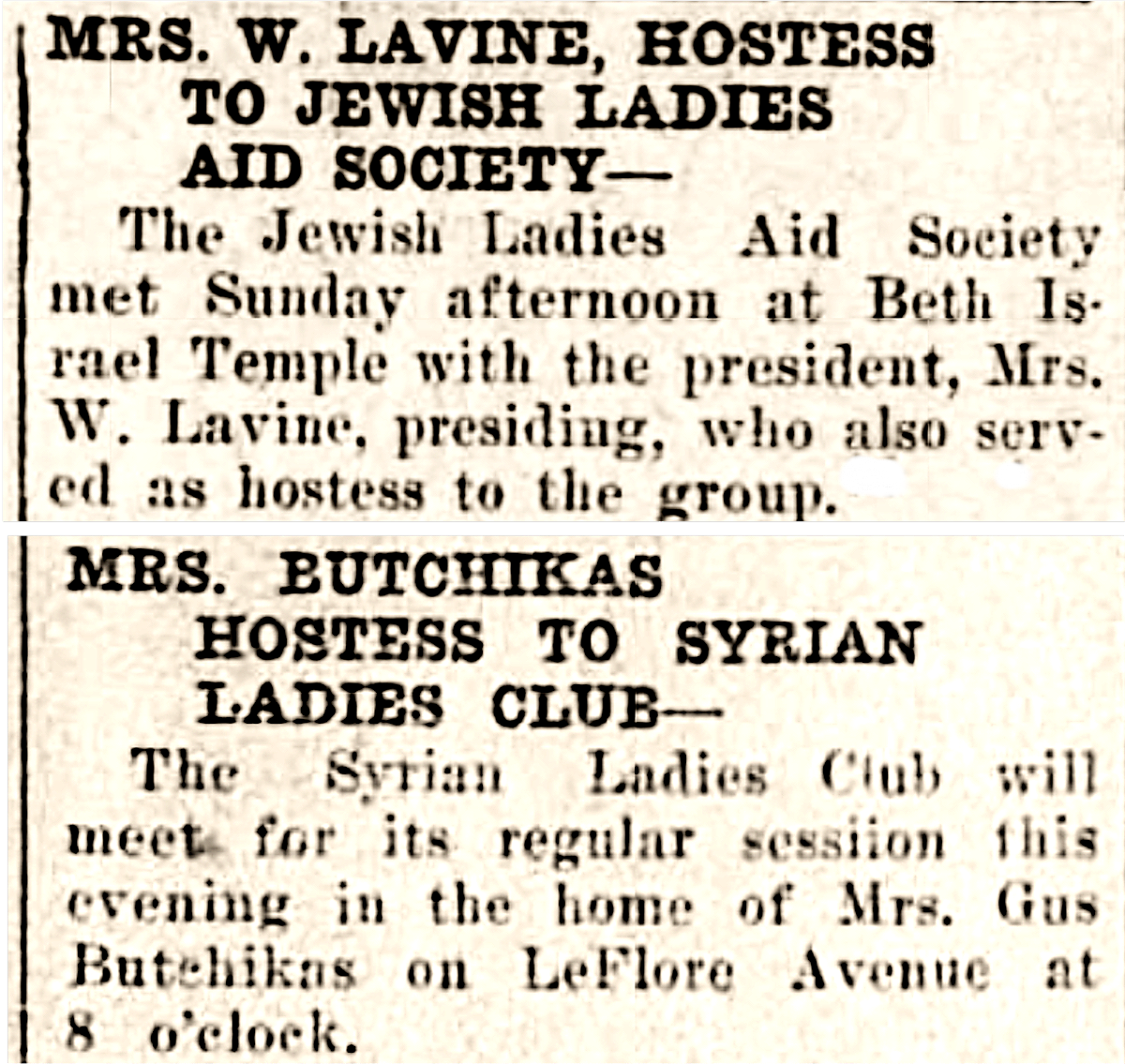
The Clarksdale Press Register's society page includes mentions of both Jewish and Syrian Ladies Club meetings. These types of notices are found in newspapers throughout the Mississippi Delta, revealing a diversity in the population that comes as a surprise to many. While predominantly a region of cotton farming, the Delta long attracted a diverse group of immigrants, each that added its unique skills, contributions, and cultures to an already unique part of the South. General stores, restaurants, and groceries were often owned by immigrants or their progeny.
|
|
SOUTH CAROLINA: October 30, 1917
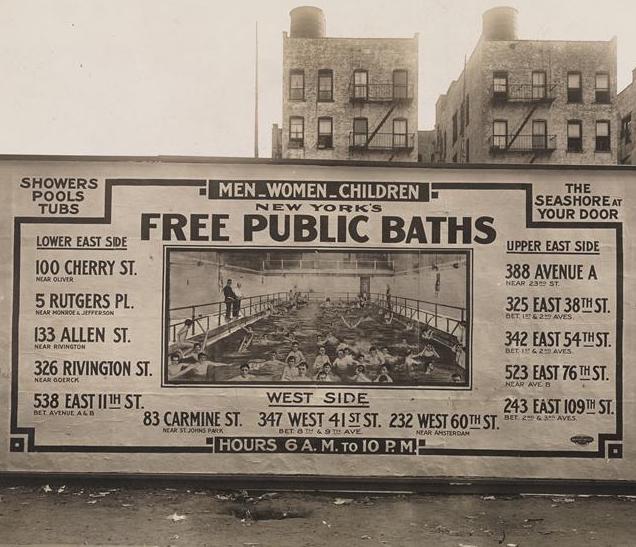
New York City names the Riverton St. Bathhouse for Dr. Simon Baruch, who spent years advocating for public health and the building of baths and pools for the city's poor. A native of Camden, SC, Baruch had been a surgeon for the Confederacy and later relocated to New York, becoming a renowned public health expert.
|
|
LOUISIANA: October 31, 1948
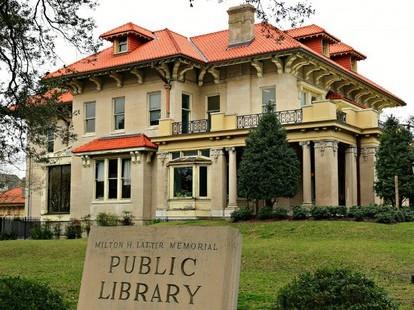
The Milton H. Latter Memorial Library is officially dedicated. Earlier that year, Mr. and Mrs. Harry Latter had purchased the St. Charles Avenue mansion with the intention of donating it to the city for use as a library. They named it after their son, Milton, who as a first lieutenant was killed on Okinawa on April 27, 1945. As part of the New Orleans Public Library system, the Latter Library serves as a reminder of the Southern Jewish contribution to the city and to our nation.
|
|
GIVE ONLINE
MAIL US A CHECK
to PO Box 15071, New Orleans, LA 70175
DONATE FROM YOUR IRA
required distribution
|
|
DESIGNATE MSJE
as a recipient of your Donor Advised Fund
DONATE STOCK
or other marketable securities
INCLUDE MSJE
in your estate planning (we can help)
|
|
Shalom. Make yourself at home.®
|
|
Museum of the Southern Jewish Experience
818 Howard Avenue | New Orleans, LA 70113
|
|
Banner images (l-r): Members of Congregation Beth Israel in Clarksdale, MS, c.1910. Collection of Museum of the Southern Jewish Experience; Blue Star campers, North Carolina, 2016. Courtesy of Blue Star Camps.
|
|
|
|
|
|
|