|
"Not only that, but we rejoice in our sufferings, knowing that suffering produces endurance, and endurance produces character, and character produces hope, and hope does not put us to shame, because God's love has been poured into our hearts through the Holy Spirit who has been given to us" (Romans 5:3-5).
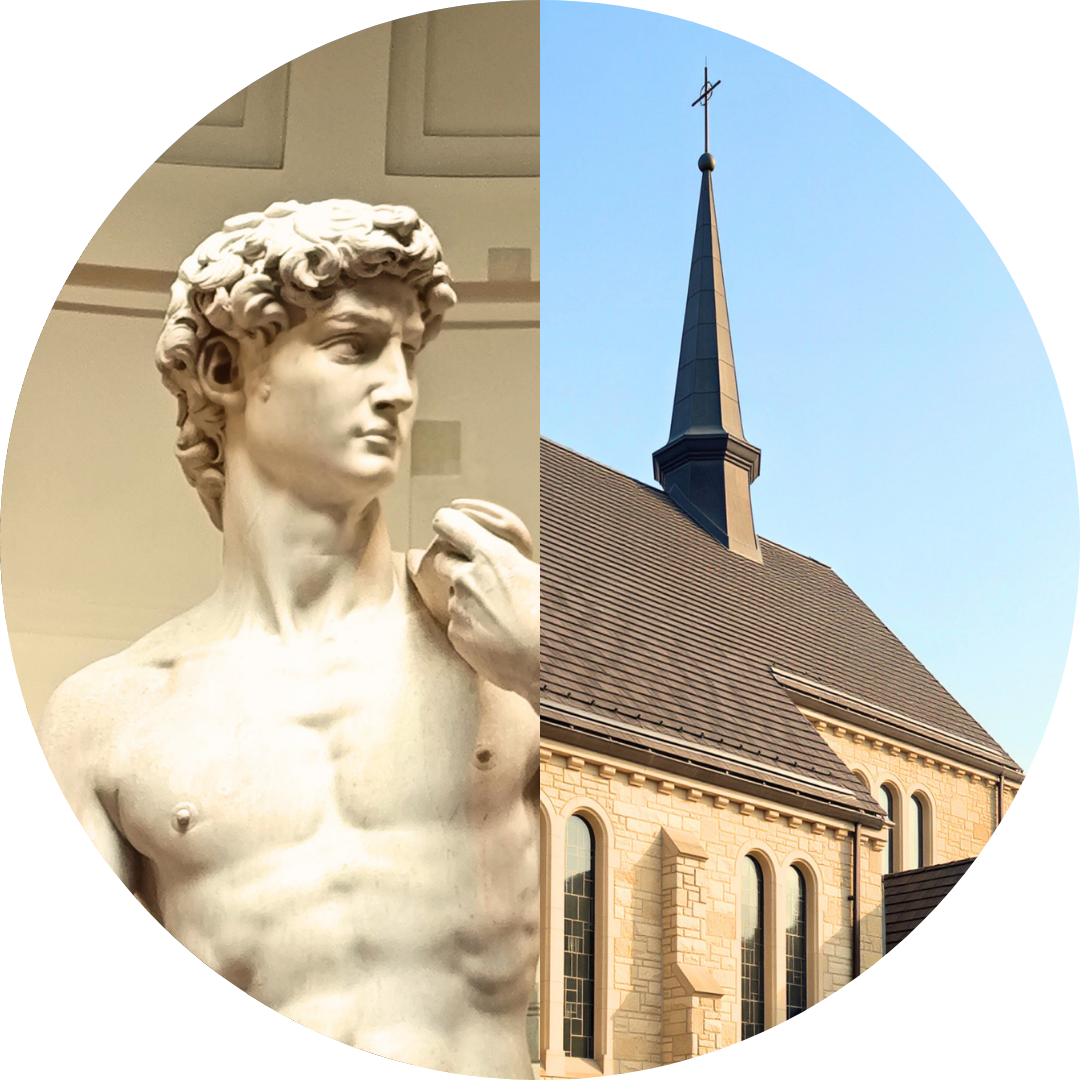
At a quarter past 8 on a Sunday morning in Florence, Italy, standing at the entrance of the Hall of the Prisoners in the Galleria dell’Accademia, an observer can’t help but look up. At the far end, beneath a glassy dome of light, past the unfinished sculptures, stands Michelangelo’s David—17 feet of solid marble formed into the shape of a man waiting for battle. The figures in the foreground seem to be struggling out of the stone, but David emerges completely. His eyes are fixed beyond the room. One hand holds the stone; the other conceals the sling. He looks calm, immense, permanent, the sort of figure who could carry anything.
But David has a problem. One of the most celebrated statues in the world rests upon two surprisingly slender ankles. Scholars have discovered fine fractures there over time, precisely where the magnificence above narrows into the small structure below. The face receives the attention. The shoulders convey courage. Yet the ankles carry the weight. The masterpiece is most vulnerable in the place almost no one comes to see.
Far across the ocean, standing at the corner of Manchester and Ballas Road in St. Louis at a quarter past 8 on a Sunday morning, an observer can’t help but look up. From a distance, longevity resembles strength. A church standing for 177 years can appear as settled as stone: steeples in the skyline, a school alive each weekday, a sanctuary returning every Sunday to familiar words and music. St. Paul’s occupies a prominent corner, and prominence creates an impression of permanence. We see the building, the history, and the generations. Still, the same fragility of David can apply to historic congregations. We do not always see the narrow places where accumulated weight is borne.
Over the last several years, that weight has been real and perhaps we feel the pangs of hidden stress: pastoral vacancies, building campaigns, construction, complex decisions, uncertainty, fatigue, all amassed with the daily individual and collective responsibilities that come with maintaining the high standards of St. Paul’s Lutheran Church and School. Through it all, however, the doors opened. Pastors preached. Teachers taught. Elders, committees, and volunteers served. Children and adults were baptized. The grieving heard the promise of resurrection. Christ’s body and blood were placed into waiting hands. What looked from the street like institutional steadiness was, up close, a congregation being sustained one promise at a time.
Now St. Paul’s stands at a crossroads between what has been carried and what may yet be built. There is a new pastor, a new building, renewed energy. But crossroads tempt us to look in every direction. We ask which program will grow, which plan will succeed, or which leader can secure the future. These are useful questions. They are not, however, the question beneath all the others: What is holding us up?
The Lutheran answer may lack the visual grandeur of Renaissance sculpture but is wonderfully concrete. It is not our endurance. Not our vision. Not the strength of our personalities or the splendor of our buildings. The Church stands because Christ has promised to be present for His people — in His Word proclaimed (Matthew 18:20), in the water of Baptism (Romans 6), and in the bread and wine of His Supper (John 6:53-56). We do not climb toward Him by becoming impressive. He comes down to us in ordinary means, meeting us precisely where human strength becomes insufficient (John 1:1-16).
That is the theology of the cross. God hides His greatest victory inside apparent defeat. The Savior bears wounds. The cornerstone is rejected. Hope enters the world through a crucifixion and an empty tomb. Saint Paul writes that suffering produces endurance, endurance produces character, and character produces hope (Romans 5:3-5). The cracks are not our glory, but neither are they proof that God has abandoned His work. They may become the places where His sustaining mercy is most clearly known.
So, as we reflect on the road ahead, perhaps faithfulness begins by looking down. Who is carrying weight quietly? Where has strain collected beneath a strong appearance? Whose ankles need strengthening, whose burden can be shared, whose hope needs the promise of Christ spoken again? Our church may stand on a prominent corner, but its true foundation lies deeper than anyone passing by can see. After 177 years — and at every crossroads still to come — the name of that foundation remains Jesus Christ.
|