Quick, Timely Reads
On the Waterfront
|
|
Felizardo’s Store: Rotting Young Minds |
|
Dr. David Frew, a prolific writer, author, and speaker grew up on Erie's lower west side as a proud "Bay Rat," joining neighborhood kids playing and marauding along the west bayfront. He has written for years about his beloved Presque Isle and his adventures on the Great Lakes. In this series, the JES Scholar-in-Residence takes note of life in and around the water.
|
|
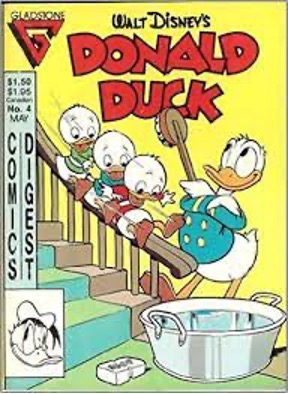
Uncle Donald with Huey (Red), Dewey (Green), and Louie (Blue) |
|
Teachers and parents said they would “rot our minds.” Comic books! They ranged from the cartoonish Donald Duck, Mickey Mouse, and Bugs Bunny comics to much darker themes. Our favorite comic book types evolved as we grew older. At the beginning the Disney and Warner comics were our favorites, especially Donald Duck. Somehow the writers who were developing Donald Duck managed to create spinoffs as well and sub themes that we all loved. At the root of the interesting subplots was the relationship between Uncle Donald and his “nephews,” Huey, Dewey and Louie, who were perpetually destroying the credibility of their “authority figure uncle.”
We often wondered about the odd situation, which found the three precocious little ducks living with an uncle as opposed to a father duck. Disney had a way of “sanitizing” characters; taking any references to gender or sexuality away so that we “innocent” children would not be scandalized. Even though Huey, Dewey, and Louie looked exactly like Donald Duck, and Uncle Donald had a regular girlfriend, Daisy Duck, he visited occasionally but did not live with. We were supposed to believe that, somehow, they were his nephews. Nephews? We were not that stupid. What was the backstory? Was there a backstory? So, life went on and “Uncle” Donald, who never wore pants (strange), was raising three sibling ducks who always seemed to make a sport of taking advantage of him.
|
|
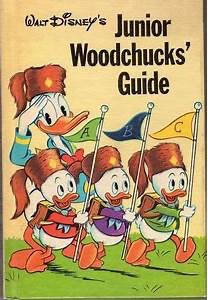
One of the chief literary mechanisms used by the boys for constantly “making a rag” out of Donald was a highly authoritarian, paramilitary organization that they faithfully followed, called the Junior Woodchucks. That august group, which used a coonskin cap as its symbol of “Americana,” provided life lessons for its members in almost every imaginable endeavor. And the “boys” were all high-ranking members with medals. When Donald Duck would perpetually blunder into foolishness, Huey, Dewey, and Louie would respond by calling upon their Junior Woodchuck handbook with its myriad well-developed rules and regulations. The handbook always seemed to have a rule that covered any situation that Donald Duck could blunder into and the boys used it to extricate their hapless uncle from his own foolishness. |
|
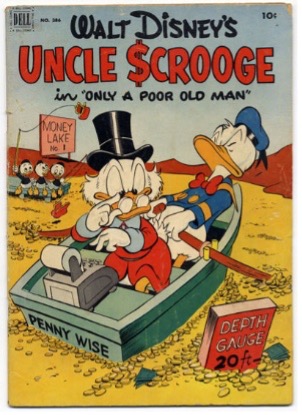
Uncle Scrooge tends to his coins. |
|
Another interesting Disney mechanism for making Donald seem hapless presented itself in a popular spinoff comic book series, “Uncle Scrooge.” Donald’s Uncle, Scrooge McDuck, was a wealthy duck who always wore a top hat, owned a huge vault filled with coins, and took Donald and the boys on amazing worldwide adventures. Uncle Scrooge often triangulated with the boys against Donald and the alliance seemed to resolve every intrafamily duck conflict. Observers of the Uncle Scrooge comic series have noted the similarities between him and (slightly) later hero, James Bond, in the sense that their adventures transported readers on adventures to glamorous places they had previously only imagined. Huey, Dewy, Louie, and Scrooge were generally allied over strategy when it came to the many adventures they encountered, usually at the expense of Uncle Donald, whose instinct always seemed to do the wrong thing.
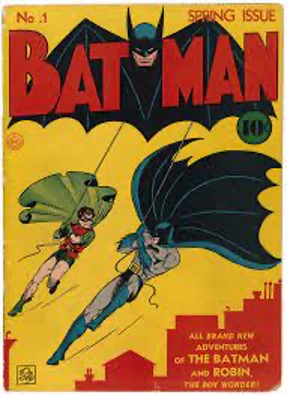
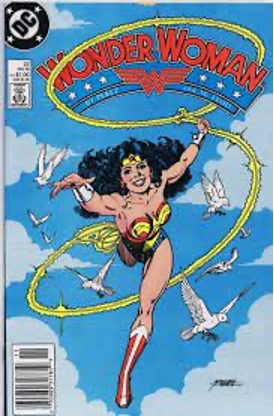
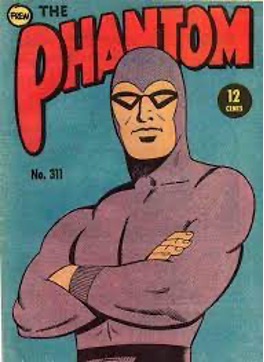
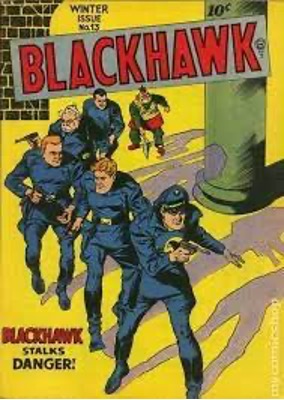
While parents generally discouraged comic book reading, they were usually not terribly threatened by Donald Duck, Mickey Mouse, Daffy Duck or Bugs Bunny. As we got older, however, comic book tastes shifted to darker heroes. That was the moment when adult concerns seemed to accelerate. By the time we were 11 or 12, we had discovered Batman, Superman, Wonder Woman, the Phantom, and Blackhawk, and each of these comics seemed to raise major objections. They were far more interesting to all of us because they had backstories, unlike the Disney characters. And the exciting backstories added to their allure. Superman’s planetary origins and susceptibility to Kryptonite. Batman’s early, sadistic tendencies, coupled with his strange relationship with Robin. Wonder Woman’s Amazonian origins and truth-telling lasso. The Phantom and his life in the mysterious continent of Africa. The Blackhawk team and their military roots. Plus, they all had secret identities! We slowly graduated to these “forbidden” comics and usually attempted to keep them hidden from the prying eyes of parents who worried about such matters as Wonder Woman’s large breasts.
|
|
Batman and Robin protected Gotham City. |
|
The amazing Wonder Woman shows off her golden lasso. We were all ready to tell the truth. |
|
How do you spell mysterious? Phantom! |
|
Fearless military heroes fight against the odds. |
|
If there was a useful life lesson to be gained by comic book collections, it was probably the role that these allegedly, mind-numbing periodicals played as commodities. Comic books were properly serialized with years and dates, making them collectible. Almost all of us had several stacks hidden in innocuous places at our homes and a few of the guys had cataloged their collections and were on the hunt for specific editions to complete a series. The inherent lesson was one of commodity value. The “right” edition of a series could be worth many times the value of random comics and we learned that lesson by trading with each other. For example, an early Batman comic, containing the backstory, might have been worth 10 or 20 Donald Duck or Mickey Mouse comics. As in stock portfolios, having a large number might have been interesting but it was obviously better to own the best individual comics (or stocks). Not at all surprising was that a few Bay Rats grew up to become highly successful brokers.
We acquired our comics either by paying retail prices at downtown stores, trading with each other, or entering the dark and mysterious world of Felizardo’s Portuguese store at the corner of West Fourth and Cascade streets. Felizardo’s occupied an odd niche in the neighborhood grocery world. It was immediately across the street from Beckman’s store but it defined the exact opposite market strategy. While Beckman’s was an established and traditional grocer, offering almost every imaginable food product, often in bulk, Felizardo’s was a “niche” provider. Antonio Felizardo sold candy, soft drinks, ice cream treats, and other things, but his place was not the kind of store that you entered if you needed a particular item. Mr. Felizardo did not always carry necessities. Instead, he offered an array of impulse goods but he was often short on staples such as flour, eggs, and canned goods.
Oddly, his was one of two Portuguese stores in the immediate neighborhood, only a short block from Bello’s at the corner of West Third and Cascade streets. Unlike Bill Beckman who ran the competing business just across the street and took a serious approach to his work, Mr. Felizardo seemed caught up in his own interests, and often the store reeked of both cigar smoke and linguica, the Portuguese sausage that was perpetually frying on a hot plate in the back of the store. With a crooked cigar hanging from his lips and threatening to burn his face at any second, he seemed more intent on playing the ethnic music that he enjoyed and stirring the frying pan filled with sausage than selling stuff.
There was one notable exception. A rack of used comic books. Somehow Mr. Felizardo managed to acquire a stunning array of used and vintage comic books that he sold at discount, probably because they were all either damaged or marked by a purposefully placed triangular tear on their covers. We were told that the mutilated covers were the reason why he was able to sell them at used prices. While we suspected that the used comics we were buying were not as valuable as they might have been if they had escaped the mutilation that apparently allowed them to be sold as “seconds,” his selection was amazing. And always willing to deal, Mr. Felizardo would often be happy to negotiate a trade: several of our first-rate, collectable comics for a few of his “used ones.” We watched with great interest for new shipments to arrive and be spread along the rack that was visible from the store window. As soon as the new comics arrived, we stormed the place looking for deals.
If Felizardo’s stock was disappointing in terms of its less-than-collector-quality condition, it made up for that deficit by virtue of content. He consistently sold the kind of comic books that made parents nuts. Violence, adult themes, salty language and all of the other nasties were more likely to show up at his store than at any other place. That was why we were such good customers. Sometimes we would collect glass pop (soda) bottles and try to use the deposits to purchase comics. Always a “wheeler-dealer,” Mr. Felizardo would discount the standard two-cent bottle deposit, offering us 60 or 70 percent of the value if the money was to be used for purchasing comics. He explained that he might have to hold the bottles for days before getting his money back. Was he teaching us a financial lesson in the “time value of money?”
There were several other random, used items available for purchase at Felizardo’s store. My favorite was a used mandolin that I paid him $12 for after days of negotiating. I went to a downtown music store, purchased new strings, spent days trying to tune the cantankerous eight-stringed instrument, and months attempting to learn to play it. With little success. I wish that I still had it because with You Tube, I am confident that I would be able to learn now. On a positive note, Mr. Felizardo offered to provide a few lessons, but he wanted too much.
|
|
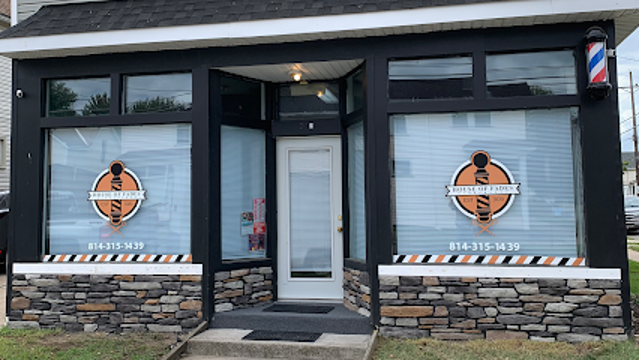
Long before it morphed into a trendy barbershop, this building at West Fourth and Cascade streets was Felizardo’s Portuguese Grocery, the neighborhood purveyor of used comic books. |
|
In 1970 when I began teaching at Gannon, I met a new faculty member from the English Department. He was a talented academic with serious scholarly credentials and a specialty in the works of Chaucer. When I revealed my ignorance of Old English literature, he laughed and told me that his real passion was comic books. He was a serious collector and later shared the fact that he was a huge fan of Scrooge McDuck and had managed to collect all but a few editions of the entire series. That was how I finally realized that parents and teachers were all wrong about comic books. They didn’t rot all of our minds! |
|
Accidental Paradise Available at TRECF!
Accidental Paradise
by Dr. David Frew and Jerry Skrypzak
|
|
The beautiful book on Presque Isle published by authors David Frew and Jerry Skrypzak – “Accidental Paradise: 13,000-Year History of Presque Isle” – is on sale at the Tom Ridge Environmental Center’s gift shop and through a special website, AccidentalParadise.com.
The book, priced at $35 plus tax and shipping, can be ordered now through the website sponsored by the TREC Foundation, AccidentalParadise.com.
Presque Isle Gallery and Gifts on the main floor of TREC, located at 301 Peninsula Drive, Suite #2, Erie, PA 16505 will also handle sales daily from 10 a.m. to 4 p.m.
For more information, send an email to aperino@TRECF.org.
To watch "Accidental Paradise: Stories Behind The Stories" click here.
|
|
ABOUT THE AUTHOR
Historian and author David Frew, Ph.D., is a Scholar-in-Residence at the JES. An emeritus professor at Gannon University, he held a variety of administrative positions during a 33-year career. He is also emeritus director of the Erie County Historical Society/Hagen History Center and is president of his own management consulting business. Frew has written or co-written 35 books and more than 100 articles, cases, and papers.
|
|
|
|
|
|
|