| | |
POLICY & ADVOCACY UPDATE
Issue #43, 10 April 2025
| | | |
- Federal election in full swing
- Trump's tariff impact
- AA fighting bed taxes again
- More disappointing apprenticeship numbers
- Instant asset write off passed for 2024/25 but not beyond
- WHM numbers continue to rise
- Canberra Region Tourism Leaders Forum
- Accommodation share of visitor nights
- Latest accommodation employment and job vacancy data
| |
Federal election in full swing
Now into the second week of the campaign aiming for a 3rd of May poll, the announcements relevant to our industry continue to be released. Of major concern this week is the Coalition promise to slash the number of international students, with particular impact to be felt in the capital cities. Not only will this have a negative impact on the economy, as international education is a major export earner, but it will also be very detrimental to the hospitality workforce. With the Coalition falling further behind in the opinion polls, they are seeing this policy as a vote winner, as it is blaming migrants for the housing crisis rather than on the more obvious cause being the lack of housing supply and the soaking up of rentals by the Short-Term Rental Accommodation market. The Coalition's international student policy has been met with criticism not just from the education and tourism sectors, but also the Migration Institute of Australia.
| | |
Trump's tariff impact
Our industry will not escape the impact of US President Trump's tariff announcements, with both threats and opportunities in the offing. On the threat side, there will almost certainly be a negative impact on both local and global growth as well as on the share markets. On the upside, there may be travellers who will choose destinations other than the US in the coming months. It will take some time for the full impact to be felt. With trillions initially wiped off the US stock market it was at least some relief to see Trump walk back some of the changes overnight. However, the tariff war with China continues, as does most of the 10% tariffs, so there will still be impacts on the Australian economy if the current situation continues. Perhaps there will be a further change of direction. We can only hope.
| | |
AA fighting bed taxes - again
In the last week, the threat of bed taxes has arisen again in Queensland, with four local councils (Whitsunday, Brisbane, Gold Coast and Cairns) writing to the Queensland Premier to seek support for the imposition of a tax on accommodation. Following this, the Courier Mail came out with an editorial suggesting it is worth considering. In response, AA CEO James Goodwin wrote a letter to the editor which was published on Monday 7 April saying:
"Tourism operators in Queensland work hard to make the state, and their region, the best place to visit, so it's surprising local mayors would renew calls for a "bed tax" when many operators are struggling ("Bed tax could secure our tourism future", Editorial, 4/4).
Accommodation providers on the Gold Coast and surrounding areas have been hit hard by cost-of-living pressures on households, as well as rising energy and insurance costs, and that's before you add recent natural disasters like Cyclone Alfred.
Hotel occupancy in March was only 55 per cent, highlighting the fragility of Queensland's visitor economy.
Why would anyone believe that applying a tax to a holiday would help boost tourism demand and fill hotel rooms? We should be putting the welcome mat out for tourists, not hitting them and the accommodation sector with a short-sighted tax grab to cover local government budgets."
QHA CEO Bernie Hogan, has also written to accommodation members directly encouraging them to push back against the tax. There is never a good time for a bed tax, which is narrow and discriminatory on the accommodation industry. Members are encouraged to oppose suggestions of a bed tax not just to the Councils but also against any other part of the tourism industry. We understand that unfortunately BEDA, Destination Gold Coast, TTNQ and Whitsunday Tourism have all indicated some support for a bed tax. Not only do all tourism businesses benefit from tourism, rather than just accommodation, but the whole economy also does through the spend of tourists and tourism related employees. The good news is at this stage the Queensland Government is indicating that they are not supportive of this approach. Let us hope it stays that way.
| | |
More disappointing apprenticeship numbers
The National Centre for Vocational Education Research (NCVER) apprenticeship data for September quarter 2024 released last week shows there has been a further drop in the number of Food Trades (chefs, bakers, butchers and pastrycooks) commencements, down 29.4% compared with the same quarter in 2023. and almost 10% below the commencements pre-COVID. The number of food trades workers in training is down to 11,995, 9.3% less than a year ago as those who commenced during the subsidised period work their way through the system. Specifically for commercial cookery, there are only 5,695 in training as at 30 September 2024, compared with 6,625 in Sep 2023. In relation to the one-year hospitality traineeships, as AA had predicted, the loss of employer incentives on 1 July 2024 has resulted in a significant reduction in traineeship commencements down from 1,625 in September quarter 2023 to only 945 in the same quarter 2024. The were only 6,330 hospitality trainees as at 30 September 2024, compared with 8,540 the previous year and 12,465 in September 2022 when the wage subsidies were in place. Across all industries, trade commencements decreased by 17.4%, with surprisingly the largest decrease apart from food trades being construction trades. There were also large falls in traineeship numbers in the community and personal services sector. Both of these sectors are on the government priority list, indicating that it is clear that the current apprenticeship settings are not working.
| |
Instant asset write off passed for 2024/25 but not beyond
Legislation to secure the $20,000 instant asset write off for businesses with revenue less than $10 million was one of the last Bills to pass the Parliament before it was prorogued. Even though the Federal Budget last month did not indicate that the write off would be available into the next financial year, Labor last week announced that it would be extended into next financial year. In comparison, the Coalition has promised to make the instant asset write off a permanent feature of the tax system for small businesses with an increased $30,000 threshold.
| | |
WHM numbers continue to rise
As at the end of February 2025, there are now record numbers of Working Holiday Makers (WHM) in Australia with a 25% increase to 226,000 compared to the same time last year. The UK FTA agreement, which allows UK citizens to stay in Australia for up to three years without needing to undertake regional work, is continuing to drive numbers from that country. The top five source countries for WHM are the United Kingdom, France, Ireland, Japan and Taiwan. The demand from Indian citizens for the limited number of capped WHM visas from that country has been overwhelming as measured by the new fee charged to seek to go into a ballot for the limited places. There has been a strong rise in demand for second and third-year visas from not just UK citizens but across the program.
| | |
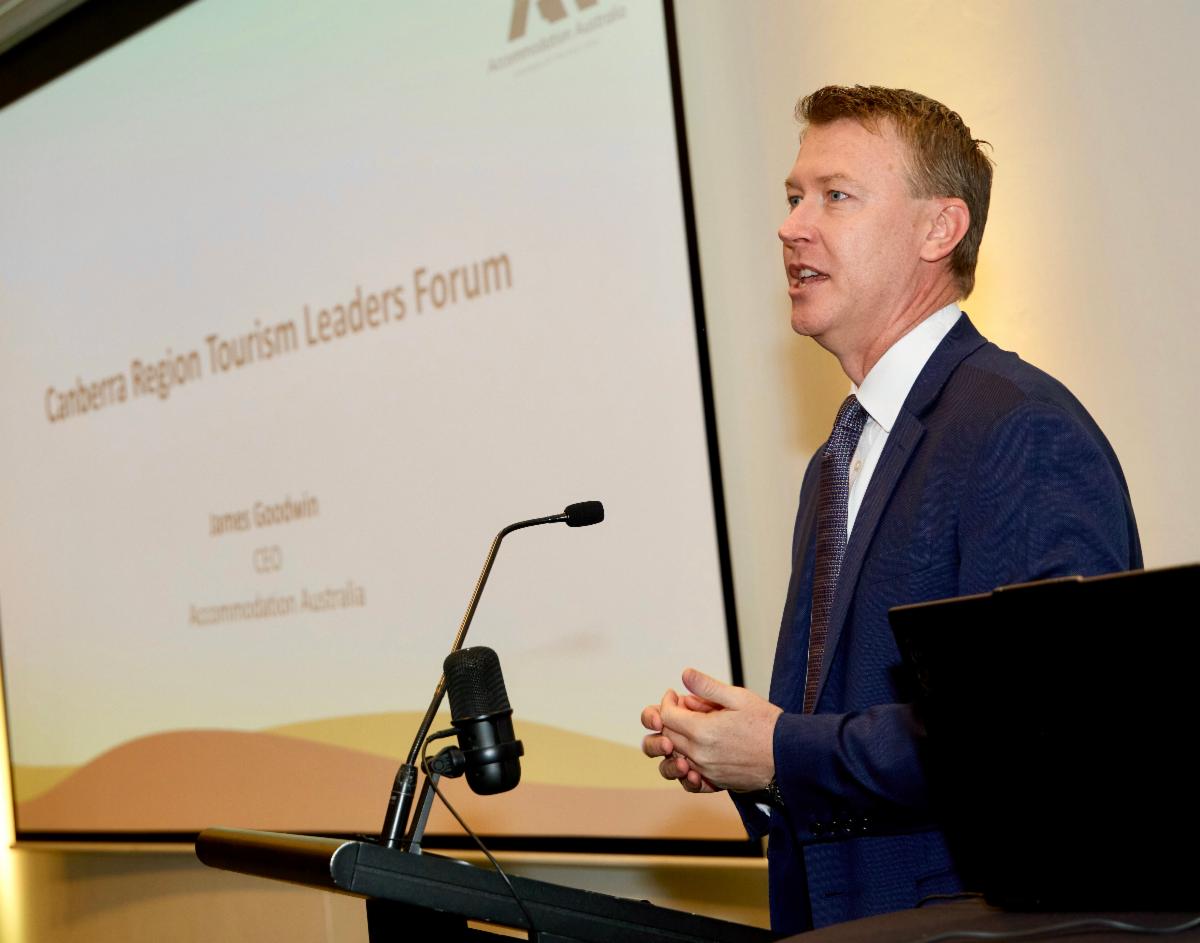
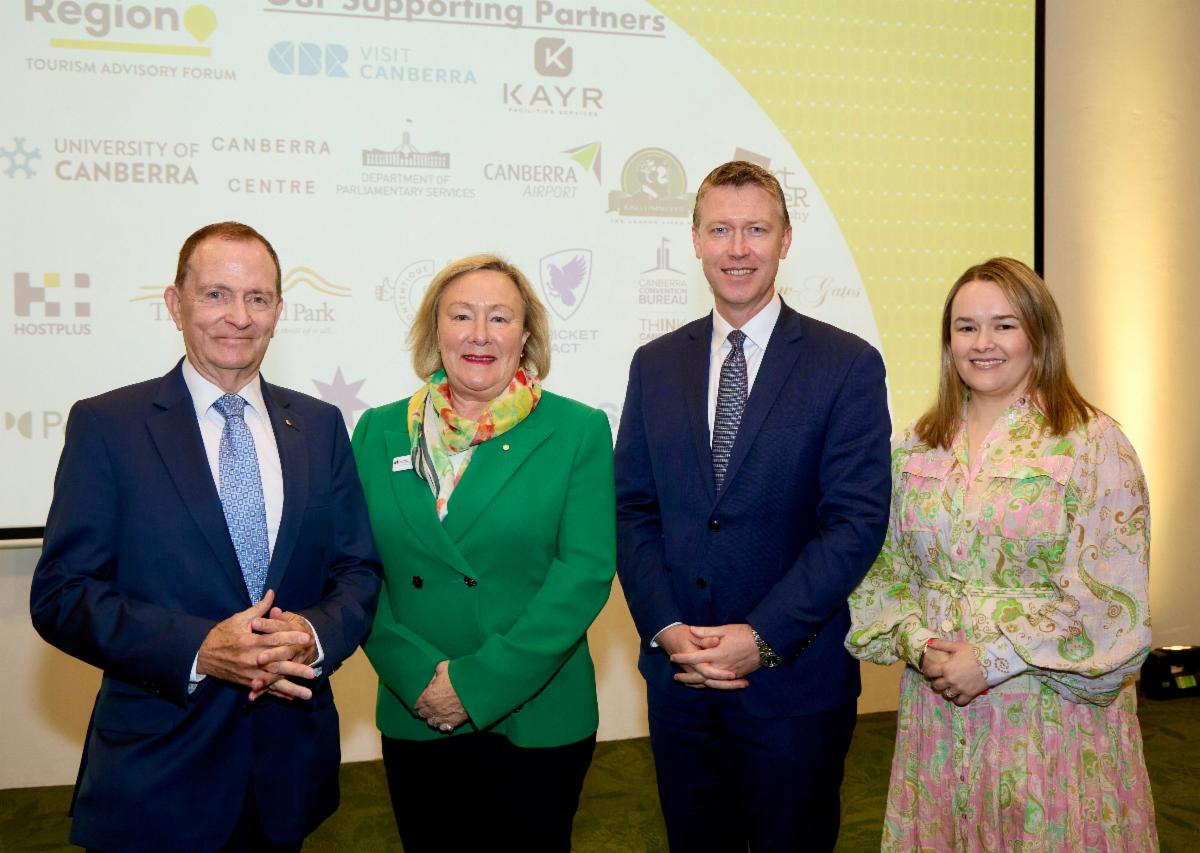
Canberra Region Tourism Leaders Forum
Harnessing tourism demand from new and emerging markets while leveraging growth in the social and eco-tourism markets were themes when CEO James Goodwin spoke at the recent Canberra Region Tourism Leaders Forum. Hotel occupancy in the ACT is trending lower than the same time last year and there was discussion about the need to boost growth in traditionally slower periods with more sporting and business events. The tourism sector also committed to work better together to improve airline connectivity and competition and to encourage greater government and industry cooperation on new infrastructure projects to help create vibrant city spaces.
| | AA CEO James Goodwin speaking at the Canberra Tourism Leaders Forum this month. | | From L to R: Chair of Canberra Tourism Forum David Marshall, Chair Regional Development Australia – ACT/Southern NSW Rowena Abbey. AA CEO James Goodwin and Property Council ACT Ashlee Berry. | | |
Accommodation share of visitor nights
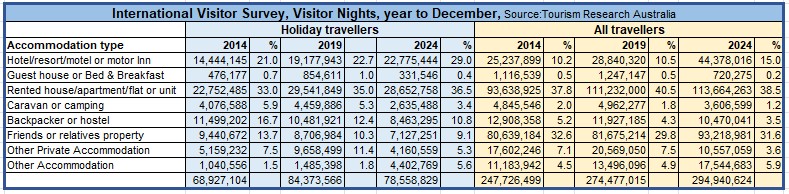
As mentioned in the last update, Tourism Research Australia recently released the latest international (IVS) and national (NVS) survey data. The table below shows the share of the international visitor nights held by the various accommodation types. Over the last ten years, the share of holiday traveller nights held by hotels, resorts and motels has risen from 21% to 29%, and from 10.2% to 15% for international visitors of all types. The State/Territory picture of night share is very mixed. The NSW and Victoria hotel share of the international holiday traveller is similar to the national average; Queensland and Tasmania it is well above at 32.5% and 36.4% respectively. For the ACT, the international holiday traveller is a much smaller percentage of the total market, with VFR and education international visitors strongly outperforming the holiday traveller.
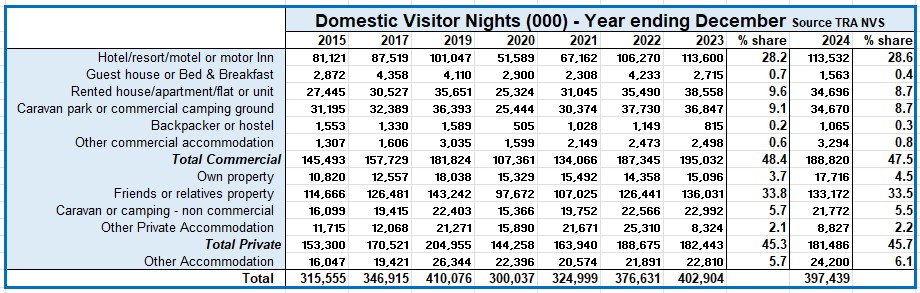
| | The table below provides the same picture for domestic traveller nights. As mentioned in the last update, the total number of domestic visitor nights has fallen in the last year, with major influencing factors being the impact of the cost of living, but also the propensity for those who are travelling to take an overseas holiday. Despite this fall, the number of nights spent in a hotel or resort has stayed relatively stable and remains higher than both the pre-COVID figure as well as the nights spent in 2022 when domestic holidaying was allowed but international was still limited. Hotel share of nights in Victoria and NSW are near the national average. In ACT, 46.4%, NT it is 38%, Queensland 31.8%, Tasmania 31.7%, South Australia 25.1%, but in WA it is only 18.8% reflecting business travel in other private accommodation (potentially mining camps) and a much higher percentage of holiday travellers camping and caravanning. | | |
Latest accommodation employment and vacancy data
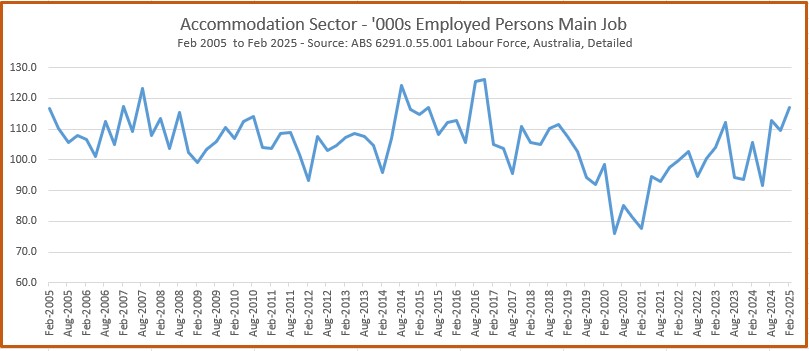
Last month the ABS released updated data on employment in the accommodation sector as well as what are called filled jobs which includes not only those jobs held by people whose main job is in our sector but also those who have their main job with another employer. The number of people whose main job is in the accommodation sector rose over the year to February 2025 by 11% to 117,200. In the last quarter alone, the rise was almost 7%. As can be seen from the graph below, which shows employment changes over the last twenty years, this is the highest employment figure recorded for accommodation since November 2016. 57.7% of those employees worked full time, the highest proportion since mid-COVID. Total employment for the Accommodation and Food Service (AFS) industry for February 2025 was 965,100 which, although less than the previous quarter, was up 6% over the year. This number compares to the 1.2 million filled jobs in the AFS in December 2024, indicating that over 200,000 people use our industry as a source of their secondary income. This is almost one fifth of all 1.1 million secondary jobs across the economy.
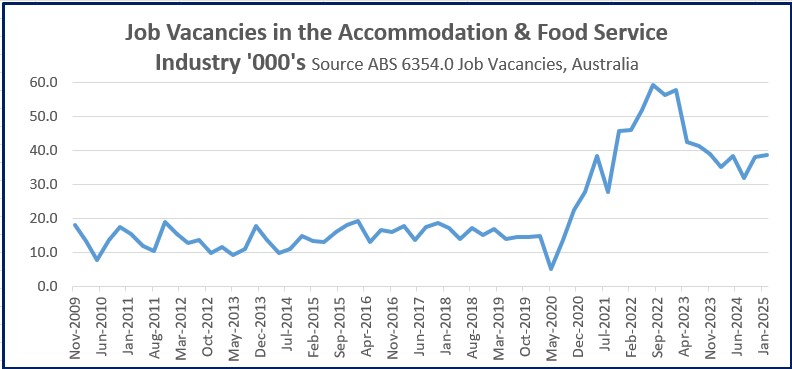
| In job vacancy data released by the ABS this week, the Accommodation and Food Service Industry had 38,700 vacancies in February 2025, which was about the same as November 2024 and up from 35,100 in February 2024. This number of vacancies is second only to the Health Care industry and more than twice as many as industries such as manufacturing. The change in vacancies since pre COVID (February 2020 - just when COVID was first impacting) is 162.5%, which is the highest change of all industries. Demonstrating the difficulty still being experienced by members and also the growth in the industry, as the graph below shows, the average quarterly vacancy figure for the AFS industry pre-COVID was much lower than it is today. Since February 2021, job vacancies have been consistently higher each quarter than the larger retail industry. | |
Drop me an email at policy@accommodationaustralia.org or give me a call on 0418 277 919 if you have any national policy issue that you think AA should be following up. If you know an AA member who is not receiving this advocacy report but wants to, then encourage them to email me and we can add them to the distribution list.
Kind Regards
Jenny Lambert OAM
National Policy Director
Accommodation Australia
| | | | |