League Logo.jpg

2025-2026 Legislative Bulletin

December 22, 2025

In this edition of the League's Legislative Bulletin, you'll find:

1. Short Break for the Legislative Bulletin Over the Holidays

2. League Lobbying Priorities in the State Capitol for 2026

3. New Laws on Plat Approvals, Emergency Powers, and More 

4. Latest on Lead Lateral Regulations and Funding in Wisconsin

5. ReVITALize Campaign Highlighted at TDA Annual Meeting

6. Updates on the Legislative Package to Address the EMS Crisis

7. Recently Introduced Legislation of Municipal Importance

8. Agency Actions, including:

a. Upcming WEDC Main Street Events

b. 2026 Local Government Services Calendar

c. Urban Forestry Grants Announced

d. 2025 Final Statement of Assessments

e. Wisconsin Property Assessment Manual

9. Reading Room Featuring NLC’s 2025 State of the Cities 

Happy Holidays! 🎄


The League will not be publishing an edition of the Bulletin next Monday, December 29th. On Monday, January 5th, we will return to our normal weekly schedule with an edition of the Wheeler Report Bulletin followed by an edition of the Legislative Bulletin on Monday, January 12th.


THANK YOU all for being dedicated readers of the Bulletin in 2025! We look forward to continuing to deliver the most timely and important information on state government developments to municipal officials across Wisconsin in 2026. We wish everyone a fun and safe holiday season! 

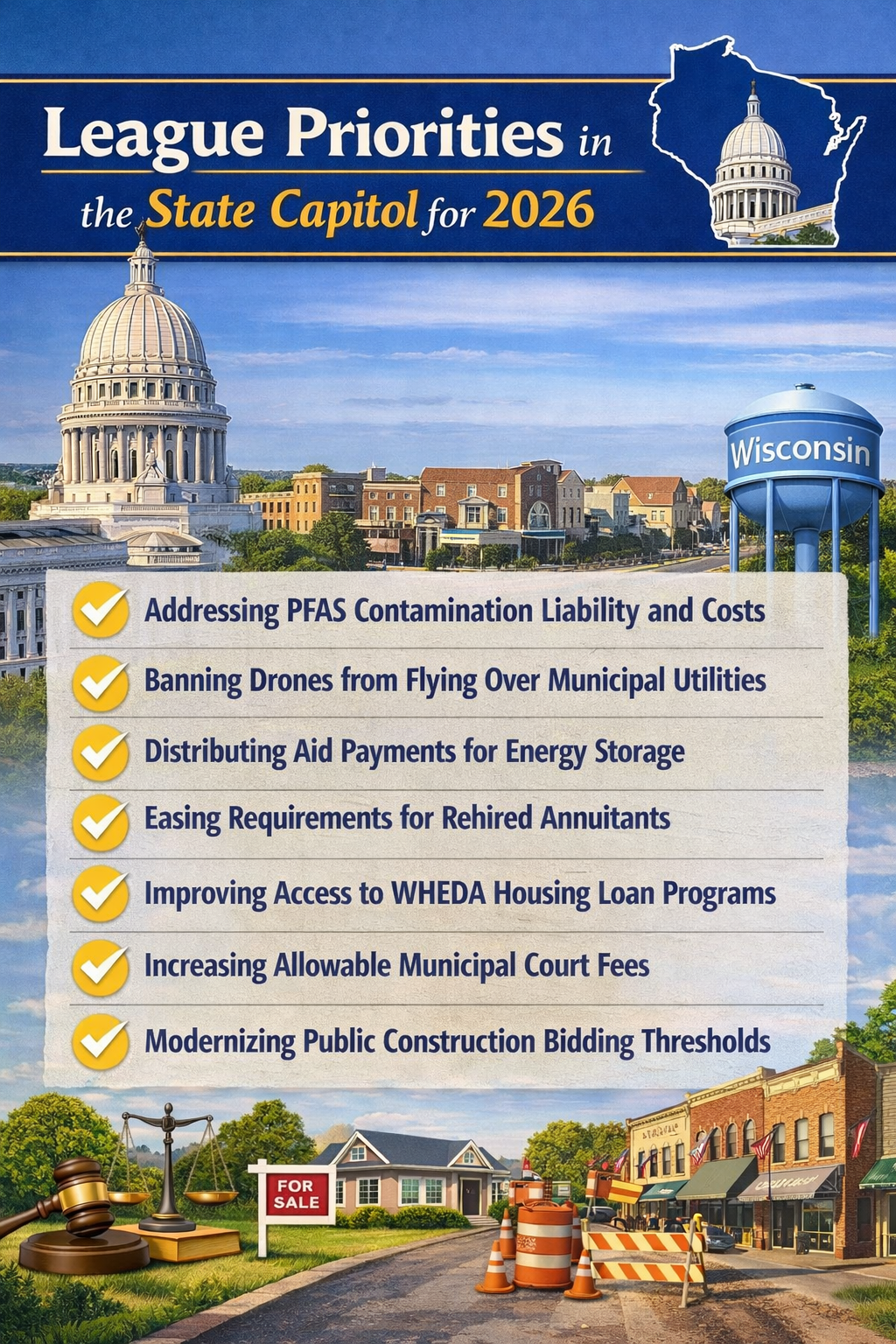
League Lobbying Priorities for 2026


Only a few months remain in the 2025-2026 Legislative Session, and the League Government Affairs Team is working hard to advance member priorities in the State Capitol. While the League has positions in-support of dozens of bills, a majority of our end of session efforts will be tailored to promote the passage of the following seven bills. 

Legislation has been introduced to address all seven priorities and, in some cases, multiple bills exist that would address these policy proposals. To learn more about each effort and its status, review the League’s Summary of Bills with League Lobbying Positions beginning on page two of this document. 


In the Christmas spirit, these bills have made the ‘Nice List.’ While many other bills join these seven initiatives on the Nice List, some bills have made the ‘Naughty List.’ In the next edition of the Legislative Bulletin, we’ll highlight efforts that the League is advocating against in the home stretch of the 2025-2026 Legislative Session. 

Governor Evers Signs 34 Bills into Law


On Tuesday, December 9th, Governor Evers signed a flurry of bills into law. Starting with Act 49 in the morning hours and concluding with Act 82 in the afternoon, these new laws have a variety of impacts for Wisconsinites. Looking at the new laws important for Wisconsin municipal officials, two are particularly notable. On both pieces of legislation, the League worked with the authors and stakeholders to address concerns and, after revisions were made, our position was neutral.


Through the end of 2025, 82 bills have been signed into law. This largely matches the pace of the 2023-2024 Legislative Session, where 86 bills had been signed into law by the end of 2023. By the time the session adjourned in Spring 2024, 272 bills had been signed into law. In other words, significant progress often happens in the final months of a legislative session, so stay tuned to the Bulletin as we enter a busy 2026 in the Wisconsin State Capitol. 


Subdivision Plat Approvals


2025 Wisconsin Act 68, previously Assembly Bill 452, makes a series of changes to the process for approving subdivision plats in Wisconsin. As the housing shortage and affordability crisis continues to be a concern for Wisconsinites, legislators have been searching for ways to address the construction of new housing in our state. While education has assisted legislators in understanding the complexity of the housing shortage and affordability crisis, the knee-jerk reaction too often is to chip away at community-first decision-making.


By working with the authors and stakeholders, the League was able to help our partners in the legislative process understand the merits of community-first decision-making and prevent a statewide mandated one-size fits all solution to address localized stakeholder concerns. The changes made to subdivision approvals in Act 68 represented one bill in a package of bills aimed at addressing housing in Wisconsin. Act 68 is now law and the provisions are outlined in greater detail in this League updated summary of this package of bills and their status. 


While Act 68 was published in statutes on December 10th, due to a clause added to the bill at the request of the League, these changes will not go into effect until July 1, 2026.


In addition to the Governor’s action signing Act 68 into law, he also vetoed another bill in the housing package the league opposed. The December 8th edition of the Legislative Bulletin provided details on that bill related to delaying the implementation of the commercial building code.  


Chief Executive Emergency Powers


2025 Wisconsin Act 61, previously Senate Bill 310, limits the length of a chief executive’s emergency powers. Under the law prior to Act 61, a chief executive of a local government could declare an emergency and exercise all the power conferred upon the government body that “appear necessary and expedient” until the governing body could meet. No requirements existed to clarify when the governing body must meet except that it must be “as soon as that body can meet.”


This new law limits these proclamations to 60 days (replicating the Governor’s timeline) but allows a governing body to meet to simply extend the proclamation along with their powers to ratify, alter, modify, or repeal the proclamation. Act 61 also defines who may act as the chief executive, including mayors or managers for a city and presidents or managers for a village. It also allows a person to temporarily act in the role of a chief executive if local ordinances or charters allow.


Act 61 took effect on December 10th, meaning that a chief executive and governing body of a local government with an emergency must now comply with the new timeline limitations. 


Various Other New Laws


Among the 32 other bills signed by Governor Evers was 2025 Wisconsin Act 78, previously Assembly Bill 280, which was supported by the League. This initiative trailers legislation last session to expand the Business Development Tax Credit to allow for certain childcare or workforce housing investments made by an employer to qualify for tax breaks. Act 78 allows for these expenses to be contributed to a third party and removes a requirement that the investments only benefit employees of the business.


The Governor also signed bills that:


  • make it a felony to impersonate a law enforcement officer, firefighter, or EMS practitioner (Act 55),


  • fund a data-sharing platform for law enforcement agencies in the greater Milwaukee area (Act 58), and


  • require motorists to move over or slow down when passing a disabled vehicle on the road just as motorists must do when approaching emergency vehicles (Act 54).

The Latest on Lead Laterals in Wisconsin


The logistical and financial burdens of lead lateral removal have been felt by municipal officials in communities of all sizes throughout the state for over a decade and will continue into the next decade or more. More than 132,000 lead laterals, also known as lead service lines (LSLs), are scattered throughout municipal utility infrastructure and customer-owned property. With a developing regulatory and financial assistance framework, please review this attachment for a summary of some of the latest news for municipalities grappling with their LSLs. ďťż

ReVITALize Campaign Highlighted at TDA Event


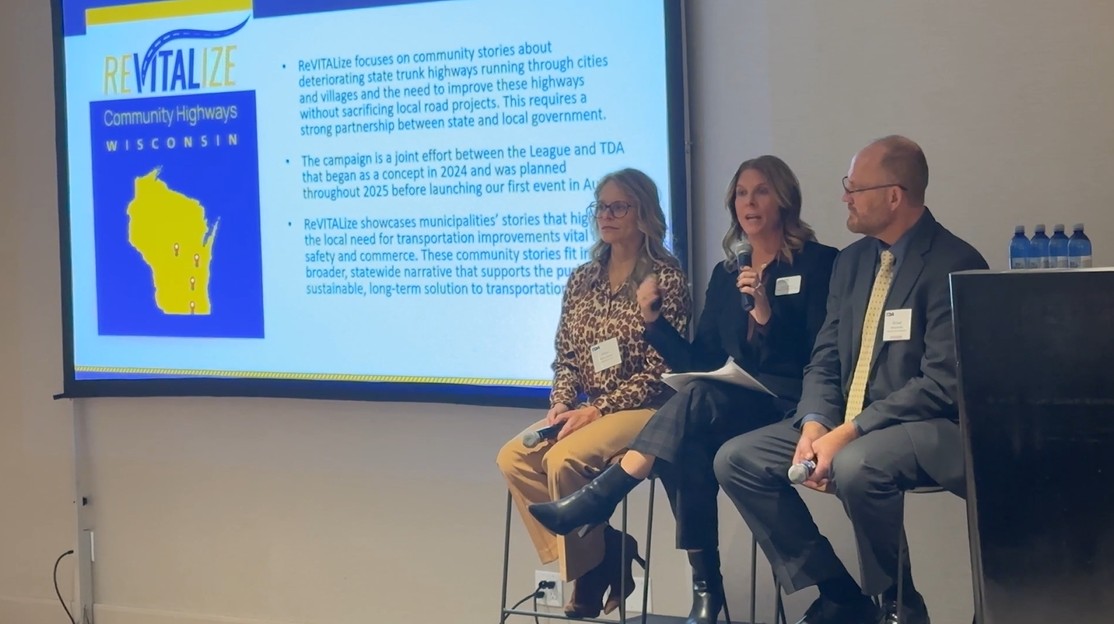
Your League Government Affairs Team has been busy speaking with members and partners in recent weeks to share our efforts on your behalf. Among those engagements was a presentation by Toni Herkert, the League’s Government Affairs Director, who provided an overview of the ReVITALize Wisconsin Community Highways campaign at the Transportation Development Association (TDA) Annual Meeting. Watch an overview of this event here. 

This initiative seeks to highlight the burdens on municipalities of maintaining deteriorating state trunk highways running through their city or village, as well as the impacts of inadequate transportation infrastructure on the broader community. Though the state bears responsibility for these highways that function as local roads, there simply isn’t enough funding for local and state projects. The impacts are felt in communities of all sizes. 

In 2025, the ReVITALize campaign visited Waterloo, Wisconsin Rapids, Oshkosh, and Beloit. While we’re currently on a winter break from these outdoor events, we’ll be visiting more cities and villages across the state in 2026. If your municipality hears concerns from community members about a local state trunk highway or if you have complaints of your own, reach out to us at the email addresses below to learn more about joining this campaign.

Updates on the EMS Legislative Package


In April, the League joined members from around the state in Senate and Assembly public hearings to testify in-support of a package of three bills aimed at addressing the emergency medical services (EMS) crisis in Wisconsin. With hours of detailed testimony and heart-wrenching stories, legislators responded, passing 2025 Wisconsin Acts 35 and 36. Thank you to the authors, Senator Marklein (R-Spring Green) and Representative Kurtz (R-Wonewoc) for your leadership on these initiatives. The new laws were outlined in the October 27th edition of the Legislative Bulletin, but we now have a few updates to share. 


EMS Training Courses


ďťżAct 35 created three new programs, including a grant program for technical colleges to expand access to emergency medical technician (EMT) courses, a reimbursement program for EMT initial training costs, and a pilot program for 911 video calls to dispatchers. While the legislation was signed into law, the three agencies responsible for the programs were required to come back to a legislative committee with a proposal seeking approval to release funding.


On Thursday, December 11th, the Wisconsin Technical College System (WTCS) had $7 million for its EMS education grant program released. As municipalities across the state seek more EMTs to fill workforce shortages and prepare for current practitioners to age out of service, this funding improves access for training new individuals to join their departments. The League thanks WTCS for its quick funding request and the Joint Committee on Finance for approving the release of the funding. 


Fire District ERP Exemption


Act 36 included three unique provisions based on concerns heard by Wisconsin’s EMS leaders. One provision exempted the annual growth in the current levy limit exemption for fire and EMS districts from the calculation for the Expenditure Restraint Program (ERP). Following clarification from the Department of Revenue (DOR), we’ve learned that this exemption will first apply to ERP forms submitted by May 1, 2026 for ERP payments distributed in 2027. While the law was in effect prior to 2026 payments, estimated distributions were calculated prior to the law taking effect, leading to this delay in implementation. 


EMS Levy Limit Exemption


Acts 35 and 36 were just two pieces of the three bill package heard in April. The third companion piece of legislation, Senate Bill 181 and Assembly Bill 197, have regrettably reached a point where the League has moved our registration from in-favor to opposed as a result of a counterproductive amendment being introduced.


Under current law, fire and EMS districts charges assessed by the district to the municipality are exempt from levy limit calculations and are allowed to grow at an annual rate of the Consumer Price Index (CPI) increase plus 2% per year. Additionally, under current law, any county can establish a countywide EMS system outside of their levy limits with no constraints on the growth.


As originally introduced, these bills would have created a third levy limit exemption for EMS that was meant to mimic the countywide levy limit exemption while recognizing that county borders may not always be the most logical territory for EMS response. If an EMS department provides service to an area that includes at least eight cities, villages, and towns or serves at least 232 square miles – both figures representing the smallest counties in Wisconsin – then their charges could be outside of levy limit calculations with an annual growth of CPI plus 5%.


To address concerns over property tax increases raised by the single stakeholder group opposed to these bills, an amendment was introduced. This amendment not only removes the benefit of this legislation but sets a dangerous precedent for the existing levy limit exemptions for EMS and other exempt costs like disaster response and transferred services.


Senate and Assembly Substitute Amendment 1 would require a referendum to establish the regional district that could implement the levy limit exemption and would then require a referendum every five years to maintain the levy limit exemption. If any referendum fails, the levy limit exemption would be void, potentially resulting in EMS interruptions, EMT layoffs, contract disruptions, and debt defaults, all while straining intergovernmental cooperation. Further, the amendment lowers the allowable annual growth in the levy limit exemption from CPI plus 5% to CPI plus 2%, matching the current fire and EMS district exemption’s allowable growth that is approved by a vote of the governing body.


Municipalities are thinking creatively and working tirelessly to continue providing timely, high-quality EMS to their residents. Increasingly this includes service consolidation with neighboring cities, villages, and towns. Incentivizing consolidation as the original legislation sought to do was a net benefit, leading to the League’s support. The amendment disincentivizes consolidation, requiring a tedious, burdensome, and expensive process with little to no benefit to residents or local governments.


As of today, the Senate Committee on Health recommended the bill for passage without the amendment on a 5-0 vote. Thank you to Chairwoman Cabral-Guevara (R-Appleton) and committee members for supporting the original legislation. After the vote, the amendment was introduced in the Senate. However, the full Senate would have to vote to adopt the amendment on the floor if the bill is scheduled for a full Senate vote. In the other chamber, the Assembly Committee on State Affairs voted on the bill with the amendment attached, regrettably leading to a unanimous 10-0 vote in support as amended.


Municipalities are already contemplating referenda to address their growing EMS costs, but these referenda may be one-time, not every five years, and municipalities can set the amount of funding requested from voters without being restricted by the tight requirements of the amended legislation. The League regrets that a once promising initiative to address the EMS crisis in Wisconsin has now turned into an avenue for powerful lobbyists to continue to attack the mechanism that can provide necessary relief for local governments in funding a critical need. With very restrictive levy limits, it is unfortunate that emergency medical service was the area selected to draw a hard line in the sand. Due to the amendment the League must move to opposed. If this legislation passes, make no mistake: this will not be the Wisconsin Realtors Association’s last attack on levy limits.


The League will be preparing an opposition memo to the legislation prior to the January floorperiod where the bill may be voted on by the full chambers. This legislation as amended hurts, not helps the EMS crisis in Wisconsin. 

Recently Introduced Legislation of Municipal Importance


The following bills have been recently introduced in the Wisconsin State Legislature and have been added to the list of those being monitored by the League. Unless otherwise indicated, no formal position has been taken on these proposals to date. 


  • Senate Bill (SB) 766: Operation of Drones Over Critical Infrastructure - Sen. Tomczyk (R-Mosinee) and Rep. Donovan (R-Greenfield) - This legislation prohibits the unauthorized operation of a drone at an altitude of less than 300 feet over or within 500 feet of a parcel on which certain critical infrastructure facilities are located. These facilities include water and wastewater treatment plants, gas or electric power plants, and telecommunications carrier plants. The prohibitions do not apply to a drone flown at the direction of a local government in its jurisdiction for official business. Persons violating this prohibition may have their drone seized and may be subject to a forfeiture of not more than $5,000. 


  • SB 707: Eliminating the Expenditure Restraint Program - Sen. Spreitzer (D-Beloit) and Rep. Anderson (D-Beloit) - Under current law, the Expenditure Restraint Program (ERP) provides aid payments to municipalities that have a property tax rate of at least five mills and have budgetary growth of no more than an inflation plus a valuation factor. Annual ERP funding is set at $58.1 million. This legislation eliminates ERP and replaces it with a payment program beginning in 2027. Payments would be equal to a municipality’s highest ERP payment in 2024, 2025, or 2026. 

⭐If you would like to contact your legislators on any bills mentioned in the Legislative Bulletin, you can find contact information for all legislators here. To find out which legislators represent your community, use the "Find Your Legislator" function on the right side of the page. 

Agency Actions


This week’s Agency Actions summary includes upcoming WEDC main street events, the 2026 local government services calendar, urban forestry grants announcement, 2025 final statement of assessments, and the final Wisconsin property assessment manual. Details on each of these items may be found in this attachment. 

📚Reading Room


As we close out the year, it’s important to look back on what has occurred as we prepare for what’s to come. Every year, the National League of Cities (NLC) prepares a report based on survey results and public data from local officials across the country that highlights the issues they are focused on in their communities. Learning what your peers are doing nationwide may help to spark ideas for your city or village. This comprehensive analysis of local priorities, known as the 2025 State of the Cities report, may be found on NLC’s website. 

Email questions or comments to:

Toni Herkert, Government Affairs Director, therkert@lwm-info.org

Evan Miller, Government Affairs Specialist, emiller@lwm-info.org

Facebook  Twitter  LinkedIn  Web