July 22, 2025

Top stories

■ Los Angeles Times owner says he will take newspaper public in next year (New York Times) 


■ ‘Washington Post executive editor Matt Murray says WP Ventures head Krissah Thompson is leaving The Washington Post’ (Ben Mullin) / WaPo pivots 'third newsroom' to a more commercial venture (Axios) / Can The Washington Post’s TikTok guy make it without The Post? (New York Times) / Washington Post opinion staff take lucrative buyouts amid newsroom transformation (Axios) 


■ NPR news chief announces she's leaving days after Congress kills federal funding (NPR) / Public media appeals to audiences for support after Congress cuts off its funding (Nieman Journalism Lab) 


■ Trump’s lawsuit against Wall Street Journal now has a judge — and it’s not Aileen Cannon (POLITICO) / New York Times comes to Wall Street Journal's defense in wake of Trump lawsuit (The Hill) / As Trump comes for Murdoch media, Fox News faces a bind (Washington Post) 


■ US appeals court will not lift limits on Associated Press access to White House (Reuters) 


■ ‘In a dramatic power play, Paramount’s board of directors overrode its three CEOs to secure the $16 million legal settlement with Donald Trump.’ (Status) / Trump says Skydance will pay an additional $20 million in PSAs and ads on top of Paramount settlement The Wrap) 


■ Trump’s campaign to crush the media (The Atlantic) / Trump's media and defamation lawsuits this year tie record (Axios) 


■ Here's how many journalists cover your town (Axios) 


■ 2 journalists facing felony charges after covering protests on Roebling Bridge: What to know (WLWT Channel 5) / Experts: Felony rioting charges for journalists covering protests are rare, troubling (Cincinnati Enquirer)


■ Bloomberg TV makes four US hires, promotes Kendall (Talking Biz News) / ESPN promotes Kelly to SVP of research (ESPN) 


■ Google seeks licensing talks with news groups, following AI rivals (Bloomberg)


■ The Verge is allowing readers to personalize its website (Talking Biz News)

CRAFT

Vanishing public data: How journalists can fight back


By Maggie Amacher


Across the U.S., environmental reporters are facing an increasingly difficult challenge: the disappearance of public data. Government records that once detailed scientific data — such as climate change and extreme weather risks — are being removed or made harder to find, often without explanation.


For journalists who depend on these datasets to tell stories, this is more than a nuisance. It’s a threat to their work.


To adapt, many are turning to new resources. Some now rely on international sources. Others are working with digital archivists who are preserving what’s been lost. Projects like the End of Term Web Archive are now playing critical roles in salvaging data that would otherwise disappear.


Mark Graham, director of the Wayback Machine at the Internet Archive, is one of the people leading this preservation work. Since 2004, Graham and his team have been part of the End of Term Web Archive, a collaborative effort dedicated to preserving U.S. government websites and datasets during presidential transitions when website purges are most likely to occur.


“The work to preserve and make available material published by the U.S. government that may be changed, or removed, from public access starts long before those changes or deletions,” Graham wrote in an email to the Institute.


In 2024 and 2025 alone, the Internet Archive houses more than 2 petabytes of archived federal websites, all available via the Wayback Machine and for download by researchers and journalists.


A pattern of disappearance


Some categories of data are more vulnerable than others. 


According to the Environmental Data & Governance Initiative, environmental justice and equity-related information have been some of the hardest hit under the second Trump administration. 


In the first 100 days of Trump’s second term, EDGI documented a barrage of removals of environmental data from agency websites, including the complete takedown of the EPA’s Environmental Justice site and the flagship EJScreen tool for environmental justice screening and mapping.


These actions build on patterns from Trump’s first term. In April 2017, the administration redirected the page for climate change on EPA’s website to a page claiming the site was being updated. That redirect remained for 18 months before ultimately leading to 404 errors.


By early 2025, EDGI observed the systematic removal of terms such as “equity” and “environmental justice” from federal pages. Entire sections were renamed from “Equity and Environmental Justice” to “Population Impacts”, and webpages highlighting the EPA’s support for African American and LGBTQ+ communities were deleted.


Early in 2025, a new wave of takedowns targeted federal agency websites. 404 Media documented that more than 2,000 datasets have disappeared from data.gov since Trump was inaugurated in January 2025 alone.


Once removed, recovering data is only part of the challenge. Verifying its accuracy, finding complete versions, and preserving context are just as important.


Tools for recovering data


Graham pointed journalists to several resources beyond the Internet Archive itself:


  • The Data Rescue Project, a joint initiative among data professionals and curators, has developed a public tracker of data rescue efforts. 
  • The Harvard Library Innovation Lab has published more than 311,000 datasets harvested from federal websites in recent years through its Source Cooperative platform.
  • The Public Environmental Data Project, a volunteer-led coalition involving Boston University and the Harvard Climate and Health CAFE Research Coordinating Center, has assembled a large inventory of federal tools and datasets, including the CDC’s Social Vulnerability Index and Environmental Justice Index.
  • Investigative Reporters and Editors has also been quietly downloading and preserving more than 120 federal datasets, ranging from FDA adverse event reports to the OSHA workplace safety database. Members of IRE can request access.
  • EDGI and its partners are working to rebuild some of the equity screening tools that were taken down, so far reviving six of the nine removed.


For those seeking to preserve at-risk pages themselves, the Internet Archive remains one of the most accessible tools.


Pages can be saved through the “Save Page Now” tool here. Files can also be uploaded directly to the Internet Archive using the “Upload” feature. The Wayback Machine is open for public searching of a full-text index of those pages.


These tools give individuals the power to preserve online content.


“Don’t expect a publisher to do the job of a library,” Graham said. “This is especially true about the world’s largest publisher, the U.S. government.”


For journalists, that means taking a more proactive approach. Archiving sources, backing up documents, and building relationships with preservation efforts are no longer optional — they’re part of the job. 


As public data becomes more unstable, ensuring continued access may depend on the people who rely on it most.

CAREER
 
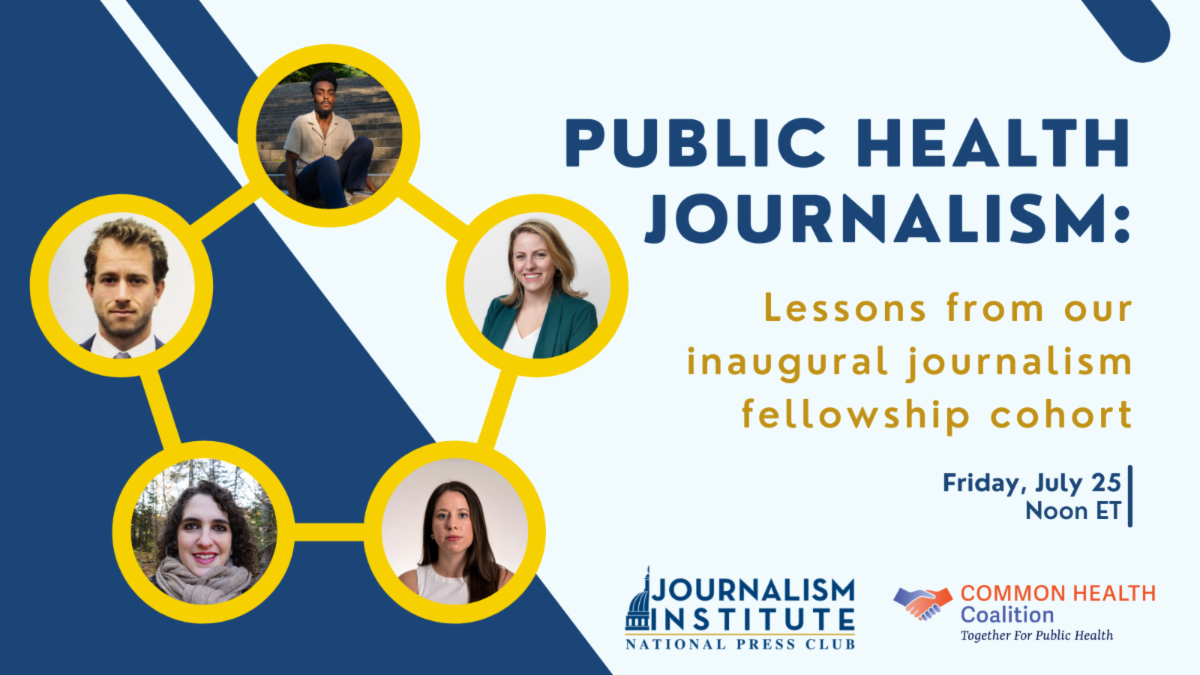
Public Health Journalism. Lessons from our inaugural journalism fellowship cohort. July 25. Noon ET

Friday: Lessons from our inaugural Public Health Reporting Fellowship cohort


As the National Press Club Journalism Institute’s inaugural Public Health Reporting Fellowship comes to a close, the five journalists who participated will share details from their ambitious reporting projects, including lessons learned, key findings, and their tips for practicing this type of journalism.


The cohort will have completed investigations into the growing disparities and solutions in disease prevention and health care for immigrant workers, rural populations, and elder communities, among other topics.


Join us at noon ET on Friday, July 25, for a celebration of their hard work; registration is open.

Speakers


  • Ted Alcorn, independent journalist
  • Jamal Jordan, multimedia documentarian and audience editor at The Washington Post
  • Eleanor Klibanoff, reporter at The Texas Tribune
  • Lygia Navarro, award-winning bilingual and disabled independent journalist
  • Amanda Seitz, healthcare policy reporter for The Associated Press


COMMUNITY

Sober support for journalists during conferences and events


Editor’s Note: The National Press Club Journalism Institute is committed to providing journalists resources and connections that support their personal and professional lives. In 2025, we are collaborating with several groups to widen those networks of support.


By Taylor Six, criminal justice reporter

The Journalists Recovery Network has heard a resounding request from our members and other journalists in recovery: The need for more sober support and spaces during journalism conferences and gatherings. 


Events can be a large trigger for journalists aiming to avoid alcohol. 


At the IRE conference in June, several JRN members were able to host a space where they could spend time together. With the help of IRE, a formal place was reserved on the agenda for sober journalist programming.  

It came together seamlessly when a person asked for support and a few of our members were able to contact IRE organizers before the conference to reserve a room and place it on the agenda. We are so proud that this need was able to be met on such short notice by the organizers — but we hope to expand that growth.


If you are someone who helps plan or is a member of a journalism organization that would like to help us provide more safe spaces for journalists in recovery, we would love to hear from you. 


We hope to have a continued presence at journalism events. This can be as simple as a reserved time and space for people to meet up or after-programming outings that don’t specifically center around alcohol. 


In addition, if you would like to include programming at your next conference regarding substance use and mental health among journalists, we would love to work with you. 


And if you feel like you need support, please contact us so we can help you.


Resources

This newsletter is written and edited by the National Press Club Journalism Institute staff: Beth Francesco, Holly Butcher Grant, Elliot C. Williams, Allison Prang, and Mitch Harle. Send us your questions and suggestions for topics to cover.


Get this from a friend? Subscribe, and view the archives.

Facebook  X  Linkedin  Youtube  

DONATE TO THE INSTITUTE


The National Press Club Journalism Institute promotes an engaged global citizenry through an independent and free press, and equips journalists with skills and standards to inform the public in ways that inspire a more representative democracy. As the non-profit affiliate of the National Press Club, the Institute powers journalism in the public interest. The Institute's tax ID number is 52-1750908.