Sunday News

October 12, 2025

CEO: Gayle Nash, MPH, RN

COO/CFO: Sam Sheth, PharmD, MBA

Contracts Manager: Kristin Miller, JD

CEO Corner


Hi all, and I hope you had a good week. This week, our mock surveys and tracer activities continue to find issues with instruments, instrument sterilization, and high-level disinfection. I also attended the Joint Commission Consultant’s Forum, which confirmed that topics related to instruments, sterilization, and high-level disinfection remain at the top of the high-risk, frequently cited list.  


Look for future newsletters delivering specifics on AEM implementation tips, updates from the Consultants Forum, the most frequently cited standards as well as an overview of the Accreditation 360 process. In short, there are no changes to the survey process, meaning tracers continue to be utilized to determine opportunities for improvement. I'd like to also point out that I'm seeing some misalignment posted on the most current Joint Commission website. That is, the National Performance Goal Chapter primarily consists of elements of performance that do not align with the Conditions of Participation (CoP) - with a few exceptions including the current elements of performance related to suicide risk. 

Last month, MS released its latest revision to the Conditions of Participation, State Operations Manual, and Interpretive Guidelines (COP-SOM). If you haven't spent much time reviewing the SOM, then please note that all items in red indicate revisions. There are lots of updates in the September revision. 


Our senior engineer consultant, Harold Blits, contributed to the discussion based upon the SOM updates as follows:


“Of particular interest to us, Physical Environment folks, are the long-awaited updates to A-0724.  If you’re a SOM geek like me, you will recall that this standard has been 'under review' for more than 18 months. A-0724 are the requirements for inspection, testing, and maintenance activities (ITM). This standard is applicable to both Equipment Management (clinical equipment) and Utilities Management (plant equipment). Most importantly, this is where you will find the expectations for implementing the Alternate Equipment Maintenance program (AEM). This iteration of the standard includes all the items previously addressed in the CMS S and C memos that were circulated more than a decade ago. On first pass, there are no new expectations beyond the program's documentation requirements and the requirement for 100% adherence to the revised intervals or strategies developed when incorporating equipment into the AEM. 


Many of us, especially in the Utilities Management realm, have shied away from implementing an AEM.  Honestly, I’ve never understood why my peers are reluctant to adopt the AEM. As skilled labor continues to be difficult to recruit in Facilities Management and, as we continue to see our workforce shrinking due to 'labor productivity' or budgetary constrictions, the AEM provides us latitude in allocating man-hours to non-essential preventive maintenance. 


I encourage all of us with clinical engineering or utilities/plant responsibilities to review these revised expectations and begin evaluating how implementing an AEM can help in managing man-hour allocation. The standard still references a 2014 ASHE book on maintaining hospital equipment for utilities management. If you’ve never seen this publication, I would recommend adding it to your library and evaluating how it could help you scale back on some low-risk, non-essential equipment maintenance.” 


General Key Points to Keep in Mind for 2026 Surveys:


  1. The manual has been updated.
  2. National Performance Goals - replacing NPSGs
  3. The Survey Process Guide has been updated, and there is no separate surveyor manual.


Rationale for updating the manual:


  • An effort is being made to streamline standards and elements of performance to align with CoPs.
  • For non-deemed hospitals, all standards apply except for those standards and elements of performance that correlate to “deemed” hospitals.
  • Critical Access Hospitals: 46% of EPs were eliminated
  • Hospitals: 48% of EPs were eliminated.
  • Manuals will display the regulation number in a new section below each EP text associated with the CoP.
  • Anything beyond a CoP has been placed in the NPG chapter. The NPG is a new chapter, but it does not introduce any new EPs or standards. 
  • EOC and LS: The Physical Environment Chapter looks different from the EOC and LS chapters, and the requirements are broader. You will notice that EOC plans are no longer required.
  • Waived Testing chapter: 
  • this chapter has been removed as the EPs in this chapter were not associated with a CoP. 
  • CLIA and lab regulations require a leader to follow the manufacturer’s instructions for use. 
  • Four EPs have been moved to the NPG Chapter. 
  • Staff must be trained and competent to perform waived tests as outlined in the MIFU. 
  • Medical Staff Chapter: This chapter remains intact; however, the CoP is listed and tied to the standard and EP. 

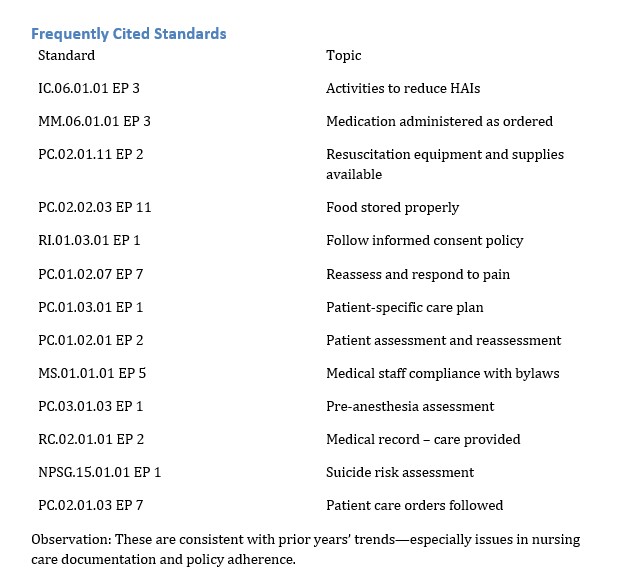
You will likely find that the frequently cited standards in this list are very common to those in the past couple of years. I would prepare future observations written in the nursing chapter when nursing standards of care are not followed, or policies and procedures are found to be out of compliance with nursing care. 


For those of you who are frequently visited by your local State Department of Health, citations for care and treatment issues are generally written in the Nursing CoP, in addition to leadership/governing body and quality. As accreditation organizations such as TJC increasingly align with CMS, expect a more rigorous review of the Nursing Chapter.


For those who are non-deemed, you may see the nursing chapter cited for issues with care and treatment and not meeting the nursing standard of care. 


Have a great week, and please don't hesitate to reach out if you have any questions or need assistance as we approach 2026.


Thank you,


Gayle Nash

Reach out today!


If you’re preparing for a survey, contact us early for support. Proactive preparation is key to addressing these common issues. Reach out to me via email (gnash@nashhc.com) or give me a call at 915-241-7830 for assistance.


Thank you!


Gayle Nash


Information, Articles, and Resources for You

  1. Anesthesiology - Obese Adolescents - Learn More
  2. AORN - Perioperative Personnel Infection Preventionists to Reduce Surgical Site Infections - Learn More
  3. AORN - Surgical Head Coverings in the OR - Learn More
  4. AORN - Type of Surgical Headwear Worn in the OR - Learn More
  5. CDC - 0 to 18 years child combined schedule - Learn More
  6. CDC - Occupational exposures to human immunodeficiency virus - Learn More
  7. CDC - Adult Vaccine Schedule - Learn More
  8. CDC - Dental Water Why Safe Water Matters - Learn More
  9. CDC - Responding to HIV Exposures in Healthcare Settings - Learn More
  10. IC - Clean bite real talk about infection control dental unit water line safety- Learn More
  11. IC - Offsite sterilization allows lifeline surgical partners to expand service lines - Learn More
  12. ISMP - Acute Medication Safety Alert - Learn More
  13. JC - Sentinel Event - Annual Review 2024 - Learn More