|
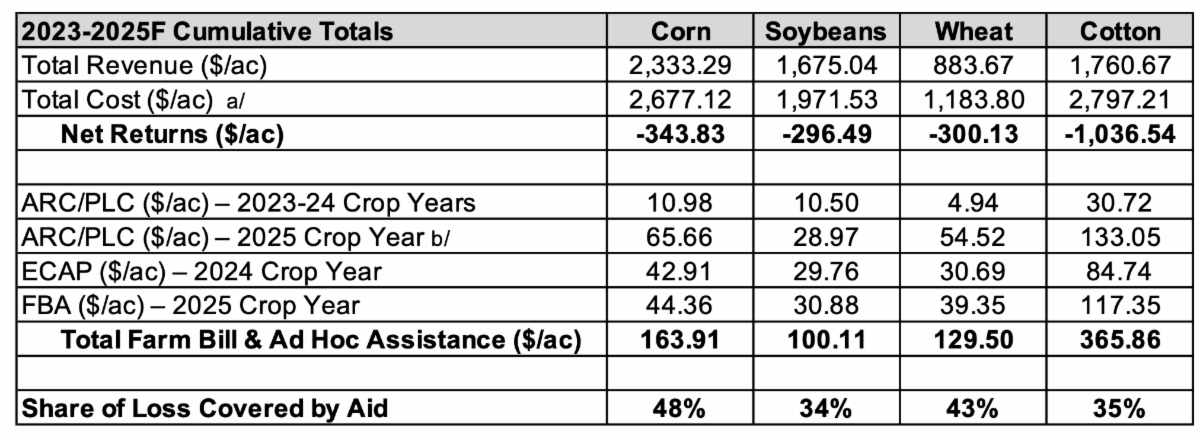
Now, for a couple of technical points. First, some may ask why we didn’t include crop insurance indemnities or natural disaster aid (think the Supplemental Disaster Relief Program) in our analysis. The reason: our total revenue estimates in Table 1 use marketing year average prices and harvested yields. Our assumption is that any crop insurance indemnities or disaster aid payments simply help partially restore producer revenue. As a result, total revenue is an appropriate proxy. Second, some may ask why we focused only on the 4 major row crops with more than 10 million base acres. The primary reasons for this were that the ARC/PLC average payments are very sensitive to acreage assumed, and there is a significant difference between base and planted acreage for these smaller-acreage crops. While that will likely change with the new addition of base acres in the One Big Beautiful Bill, it remains a limitation for analyzing the 2023-2025 period that would likely skew our results. Further, for some of the smaller-acreage crops, payment limits are significantly binding. Without a reliable way to incorporate the effects of payment limits into this analysis, the estimated payments would be significantly over-stated. While some of these challenges also impact the major row crops, in our opinion, they are less pronounced. So, while we may follow up on this analysis in the future, for today we focused on the 4 major row crops.
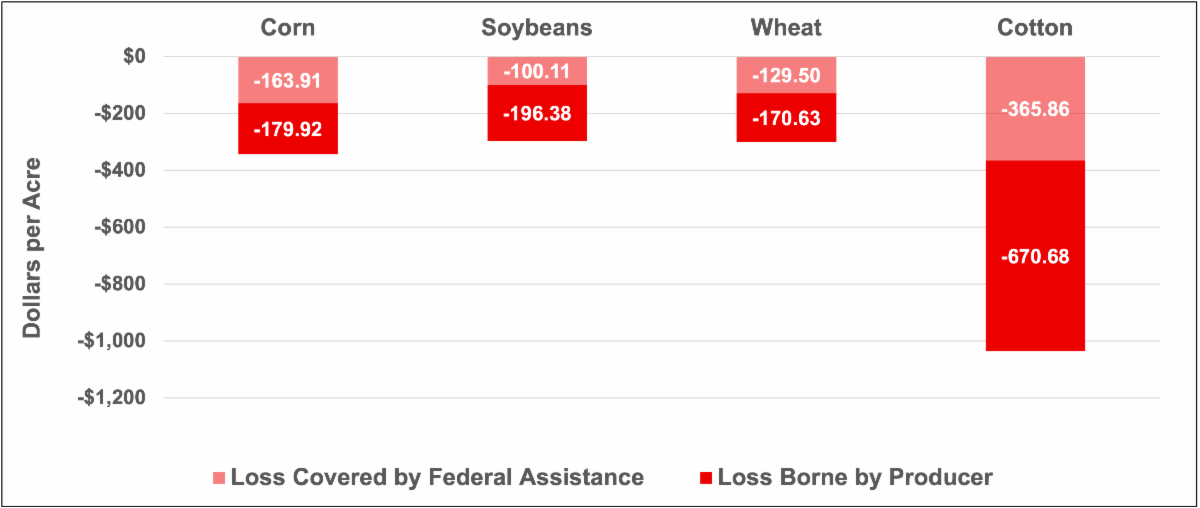
Bottom line: for the major row crops, while the federal government has provided a significant amount of assistance, farmers are shouldering even more of the loss, and they are facing a growing season in 2026 that may well compound the loss even more. In dealing with the uncovered losses already incurred, producers have only so many options: (1) watch their equity erode in proportion to the losses they’ve faced; (2) to the extent that equity is gone they can [try to] borrow money to cover the losses; or (3) they go out of business. They are going through that mental math while also trying to cash flow the upcoming year.
One final point: we appreciate more than most the difficulty of getting anything done in Washington, D.C. We also encounter producers every day who are very grateful that policymakers have stepped up to the plate to help keep them on their farms during these very trying times. But, we’d be remiss if we didn’t also note that over the last 3 years, as a nation, we’ve essentially been asking farmers to put their livelihoods on the line – with very little hope for profits – to keep raising food and fiber…while hoping that the federal government will deliver relief at the 11th hour to help keep them there. One of us is married to a rocket scientist…but it doesn’t take a rocket scientist to know this isn’t sustainable.
|