|
I’ve spent a good portion of 2021 researching and writing about Porsche for Porsche Centre Calgary - my former employer. Now, I have been selling Porsches for the better part of ten years and drove either the dealership’s demos or my own older 911s and Cayennes every day - I knew something about the company, or so I thought.
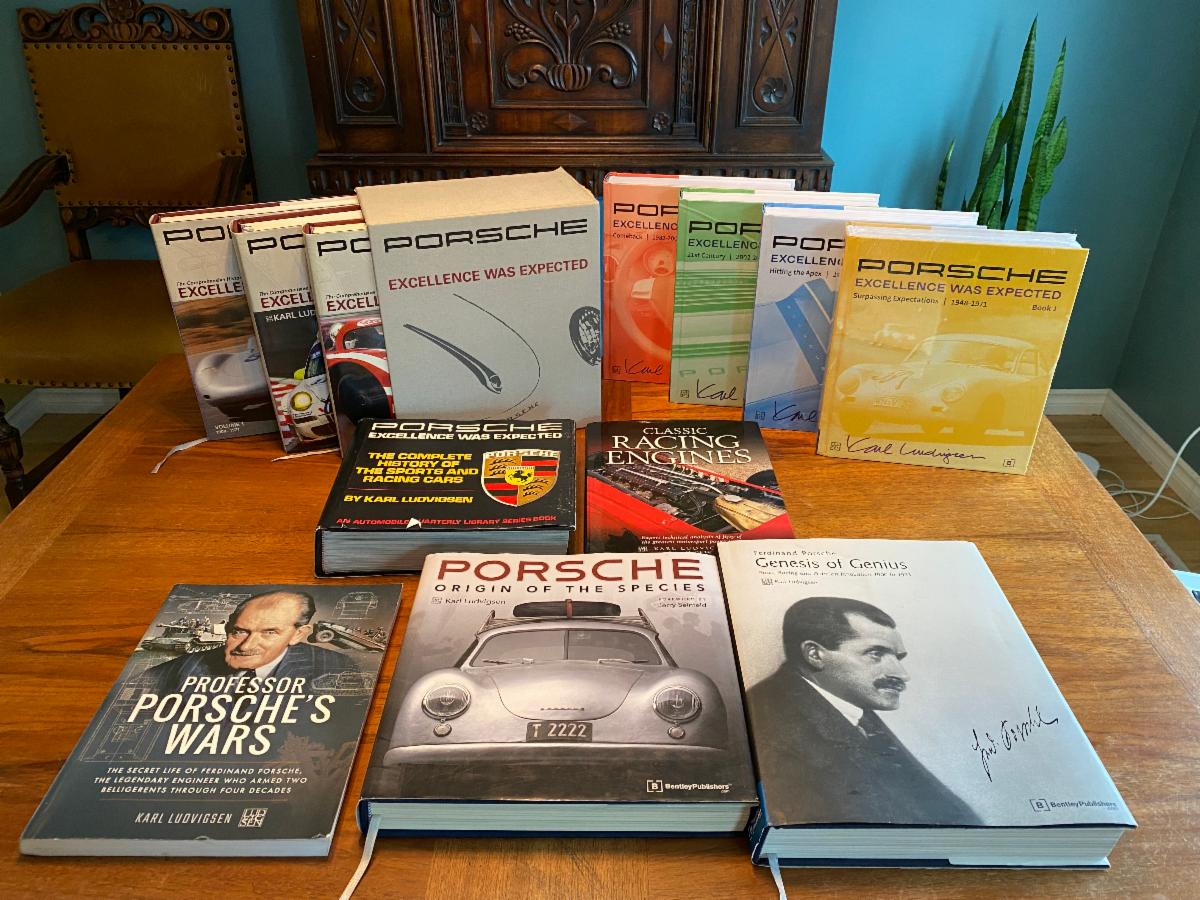
When you start getting deeper into any field of research, what you find out pretty quickly is that you are always going to be a student. My teacher, through his books and magazine articles, is Karl Ludvigsen. I first became aware of him reading my 1950’s Road & Track magazines, where he was a contributor. He started out writing technical articles for the student tech magazine at MIT, where he studied. Later he was the editor of Car & Driver and Automobile Quarterly. He had corporate stints at General Motors, Ford and Fiat at the VP level. But he is most well known for writing “Excellence Was Expected”, an 850 page book about Porsche, which was originally published in 1977.
The title could have just as easily been applied to himself. “Excellence”, as it is known, had an expanded three-volume 2nd edition published in 2003, and then an update published in 2008. The most recent 4th Edition was released in 2019, with four volumes and 2,400 pages in total!
I remember reading a review in one of my vintage car magazines of the 2008 edition, before shelling out the $400 to buy it; “You expect a 1,400 page tomb by Ludvigsen to be definitive, and it is”. “Excellence” has been called the best automotive book written on any automotive subject. Ludvigsen commanded such respect that he got unprecedented access to Porsche archives, and personnel – who opened up to him. More than just facts and numbers, Karl weaves a really interesting story of the people behind the cars.
Ludvigsen has published about thirty motoring books in total, though Porsche is the most prominent subject. He followed up ‘Excellence’ with “Origin Of The Species” which is forwarded by Jerry Seinfeld and features one of Jerry’s very early, Gmund-built 356’s. The book explores the history of the first car to have the Porsche name. “Genesis of Genius” I found the most interesting as it describes Ferdinand Porsche’s designs in the first half of the 20th century. “Professor Porsche’s Wars”, goes into the technical advancements that were accelerated by the stress of war. The book, “Classic Racing Engines”, isn’t just about Porsche, but describes in detail some of Porsche’s finest racing engines such as the Fuhrmann 4-Cam and the 917 flat-12.
So, what did I learn digesting this giant Porsche library? Well first of all I’ve moved the inception date of the Porsche car company back from 1948 to 1900 - because it all started with Ferdinand Porsche Sr. Porsche wanted to be like Bugatti and make his own cars from very early on - but lacked the capital. His children, Ferry and Louise, were finally able to do this with the profits made from designing an F1 car for the Italian company Cisitalia.
Ferdinand Porsche’s grandson, Ferdinand Piech, had a significant influence in the company, before developing the 5 cylinder engine for Mercedes-Benz and the Quattro drivetrain for VW. Piech shared his grandfather's love of complex engineering - bringing the Bugatti Veyron to market. This 8 Litre quad-turbo W-16 could be considered the spiritual successor to the Auto Union C-Type V-16 Grand Prix car.
Porsche is really an engineering dynasty that spanned the entire 20th century, and continues today - not a sports car manufacturer started in 1948.
Porsche ‘4x4s’ started well before the Cayenne. Probably half of everything designed by a Porsche was some form of off-road vehicle, and most of those were gasoline-electric hybrids. Tractors, road ‘tugs’ for towing military equipment, tanks, scout cars, amphibious vehicles, etc.
Porsche doesn’t throw anything away. The gas-electric hybrid concept developed for the Lohner ‘Mixte’ in 1901 wasn’t dissimilar to what was put in tank engines in WW2. The vertical shaft, bevel gear, camshaft drive for the Cisitalia F1 car, designed in 1947, used Ferdinand Porsche’s pre-war Auto-Union grand prix engines for inspiration. It was copied forward by a young Ernst Fuhrmann who designed the ‘Carrera’ engine for the Porsche 550 Spyder. The ‘Quattro’ AWD system developed by Ferdinand Piech for Audi didn’t come out of the ether - it was influenced by his grandfather’s designs. The ‘Mezger’ 6 cylinder 911 engine, developed with Piech, evolved from a 2.0L 130hp normally-aspirated powerplant in 1963 to a 2.6L turbo charged 800hp racing engine in the late 1970’s, and then was transformed into an entirely water-cooled engine which powered the Porsche GT3’s and 911 Turbos more than 40 years later. I do my best to summarize 40 years of Mezger engines here.
The one thread that connects most of Porsche’s designs is that they are very ambitious technically. There were no focus groups or competitive analysis or cost projections. Porsche designed the most perfect solution to what ever problem sat in front of him. Henry Royce, the engineering perfectionist behind Rolls Royce, said of Dr. Porsche, “Just do it they way Porsche does, he always does things correctly”. This was true of the V-16 F1 car that Porsche built on spec in the mid-1930’s, then sold to Auto Union. It was true of Porsche’s tank designs in WW2 that were too sophisticated for field use, leading the German Armaments Minister to call him ‘the mad scientist’. It was also true of his son Ferry’s first project; the Cisitalia F1 car with a supercharged flat 12 engine, 4-wheel drive, and 5-speed sequential gearbox – in 1947. The Porsche 917 and the 959 road car of the late 1980’s are other examples, as are Ferdinand Piech’s VW’s XLI ‘1 Litre road car’ and the Bugatti Veyron. The Le Mans winning Porsche 919 Hybrid may be the most complicated vehicle every constructed.
This engineering extravagance didn’t always end well. Ferdinand Porsche and corporate bean-counters did not mix. Porsche had Technical Director positions at Lohner, Austro-Daimler, Daimler-Benz (Mercedes) and Steyr. Porsche would come in, design ten years of products, then want to re-design them the year after. When something didn’t meet his expectations he was known to jump up and down on his hat. At least one boardroom meeting ended with him throwing an ashtray! Over-spending on R&D has led the Porsche company to more than one cash crunch.
Ludvigsen masterfully tells all of these stories. Karl is in his 80’s and won’t be writing books forever, though he still has a couple projects on the go. His ability to look at the past to understand the present and predict the future comes in no small part due to the library of books and photographs he has accumulated over 50 years.
|