Board Meeting:
Monday, May 10, 2021 8:00am
|
Save the Date: the June 2021 Board Meeting is tentatively scheduled for Monday, June 14, 2021. Please check our website for updates related to the date, time and location of that meeting. |
|
Please note that due to the coronavirus pandemic, the May 10, 2021 Board Meeting will not be held “in-person” at District headquarters. Rather, the meeting will be conducted via video and phone conference call. Guests may access the meeting in the following ways:
You may daily in using your phone:
(408) 650-3123 Access Code: 198-360-629
Join the meeting from your computer, tablet or smartphone at the following link:
|
|
Governor Issues Drought Proclamation Statewide |
|
Summary
Governor Newsom issued a statewide drought proclamation in April with much of the West experiencing drought conditions and California in a second consecutive dry year. In addition, Newsom declared a drought emergency in Sonoma and Mendocino Counties. Newsom emphasized that “climate change is intensifying both the frequency and the severity of dry periods.” The Proclamation directed state agencies to take immediate action to bolster drought resilience, to increase water conservation efforts and to prepare for impacts on communities, businesses and ecosystems if dry conditions extend to a third year.
As evidence of our dry winter, the last snow survey of the year by the Department of Water Resources in April was canceled because there was not enough snow on the ground. According to the U.S. Drought Monitor, all of California is “abnormally dry,” nearly 90 percent of the State is experiencing “severe” drought conditions and more than half the state is experiencing “extreme” drought conditions. Thus, water supplies statewide and in the San Gabriel Valley (local groundwater) are both below average.
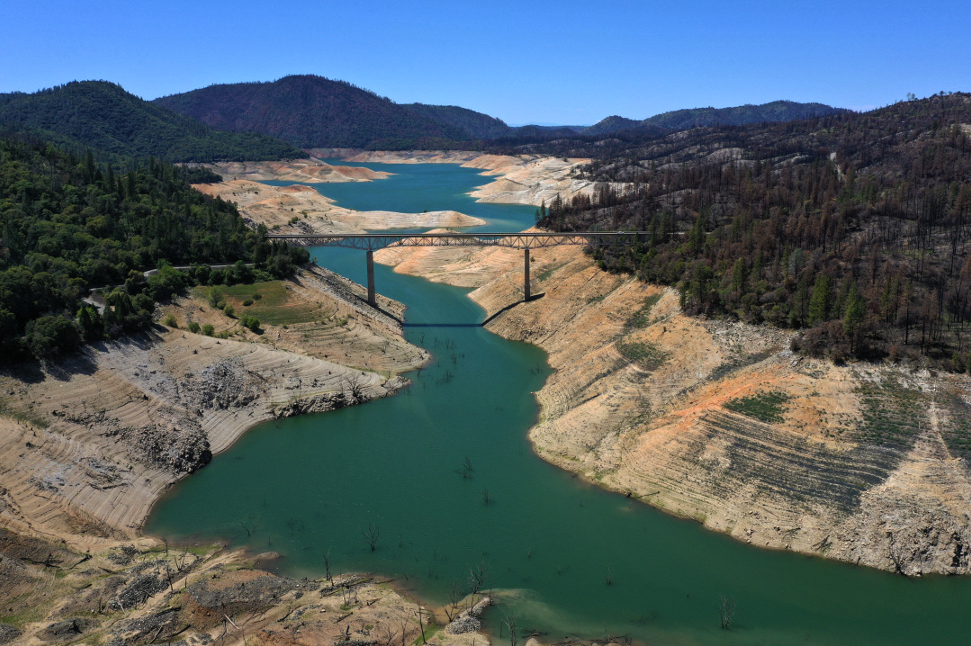
In late March, in response to these dry conditions, the State Department of Water Resources took the rare action of reducing needed imported water allocations for the State Water Project from planned amounts. Commitment to smart water management and water conservation are more important than ever as Mother Nature and climate change are more volatile and unpredictable than ever. Below is a picture of the State’s second largest reservoir, Lake Oroville, which was only 42% full as of April 27, 2021.
|
|
Imported Water Delivery Update
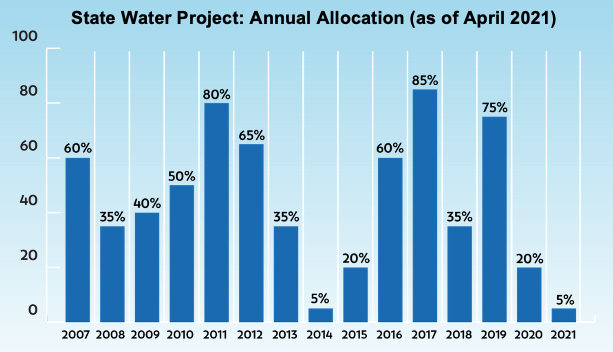
Amid worsening drought and water supply conditions, as California is experiencing a second consecutive dry year and six consecutive months of below average snow and precipitation, the State Department of Water Resources reduced State Water Project (SWP) allocations (the “imported” water that flows from northern California to southern California) to 5 percent of requested supplies, down from the initial allocation of 10 percent announced in December. This means the District will receive only 1,440 acre-feet (5%) of its allotted 28,800 acre-feet of imported water which is used to replenish declining groundwater supplies in the Main San Gabriel Basin.
About 80 percent of the Valley’s water supply is furnished by local groundwater, and the Valley imports approximately 20 percent of the water we use. Thus, annual imported water allocations from the Department of Water Resources (DWR) are very important. The SWP provides water to 29 SWP contractors, such as SGVMWD, who supply water to more than 27 million Californians and 750,000 acres of farmland.
The graph below shows how imported water allocations from the state vary from year to year and demonstrates how difficult water management and planning has become. As a rule of thumb, a 60% allocation is needed to meet the demand of our member cities for replacement water. Thus, in years where the allocation dips below that amount, we see the important role that water storage plays.
|
|
District Operations
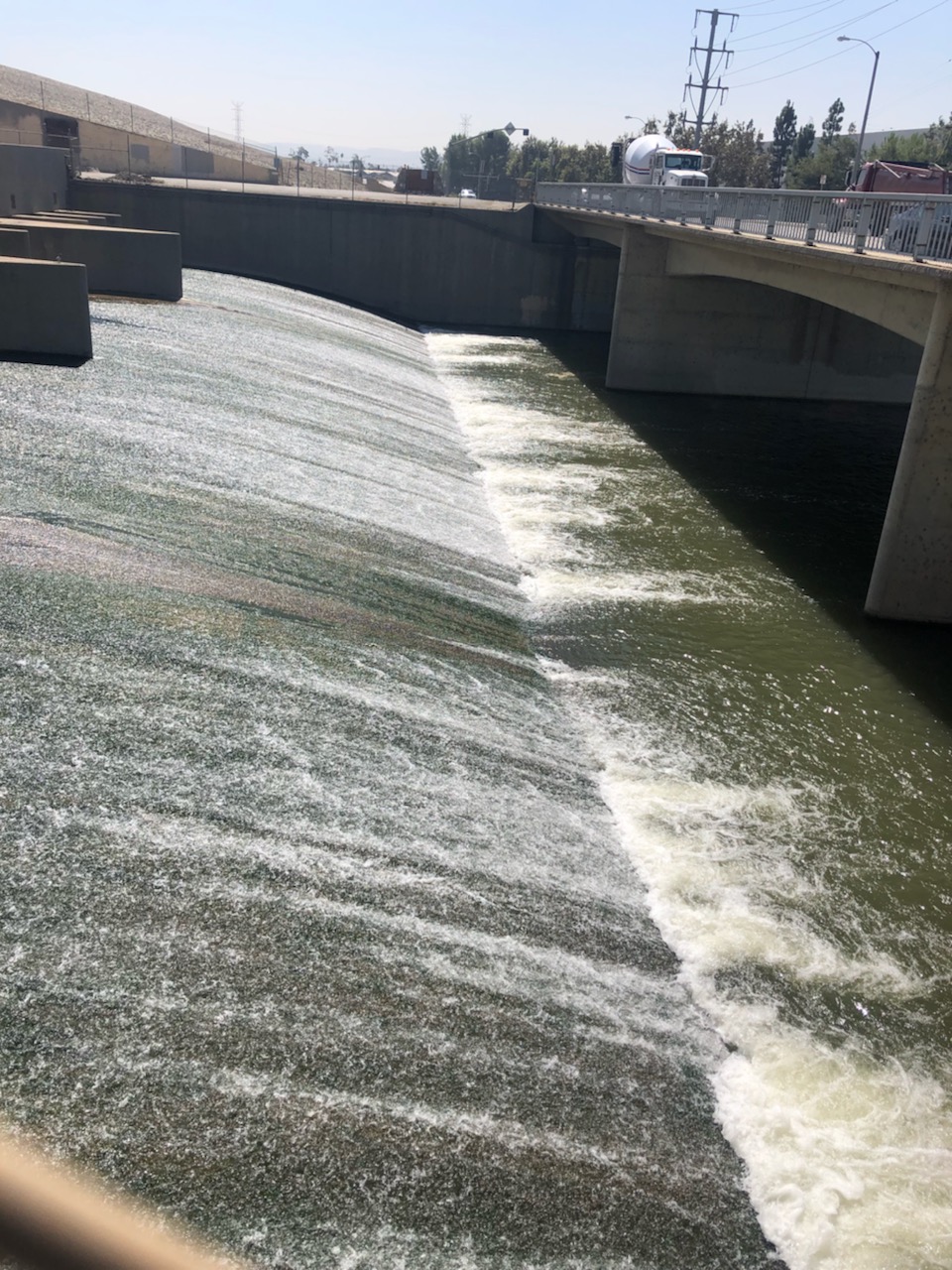
The District finalized its deliveries to the Main San Gabriel Basin (Canyon Spreading Grounds), which began April 5th. The District’s total delivery of the Table A allocation was 1,522 AF which was completed the first week of May.
|
|
Following is a summary of water supply conditions in the State and the San Gabriel Valley:
-
State Summary – According to the U.S. Drought Monitor, as of April 27, 2021, 100% of the State is considered “abnormally dry,”; 97.51% of the State is experiencing moderate drought (increased from 95.2% three months ago); and 87.95% of the State is experiencing severe drought (increased from 75.74% three months ago). Further, 58.22% of the State is experiencing extreme or exceptional drought (up from 43.32% three months ago).
-
Rainfall – the Los Angeles Almanac reports rainfall for the annual period of July 1, 2020 to June 30, 2021 from a variety of weather stations in the County. At the Pasadena weather station, at the end of March, 5.66 inches of rain had been measured year-to-date compared to normal precipitation of 19.25 inches at this time of year (29.4% of normal). At the Santa Fe Dam weather station, trace amounts of rain were reported in April and 6.39 inches of rain has been measured year-to-date compared to normal precipitation of 18.91 inches at this time of year (33.8% of normal). To review recent history, rainfall totals in Pasadena for the “year” ended June 30, 2020, totaled 20.67 inches compared to a season average of 19.77 inches (105% of average). At Santa Fe Dam in Irwindale, rainfall totaled 15.33 inches compared to a season average of 16.94 inches (91% of average).
-
Snowpack – as of May 3, 2021, statewide, the average “snow water equivalent” is 3.7 inches, down from 13.6 inches a month ago. Snow levels are 17% of normal for this date and 13% of the April 1 average. On average, the Sierra Nevada Mountains snow pack, which is a key source of water banked in reservoirs, supplies about 30% of California’s water needs as it melts in the spring and early summer, feeding reservoirs and the water table, resulting in groundwater. Water departments look to the result of the April 1 measurement, when snow pack is typically at its highest, to make supply decisions for the remainder of the year.
-
Reservoir Levels – statewide, as of March 31, 2021, (the latest data available to us), reservoir levels were at 74% of average and 51% of capacity (compared to 77% and 50%, respectively, from the end of February). Every winter, most areas need about 12 inches of rainfall before the ground is saturated enough to get large amounts of runoff into streams and reservoirs. Because last year’s precipitation levels were low and the ground was so dry, the ground absorbed high levels of recent precipitation. California’s reservoirs generally hold enough water to go one dry year without impacts but begin to empty if a wet year does not follow.
-
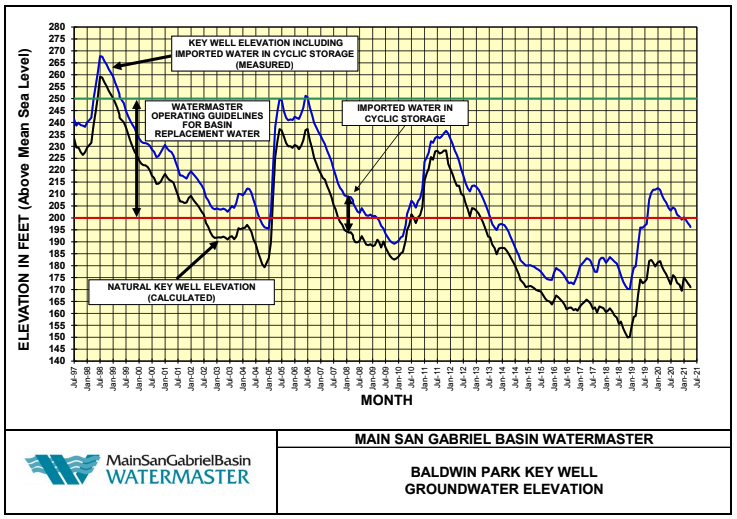
Groundwater – in the Main San Gabriel Basin, the “Baldwin Park Key Well” is the indicator of groundwater levels (see graph below – blue line includes cyclic storage; black line does not). As of April 30, 2021, the level is 194.8, a decrease from one month ago. The Basin has experienced a fairly steady decline from 212.5 feet above mean sea level in December 2019. The present level is still an improvement from the historic low of 169.4 as recently as November 21, 2018. Watermaster’s operating guidelines for replacement water or “safe yield” is between 200 and 250 feet above mean sea level. Main San Gabriel Basin groundwater supplies, which account for nearly 80% of the water we use, remain below desired levels and remain in need of ongoing smart management, replenishment and conservation. We live in a dry region where drought will recur; we all need to view “conservation as a way of life.”
|
|
As Pandemic Restrictions Decline and Drought Conditions Worsen, New Outreach and Education Projects are in the Pipeline!
|
|
Nearly every water district, government agency and business has had to adapt and be innovative to continue to reach stakeholders and customers during the Covid-19 pandemic. Below, we’ve recapped recent initiatives, many new, that are being implemented by the District to continue to inform and educate our key stakeholders about water supply issues and conservation, especially as drought conditions worsen.
Our new website will be unveiled soon with a new look to the home page, new and updated content, increased ease and function of application forms for the rebate and O.W.L. Grant programs, and improved functionality for smart-phones, tablets, laptops and home/office computers. In everything that we do, we stress that conservation as a way of life is increasingly important due to imported water reductions and declining local groundwater supplies.
Earth Day Public Information Ad
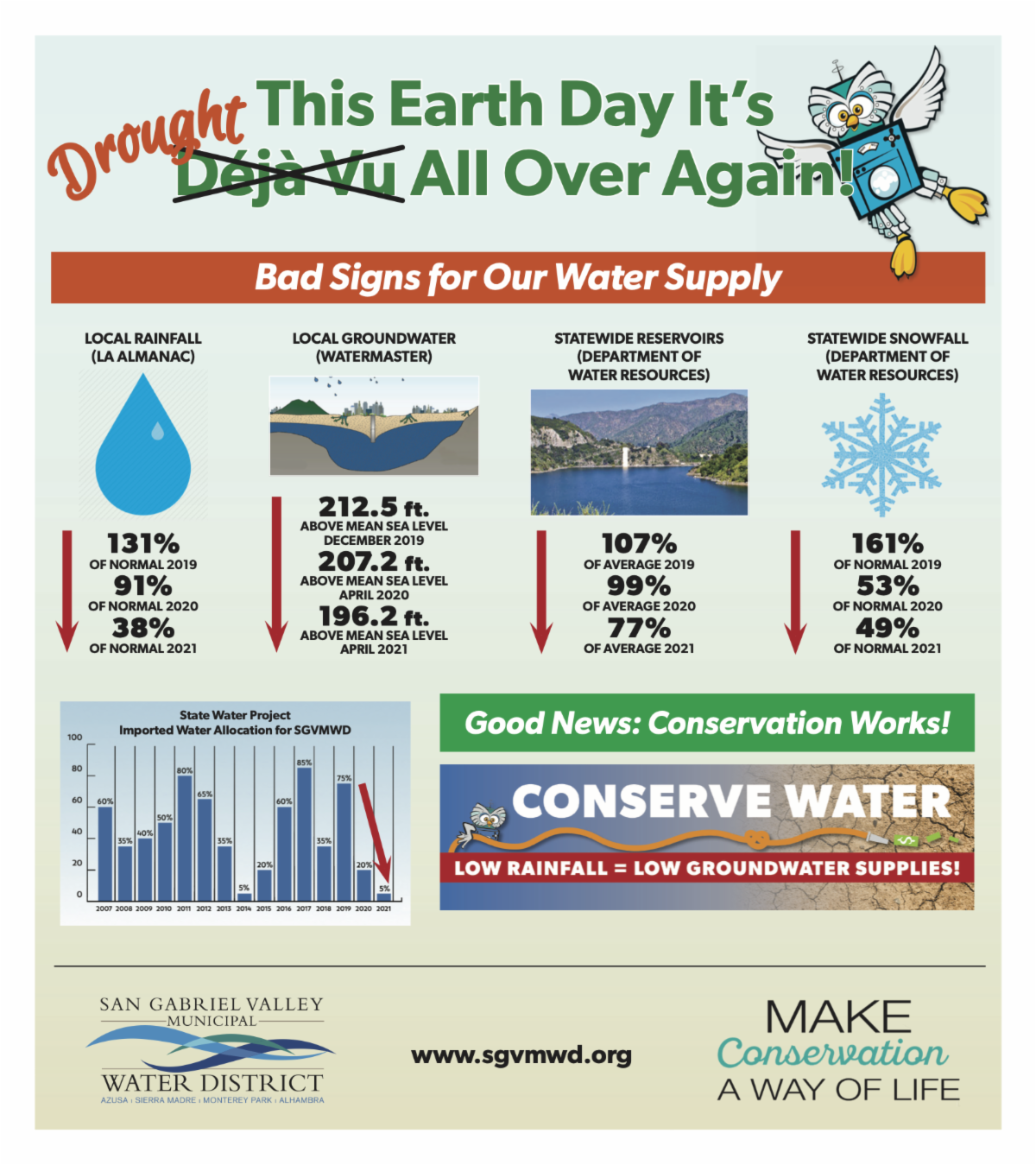
For nearly a decade, the District has placed public information ads (see below) in supplements to the LA Times and the San Gabriel Valley Tribune to inform stakeholders, especially residents and community leaders, about important water issues and trends in the San Gabriel Valley, which sometimes get overshadowed by news about water conditions in the City of LA. Note that our message is that drought conditions have worsened but that water conservation is a big part of the solution if everyone adopts “Conservation as a Way of Life.”
|
|
Drought Awareness Plan
Similar to our most recent severe drought which lasted from 2014-2019, the District’s Board of Directors has been evaluating a variety of drought awareness initiatives as our local groundwater supplies, as well as supplies of water imported from northern California, have declined. The District is working closely with Main San Gabriel Basin Watermaster, its member cities, local businesses, and schools and libraries to develop messaging for banners, lawn and median signs, social media, Town Halls, printed materials, media outreach, community events (as they gradually ramp up), and other communications vehicles. We’ll have more to report on this in upcoming editions of this newsletter.
New, Fun "Water Awareness Growth Chart"
As part of our commitment to assist and work with teachers, parents and students during the pandemic, the District created a new, fun water education project, the “Water Awareness Growth Chart.” Already, the Alhambra Unified School District, which serves Alhambra and Monterey Park, and Sierra Madre Elementary School and local libraries, are planning to share the Growth Chart with their students!
It will help students learn more about groundwater, imported water, water terminology, and water conservation. The fun part is the Growth Chart is about 3-feet long and folds out so that students can keep it long-term in a convenient location and engage in several fun activities:
-
Coloring in images of the Valley, the Sierra Nevada Mountains, H2Owl, Native Plants and more
- Use the “Water is Amazing” maze to figure out how water gets from northern and southern California to groundwater and, ultimately, to our taps in the San Gabriel Valley
- Play a multiple choice game featuring fun water facts and terms
- Measure rainfall on a life-size scale
- Measure students’ height on a life-size scale!
Check it out and download our Growth Chart here. Or, you may contact the District (626-969-9711; info@sgvmwd.com) and we’d be happy to mail you your own Growth Chart!
|
|
New Brochure
A new brochure was created for use in both printed and electric forms. You may read or download the brochure on our website.
|
|
Speakers' Bureau Presentations and Virtual "Town Hall" Outreach Meetings
Each year, the District meets in person with Member City City Councils, legislators, media and others to provide a comprehensive overview of its operations, water supply issues and conditions, and water conservation initiatives. Due to the pandemic, the District is utilizing online resources to sustain its outreach program.
Recently, Director Miles Prince (Division IV – Sierra Madre) provided a “virtual/on-line” presentation to the Sierra Madre City Council. On Wednesday, March 31, 2021, the District, along with guest Tony Zampiello, Executive Officer of Main San Gabriel Basin Watermaster, hosted a virtual “Town Hall” meeting for all of its member cities where District representatives and guest speakers discussed topics including the District’s new Rate Assistance Program, the new Pandemic-Related Loan and Grant Program, local and state water supply conditions, the District’s recent $2.68 million investment in the Delta Conveyance Plan, and spring and summer water conservation opportunities.
On May 25th, the District is planning an on-line “Town Hall” meeting for LA County legislative staff, with another on-line “Town Hall” meeting for Asian-language media planned for late June.
Education Videos and "Virtual School Assemblies"
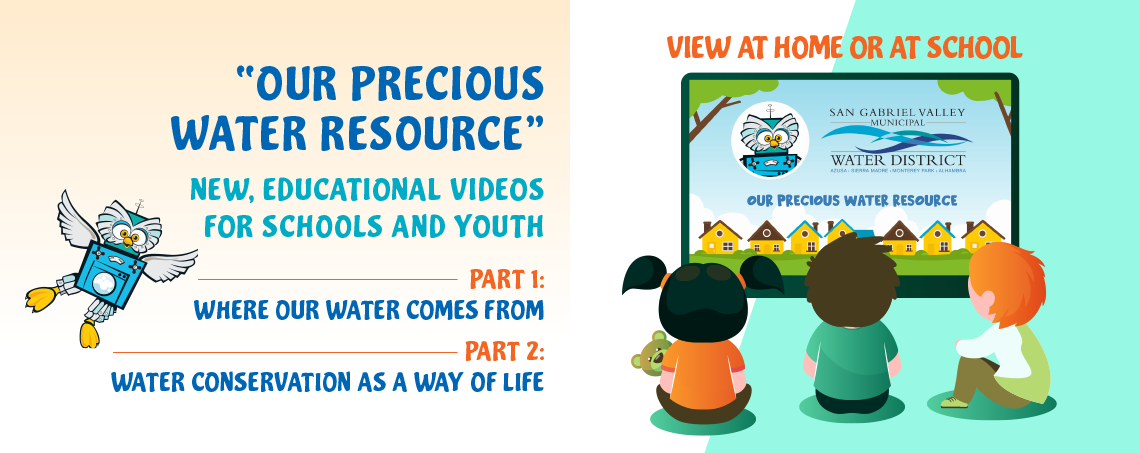
For more than a decade, the District’s community and school education programs featured in-person appearances and presentations by H2Owl and District spokespersons at more than a dozen elementary schools each year. We participated in “assemblies,” meeting with thousands of students and teachers each year to encourage home-based, learn-by-doing water saving practices. Those presentations, which were refined through many years of trial, have now been creatively re-imagined into the video series entitled, “Our Precious Water Resource.” The videos may be viewed individually or in conjunction with the District’s long-standing Home Water Survey exercise.
Please enjoy the videos highlighted below and contact Evelyn Reyes (626-969-7911) if you’d like to work together to present the “Our Precious Water Resource” videos and/or “Water Awareness Growth Chart” to your schools, students or community organizations.
|
|
O.W.L. Grant Program - Get Ready for Summer!
The Opportunities for Water Leadership Grants (O.W.L.) remain available despite the Covid-19 pandemic and now is the time to plan and prepare for projects later this year when, hopefully, community activities become normalized again. The O.W.L. - Opportunities for Water Leadership Grant Program is a great way to aid educational events such as Earth Day festivals (outdoors or virtual/on-line), re-landscaping projects, waterway cleanups, tree plantings, school projects, conservation curriculum, and other civic, volunteer activities.
The grants range from $200-$2,000 for local, creative water conservation projects. The District welcomes creative ideas from schools, teachers, PTAs, community organizations, scouting organizations, athletic teams and service clubs, and is happy to provide technical assistance to help you understand and complete the grant application. The Grant Program remains open to applicants through June 30, 2021.
Our list of grant recipients is growing so please review our grant program information and prepare your applications today! A recap of our grant recipients to date is included on the District’s website: Please click here to read about the Grant Program and to access the online application. For further information, please contact the District at 626-969-7911.
|
|
Update on Rate Assistance Program and $8.2 Million in Financial Support for Member Cities for Water-Related Infrastructure and Pandemic Relief Projects |
|
Rate Assistance Program
The Rate Assistance Program is designed to make grant funds available of up to $500,000 to Member Cities for low-income bill assistance and/or delinquent account assistance. To date, the financial impact from the pandemic for past due accounts over 120+ days for our Member Cities totals over $1 million. The Program will help fund existing low-income assistance programs, and it would also assist in providing a discount to residential/commercial accounts that have selected to enroll in a repayment program. The Program is funded by interest revenue earned from District reserves and will be administered by Member Cities.
Two Million Dollar, Zero-Interest Loans
At its November 2020 meeting, the District’s Board of Directors voted to increase the zero-interest loans available to both Sierra Madre and Monterey Park from two to as much as four million dollars after the cities of Alhambra and Azusa declined the two million dollar loan offered to each. Earlier in 2020, the Board had approved offering member cities this zero-interest financing for water-related infrastructure and pandemic relief projects (loans amounting to $2 million for each city). These modifications do not change the anticipated budget impact from the program.
$50,000 Grants
The District also offered grants of $50,000 per member city, with each member city accepting the grants, for water-related projects such as rate-payer relief, water conservation and public education, to help cities cope with the effects of the COVID-19 pandemic.
The funds for each component of the financial support will be allocated out of reserves to spur water infrastructure investment to help ensure continued safe and reliable water supplies and also to help support local jobs during the current economic downturn. To read the complete news release on this subject, please click here.
|
|
Summary of Projects Funded in Member Cities
Following is an update of how our member cities plan to utilize the loan and grant funds. We will provide updates in future editions of this newsletter as details of the loans and grants are finalized.
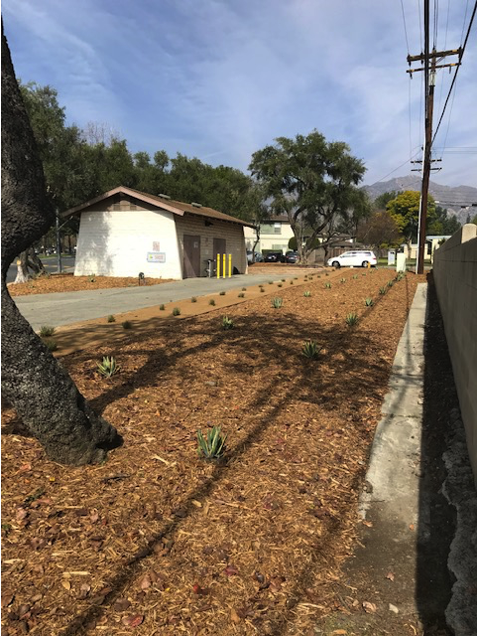
- Azusa plans to utilize its $50,000 grant for landscaping projects such as removal of vegetation, installation of drip irrigation systems with weather based controllers, planting of new California Native and drought tolerant plants, and installation of permeable ground cover at the following locations: 11th and Vernon Booster Station (pictured right), Well 7, Well 8, the Water Yard, Griffith Reservoir site and the Water Filtration Plant.
- Alhambra will utilize its $50,000 grant for water-efficient landscaping projects.
- Monterey Park will apply their four million zero-interest loan for construction of a PFAS/PFOA treatment facility, which will coast approximately six million dollars. The City will use the $50,000 grant to update urinals and toilets in facilities throughout the City.
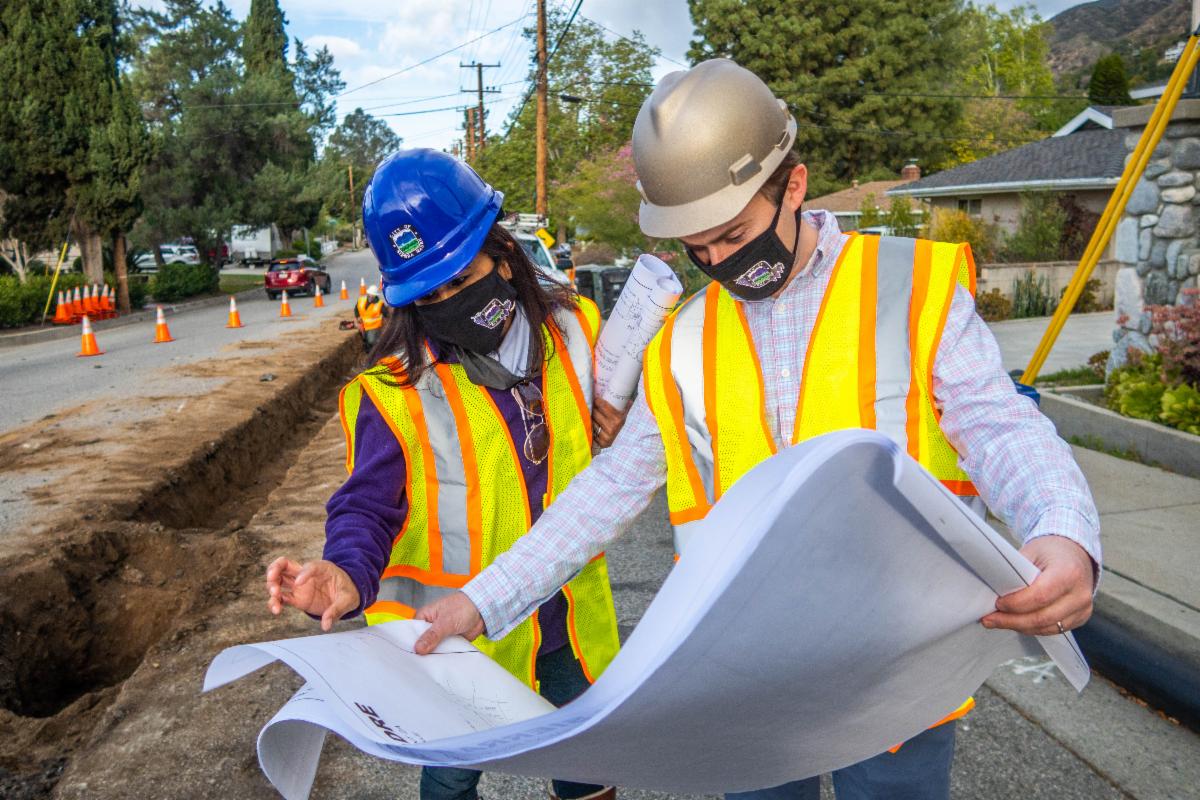
- Sierra Madre plans to utilize a $2.8 million loan to fund water main replacement projects in fiscal years 2021, 2022 and 2023. The first of the projects has already begun as shown in the photo below of Sierra Madre Mayor Rachelle Arizmendi and SGVMWD Board Member Miles Prince reviewing plans at a construction site. The City will utilize $50,000 of grant funding for water related projects such as improving its West Tunnel treatment facility, establishing a pandemic relief fund for utility customers experiencing financial hardship, and providing funding for its low-income water rate.
|
|
Sierra Madre Mayor Rachelle Arizmendi (left), SGVMWD Division IV Director Miles Prince (right)
Photo courtesy of City of Sierra Madre
|
|
Saving Water Means Saving Money!
Increased Rebate Amounts for Clothes Washers and Rain Barrels
|
|
Early spring is a good time to plan ahead to save water…and save money…by checking for leaks, turning off outdoor sprinklers, making sure we are efficient in our use of indoor appliances, taking shorter showers and turning off the water when we brush our teeth.
The San Gabriel Valley Municipal Water District has offered a rebate program for many years for a variety of water-saving appliances and equipment. Many residents have cashed in and reaped the benefits of lower water bills and money in their pockets. Winter is a great time to plan ahead in advance of the warmer, drier months when water usage spikes upward. The decisions you make now will save you water and money later in the year.
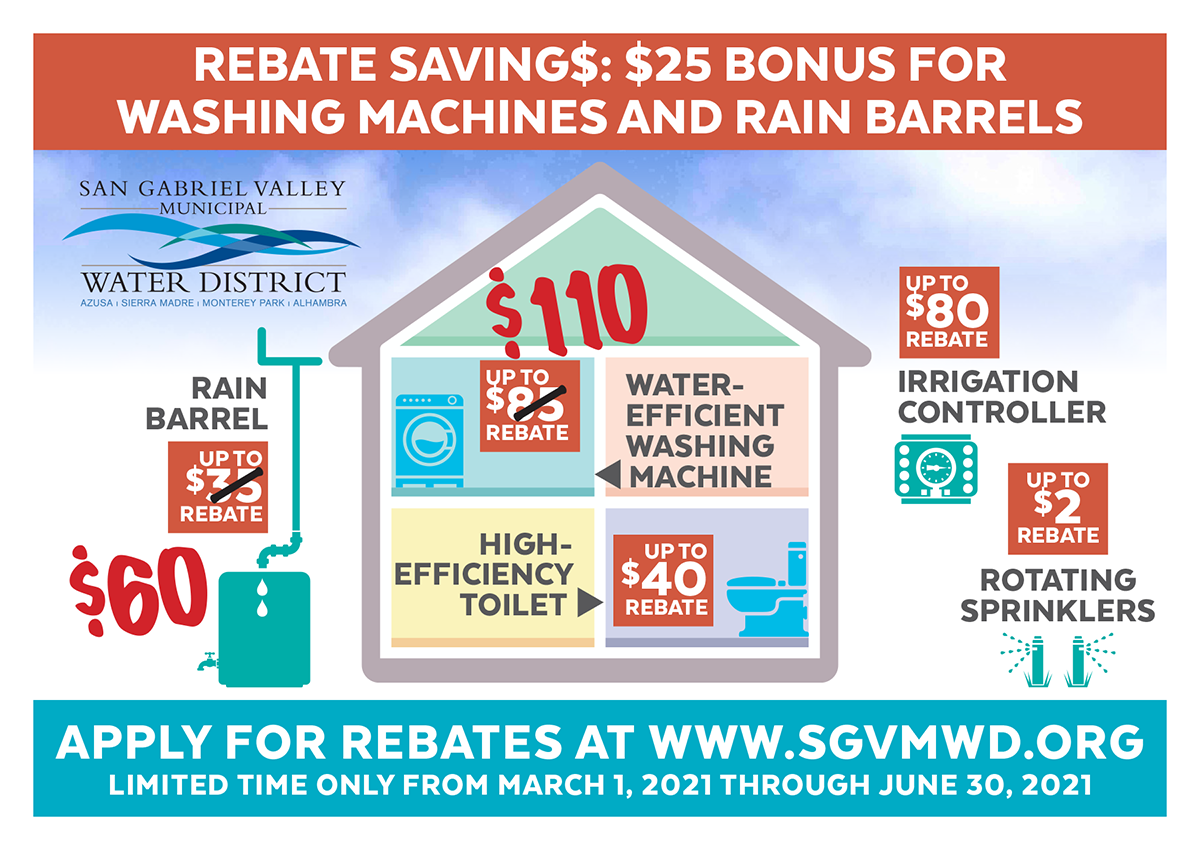
Beginning March 1, 2021, and continuing until June 30, 2021, the District is increasing the rebate amounts for two of our most popular rebate items – water-efficient washing machines and rain barrels. We want to help you and “flood the market” with more water saving devices that use less water and electricity, use less detergent, and capture water that could wind up in sewer drains or cause erosion around your home. The illustration shows the variety of rebates available and shows the $25 bonus rebate amounts for water-efficient washing machines and rain barrels.
If you’re in the market for any of the appliances or equipment shown on the illustration, take advantage of our rebate program, and increase your savings on clothes washers and rain barrels whether you purchase in person or online. Residents who pay their water bill to the cities of Alhambra, Monterey Park and Azusa are eligible to participate. Visit our website (www.sgvmwd.org/Conservation/Rebates) for further information to help you apply and know which products qualify for the rebates.
The District is also trying to get the word out about the increased rebate amounts by advertising in local papers and using a direct mail campaign featuring a postcard with rebate information sent to thousands of households. Upcoming phases of the direct mail effort will likely include “bonus” amounts and new items for which rebates may be obtained.
If you take action today, you should be enjoying that rebate, extra cash and water savings within 8-10 weeks time. If you have any questions, please call us (626-969-7911) or email us (info@sgvmwd.com). Thank you and stay safe!
|
|
San Gabriel Valley Municipal Water District
|
|
|
|
|
|
|
|