The voice for pharmacy compounding | June 18, 2021

From APC’s President
Once upon a time

Michael Blaire, RPh, FIACP
APC President
Narrative economics is a branch of economic science that attempts to explain asset bubbles in capital markets, and more importantly, why they burst. The approach has recently received an extended definition and analysis in Nobel Prize winning economist Robert Shiller's book, appropriately titled Narrative Economics. Defined simply, a narrative is a story. The extended definition is that a narrative is a story that is widely shared through various channels and has a powerful influence on behavior in ways that shape the course of social change. Spread through the public in the form of popular stories, ideas can go viral, transmitted by word of mouth, by the news media, and, of course, by social media. The importance of narratives is not whether they are true or false, but that belief in the narrative affects behavior. Using a rich array of historical examples, Shiller argues that studying popular stories that affect individual and collective behavior has the potential to vastly improve our ability to predict, prepare for, and lessen the damage of major events.
The concept of narratives in and of itself is nothing new. Narratives have been studied by literary scholars and social scientists for decades. In some ways, narrative economics is just a more formal presentation of what has always been referred to as anecdotal evidence. But in the realm of science, anecdotal evidence is discounted because it is difficult to quantify and cannot easily be plugged into a spreadsheet. But anecdotal evidence is powerful when used properly.
Six months ago APC set out to collect anecdotal evidence in an attempt to craft a narrative about what compounding pharmacists do, especially as it applies to the compounding of bioidentical hormone therapy. For years FDA and its supporters at think tanks and the media have pushed the narrative that the "unregulated, shadow industry" of compounding pharmacy puts millions of Americans who use our unapproved preparations at risk. Those who do not know any better easily fall in line. Which is why our cBHT Media Campaign is so important. It is easy to vilify a faceless, monolithic entity like "compounding pharmacies" or "Big Pharma." It is much harder to vilify hundreds of post-menopausal women, infertile couples and men with low T.
Anecdotal evidence has been flowing into our website, Compounding.com. But that source is about to dry up. We are still $400 thousand short of the $1.5 million that we need. That we have raised over $1 million in 5 months is impressive, and to everyone who has contributed, thank you. But there are still groups and people who benefit from cBHT and our ability to compound it who have not yet contributed. Please check that all of your vendors have contributed, and if they haven't, ask them to do so immediately — the link is A4PC.org/cbhtcampaign. Talk to friends and family, and ask for their support. Likewise, if you are a member of a local, state or national association with an interest in pharmacy or cBHT, make the ask.
We’ve got a whole website of members-only tools for you to use, from posters and handouts you can print, to sample letters and social media posts. Use it: A4PC.org/cbhttools.
Reframing our narrative will have benefits that extend far beyond just cBHT. Please help ensure that our story has a happy ending.
Michael Blaire is APC’s president, but his day job is vice president for government and regulatory affairs at Wedgewood Pharmacy in Scottsdale, Arizona. You can reach him at mblaire@wedgewoodpharmacy.com.
This Week
JUST HOURS AWAY:
An URGENT briefing on the cBHT campaign
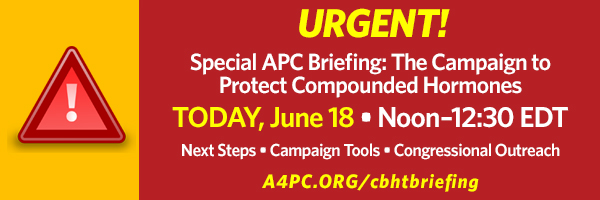
Join us TODAY, June 18, from noon to 12:30 EDT when APC hosts an important update on the current situation of the media campaign to protect compounded hormones. It will include our next steps (including congressional outreach), plus the latest campaign tools we've developed for compounders.
We know you're busy. We'll do it this in 30 minutes or less. It's free via Zoom and open to anyone.
If you compound or prescribe cBHT, YOU NEED TO ATTEND.
Visit A4PC.org/cbhtbriefing for details and to register!
CALL TO ACTION: Urge Congress to co-sign the letter to FDA
Several states have already said they're unable to sign the MOU due to their existing laws — or simply because it requires legislative action that can't happen in time.
That's why Reps. Henry Cuellar and Neal Dunn are asking fellow congressmen and -women to sign their letter — a letter to be sent to FDA requesting a delay in the MOU's implementation. Read the letter yourself here.
The CALL TO ACTION: We must get our representatives to add their names to that letter. Send an email. Make a phone call. Visit the district office. Do whatever it takes to get the message out and a signature on the letter.
THE LETTER CLOSES FRIDAY THE 25TH, so we have ONE WEEK to get those co-signers. Don't wait! Right now, make that call or send that email. It takes five minutes, tops, to say, “I’m a constituent and I’d like to ask Representative ______________ to respond to the Cuellar-Dunn letter.”
FDA has waited 24 years to implement the MOU. It can surely wait one more.
STARTS NEXT WEEK
Steri-Tek, Topi-CLICK add $20,000 to cBHT campaign
We're so close — we need you now. APC's cBHT Media Campaign has received a pair of $10,000 gifts to the campaign — one from Steri-Tek and one from Topi-CLICK/DoseLogix. This is amazing news, and we owe both companies a big thank you.

This means we've raised about $1.16 million of the $1.5 million we need for a full campaign launch — we're still more than $300,000 short of the goal. If we don't meet that goal, it will mean much of the work and money we've put into the campaign will go to waste. We'll have plenty of content, but not enough funding to get the word out nationally.
PLEASE: If you haven't yet supported the campaign to save cBHT, we need you now. Time is running out. If every pharmacy compounder contributed just 1 percent of their cBHT business, we'd have hit our goal long ago. That's all we're asking: 1 percent to protect the other 99 percent.
Remember, if you make your contribution by June 30, Medisca will match it. You'll double your impact. So please, do it today.

Board approves new ‘company’ APC membership
Among decisions the APC Board of Directors made when it met this past Tuesday was approval of a new “company” membership category. The aim is to roll out the new membership in January 2022.
“For our entire 30-year history, we’ve been an individual-membership organization, and when the number of compounders was greater, it’s a model that worked,” said APC’s CEO Scott Brunner. “But continuing consolidation in the business, coupled with new and thorny policy challenges, means that old model cannot sustain APC. Company memberships will allow us to represent many more voices while providing additional revenues to fund our advocacy work.”
Under the proposal the board approved, the new membership will be in the name of the pharmacy or outsourcing facility, and all employees will become APC members. Dues will be based on the total number of pharmacists and technicians the company employs, and company members will be eligible for a range of value-add services, included in the dues, that are not available to individual members.
“Now that the board has approved it, we’ll begin to build out the system,” Brunner said. “Our aim is to be able to make the services delivered via a company membership so attractive that it will be hard for a pharmacy or facility owner to say no to it.”

Next week: Three APC district town halls
Don't forget, if you're in APC's District III, District IV, or District VII, you've got a district town hall coming next week!
District III: June 22 at 4:00 pm EDT
Illinois, Indiana, Kentucky, N. Carolina, Ohio, S. Carolina, Virginia, W. Virginia
District IV: June 23 at 4:00 pm EDT
Alabama, Arkansas, Florida, Georgia, Mississippi, and Tennessee
District VII: June 24 at 2:30 pm PDT
Alaska, Arizona, California, Hawai'i, Idaho, Nevada, Oregon, and Washington
Get updated on the latest issues facing the compounding profession, what APC is doing about them, what we see coming up, and — of course — how you can help. It'll be hosted by local APC board members, and it's open to both members and non-members — no registration required.
Some topics on the agenda:
- The current state of potential cBHT limits, and of APC's Media Campaign to protect compounded hormones
- USP <795> and <797> updates
- APC’s just-introduced “Urgent Use” legislation
- Upcoming APC meetings and educational opportunities
When it's time for your meeting, just log in with Zoom:
Click here to join by computer
Meeting ID: 867 8814 5153
Passcode: 261703
Or by one-tap mobile: +13126266799,,86788145153#,,,,*261703#
Questions? Drop a note to info@a4pc.org.
DEA is upping enforcement — are you ready?
Do you work with controls? If so, you NEED to be at next week's important CE webinar.
Compounding with controlled substances means you need to be more than smart and ethical — you must be 100% compliant.
When it comes to compounding, the DEA doesn't pull punches.

Help end DIR fees!
APC has signed onto a letter of support for the sponsors of H.R. 3554 and S. 1909, the Pharmacy DIR Reform to Reduce Senior Drug Costs Act. But we need more than just thanking the sponsors — we need more sponsors!
We know you’re busy, so our friends at NCPA are making it easy. One click is all you need. Go here to contact your senators and representative and urge them to support bipartisan pharmacy DIR reform efforts by cosponsoring S. 1909/H.R. 3554, the Pharmacy DIR Reform to Reduce Senior Drug Costs Act.
Pharmacy DIR fees grew 91,500% between 2010 and 2019, more than doubling between 2017 and 2019. Ridiculous? You bet it is. DIR fees are out of control and are unsustainable.
We need your help! Voice your support for this important legislation for community pharmacy.

Coming Up
TODAY, June 18; noon to 12:30 EDT — special APC briefing on cBHT media campaign
June 23; 2:00–3:00pm EDT — APC CE: Controlled Substances and the Corresponding Responsibility of the Pharmacist
APC district town hall meetings:
- June 22; 4:00pm EDT — District III
Illinois, Indiana, Kentucky, N. Carolina, Ohio, S. Carolina, Virginia, W. Virginia
- June 23; 4:00pm EDT — District IV
Alabama, Arkansas, Florida, Georgia, Mississippi, and Tennessee
- June 24; 2:30pm PDT — District VII
Alaska, Arizona, California, Hawai'i, Idaho, Nevada, Oregon, and Washington
APC CE: Leveraging a COA — a three-part course bundle:
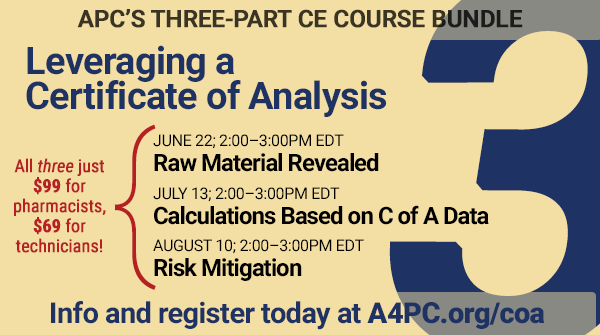
- June 22; 2:00–3:00pm EDT — Leveraging a COA: Raw Material Revealed
- July 13; 2:00–3:00pm EDT — Leveraging a COA: Calculations Based on C of A Data
- August 10; 2:00–3:00pm EDT — Leveraging a COA: Risk Mitigation
This fall (date TBA) — Compounders on Capitol Hill
November 8–10 — Informa Connect's Compounding Pharmacy Compliance East In Person
November 15–17 — Informa Connect's Compounding Pharmacy Compliance East Virtual
Short Takes
Connecticut pharmacists — quit your day job? The Connecticut Department of Consumer Protection is looking to hire a Consumer Protection Drug Control Principal Agent to work with the state's potential upcoming cannabis marketplace. Click here for info and to apply — you have till June 30.
CureVac flops: German drugmaker CureVac’s Covid-19 vaccine was only 47 percent effective in a large clinical trial. So don’t expect to see it very soon, unless the FDA suddenly starts approving drugs that don’t necessarily work*.
* And that could never happen, of course.
Science marches on: Who among us hasn’t woken in the middle of the night wondering, “Can honeybees become alcoholics?” Polish researchers finally have the answer. Yes, if you give honeybees alcohol, then stop, the bees get withdrawal symptoms. Now you know.