UC Davis TERC has compiled an unbroken chain of data from Lake Tahoe for over 50 years. Not a week goes by when an instrument is not deployed, a water sample not collected, or algae not viewed under a microscope. Measurements are typically taken every 10-30 days, amassing a huge data set. These data enable us to keep track of changes in lake clarity and record the seasonal progressions of life in the lake and have allowed us to inform management decisions for Lake Tahoe.


But changes in a lake actually happen much faster than that. In a matter of hours, a storm can move contaminants across the lake, zooplankton can ascend hundreds of feet in a single night, and pulses of storm water can carry much of the year’s fine particles into the lake. The details of these events have largely gone unrecorded, but that is about to change.


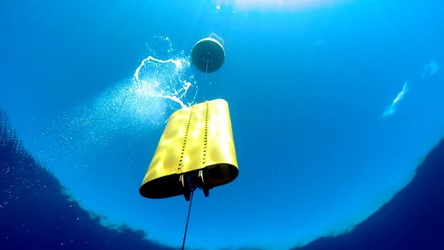
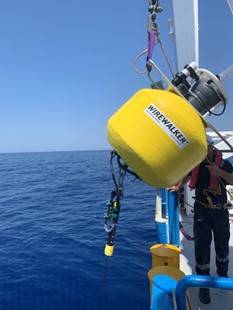
In spring  2024, TERC will be commissioning the next element in the Autonomous Realtime Lake Observatory (ARLO)― the Wirewalker. It will join the existing TERC Observatory components that include nearshore stations, underwater gliders, and deep-water temperature and oxygen stations, that currently operate in the lake. The Wirewalker is a wave-powered, water quality profiling system, capable of taking measurements of lake properties from the lake bottom to the lake surface every 20 minutes― 24 hours a day, 7 days a week, 365 days a year.

A Wirewalker in operation (courtesy of Del Mar Oceanographic)

The system moves along a wire suspended vertically between a surface buoy and a bottom weight. Following the motions of the buoy on the waves, the Wirewalker drives itself down the wire. An internal cam grasps the wire when the buoy descends and releases when the buoy ascends on a wave. Once at the bottom of the wire, it disengages from the wire and slowly floats up, taking eight measurements per second as it rises and relaying the data to the buoy. At the top, the cam resets and the cycle repeats, powered by the endless motion of the waves.

The system moves along a wire suspended vertically between a surface buoy and a bottom weight. Following the motions of the buoy on the waves, the Wirewalker drives itself down the wire. An internal cam grasps the wire when the buoy descends and releases when the buoy ascends on a wave. Once at the bottom of the wire, it disengages from the wire and slowly floats up, taking eight measurements per second as it rises and relaying the data to the buoy. At the top, the cam resets and the cycle repeats, powered by the endless motion of the waves.


Data from the Wirewalker buoy (pictured left courtesy of Del Mar Oceanographic) will be uploaded in real-time and analyzed by researchers and graduate students. The data will also be available to the public in TERC’s science education stations around the Lake Tahoe basin.


What difference will this Wirewalker make? Rather than simply infer what happened between monthly measurements as is currently done, TERC researchers will be able to study the evolution of water quality and ecosystem changes at a detail that exists at almost no lake in the world. Every 20 minutes a new set of data will be acquired. This will also help in the development of better predictive models, which in turn help formulate improved lake management approaches.


The Wirewalker and most of the ARLO components were purchased and maintained through private support― the people and foundations who care about Lake Tahoe 24/7/365. To learn more about how you can join this network of supporters and keep Lake Tahoe the smartest lake in the world, please contact Toni Myshyakova (amyshyakova@ucdavis.edu).


To learn more, update your UC Davis TERC mailing lists options, visit the UC Davis Tahoe Science Center in person, check out the UC Davis Tahoe YouTube channel, and stay social with us on Facebook, Instagram, and Twitter.


Support Science to Save the Lake


Share this story on Facebook, Twitter, or LinkedIn:

LinkedIn Share This Email
 
 
Facebook  Instagram  Twitter