| |
|
September 8, 2026
News and Resources for Physicians and their staff in Kern County
| | |
Please take the KCMS Event Attendance Insight Survey now! Due Date extended to September 11, 2026.
Your input is needed. Please take our brief event attendance insights survey!
KCMS is reviewing how we manage RSVPs and attendance for socials, educational programs, and other member events. Historically, KCMS experiences no-show rates ranging from 25%–65%, making it challenging to accurately plan for food, materials, and event costs.
We hope to gain a better understand why members are unable to attend after registering and whether a simple reconfirmation process before events could help KCMS obtain a more accurate headcount and reduce unnecessary costs, while ensuring we have sufficient accommodations for attendees.
Please take our survey by September 11, 2026!
| | |
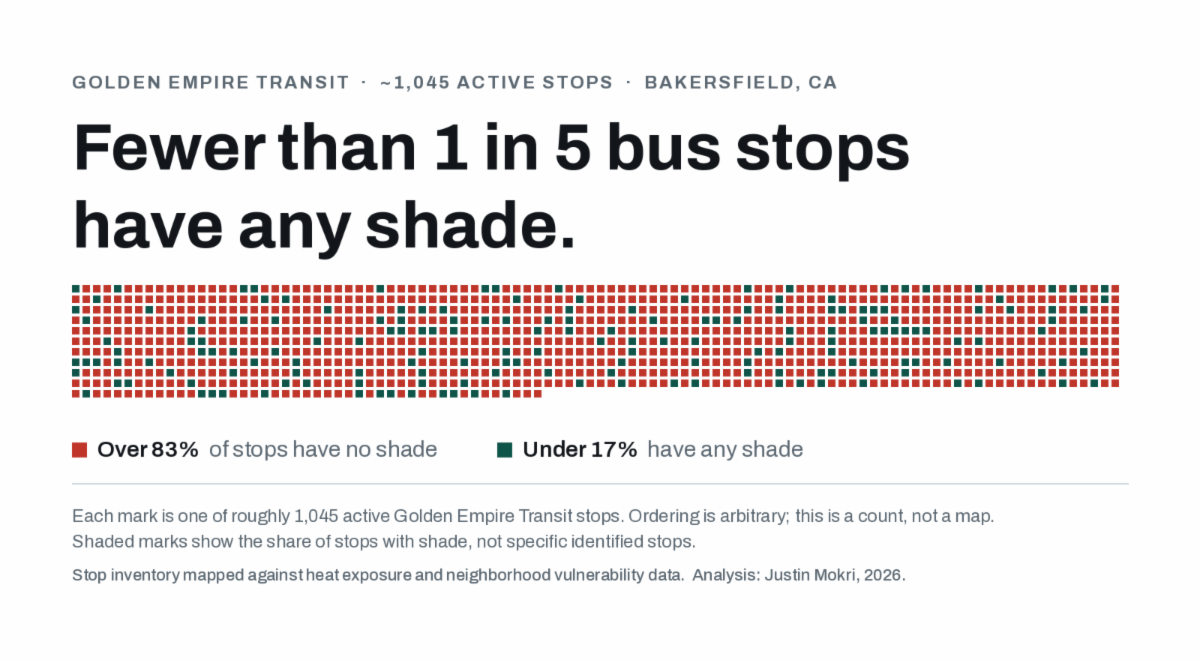
Fewer Than One in Five Bakersfield Bus Stops Have Shade
KCMS members are invited to sign a letter to the Bakersfield City Council and the Golden Empire Transit Board.
By Justin Mokri, Bakersfield Christian High School Student
August 2026
Golden Empire Transit operates roughly 1,045 stops in the Bakersfield area. Fewer than 17 percent have any shade, and the stops with the least shade are concentrated in the neighborhoods with the highest heat exposure and the highest rates of transit dependence. The KCMS Board of Directors voted unanimously this month to support a proposed city shade standard at highridership stops, and Kern County physicians are invited to add their names to a sign-on letter to the Bakersfield City Council and the GET Board. Adding your name takes about a minute.
California already treats shade as a heat-protection measure. Under Cal/OSHA's heat illness prevention standard, employers must make shade available to outdoor workers once the temperature passes 80 degrees. A Bakersfield resident who works outdoors is entitled to shade on the job site and has no claim to it at the stop where they wait for the bus that takes them there, at the same hour, in the same heat. The people waiting are largely people without another option. Riders skew toward older adults, people with disabilities, households without a vehicle, and patients traveling to recurring appointments. Their exposure is not discretionary. Someone going to dialysis three times a week cannot move the trip to a cooler hour, and the wait is not short. Off-peak headways on much of the GET system run 30 to 60 minutes
READ THE FULL ARTICLE
JOIN THE EFFORT AND SIGN THE LETTER TODAY
| | |
CalMedForce opens 2026–27 grant cycle with $83.5 million available for California GME programs
Physicians for a Healthy California (PHC), in partnership with the University of California, has opened the FY 2026–27 CalMedForce and CalMedForce+ grant cycle, providing approximately $83.5 million to support graduate medical education (GME) programs across California.
Together, CalMedForce and CalMedForce+ support new, expanding and existing residency and fellowship programs, with funding aimed at strengthening California's physician workforce and supporting programs that serve medically underserved areas and populations. More...
| | |
| |
Why Aren’t We Treating Stroke as a Chronic Health Condition?
The health care industry approaches stroke as an acute transient event, with access to innovative and even standard treatments limited by money rather than the patient’s recovery potential.1 Stroke has been classified by the United States Centers for Medicare and Medicaid Services (CMS) as a condition that lasts at least 1 year, requires ongoing medical attention, and limits activities of daily living.2 A stroke impacts multiple systems resulting in lasting morbidities that will decrease life quality. If stroke is a chronic health condition, why aren’t we treating it as such?
Although we generally think of stroke as a medical problem of older adults, it is estimated that 10% to 20% of strokes occur between ages 18 to 50 years and rises by a factor of 100 from age 40 to 80.3 Young adults with strokes have been found to have a 15% cumulative incidence of a second stroke. Approximately 33% to 42% of stroke survivors will require assistance with daily living activities 3 to 6 months poststroke, and of those, 36% will report a disability after 5 years. More...
| | |
|
Medical board physician licensing fees to increase Jan. 1
Physicians applying for or renewing a Physician’s and Surgeon’s license through the Medical Board of California will pay higher fees beginning Jan. 1, 2027.
The fee for both initial licensure and biennial renewal will increase by $104, from $1,151 to $1,255. The same increase applies to initial and renewal fees for special faculty permits.
Other fees will also increase:
- The half initial license fee will increase from $575.50 to $627.50.
- The delinquent fee will increase from $115.10 to $125.50.
-
The penalty fee will increase from $575.50 to $627.50. More...
| | |
| |
CMA webinar series helps practices prepare for and respond to payor audits
The California Medical Association (CMA) will host the second installment of its two-part coding risk monitoring webinar series on Sept. 10, with practical guidance for responding to payor audits, reviews and investigations. Physicians and practice staff who missed the first session can watch it on demand before attending Part 2.
Presented by health care data scientist and Medicare audit defense expert Frank Cohen, the series helps practices identify potential coding concerns and respond appropriately when issues arise. More...
| | |
| |
CMA President’s Letter: Proposition 35 implementation and investments
What You Need to Know: CMA President René Bravo, M.D., provides an update on Proposition 35 implementation, including substantial new investments in graduate medical education, family planning services and supplemental Medi-Cal payments for primary and specialty care.
Dear Colleagues,
I want to update you on the hard-fought Medi-Cal investments CMA secured through Proposition 35. This year, we are seeing substantially more investment than we did in 2025 to strengthen the physician workforce and protect access to care. More...
| | |
| |
Reminder: Physicians should verify Medi-Cal enrollment ahead of ORP enforcement
The California Department of Health Care Services (DHCS) expects to begin phased enforcement of Medi-Cal ordering, referring and prescribing provider enrollment requirements as early as February 2027. DHCS previously planned to begin enforcement in June 2026 but postponed implementation in favor of a phased, multiyear approach beginning with provider outreach, education and enrollment assistance.
Physicians should verify their enrollment status now and, if necessary, enroll as soon as possible, as applications can take up to 90 days to process. More...
| | |
| |
CMA medical group symposium examines a sustainable path to health care affordability
How can California make health care more affordable without compromising access or quality or further straining the health care workforce?
That challenge was a central focus of the California Medical Association’s (CMA) 2026 Medical Group Advocacy Symposium, held August 21 in Newport Beach. Physicians, medical group executives, health plan leaders, purchasers and policymakers examined the political and economic pressures reshaping California’s health care system — and what it will take to build a more sustainable path forward. More...
| | |
2027 proposed Medicare fee schedule: What physicians need to know
In July 2018, the Centers for Medicare & Medicare (CMS) first proposed the idea of cutting physicians’ Medicare pay when they provide a separately identifiable office or outpatient evaluation and management (E/M) visit on the same day as most procedures are performed.
The agency scrapped the plan eight years ago after physicians and other stakeholders raised serious concerns. But CMS is pitching a similar idea in its 2027 Medicare physician payment schedule proposed rule. If finalized, most changes, including this one, would be scheduled to take effect Jan. 1.
More...
| | |
4 tips for resident physicians to weather their first night shifts
Your first night shifts as a resident physician may be unlike anything you’ve faced before in medical training. The stakes are high, your responsibilities are greater, and with fewer other members of the care team available, the workload can be particularly heavy. But with education, planning, solid fatigue mitigation strategies and proper sleep hygiene skills, you can learn how to thrive in the new environment. More...
| | | | |
Looking for Upcoming Events & Webinars
Due to the number of upcoming events & webinars available, we send information for them in a separate email. See our last email:
Upcoming Events & Webinars
| | | | |