JUNE 15, 2026

Facebook  X  Instagram  Email  Web

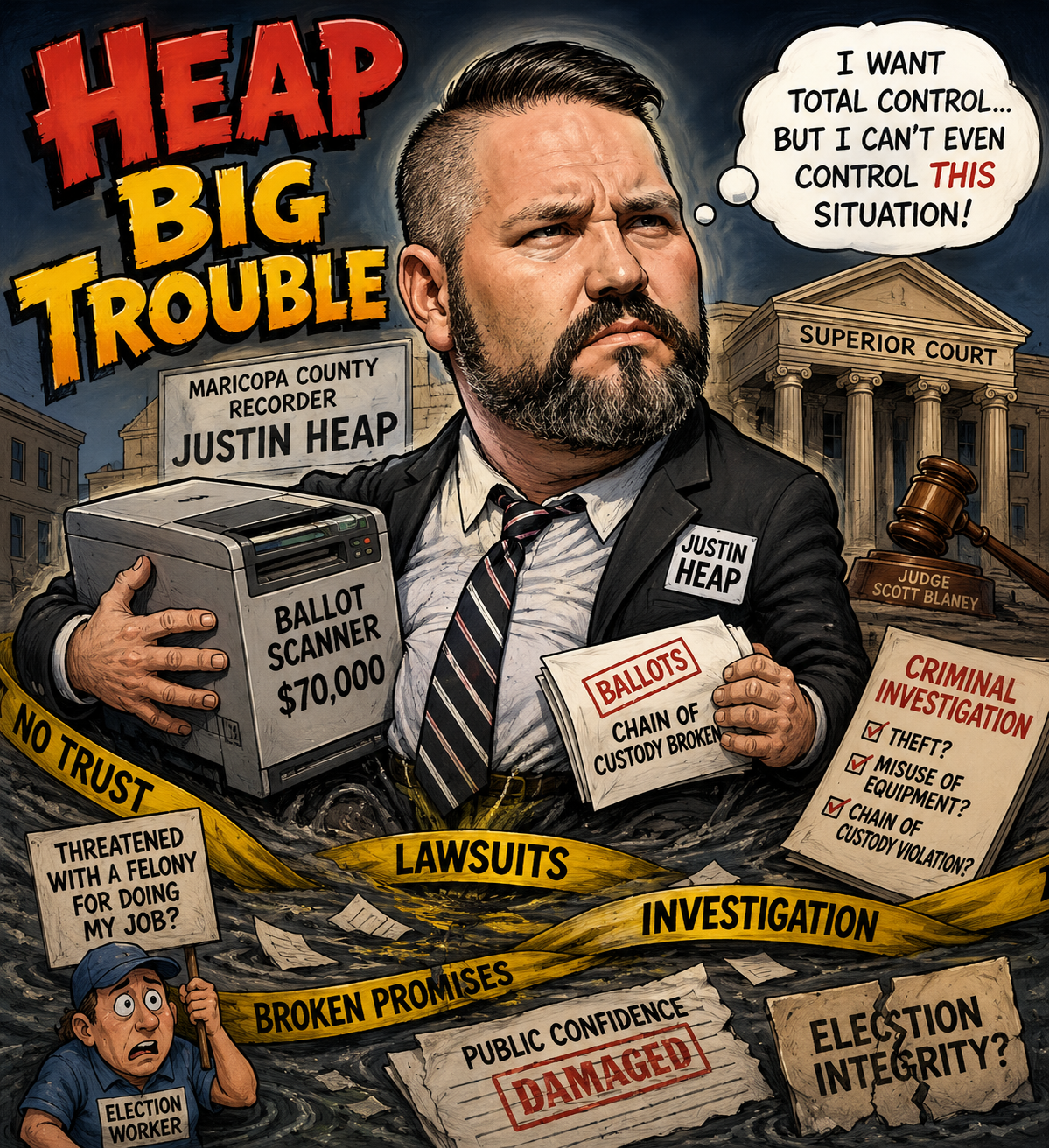
Heap Big Trouble


With early voting for the July 21 primary only weeks away, another chapter has been added to the ongoing dispute between Maricopa County Recorder Justin Heap and the Maricopa County Board of Supervisors.


The latest controversy centers on a ballot envelope scanner removed from the Maricopa County Tabulation and Election Center while election results were being tabulated during the March Tempe election. According to Board Chair Kate Brophy McGee and Vice Chair Debbie Lesko, security footage showed two Recorder's Office employees loading the scanner into a personal vehicle and leaving the secure facility. The scanner reportedly was returned approximately 50 minutes later after county election officials alerted Recorder's Office leadership.


County officials say they could not determine what occurred while the scanner was outside the secure facility. Because election equipment is subject to strict chain-of-custody requirements, the Board determined the scanner had been compromised and spent approximately $70,000 to replace it. Investigators also reviewed the removal of several provisional ballot affidavit envelopes, although a subsequent count found that all ballots and envelopes were accounted for.


Following an internal Human Resources investigation, that Heap refused to participate in, the matter was referred to the Maricopa County Attorney's Office, which appointed a special prosecutor because of a conflict of interest. According to court filings, Pinal County deputies later informed Maricopa County Recorder's Office Chief Information Officer Bryan Colby that he was under investigation.


Recorder Justin Heap argues that the scanners belong to his office because they were purchased using early voting funds and says his employees were attempting to retrieve equipment needed for upcoming elections. Heap has asked Superior Court Judge Scott Blaney to halt the criminal investigation, order the return of the scanners, and prevent what he describes as retaliation against Recorder's Office staff.


County budget documents, however, indicate that funding for the envelope scanners came from the Elections Department budget, which is under the authority of the Board of Supervisors. Former Recorder Stephen Richer reportedly did not include the scanner purchase in his own budget request, while Elections Director Scott Jarrett presented the expenditure. According to county officials, the Board also sent an email to the Recorder's Office in March informing them that the scanner was not property of the Recorder's Office.


Former Maricopa County Recorder Helen Purcell, who served in the office for 28 years, said she had never heard of anything like the incident. When asked whether she had ever heard of a staff member taking election equipment off-site, Purcell responded, "No, I have not. I did this for a long time. I have never heard of anything like that."


Purcell also supported the decision to replace the scanner, noting that once chain of custody has been compromised, confidence in the equipment is jeopardized.


"If you don't know if the machine has been corrupted, are you going to use that machine? When you have no idea? I don't think so," Purcell said.


Board Chair Kate Brophy McGee expressed similar concerns.


"I was shocked. I thought this is the most incredibly bad judgment on the part of someone to do this," she said.


It is important to note that materials associated with an active election were temporarily outside the prescribed chain of custody while the scanner was removed from the secure facility. Although election officials later determined that all ballots and envelopes were accounted for, chain-of-custody procedures are fundamental to election integrity and public confidence. Even the appearance of a break in those procedures raises legitimate concerns and warrants a thorough investigation.


This latest dispute also highlights a broader disagreement over the roles of the Recorder and the Board of Supervisors. Arizona law assigns election responsibilities to both entities, and the public benefits from transparency and oversight rather than concentrating authority in any single office.

The allegations surrounding the scanner are serious. If investigators determine that county-owned equipment valued at approximately $70,000 was improperly removed, significant criminal penalties could potentially apply. That determination, however, belongs to investigators and the courts, not politicians or the media.


Ironically, this controversy follows warnings issued by Heap's office suggesting that election workers who carried out their assigned duties involving early ballot drop boxes could face Class 5 felony charges. Now, some of the same legal questions are being directed toward personnel within the Recorder's Office itself.


At this point, the central issue is whether the equipment belonged to the Recorder's Office or the Elections Department and whether established chain-of-custody procedures were violated. Those questions remain unresolved and are now in the hands of investigators and the courts.


Regardless of where one stands politically, the spectacle unfolding in one of the nation's largest election jurisdictions is troubling. Public confidence in elections depends upon cooperation, transparency, and strict adherence to chain-of-custody procedures. With early voting beginning later this month, voters deserve answers, accountability, and an election process focused on serving the public rather than continuing a seemingly endless cycle of lawsuits, accusations, and political brinkmanship.

Trump Posts Lt Col Rodney Glassman Endorsement


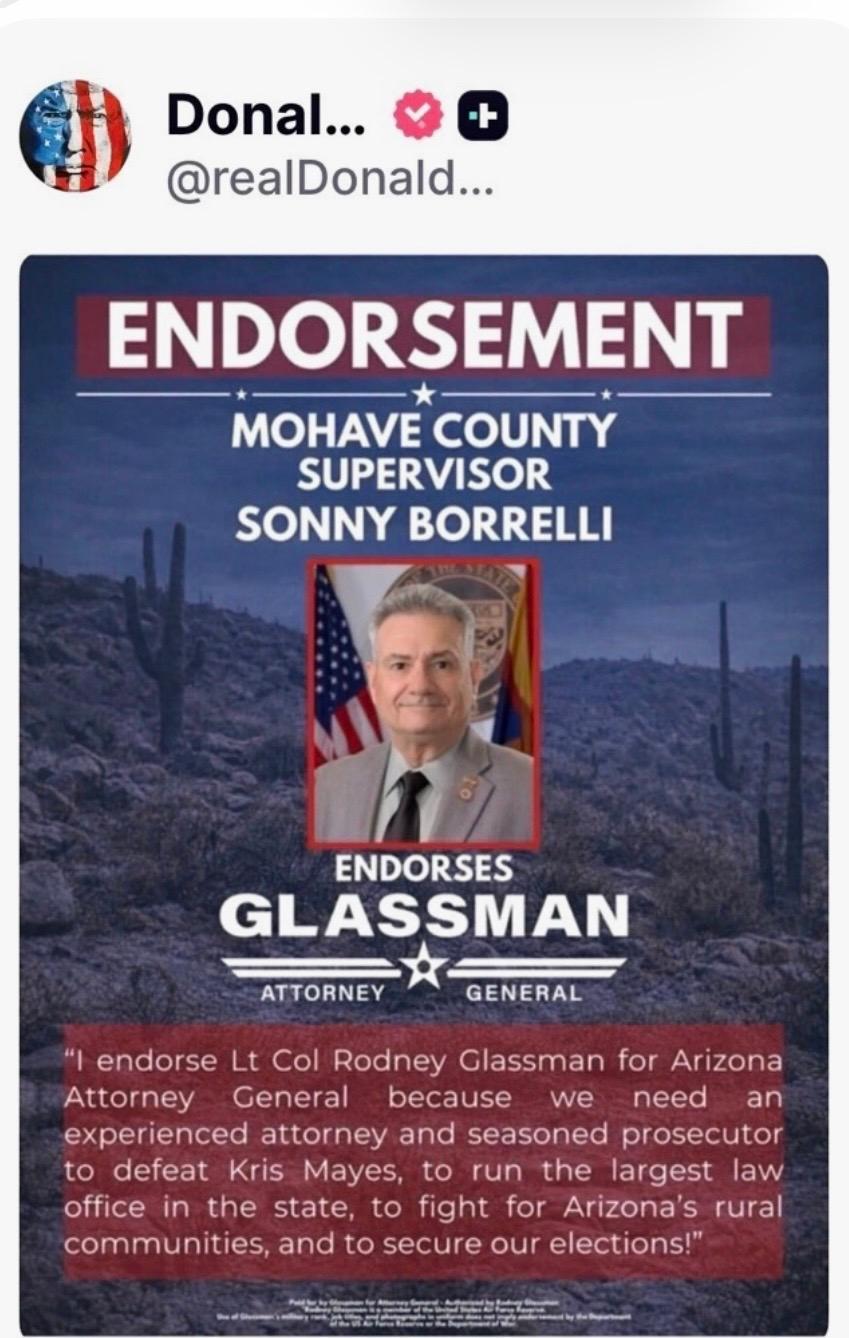
On President Donald Trump's birthday, he took time to post on Truth Social highlighting an endorsement from Mohave County Supervisor Sonny Borrelli for Rodney Glassman in the race for Arizona Attorney General.


The post immediately sparked speculation among Arizona political observers.

Political analyst Brahm Resnik wrote on X, "Is there such a thing as a 'bank shot' endorsement? Looks like Trump is endorsing Rodney Glassman..."


Election analyst Garrett Archer also weighed in, posting, "In a Truth Social post Trump either endorses Sonny Borrelli for Mohave Supervisor or Rodney Glassman for Attorney General."

Regardless of the original intent, the post is welcome news for Glassman supporters. Glassman's opponent has been airing campaign commercials suggesting he possesses President Trump's coveted endorsement. However, Trump's decision to highlight Borrelli's endorsement of Glassman has many observers concluding that the President is, at minimum, signaling support for the Republican nominee for Attorney General.


While some may debate whether this constitutes a formal endorsement, there is little doubt that Trump's social media post has changed the conversation in the race.

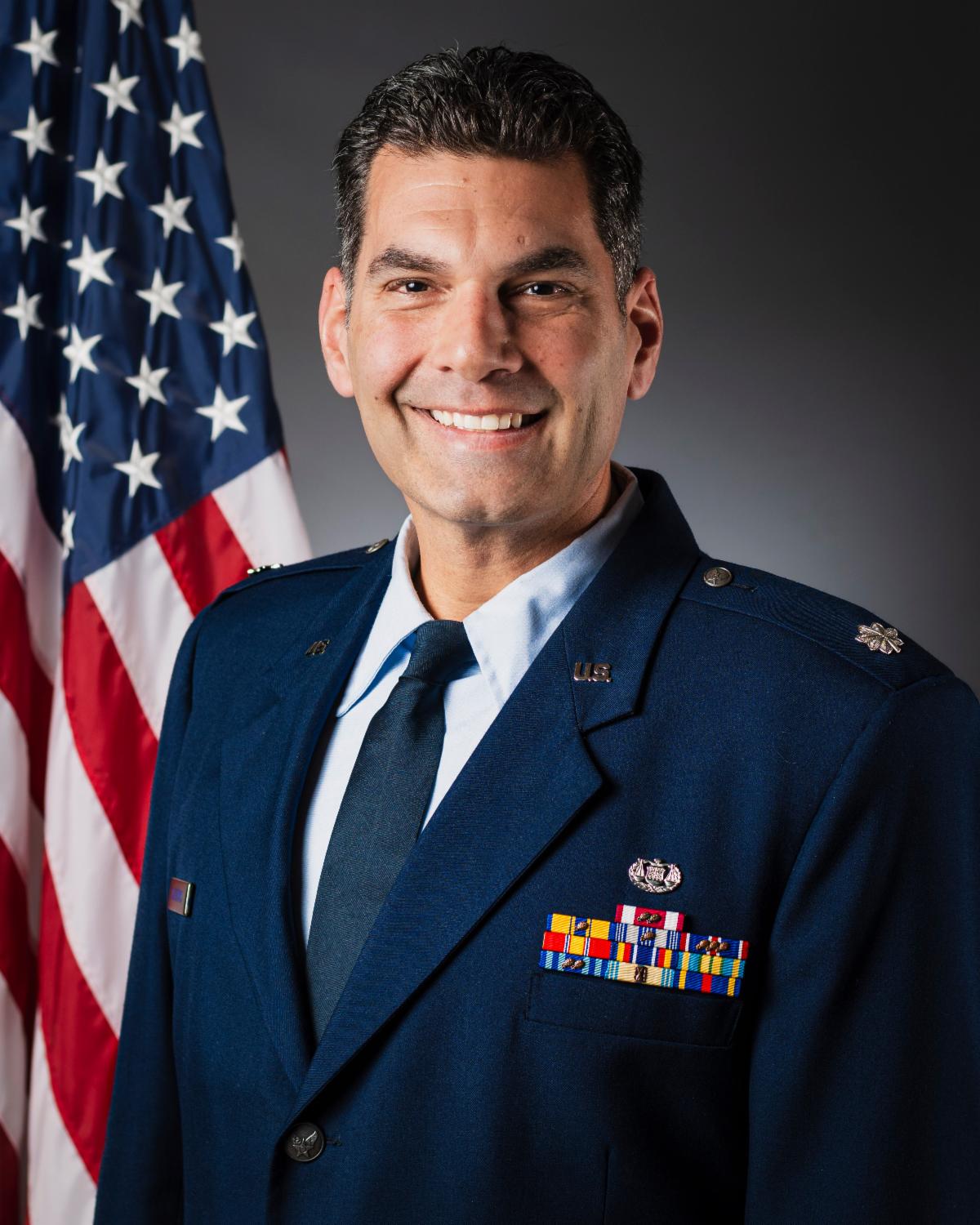
The attention also underscores a major contrast between the candidates. Rodney Glassman is the only candidate in the race with substantial legal experience. A Judge Advocate General (JAG) officer in the United States Air Force and a practicing attorney, Glassman brings firsthand legal experience to a position whose primary responsibility is serving as Arizona's chief law enforcement officer.


As the campaign continues, voters will ultimately decide whether legal experience or political branding carries more weight. But after President Trump's birthday Truth Social post, one thing is clear: Rodney Glassman's campaign received a significant boost, and claims that another candidate enjoys exclusive support from President Trump appear far less certain than they did just days ago.

Arizona Finally Has a Budget — And Both Parties Had to Compromise


After months of negotiations, vetoes, and uncertainty, Arizona lawmakers finally reached agreement on a state budget that Governor Katie Hobbs signed into law. While neither Republicans nor Democrats got everything they wanted, the final budget demonstrates what divided government looks like: compromise.


One interesting footnote to the timing is that the agreement came together just days before Senate Republicans are scheduled to travel to Washington, D.C. Whether that timing is simply coincidental or provided additional motivation to bring the lengthy budget battle to a close is open to speculation. Regardless, lawmakers avoided prolonging the session even further and finally delivered a budget.


Earlier this year, Republicans in the Legislature approved a budget that Governor Hobbs vetoed, arguing it failed to adequately address her priorities. Republicans countered that Arizona was facing a structural deficit and that state spending needed to be brought under control. Democrats, meanwhile, pushed for greater investments in education, housing, health care, and social programs.


The final agreement reflects concessions from both sides.


Republicans scored several important victories. Arizona became the first state in the nation to fully conform with President Donald Trump's federal tax package, bringing state tax relief on tips and overtime pay, increasing deductions, and expanding family tax benefits. Republicans also successfully protected Arizona's Empowerment Scholarship Account program from efforts to limit or roll back school choice.


Conservatives also maintained funding for public safety and border security while avoiding broad-based tax increases.


However, Republicans had to compromise. Many conservatives had hoped for deeper spending reductions and more aggressive cuts to government programs. Those cuts did not materialize. Republicans accepted additional spending for developmental disability services, child welfare, transportation, and housing initiatives.


Governor Katie Hobbs and legislative Democrats made concessions as well. Democrats have repeatedly criticized the ESA program and sought greater restrictions, yet the final budget leaves the program intact. Democrats also accepted Republican-backed conformity with the Trump tax package, despite concerns among some progressives about its long-term effect on state revenues.


Democrats did secure additional funding for K-12 education, affordable housing, and health-related programs. Republicans agreed to those expenditures, recognizing that government still has essential responsibilities that must be funded.


Infrastructure spending also reflected compromise. Republicans wanted continued investment to support Arizona's growth and economic development, while Democrats sought investments benefiting communities and local projects. The final package included priorities from both sides.

In divided government, no one gets everything they want. Republicans control the Legislature, Democrats hold the Governor's Office, and neither side possesses enough power to govern alone.


Senate President Warren Petersen and House Speaker Steve Montenegro emphasized protecting taxpayers and exercising fiscal restraint, while Governor Hobbs highlighted investments in schools and critical services. Each side can claim victories. Each side also had to accept provisions they likely would have preferred to avoid.


For conservatives, the biggest takeaway is that despite having a Democrat governor, Republican priorities such as tax relief, educational freedom, public safety, and fiscal responsibility continue to shape Arizona policy. Democrats, meanwhile, succeeded in preserving funding for programs important to their constituencies.


At a time when Washington often seems incapable of compromise, Arizona's elected officials ultimately demonstrated that divided government does not have to mean dysfunction. The process was messy and at times frustrating, but in the end lawmakers fulfilled their most basic responsibility: passing a budget.

Has the Golden Ticket Lost Its Golden Shine?


For decades, Arizona Republicans have known to keep an eye on their front doors shortly before general election ballots arrive. Along with campaign mailers and voter guides, many Republican households looked forward to receiving the familiar "Golden Ticket" distributed by precinct committeemen. It was never intended to be an official decree, but rather a guide compiled by grassroots activists to help identify conservative Republican candidates and unite the party after the primary election.


The philosophy behind the Golden Ticket was straightforward. Republican voters were trusted to make up their own minds during contested primaries. Candidates would compete, voters would decide, and afterward the party would come together to support the nominees in the general election. Unity came after the voters had spoken.


That tradition appears to be changing.


Individuals have always been free to endorse candidates and create their own personal lists to share with friends and family. But historically, legislative districts, acting as organizations, generally refrained from issuing endorsements in contested Republican primaries. In fact, Arizona Republican Party bylaws prohibit party endorsements in contested primaries, and many legislative districts traditionally followed the same principle.


Arizona Republican Party Chairman Sergio Arellano has publicly stated that legislative districts, as a body, should stay out of primary elections and refrain from distributing Golden Tickets before Republican voters have made their choice. For many years, neutrality during primaries was considered a cornerstone of party unity.


Yet a new trend is emerging across Arizona.


Legislative districts, clubs, political organizations, and advocacy groups are increasingly producing their own versions of the Golden Ticket. Some organizations have amended their bylaws to allow endorsements. Others have proceeded despite questions about whether endorsements are permitted under existing rules.


The expansion has gone beyond races within a district's own boundaries. In one instance, precinct committeemen in Legislative District 3 voted on endorsements for Scottsdale City Council candidates, even though many members participating in the endorsement process do not live within Scottsdale city limits. Critics argue this raises questions about whether individuals who cannot vote in those races should be influencing the endorsement process.


Another interesting development is that some organizations issuing endorsements are not even led by registered Republicans, but by individuals registered as independent voter. As a result, Republican voters increasingly find themselves being told how to vote by organizations whose leaders are not members of the party itself.


Supporters of primary Golden Tickets argue that endorsements provide helpful guidance in increasingly crowded races and allow those closest to the process to share their knowledge with voters. Critics contend that official endorsements place the thumb of the party on the scale and risk creating divisions before Republican voters have rendered their verdict.


The growing number of competing Golden Tickets also raises practical concerns. If every legislative district, club, PAC, and political organization issues its own slate of preferred candidates, what happens when those recommendations conflict? Will voters become confused? Will the Golden Ticket lose its influence simply because there are too many versions competing for attention?


Perhaps that is the key distinction.


Individuals should absolutely be free to endorse candidates. But should legislative districts, acting as official party bodies, do the same during contested primaries? I do not believe they should.


The original Golden Ticket carried influence because it was relatively rare and represented unity after competition. Today, with organizations increasingly competing to determine winners before voters have spoken, perhaps the more important question is no longer who belongs on the Golden Ticket.


Perhaps the real question is whether the Golden Ticket has become so common that it is losing the very value that once made it special.


Republicans often speak about trusting the voters. The debate over primary endorsements is really a debate about whether we still do.

Voucher Reform Deal Collapses as Petersen and Hoffman Join Democrats in Voting No


An unusual coalition in the Arizona Senate brought down a last-minute agreement on school vouchers Friday, setting off a new round of political warfare over education and putting the future of Arizona's Empowerment Scholarship Account (ESA) program squarely before voters.


House Republicans had negotiated a compromise with the Arizona Education Association (AEA), the state's largest teachers union. Under the agreement, lawmakers would have placed modest restrictions on ESA spending while the union would stop gathering signatures for the "Protect Education Now" initiative, a proposal backed by teachers and public school advocates that would impose stricter limits on the universal voucher program.


The deal also called for Republicans to abandon two controversial ballot referrals, one restricting teacher union activities and another requiring school districts to spend at least 60% of their budgets on classroom instruction.


But the agreement never made it out of the Senate.


In a surprising turn, Senate President Warren Petersen and Senator Jake Hoffman joined Democrats in voting against the House-crafted compromise, effectively killing the deal. Their votes forced Republicans to change course and pursue a different strategy.


Instead, Senate Republicans advanced a constitutional amendment to the ballot that supporters say protects ESA access for military families. Critics, however, argue the proposal is really aimed at neutralizing the citizen initiative backed by the teachers union and Save Our Schools Arizona. Because constitutional amendments take precedence over statutory changes, opponents contend the measure contains a "poison pill" designed to override any voucher restrictions approved by voters.


Save Our Schools Arizona spokesman Tyler Kowch called the proposal "a blatant, undemocratic attempt to invalidate the will of voters."


Democrats echoed those concerns. Senator Lauren Kuby dismissed the effort as "political theater" and argued it was intended solely to undermine the pending initiative.

Meanwhile, Republicans rejected accusations that they were acting in bad faith. Senator Jake Hoffman argued the measure was designed to ensure military families continue to have access to educational options.


With the compromise dead, lawmakers revived two previously shelved ballot referrals.

House Concurrent Resolution 2040 would prohibit school districts from financially supporting labor unions, ban union activities during working hours, prevent teachers from distributing union communications while on the job, and prohibit public school teachers from striking.


Another proposal, HCR 2007, would require larger school districts and districts located in Maricopa and Pima counties to spend at least 60% of their budgets on direct classroom instruction. Representative Matt Gress argued the measure is necessary because Auditor General reports show Arizona districts spend only about 52% of their funding on instructional expenses.


Democrats countered that such calculations fail to account for counselors, speech pathologists, social workers, school resource officers, utilities, and other essential services that support student success.


The collapse of the compromise underscores the deep divisions surrounding Arizona's universal ESA program. What began as a negotiated settlement between House Republicans and the teachers union quickly devolved into a battle over competing ballot measures and constitutional questions.


Perhaps the most surprising aspect of the drama was the role played by Senate President Warren Petersen and Senator Jake Hoffman. By joining Democrats in opposing the House agreement, they ensured that Arizona voters—not lawmakers—may ultimately decide the next chapter of the state's school choice debate.

What Freight Rail Safety Concerns Could Mean for Wittmann


As residents continue to debate the proposed BNSF intermodal facility in Wittmann, much of the discussion has focused on truck traffic, water use, noise, air quality, and impacts to nearby neighborhoods. Those are all legitimate concerns. However, there is another issue receiving far less attention: the condition and age of the freight rail fleet itself.


For decades, the rail industry has pursued greater efficiency by increasing the amount of freight each railcar can carry. In the early 1990s, the Association of American Railroads approved loading many railcars originally designed for a gross rail load of 263,000 pounds to 286,000 pounds. The change immediately increased carrying capacity by approximately 9 percent without requiring the purchase of new railcars.


On paper, it was a tremendous economic success.


But many industry experts quickly recognized a problem. Railcars designed and fatigue-tested for 263,000 pounds were now carrying significantly heavier loads. As one industry observer noted, "There is no free lunch."


The heavier loads increased stress on railcar components, wheels, bearings, rails, and suspension systems. In response, the industry spent years researching safer designs. By 2004, improved S-286 railcar standards and M-976 truck suspensions became the new benchmark. These newer designs significantly reduced wear, improved fuel efficiency, and lowered the risk of rolling contact fatigue.


The concern is that more than 300,000 older railcars remain in service today. Many were built before 2004 and continue operating under standards developed for lighter loads. The long-term fatigue life of many of these components remains uncertain.


The 2023 East Palestine, Ohio derailment serves as a sobering reminder of what can happen when rail equipment fails. That accident, which has already cost more than $1 billion, was linked to a bearing failure on a railcar built under older specifications. While not every older railcar poses a danger, the incident highlighted the enormous consequences that can occur when even a single component fails.


Now consider Wittmann.


If BNSF's proposed intermodal hub moves forward, the West Valley could see a substantial increase in freight rail activity for decades to come. More trains, more freight cars, and more traffic inevitably mean greater exposure to risk. Even if the probability of a major derailment remains low, the consequences of such an event near homes, schools, churches, and businesses could be significant.


Industry leaders are now faced with difficult choices. They can continue operating older equipment, invest billions of dollars upgrading railcars with newer bearing systems, or reduce carrying capacities to original design specifications. None of those options are inexpensive.

What is clear is that the rail industry itself recognizes that aging equipment presents challenges. The debate is no longer whether older railcars experience greater stress; the debate is how much risk is acceptable and who should bear the cost of addressing it.


For communities like Wittmann, that discussion matters.


Residents are being asked to accept a massive freight operation in their backyard. Before any project of this magnitude moves forward, citizens deserve a full understanding not only of traffic and environmental impacts, but also of the realities of modern freight rail operations. The lessons from East Palestine demonstrate that rail safety is not an abstract concern. When failures occur, the costs can be measured in billions of dollars and years of community disruption.


The rail industry has made tremendous advances in safety over the past two decades. The question is whether enough is being done to address the risks posed by hundreds of thousands of older railcars still operating throughout the national rail network.


That is a question every community along a major freight corridor should be asking.

A Tragedy That Cannot Be Undone


Like many Texans, I followed the trial surrounding the death of 17-year-old Austin Metcalf with a heavy heart. Having lived in Frisco for many years, I know the community well. Frisco is a city that takes tremendous pride in its schools and student-athletes. High school sports are part of the culture. The Dallas Cowboys have their world headquarters and practice facility there, and current and former players frequently work with students, promoting teamwork, sportsmanship, and character.


That is why this tragedy has been so heartbreaking.


A Collin County jury found Karmelo Anthony guilty of murder in the fatal stabbing of Austin Metcalf during a 2025 track meet. The jury rejected the defense's claim of self-defense and determined that Anthony was criminally responsible for Austin's death.


Sadly, two families have lost a son. One young man lost his life, and another young man now faces a minimum of 17 years behind bars. No verdict can restore what was taken or erase the pain both families will carry for the rest of their lives.


What troubles me most is how quickly many people attempted to turn this case into a racial issue. Even members of Austin Metcalf's family publicly pleaded for people not to exploit the tragedy for racial division. Yet activists and protesters from various groups appeared determined to inject race and politics into a case that was, at its core, about a terrible decision made in a moment that changed countless lives forever.


Perhaps there is a lesson here for parents and young people. Some choices cannot be undone. Words spoken in anger, actions taken in the heat of the moment, and split-second decisions can have permanent consequences. We must teach our children that character, self-control, and respect for others matter.


I also pray that the people of Frisco and Collin County reject violence and unrest in response to the verdict. Justice was carried out through the legal process, and disagreements should never become an excuse for riots or destruction.


Questions have been raised by some regarding how money donated to support the Anthony family has been used. While donors have every right to expect transparency and accountability, those concerns should ultimately be addressed by the family and the individuals who contributed. I fear the family trades thier son for a lavish lifestyle.


My husband, who is Black, raised an interesting perspective that deserves consideration. He suggested that the absence of Black jurors was not the result of discrimination or exclusion, as some have alleged. Given the intense media attention and the effort by some activists to frame the case through the lens of race, serving on the jury may have seemed like a no-win situation for many Black citizens. A Black juror who objectively weighed the evidence and voted to convict could have faced accusations of betraying their community or been subjected to harsh criticism and public scrutiny. In today's polarized environment, some Black people who value the rule of law and wish to remain objective may understandably choose to avoid such highly charged cases out of concern for their own privacy and well-being. While no one can know the motivations of individuals who were not selected, it is a perspective worth considering before rushing to conclusions about the composition of the jury. I feel certian that will be areason listed for an appeal.


Above all, I pray for everyone involved. I pray for Austin Metcalf's family as they continue to grieve the loss of a son and brother. I pray for Karmelo Anthony and his family as they face the consequences of this tragedy. And I pray that this painful chapter reminds all of us that life is precious, choices matter, and some actions can never be taken back.

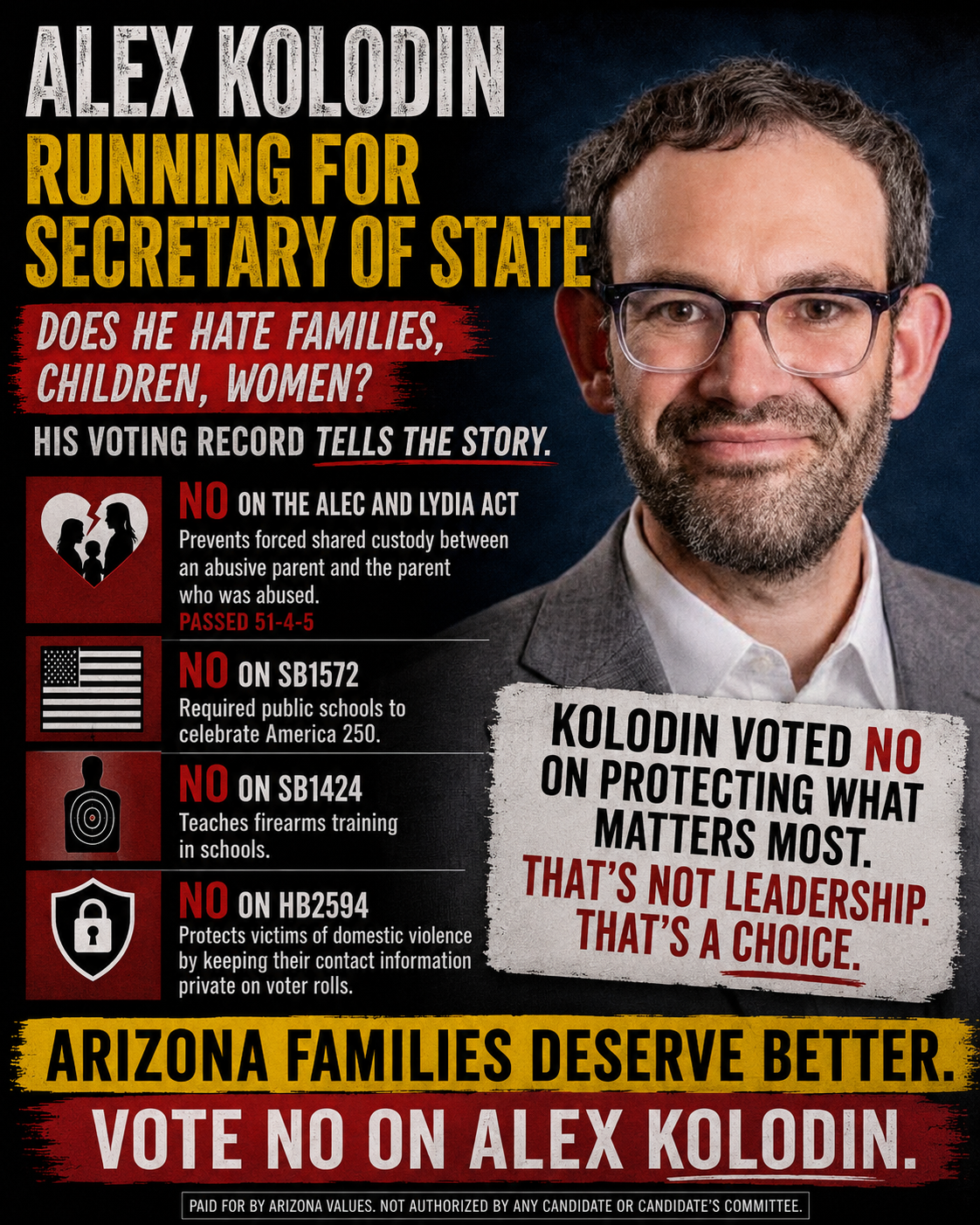
What Is Going on With Alex Kolodin? His Voting Record Raises Questions


Campaigns are often filled with promises and rhetoric, but a legislator's voting record provides a window into the priorities they bring to public office. As Representative Alex Kolodin campaigns for Arizona Secretary of State, some of his recent votes are raising questions among voters about where he stands on issues affecting families, children, and victims of domestic violence.

One of the most controversial votes came on the Alec and Lydia Act, legislation designed to protect survivors of domestic violence and their children. The measure prevents courts from forcing shared custody arrangements between an abusive parent and the parent who suffered abuse. The bill received overwhelming bipartisan support, passing the Arizona House by a vote of 51-4-5. Kolodin was one of only four representatives to vote against the measure.


Kolodin also voted against SB1572, legislation requiring Arizona public schools to recognize and celebrate America 250, the nation's upcoming 250th anniversary. Supporters viewed the bill as an opportunity to promote civic education and appreciation for the country's history. Kolodin joined a minority of lawmakers opposing the measure.


Another "no" vote came on SB1424, which allows firearm safety training and education to be offered in schools. Advocates argued the measure would help promote responsible firearm handling and improve safety awareness among students. Again, Kolodin voted against the proposal.


Kolodin was also one of the lawmakers who voted against HB2311, legislation requiring disclosures when artificial intelligence is used in certain contexts. Supporters argued that the bill would provide transparency and help the public distinguish between authentic content and AI-generated material. Once again, Kolodin found himself voting alongside Democrats in opposition to the measure.


Kolodin also voted against SB1476, legislation aimed at strengthening protections for children exposed to illegal drugs before birth. The bill would make it a felony when a baby is born with illicit substances in his or her system. Supporters viewed the legislation as an important step toward protecting vulnerable children and holding adults accountable for exposing newborns to dangerous drugs. Kolodin's vote against the measure has raised questions among conservatives who believe the state has a responsibility to safeguard infants and support families struggling with substance abuse.


Perhaps most troubling to many Arizonans was Kolodin's opposition to HB2594. The legislation strengthens protections for victims enrolled in Arizona's Address Confidentiality Program by ensuring that sensitive contact information remains private on voter registration records. The bill was intended to safeguard victims of domestic violence, stalking, and other crimes from having their personal information exposed.


These votes have led some to ask whether Alex Kolodin's priorities align with the concerns of families, children, and survivors seeking protection. Supporters may argue that he had legal or philosophical reasons for opposing the bills. However, as voters evaluate candidates seeking higher office, it is reasonable to examine not just campaign promises, but the record they have already established.


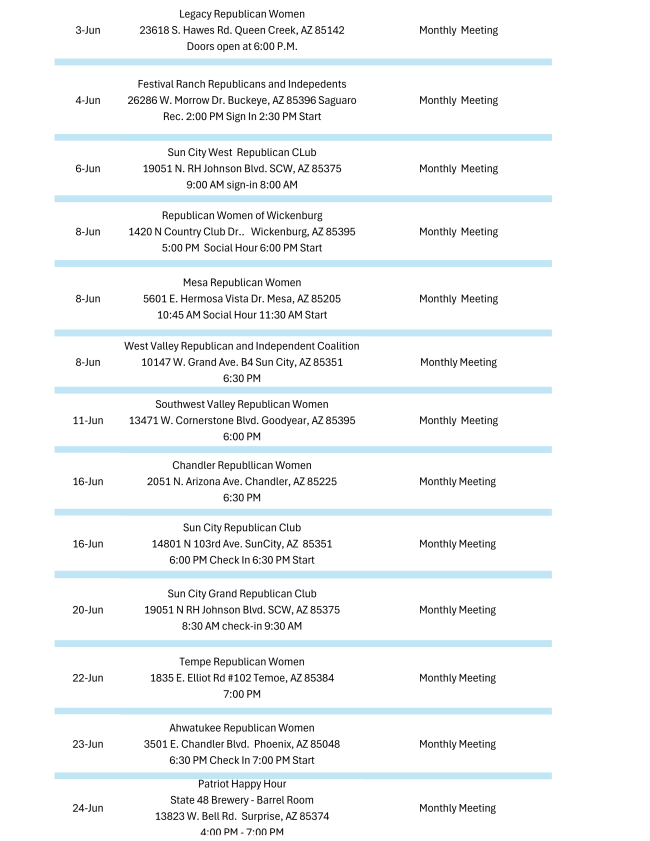
IF YOU WOULD LIKE YOUR CLUB LISTED PLEASE CONTACT ME

Thank you,

Lisa Everett


www.patriotnheels.com


Follow me on:

X - @patriotnheels

Facebook - @patriotnheels

Instagram - @patriotnheels