📼 Protecting Our Living Coast
State of Our Water Panel Recording | | |
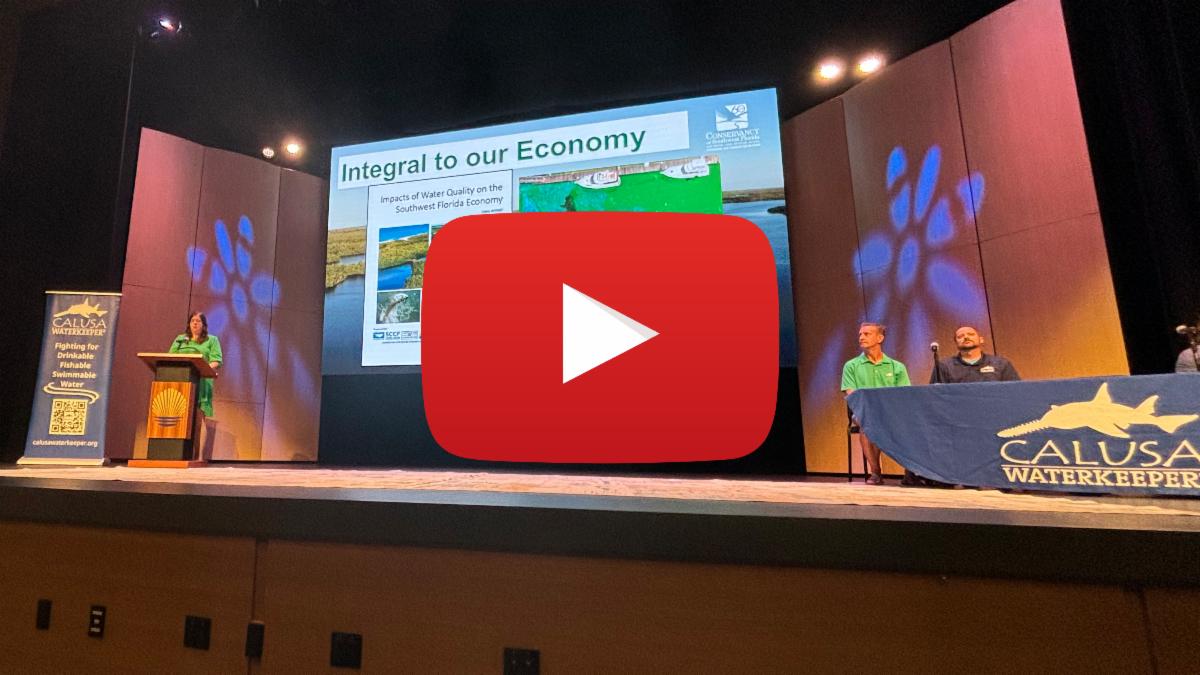
Earlier this month, Calusa Waterkeeper brought together conservation leaders from the Conservancy of Southwest Florida, Sanibel-Captiva Conservation Foundation, and Florida Gulf Coast University for Protecting Our Living Coast, our latest State of Our Water forum.
The discussion focused on the future of the estuary at the mouth of the Caloosahatchee, including current conservation efforts, development pressures, pending policy challenges, and opportunities to protect remaining coastal lands through collaboration and community engagement.
A sincere thank you to our panelists and to Shell Point Retirement Community for hosting this important conversation and producing the video recording. If you missed the event—or would like to revisit the discussion—we invite you to watch the recording and share it with others who care about the future of Southwest Florida's coastal waters.
| | |
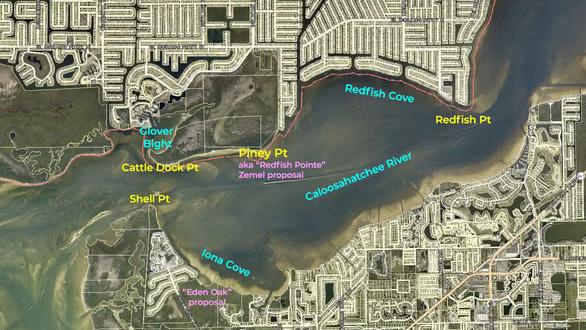
Map of the largest privately owned properties near the mouth of the Caloosahatchee
Calusa Waterkeeper - October 10, 2026
| | |
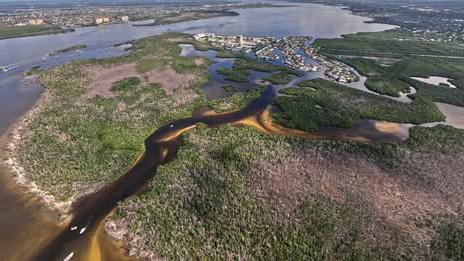
Lee County to buy 306 acres environmentalists call critical for protection
News-Press - October 9, 2026
| | |
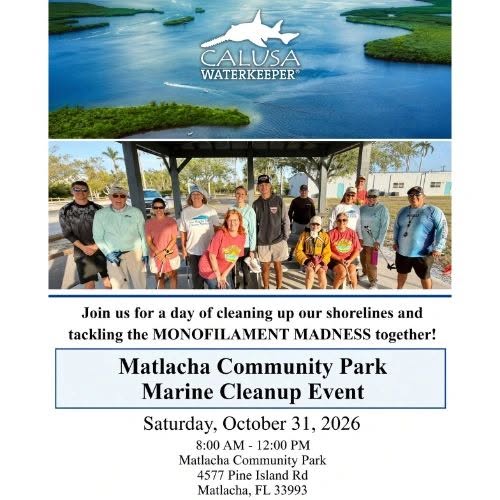
🗓️ Monofilament Madness on Matlacha
8am - 12pm, October 31, 2026
Matlacha Community Park
4577 Pine Island Rd
Matlacha, FL 33993
Keep Lee County Beautiful is hosting multiple clean-ups on October 31st, and we're partnering with them to participate at the site on Matlacha. Monofilament Madness is an annual event where volunteers work to remove monofilament fishing line and other debris from the water, shoreline, and mangroves of Lee County. Volunteers can participate by foot, power boat, jet ski or kayak as we clean up our beloved marine environment and help to improve the health of our local waterways. Supplies will be provided.
| | | Waterkeepers Florida Opposes Amendment 3 | | |
Waterkeepers Florida, representing the 15 Waterkeeper organizations working to protect and restore waters across our state, urges Floridians to vote NO on Amendment 3. By suddenly and sharply reducing the property tax base that supports local governments and Florida’s five water management districts, this amendment would jeopardize the projects our communities need to prevent pollution, protect habitat, and restore clean water.
Florida families deserve meaningful relief from rising property taxes. However, abruptly cutting the revenue available to protect our waters would harm every Floridian, including homeowners who benefit from homestead exemptions. Drinking water, hunting, fishing, public health, and quality of life would all be at risk.
Waterkeepers Florida urges a NO vote on Amendment 3 to protect the waters and communities we serve.
| | | |
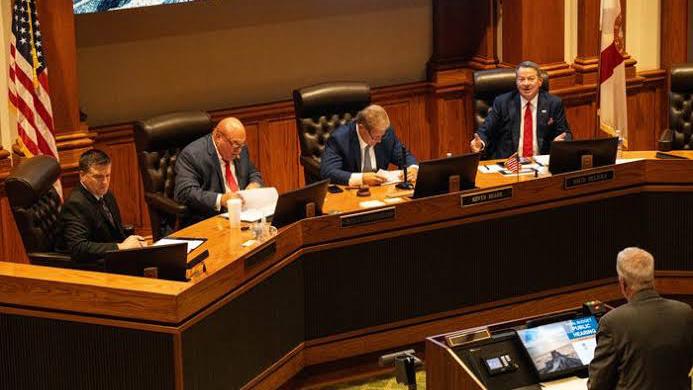
Lee County Commissioners discuss impact of, solutions for Amendment 3
Cape Coral Breeze - October 14, 2026
| | |
Miami Waterkeeper Rachel Silverstein weighs in on Amendment 3
Miami Waterkeeper - October 21, 2026
| | Lee County's Development Plans: Whose Interests Are Being Served? | | As Lee County continues considering major changes to community planning and development regulations, Calusa Waterkeeper remains concerned that environmental protections and meaningful public participation are being weakened in the name of efficiency. Decisions about where and how we grow have lasting impacts on water quality, wetlands, wildlife, and flooding. Read the latest commentary on why these changes matter—and why science, transparency, and public input must remain central to protecting Southwest Florida's waters. | | |
🧫 Fecal Indicator Bacteria - Monthly Results
| |
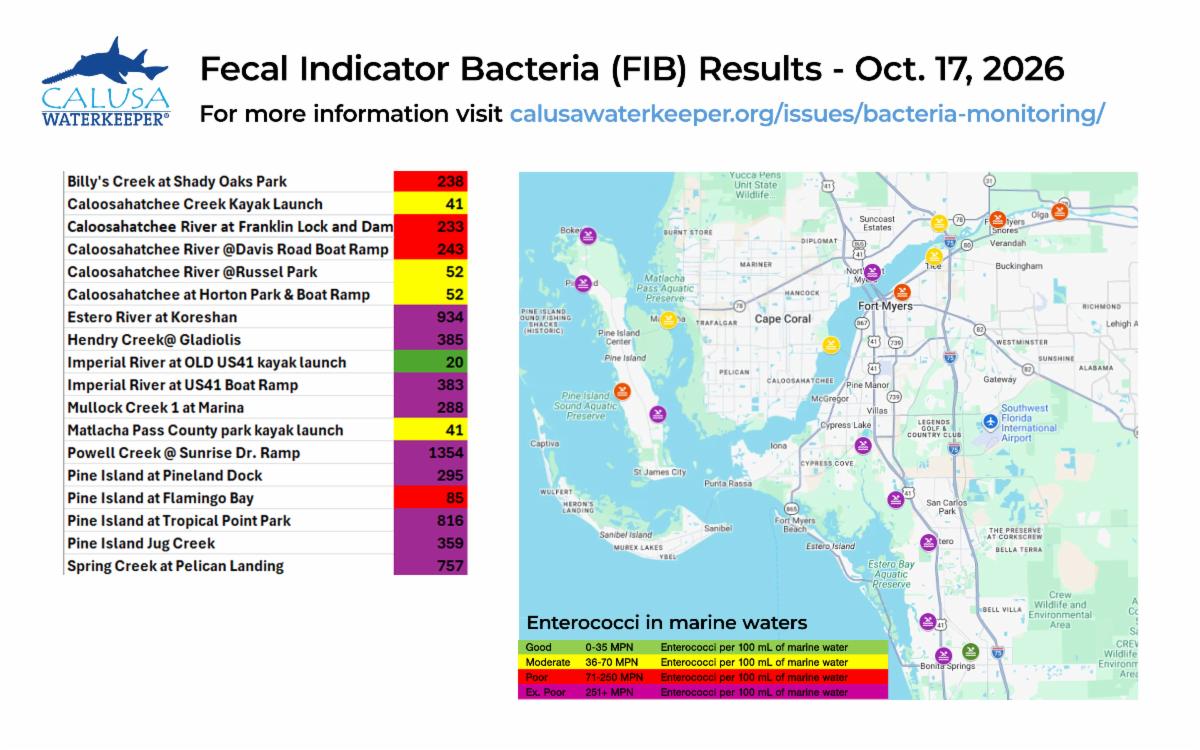
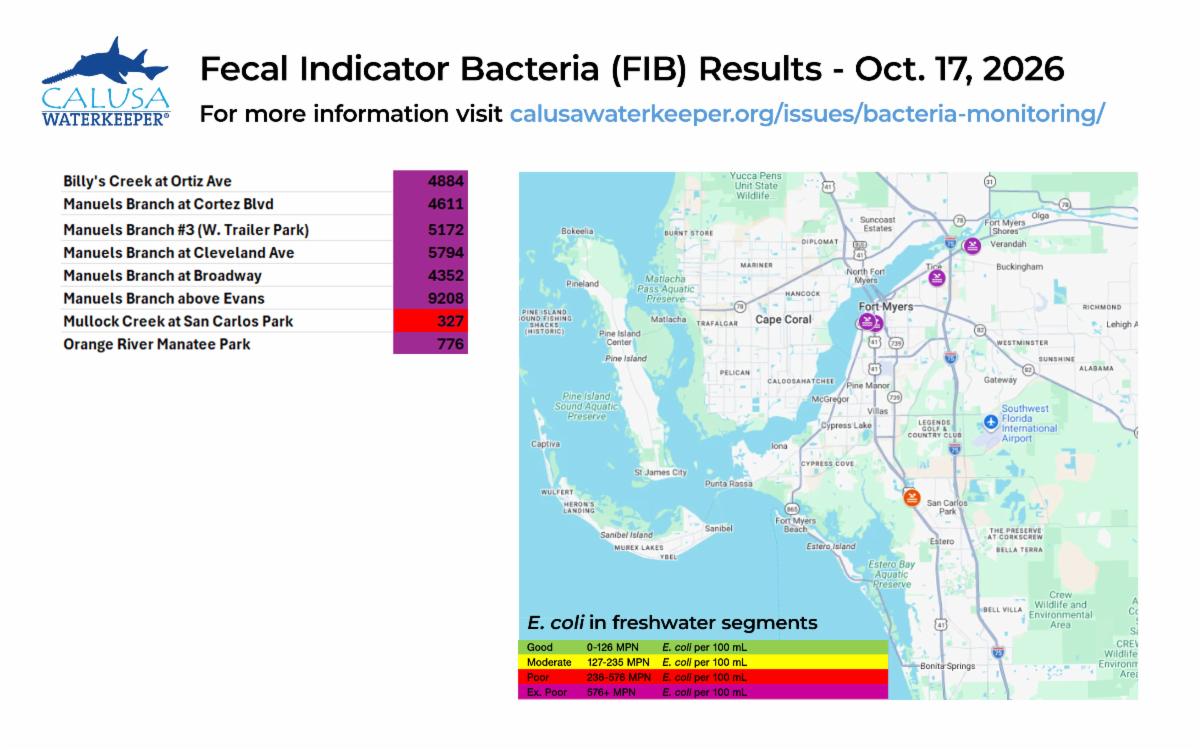
Calusa Waterkeeper's trained volunteers conduct FIB water sampling at up to 30 sites in Southwest Florida each month. We publish the results to keep the public informed on potential risks. Enterococci and E. coli bacteria found in water can cause gastrointestinal illness, infections, and rashes.
Most of the locations we are monitoring are public access sites such as parks, boat ramps and kayak launches that the state of Florida does not monitor. The state does monitor the most popular beaches, and that data can be looked up separately on their "Healthy Beaches" website.
In marine waters, two consecutive results over 70 MPN would trigger an advisory from the Florida Department of Health if these sites were classified as "public bathing places." The maximum allowable threshold set by the Florida Department of Environmental Protection is 130 MPN (TPTV) for Enterococcus. In freshwater, 410 MPN (TPTV) is the regulatory threshold for E. coli.
For more information and historical data on our FIB program, please visit http://calusawaterkeeper.org/issues/bacteria-monitoring/
Note that water conditions are dynamic and change daily, if not hourly, especially when under tidal influence.
|
| | |
📬 From the Mailbag: Wind Rows & Langmuir Circulation
We often field interesting questions from the community. Here's a recent one that is quite relevant as we observe the first few cold fronts of the season pushing into our area.
| |
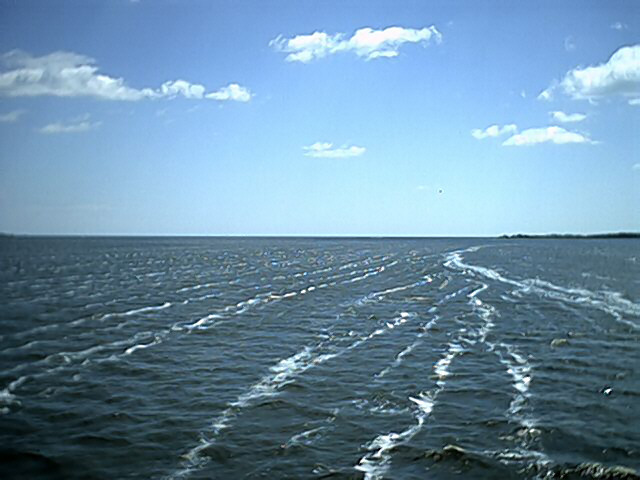
Question: This morning, the Caloosahatchee River had long steaks of white foam... along the river banks, some areas had piles of white foam. Do you know what creates this foam? Is it toxic?
Our answer: The white foam and streaks are something we see fairly often during windy conditions. A common description for them would be windrows. To get more technical, langmuir circulation explains how these long, parallel streaks form on the surface of lakes, rivers, and coastal waters.
What you're seeing foam up is a mixture of air and water stabilized by surfactants (surface-active compounds). These surfactants are produced as bacteria and other microorganisms break down organic matter such as leaves, plants, algae, and other materials in the water. When sustained winds organize the surface into windrows and trap air bubbles, the foam collects into the long white streaks you're seeing.
Most of the time this is a natural process. However, foam can also concentrate whatever is present in the water. During a harmful algal bloom or pollution event, it may also contain algal toxins or other contaminants, so it's best not to assume all foam is harmless.
Here's an article published recently from our friend Dr. Richard Whitman of Heal our Harbor that might be of further interest: Is that water foam natural or pollution?
| | |
🍻 Thank you to our sponsors!
Cheers to our local business partners for investing in our mission! Please join us in thanking our recurring annual sponsorships and financial support from two local companies: Chubby Mermaid Brewing and Suncoast Beverages!
| | 📰 In the Press & Around the Watershed | | |
Lee County approves plan reshaping 82,000 acres despite environmental pleas
Fort Myers News-Press - October 28, 2026
| | |
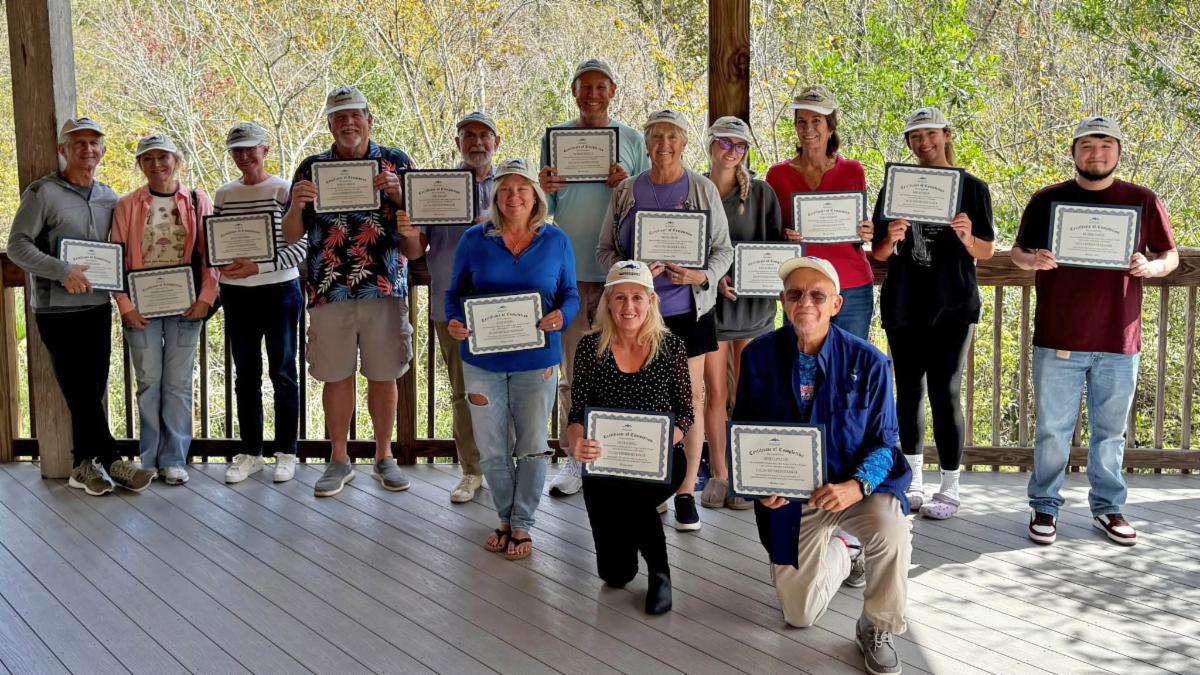
We are thrilled to officially announce the graduation of our newest class of Calusa Waterkeeper Rangers!
Calusa Waterkeeper - October 27, 2026
| | |
As one of our Rangers Maureen points out, getting out early to do FIB testing can have its rewards! (Pine Island / Matlacha Pass)
Calusa Waterkeeper - October 22, 2026
| | |
Lee County approves land use plan changes as developers eye housing, retail and private schools
Gulf Coast News - October 21, 2026
| | |
Sad news to have lost both Linda and Nick Penniman recently. Linda was a board member and advisor to Calusa & Collier Waterkeeper orgs and many other SWFL non-profits over her years of service to the community.
Calusa Waterkeeper - October 21, 2026
| | |
Commentary: New Florida stormwater rules don't fix our pollution problem
Florida Phoenix - October 15, 2026
| | |
Honoring the Calusa on Indigenous Peoples' Day
Calusa Waterkeeper - October 12, 2026
| | |
330,000 gallons of raw wastewater spills inot the Gordon River in Naples
WINK News - October 8, 2026
| | 💸 ADAM Funding Goal Acheived! | |
Thanks to supporters like you, we reached our $10,000 matching challenge!
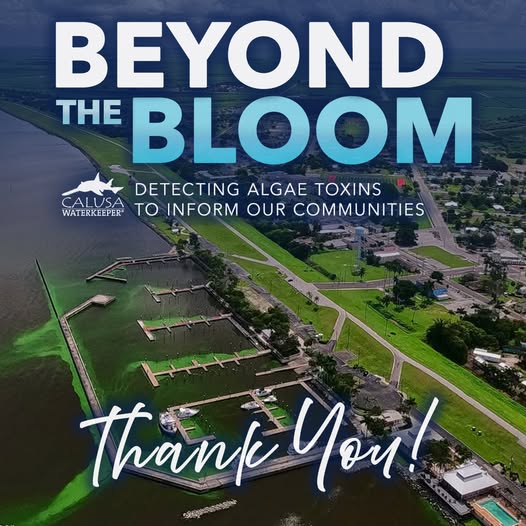
Because of your support, Calusa Waterkeeper will expand ADAM monitoring, collect more field data, and continue building the science around airborne toxins associated with harmful algal blooms. We've already learned these toxins can become airborne. Now we're working to understand where they occur, how often they're present, and what they may mean for the health of our communities.
|
| | 🤝 Other Ways to Support Our Work |
| | | | |