Weekly Digest Number 47 - November 23rd, 2021 |
|
(Editor's Note: After a quarter century of Hoffa, the opposition caucus in the Teamsters union - known as "Teamsters United" - has scored a major victory! Kudos to Teamsters for a Democratic Union - TDU - for the pivotal role they have played for nearly a half century now in democratizing the largest labor organization in the U.S. Two rail unions - BLET and BMWED - have been Teamster affiliates for years now, comprising the Teamster Rail Conference. RWU urges members of those rail unions to pay special attention to what happens next. This could signal a new day for rail labor! ) |
|
Teamsters United Takes the Wheel |
|
A new administration will soon take the helm of the 1.3 million-member Teamsters union. The Teamsters United slate swept to victory in this week's vote count, beating out their rivals 2 to 1.
It’s the first time in almost a quarter-century that a coalition backed by Teamsters for a Democratic Union has taken the driver’s seat in the international union.
The incoming president is Sean O’Brien, leader of New England Joint Council 10. He says his top priorities are to unite the rank and file to take on employers, organize Amazon and other competitors in the union’s core industries, and withdraw support from politicians who don’t deliver on union demands.
Essential to organizing at Amazon or anyplace else, O’Brien argues, is winning enviable contracts for the existing Teamsters. “Our biggest selling point to potential members is showing in black and white what a union contract can do,” he said. “We’ve got to have a grassroots campaign to engage our members working in similar industries and showcase what Teamsters can do—and that means negotiating strong contracts that people want to be part of.”
In UPS negotiations in 2023, he says, the union must abolish the second tier of drivers, raise the starting pay of part-timers from $14 an hour to $20, and crack down on subcontracting and Uber-like deliveries by “personal vehicle drivers.” He and his running mates have pledged to strike UPS if necessary.
Five years ago, O’Brien won an Eastern region vice president spot on the incumbent slate of longtime President James P. Hoffa, who is retiring this year. But in 2017, Hoffa fired him as package division director after O’Brien insisted the UPS bargaining team should include opposition leader Fred Zuckerman, president of Local 89 in Louisville, who had led the 2016 Teamsters United ticket that nearly toppled Hoffa. Now Zuckerman will take the number two seat as secretary-treasurer.
Teamsters United has won a controlling majority on the union’s 27-seat international executive board.
|
|
What’s in the Infrastructure Package for Passenger Rail? |
|
... Title II of the legislation, beginning at §22001, is the Passenger Rail Expansion and Rail Safety Act of 2021. It includes grants to Amtrak (§22101) and the FRA (§22102), funds for consolidated rail infrastructure and safety improvements (§22103), a railroad crossing elimination program (§22104), restoration and enhancement grants (§22105), a federal-state partnership program for intercity passenger rail grants (§22106) and Amtrak’s Office of Inspector General (OIG; §22007).
Amtrak’s authorizations for the Northeast Corridor (NEC; at §22101(a)) begin at $1.57 billion for FY22 and decrease to $1.1 billion for FY23, then rise to $1.2 billion for FY24, $1.4 billion for FY25 and $1.5 billion for FY26. The authorizations for Amtrak’s National Network under §22101(b) start at $2.3 billion for FY22, decrease to $2.2 billion for FY23, and then increase to $2.45 billion, $2.7 billion, and $3.0 billion for the next three years, respectively.
Comparing funding levels, the national network will receive about 1.5 times the NEC authorization for this fiscal year, exactly twice the NEC authorization during the next fiscal year, and slightly more than double the NEC amounts after that. There are also grants for the State-Supported Route Committee, the Northeast Corridor Commission, and Interstate Rail Compacts. Some of that money is provided specifically for accessibility upgrades and corridor development.
Amtrak Reform
Subtitle B, beginning at §22201, calls for certain reforms at Amtrak. Perhaps the most significant is a change in Amtrak’s mission, noted at §22201(a). The new legislation amends 49 U.S.C. §24101(a) to strike a former mission statement that Amtrak “achieve a performance level sufficient to justify expending public money” and substitute a mission statement containing the words “in order to meet the intercity passenger rail needs of the United States.” Both intercity passengers and commuters are now considered important constituencies, as are both rural and “major urban” communities. Other new language states: “Long-distance routes are valuable resources of the United States that are used by rural and urban communities.” This change in Amtrak’s stated mission may be one of the most significant developments in the entire bill; at least in theory.
|
|
Let Workers Know You Stood In Solidarity With Them In 2021! |
|
In 2021 we’ve seen workers across the country stand up and take collective action, go on strike, and bargain for higher wages, better benefits, and healthier, safer workplaces.
They took action and WON.
Let’s join together and show our solidarity for those workers who’ve taken action this year. From striking factory workers at companies like Nabisco, John Deere, and Kellogg’s to the nurses, home care workers, and Kaiser employees who’ve all gone on strike during this powerful year.
As we close out the year, add your name to the list of those who continue to support workers who have or will take collective action as we all seek to build a democracy and economy that works FOR working people.
Those who went on strike showed us what’s possible. Let’s have their backs for the rest of 2021 and into 2022 and beyond.
Add your name to the letter today.
P.S. Are you interested in opportunities to join us for trainings, events, and other actions alongside other top-level activists? If so, please check off that you want to join the Unified Action Team and we'll be in touch on how YOU can get involved with Jobs With Justice in a deeper way!
|
|
BMWED/SMART-MD National Negotiations Update |
|
The BMWED and SMART-MD bargaining coalition recently held a mediation session with the National Carriers Conference Committee.
The carriers gave a presentation regarding their desire to standardize and streamline discipline, claims and grievance handling procedures across the NCCC railroads. The Carrier’s presentation can be found here. The Carrier’s presentation was in response to BMWED’s June 4th comprehensive proposal, which included a proposal to standardize and improve discipline, claims and grievance handling procedures for BMWED and SMART-MD Members.
BMWED and SMART-MD provided the carriers with a presentation regarding the coalition’s paid sick please proposal. You can find the paid sick leave presentation here. The presentation makes it abundantly clear that the railroads paid leave – or lack thereof – is antiquated and insufficient to meet the real world needs of critical infrastructure employees.
“While I appreciate the railroads finally responding to one aspect of our comprehensive June 4th proposal, it should not have taken over 5 months to do so. And their response should have been about more than one thing,” BMWED President Freddie N. Simpson said. “It is obvious the railroads want to drag out negotiations as long as possible. This is just a tactic that does nothing more than deny honest, hardworking railroad workers a much-deserved raise. I am ready to negotiate anytime, anywhere. Let’s get serious.”
|
|
(Editor's Note: Labor Notes has been extremely helpful to RWU over the years, as has the caucus group, Teamsters for a Democratic Union (TDU). Learn how YOU can put together a caucus in your union local, general committee or national union to challenge the leadership and direction of your union. Get ready to roll your sleeves up and jump in with both feet. Help put the Movement back in the Labor Movement!) |
|
Building a Caucus and Transforming Your Union: A Labor Notes Webinar |
|
Join caucus leaders from health care, education, the Teamsters, and the UAW to learn about how they are transforming their unions through caucus organizing. We will hear from union members in the earliest stages of caucus development as they make decisions about establishing a shared vision and growing the caucus. And we will hear from leaders of established caucuses about deciding when to run for office and how to integrate new members as the caucus grows.
Tuesday, December 7
8:00 PM Eastern (7 PM CT, 6 PM MT, 5 PM PT)
Confirmed panelists include: Sean Williams, IBT Local 71, Teamsters for a Democratic Union; Shoshana Brown, United Federation of Teachers, Movement of Rank and File Educators;Martha Grevatt, retired UAW Local 868, Unite All Workers for Democracy (UAWD) and Andrew Bergman, UAW Local 5118, UAWD
Organizations listed for identification purposes only.
This event is free, but registration is required and donations are welcome. If you'd like to make a donation, you can do so when you register below by choosing the $10 or $20 options. To make a donation larger than $20 or to become a Labor Notes monthly donor, visit labornotes.org/donate. Your support helps Labor Notes offer more events like this one and continue our coverage of efforts to put the movement back in the labor movement. Questions? contact barbara@labornotes.org
|
|
Week 45: Intermodal Takes Another Hit |
|
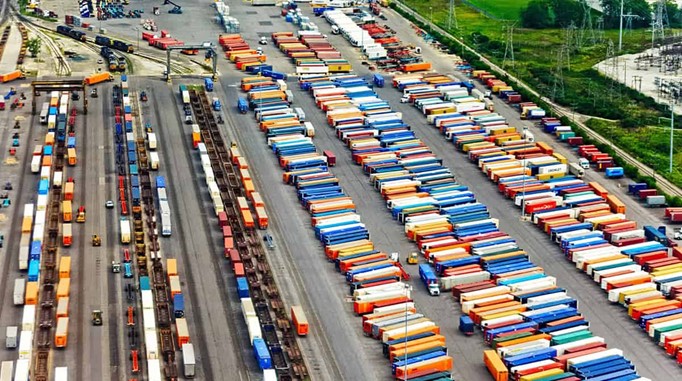
U.S. rail traffic for the week ending Nov. 13, 2021 continued to suffer, as a near-10% drop in intermodal loadings canceled out a small carload gain, the Association of American Railroads (AAR) reported Nov. 17.
Week 45 U.S. freight rail traffic was 502,613 carloads and intermodal units, down 4.7% compared with the same 2020 week. Total carloads were 235,867, up 1.7%, while U.S. weekly intermodal volume was 266,746 containers and trailers, down 9.7% compared to 2020.
Six of the 10 carload commodity groups posted an increase compared with the same week in 2020. They included coal, up 6,917 carloads, to 67,225; nonmetallic minerals, up 1,913 carloads, to 30,983; and chemicals, up 1,555 carloads, to 33,513. Commodity groups that posted decreases compared with the same week in 2020 included grain, down 3,772 carloads, to 25,336; motor vehicles and parts, down 2,800 carloads, to 12,690; and miscellaneous carloads, down 729 carloads, to 9,414.
For the first 45 weeks of 2021, U.S. railroads reported cumulative volume of 10,428,104 carloads, up 7.2% from the same point last year; and 12,424,895 intermodal units, up 7.2%. Total combined U.S. traffic for the first 45 weeks of 2021 was 22,852,999 carloads and intermodal units, an increase of 7.2% compared to last year—one that was hit particularly hard by the COVID-19 pandemic.
|
|
STB Schedules Three Hearings in Q1 to Address Major Proceedings |
|
The Surface Transportation Board (STB) on Friday announced plans to hold three public hearings in first-quarter 2022 on major rail industry cases.
The board has scheduled a hearing Jan. 13 on CSX’s revised application to acquire control of Pan Am Systems Inc. and its subsidiaries. In late 2020, CSX reached an agreement to purchase the Class II railroad based in North Billerica, Massachusetts, from Pan Am Systems in a deal estimated at $700 million.
Landing the largest U.S. regional would be the Class I’s biggest acquisition since the Conrail split with Norfolk Southern Railway in 1999. For more information on the planned acquisition, read this cover story in Progressive Railroading’s October issue.
The STB also scheduled a hearing Feb. 15 concerning Amtrak’s application for an order requiring CSX and NS to allow Amtrak to operate its trains on the Class Is’ lines between New Orleans and Mobile, Alabama. On Oct. 15, the board issued a decision extending the application’s procedural schedule and setting a due date of Dec. 30 for proposals on the hearing format. Read more about the ongoing case here.
Finally, the STB will hold a hearing March 15-16 regarding the reciprocal switching regulations the board proposed in 2016. A notice of proposed rulemaking on the matter generated divergent responses from a variety of stakeholders, STB officials said in a press release. And since the notice was issued and written comments were received, there have been significant changes in and affecting the freight-rail industry, they added.
“Commenters may now have additional or modified views on the effects of and/or need for the proposed regulations,” STB officials said. “Interested persons are invited and encouraged to engage in this public hearing to address these issues and any other matters relevant to this proceeding.”
|
|
USDOT Explains Infrastructure Law's Impact on Each State |
|
The fact sheets report how the law will fund the repair of roads and bridges; improve transportation options such as rail; build a national network of chargers to accelerate the adoption of electric vehicles; and upgrade airports and seaports.
The IIJA includes nearly $550 billion in new spending to address the nation’s aging transportation networks.
Links to the USDOT’s fact sheets for each of the 50 states and the District of Columbia can be found by clicking here.
|
|
FTA Outlines How Historic Spending Level Will Play Out for Transit Infrastructure |
|
The Bipartisan Infrastructure Deal is the largest investment in American infrastructure in generations, and marks an inflection point for American transit.
It will boost transit funding for communities all over the country by an average of 30%—helping them address maintenance backlogs, modernize, and expand. The new funding provided under the bill will help transit agencies reduce the current maintenance backlog by 15%.
Following President Biden’s signing of the Bipartisan Infrastructure Deal (BID) into law, the U.S. DOT’s Federal Transit Administration (FTA) announced key priorities and historic funding amounts for public transportation. The BID authorizes up to $108 billion, including $91 billion in guaranteed funding for public transportation—the most significant federal investment in transit in the nation’s history.
“As the transit industry renews ridership, this historic support will help us transform the way we plan and use public transportation in the United States,” said FTA Administrator Nuria Fernandez. “Long-overdue investments in transit infrastructure will deliver new and expanded public transit services, especially in communities that have suffered from historical funding inequities.”
Key priorities for public transportation under the BID include:
- Safety: The BID will enhance state safety oversight programs by strengthening rail inspection practices, protecting transit workers and riders from injuries, and ensuring safe access to transit;
- Modernization: The BID will reduce the maintenance backlog by repairing and upgrading aging transit infrastructure and modernizing bus and rail fleets; and
- Equity: Investments in the BID will improve transit service for communities that have historically had more limited access to transit and provide for substantial upgrades to accessibility.
|
|
Amtrak Service Along Point Defiance Bypass to Resume 4 Years After Deadly Derailment |
|
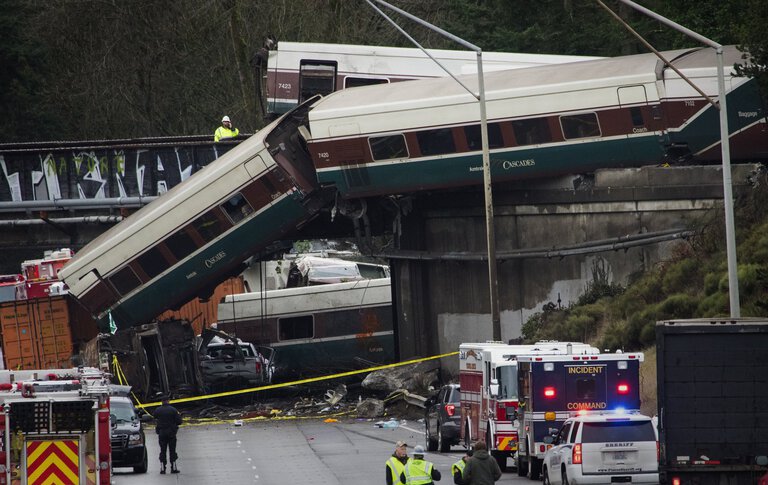
Almost four years after a deadly derailment on the Point Defiance bypass near DuPont, Amtrak Cascades service will resume on the bypass on Nov. 18.
The first train to use the bypass is scheduled to leave Seattle at 7:22 a.m. and arrive at the new Tacoma Dome station at 8:08 a.m., according to an Amtrak statement. The first northbound train will leave Eugene, Ore., at 5:30 a.m., stop in Portland at 8:20 a.m., and arrive in Tacoma at 10:54 a.m.
Amtrak said a total of eight trains — including Amtrak Cascades and Coast Starlight — will use the bypass daily, with additional trains added in the months ahead as COVID restrictions ease.
Use of the bypass is resuming after the addition of safety measures and the implementation of most of the National Transportation Safety Board’s (NTSB) recommendations following the 2017 derailment, the Amtrak statement said. The other recommendations are being pursued, the statement said.
Key among the safety improvements is the installment of activated positive train control, which uses GPS technology to stop or slow down a train before a collision or derailment occurs.
|
|
The FRA's New Midwest Regional Rail Plan and CrossRail Chicago |
|
Please join us as we take a look at the FRA’s new Midwest Regional Rail Plan and discuss the importance of building a high-capacity, dedicated passenger line through Chicago to make the proposed network a reality.
The Federal Railroad Administration’s Midwest Regional Rail Plan, released October 13, lays out a compelling vision for a network of high-speed trains that would transform travel across the Midwest.
The plan envisions a network that consists of four “pillar corridors” radiating out from Chicago, with endpoints in Minneapolis-St. Paul, St. Louis, Indianapolis and Detroit. These high-speed lines form the backbone of the system and would be integrated with transit systems and regional lines. This would make connections much faster and easier between hundreds of cities throughout the Midwest.
In order for this network to work, Chicago needs to be prepared to handle increased rail traffic. That’s why we’ve proposed CrossRail Chicago. CrossRail would create a north-south route through Chicago to connect fast regional trains, airport trains, and high-speed trains from around the Midwest to Union Station and O’Hare.
Both of these proposals are inextricably linked in the effort to bring high-speed trains to the Midwest.
|
|
Flooding Cuts off Port of Vancouver Rail Service |
|
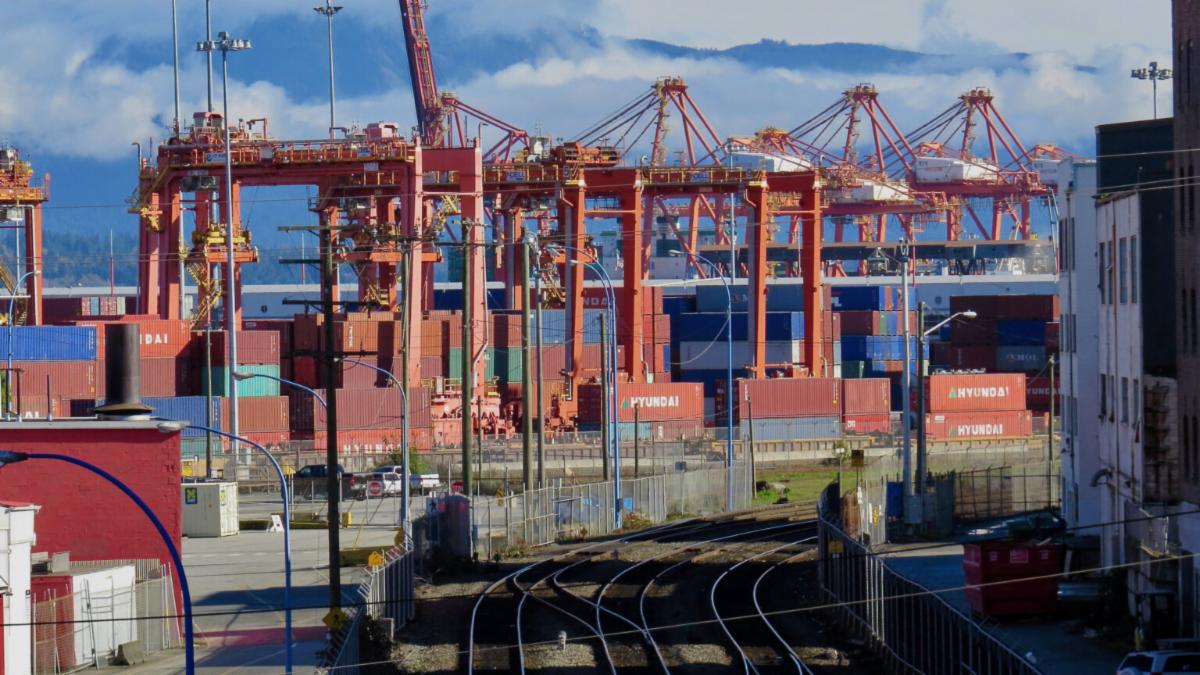
Flooding and landslides in British Columbia have cut off the Port of Vancouver from all rail services as officials warned on Tuesday of forthcoming vessel delays and disruptions to terminal operations.
Significant portions of CN (NYSE:CNI) and Canadian Pacific (NYSE:CP) rail lines serving the port — Canada’s largest — were shut down after heavy rain pounded the province and the Pacific Northwest. The consequences likely will be felt throughout the Canadian supply chain, adding delays for shipments of everything from containers to bulk commodities.
“Vessel delays and heightened anchorage demand are expected due to disruptions to terminal operations,” port spokesperson Matti Polychronis wrote in an email. “We are working closely with our terminal operators, railways, and all levels of government to understand the impacts of these delays on terminal operations and to develop a recovery plan.”
As of Tuesday night, the port reported 32 vessels at anchor.
|
|
|
|
|
|
|