|
For 39 years, Michael Lapniewski got away with murder. It took the dedication of cold case detectives, the hard work of the State Attorney’s Office, and incredible advances in genome sequencing to bring the killer to justice at last. This month he was sentenced to life in prison for the 1987 murder of 82-year-old Opal Weil.
Opal Weil was born in Georgia and moved to Florida in 1977 after the death of her second husband to be closer to her family. Her brother and sister-in-law lived across the street just a couple of houses down from Opal, and she often got together with them and her niece and great-niece. Her sister-in-law last spoke with her the evening of February 8th and planned to see her the next day. But when she called Opal at 7:45 a.m. on February 9th she didn’t answer. She checked the backyard, found that the back door was open, and discovered Opal dead in her bedroom with obvious signs of violence.
The suspect had cut the telephone line and entered through the Florida room at the back of the house. Theft was probably the motive – her wedding ring was missing and several drawers were opened, although a watch and earrings on the dresser were left behind.
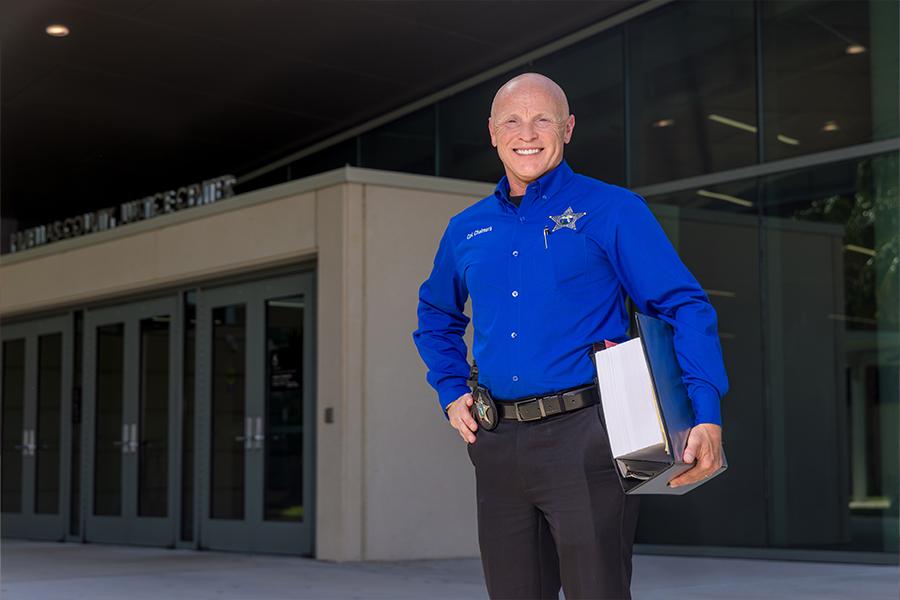
The attack was brutal. The cause of death was strangulation, but she was severely beaten too, with a broken clavicle, multiple broken ribs, a transected brachiocephalic artery, and a ruptured pericardial sac. Multiple hairs were found at the scene, clustered in five different locations, including on Opal’s nightgown and under a knife found at the scene. Although they weren’t able to offer much forensic insight in 1987, those hairs were documented, photographed, and saved as evidence. For decades they stayed preserved, until cold case detective Corporal Ron Chalmers realized that new technological advances might mean those hairs held the secret to Opal’s killer.
The science is a little complicated and involves a unit for measuring genetic linkage called a centimorgan. “Each person has about 7,200 centimorgans,” Corporal Chalmers said. “A child gets about 3,600 from each parent, and that splits with each generation, with half coming from your mother and half from your father. A grandchild will only share about 1,800 centimorgans with their grandparent.” The farther the degree of relation, the fewer shared centimorgans.
DNA from the suspect hairs was uploaded to FamilyTree DNA and GedMatch, two ancestry databases that people use to build their family trees. Users can opt in to allow law enforcement to use their information in searches to help solve cases. The hope is that DNA from a case will show the suspect is related to someone who put their own DNA into the database. From that, a genetic genealogist can create a family tree to find out how that suspect sample is connected to people on the database.
It could be easy if someone’s brother happened to be in one of the databases, since they share so much genetic material, or there could be no relative in the database. In this case, the suspect and their closest match only shared 77 centimorgans. That meant the suspect was a very distant relative of someone in the database – a third cousin at least. But that match combined with a couple of other even more distant matches were enough for a professional genetic genealogist to create more than 24 family trees, eventually determining that the suspect was one of three brothers. One was dead, and they already had DNA from another so he could be eliminated. That meant they had to get a DNA sample from the third possibility, Michael Lapniewski, who was living in Mississippi.
Detectives from PCSO’s Tactical Investigations Section collected surreptitious DNA samples from Lapniewski. First they collected a coffee stirrer he had sucked on, then devised a ruse offering him a free lunch, after which they collected his utensils. The DNA was a match – he was definitively the source for the clumps of hair found in at the scene.
Michael Lapniewski was 19 years old at the time of the murder, with youthful arrests for shoplifting, forgery, and using a stolen credit card. Later in life he had arrests for DUI and domestic violence in Florida, California, and Mississippi. His family had lived just nine houses down from Opal, but before the murder had moved to a different house about half a mile away. Lapniewski claimed that he didn’t know Opal and had never been in her house – which left him with no reasonable explanation of how so much of his hair, including clumps that had been violently pulled out, came to be in Opal’s house. To Corporal Chalmers and the State Attorney’s Office, the evidence was clear.
When there’s science in a case, it can be a challenge to present it to the jury clearly. Jury members took copious notes. “I’m very happy that the jury could see it for what it was, and a lot of that is a credit to the State Attorney in presenting the case in a very easy to understand format,” Corporal Chalmers said.
After only an hour and a half of deliberation, the jury came back with its verdict: guilty.
“I’m so thankful for all of the detectives who worked on this case before me, for the forensic scientists, and for the people in the FDLE lab for their tenacity and willingness to help,” Corporal Chalmers said. “I’m grateful for the State Attorney’s Office, and for the members of the jury for their work to ensure justice for Opal and her family.”
It was a bittersweet moment for Opal’s surviving family, including her great-niece who testified at the trial. Corporal Chalmers keeps in close contact with relatives of cold case homicide victims, checking in on them at birthdays and the anniversary of their loved one’s death. He got in touch with Opal’s great-niece after the trial was over to see how she was doing.
“This is the opposite of closure for her – this is reopening all the family’s old wounds,” said Corporal Chalmers. “The family had adapted to a new way of life without Opal and every day that passed made it a little easier to bear. The trial was tough for her. She heard about the horrific things that had happened to Opal, heard the interview with the man who killed her. I’m sure the family was happy with the justice but it reopens all of those wounds that had almost healed.”
Another person keenly watching the trial was the grandson of Eleanor Swift, another elderly woman who was killed not far away and just a few days after Opal’s murder. Just like with Opal, the suspect broke in through Eleanor’s Florida room and stole her wedding ring. Then two weeks after that another elderly woman was robbed and beaten in her home, though she survived. Because of the very similar circumstances, Lapniewski could be a suspect in Eleanor’s murder.
The Monday after the trial was over, Corporal Chalmers was digging into more cold cases. “Now I’m just focusing on the next one and hoping we can get another successful case. I’d still love to be able to put the Eleanor Swift case together, whether it’s him or someone else. I’m sure it’s hard for that family to see the success in getting a conviction for Opal’s killer but to know their own grandmother doesn’t have full justice yet.”
When Corporal Chalmers was a homicide detective, he had cases of this magnitude several times a year. But cold cases are different. With degraded evidence, lost witnesses, and the passage of decades, successfully closed cold cases are few and far between. He said it’s strange to think about the amount of time since the crime had occurred. “When I stop and think about how long 39 years is – that’s a long time. I think about where I was and what I was doing February 8th and 9th, 1987. I was a freshman in high school in Los Angeles, playing baseball, my season was probably just starting. To think that 39 years later our paths would cross and end with her killer being convicted.”
|