|
Hail–Locusts–Darkness Plagues
“But when Pharaoh saw that the rain and the hail and the thunder had ceased, he sinned yet again and hardened his heart, he and his servants alike.” (Exodus 9:34)
God not only warned of the plagues but also urged the Egyptians to make a decision, declaring that those who took the warning seriously could avoid harm. The text points out in 9:20 that “those who feared” were found “among the servants of Pharaoh.” This indicates that among the officials in Pharaoh’s court—who personally witnessed Moses and Aaron delivering God’s word to Pharaoh and saw the plagues take place—there were some who experienced God’s mighty works and came to fear His word. Conversely, it also suggests that, like Pharaoh, there were officials whose hearts were hardened and who, despite witnessing many plagues, still did not fear God. From this we can see that Egypt was truly a land of pagan idols that neither knew God nor believed in His power.
The Plague of Hail
The hail fell together with thunder, appearing as though hail and fire were falling at the same time. As countless hailstones came down, accompanied by thunder and flashing lightning, it is described as if what was falling from the sky was not merely hail but fiery masses. Moreover, the word translated as “very severe” (kāvēd), which carries the meanings “heavy” and “intense,” implies that the hailstones were extremely large and heavy. This suggests how devastating the plague of hail that struck Egypt truly was. The hail plague did strike Pharaoh’s heart, leading him to recognize his wrongdoing—though only briefly. At the same time, this plague appears to foreshadow the seventh bowl judgment of the last days.
The Plague of Locusts
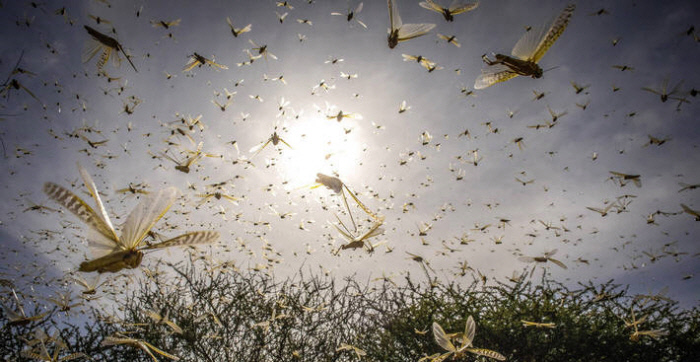
Late crops ripen one or two months later; therefore, there was still food left for the locusts to consume. In verse 15, the word translated “it became dark” (ḥatteḥšāk) means “to be pitch dark” (Amos 8:9) or “to be dark” (Isaiah 5:30). Thus, when the locusts filled the entire land of Egypt, it became dark because the locusts completely covered the land, turning it black. The word translated “remain” (yāṯar), meaning “to be left” (Joshua 11:22), is used together with the strong negative lōʾ, meaning “not at all,” to indicate “nothing whatsoever.” This emphasizes the extent of the devastation caused by the locusts: not a single green plant remained in all the land of Egypt. In other words, all the herbs, vegetables, and fruits of the trees that humans and animals depended on for food were completely destroyed. This strongly indicates that a severe food crisis had already been brought upon the entire land of Egypt. Even today, locust swarms that sweep across the African continent are among the most severe examples of what the Old Testament describes as “the rod of God.” Pharaoh’s confession of sin, Moses’ prayer for Pharaoh, and Pharaoh’s renewed hardening of heart are repeated again and again, and the end is still not in sight.
The Plague of Darkness
It is recorded that the Egyptians “did not rise from their places at all.” This does not mean that the Egyptians simply slept and did not get up, but rather that all the people of Egypt remained inside their own homes, completely giving up going out or engaging in any outside activities. This was, of course, because they could not see ahead due to the thick darkness that came upon the land of Egypt. At the same time, it was also because of the indescribable fear and terror brought about by that deep darkness.
Although the plague of darkness may appear to be a lesser plague than the hail or the locusts, if the darkness is understood as a “sign,” it actually indicates that the plagues had intensified even further. The darkness of this plague was different in meaning from ordinary night. On the one hand, it recalls the state of chaos before creation; on the other hand, it foreshadows the day of God’s judgment. Just as light shone for the Israelites in the midst of the darkness, in the Old Testament light itself signifies God.
Reflection
Because of the deep darkness that covered the entire land of Egypt for three days, all the Egyptians were unable to see the sun. The paralysis of their activities symbolized that the shadow of death was slowly advancing over the whole land of Egypt. It also served as a prelude to what would soon be the greatest plague in Egyptian history—the death of the firstborn.
At the end, Pharaoh acted as though he were God and warned Moses not to see his face again. This expression is the same wording God used when He told Moses that a human being would die if he saw God’s face. Moses’ reply expresses the certainty that the time for demands and negotiations had ended and that the day of the Exodus was drawing near.
|