Weekly Digest Number 50 - December 14th, 2021 |
|
Please note that due to the holidays, the RWU Rail & Labor News will not be available the weeks of December 21st and December 28th. Enjoy the holidays fellow workers, relax and rejuvenate, and we will get back to it in the new year. Solidarity Forever!
|
|
(Editor's Note: The author of this article - Kim Moody - is a longtime staff writer for Labor Notes, a supporter of RWU, and will be invited to speak at our Convention in June in Chicago on the supply chain question.) |
|
The Supply Chain Disruption Arrives ‘Just in Time’ |
|
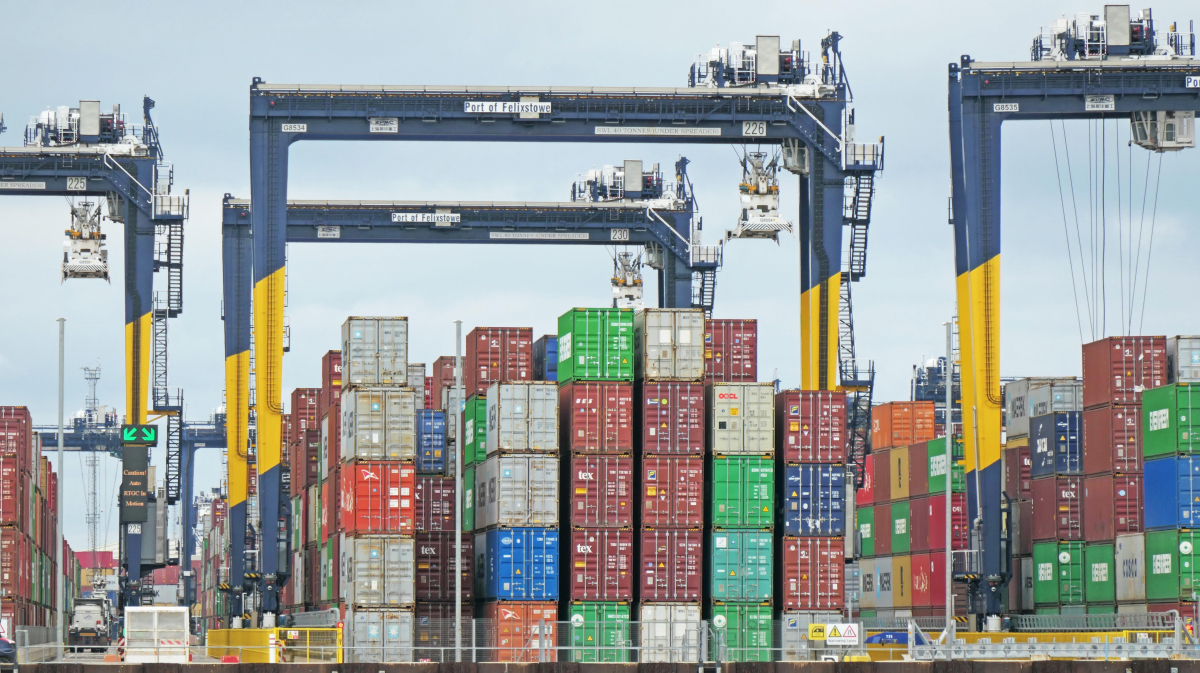
But the Ever Given snafu was no isolated incident. On the other side of the world, by early November some 77 container ships were stranded at sea outside the ports of Los Angeles and Long Beach, while almost a third of the ships in dock had to wait five days or more to be unloaded. Bloomberg declared that a “global supply-chain crisis” was “pushing warehouses to capacity and forcing logistics managers to scramble for space.” The Institute for Supply Chain Management reported that manufacturing activity was down as “supply chain challenges continued to weigh on U.S. manufacturers in October.” What’s going on?
The problem, however, didn’t begin with the pandemic. The U.S. industry journal Transport Topics reported in 2018 that truck and rail carriers already “faced difficulties in keeping up with demand.”
LABOR ‘SHORTAGE’ KEY
The single most important underlying cause of the 2021 supply chain back-up and crisis in the U.S. is a longstanding “shortage” of workers to keep goods moving.
According to the American Trucking Association there’s a “historic high” shortage of 80,000 drivers. This isn’t just truckers down with the virus. Nor is this “shortage” due to a lack of people who could drive trucks. As any Teamster can tell you, it’s stagnant pay, long hours, high stress, and health issues that drive workers from the industry and keep job seekers away. And that was the case well before the pandemic struck.
Warehouse workers, who also saw stagnant wages and poor conditions over this period, were also in relatively short supply for the same reasons. The recent wage increases —which resulted from these labor shortages and high “quit” levels — are too little, too late.
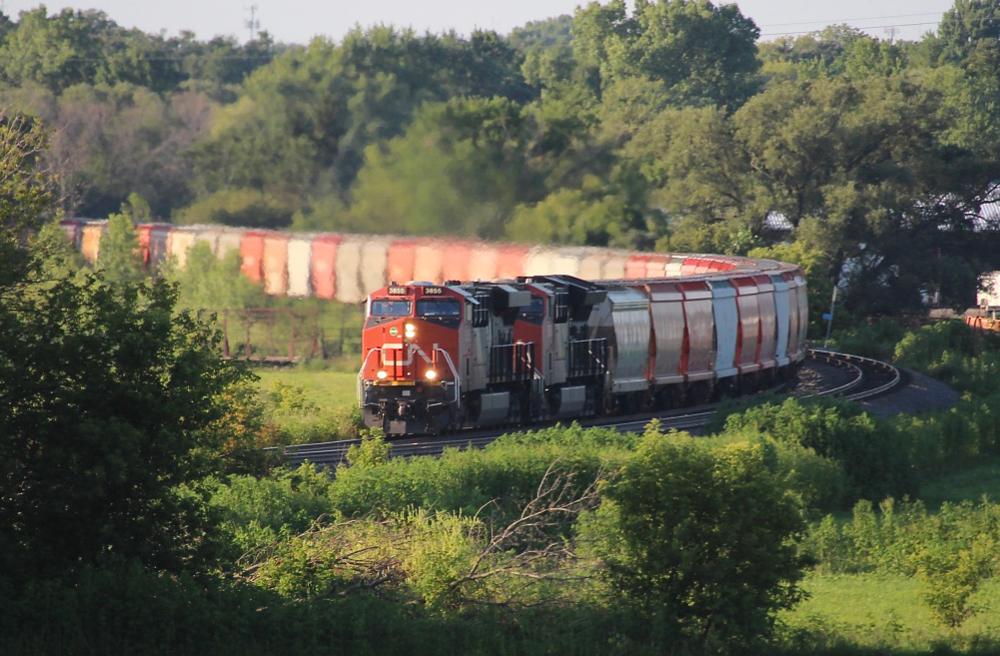
To make matters worse, over the last several years the big rail freight rail carriers who move goods across the continent have whittled down their workforce using Precision Scheduled Railroading, their version of just-in-time lean production. As a result the number of workers on Class I freight railroads fell from 170,000 in 2017 to 135,000 in 2020, while rail freight increased by 40 percent in weight and 37 percent in dollar value from 2010 to 2019. As the cross-craft rank and file organization Railroad Workers United points out, PSR reduced “railcar equipment when needed,” “clogged ports and terminals,” and exhausted train crews, thus contributing to the supply chain crisis.
A lack of truckers, railroad workers, warehouse workers, and others along the nation’s supply chains means congested ports, stalled and unloaded ships, overloaded warehouses, increased delays, empty shelves, and higher prices.
|
|
(Editor's Note: The article below is from the Airline Pilots Association - ALPA - the world's largest airline pilots union. Note the points that ALPA makes and their similarity to the points that railroad workers and our organizations make on the question of two aboard the locomotive. In fact, many of these same points can be made for ANY set of workers in a safety sensitive position.) |
|
Why Two Pilots are Better
America Needs to Keep Two Pilots on the Flight Deck
|
|
Having at least two highly trained and experienced pilots on every flight keeps air travel America’s safest mode of transportation The most vital safety feature on a commercial airline passenger and cargo aircraft is this: at least two experienced, trained and rested professional pilots on the flight deck. Flying a commercial airliner isn’t something that can safely be done solo. It’s true that significant technological advances in weather monitoring, automation, navigation, surveillance, communications, and information-processing contribute to the impressive safety record of U.S. commercial aviation. But more than a decade of research by NASA and the Federal Aviation Administration(FAA) has shown that all these systems not only work best when there are at least two pilots on deck – one pilot flying and one pilot monitoring aircraft status, weather, and operations.
Those who think the industry can save money by having only one pilot on a flight — while not jeopardizing safety — are just plain wrong.
There’s a lot to do when safely flying an aircraft. And for two people working together on a difficult and often stressful job and acting on guidance provided by the FAA, pilots are able to divide operating duties so everyone knows their responsibilities, and no one gets overtaxed. Here’s how pilots divvy up their roles when there’s two on board:
- The Pilot Flying — Focuses strictly on flying and operating the aircraft; manipulating the flight controls for takeoff and landing; as well as overseeing and managing operations during the flight.
- The Pilot Monitoring — Manages the aircraft and flight; communicates with air traffic control; completes the checklists; monitors aircraft systems; keeps tabs on fuel, weather, pilot wellness levels, and any issues that come up that could interfere with the pilot duties.
Pilots may alternate or swap these duties during the flight, to provide the safest trip possible. Research shows that a pilot working alone with automated systems or working with a second pilot who is on the ground is not as safe as two pilots working side by side. As they engage in a multitude of tasks on the flight deck, they rely on nonverbal cues, like head nods, facial expressions, and physical actions, to confirm a task is being performed or a message was heard.
|
|
(Editor's Note: With this conformation, rail labor can expect more positive rulings from the Board in the coming months and years. One more reason why at this moment in history, the cards are stacked in favor of rail labor to take action and win! As we have said in recent issues of this News Bulletin, these conditions will not remain indefinitely. In fact, we may have a short window of opportunity in which to strike.) |
|
Teamsters Applaud Conformation of Deirdre Hamilton to serve on the National Mediation Board |
|
The Teamsters Union applauds today’s confirmation of Deirdre Hamilton to serve as a member on the National Mediation Board (NMB) by the U.S. Senate. Hamilton brings more than 20 years of experience representing workers before federal courts and the NMB on a wide range of legal issues.
Hamilton has served as the staff attorney for the Teamsters Airline Division for the past six years and at the Association of Flight Attendants for the previous 12 years. In these roles, she has expertly represented the union and its members in NMB elections and mediations and advised bargaining committees for various crafts or classes of airline employees at multiple carriers.
“Thanks to today’s confirmation, workers across the country in our rail and airline industries have a true champion serving on the board,” said Teamsters General President Jim Hoffa. “I have no doubt that Ms. Hamilton will uplift workers’ rights and improve labor-management relations as a member of the NMB.”
Created by Congress through the Railway Labor Act (RLA), the NMB plays an essential role in the facilitation of labor-management relations in the aviation and rail industries. Tens of thousands of Teamsters work in these industries as mechanics, pilots, flight attendants, engineers, and maintenance of way employees, among other critical roles.
“Ms. Hamilton will be an outstanding member of NMB,” said Teamsters Rail Conference Director and Vice President At-Large John Murphy. “She has consistently demonstrated her commitment to putting workers first throughout her career and I am confident she will continue to do so as a member of the board.”
|
|
(Editor's Note: A national rail strike looms in the UK over a number of issues, many of them not dissimilar to what rail workers are facing on this side of the Atlantic. What path will railroad workers and our unions decide upon in North America? Railroad Workers United is drafting a statement containing our thoughts on the question. Stay tuned.) |
|
Unions Plan for National Rail Strike as Job Cuts Loom |
|
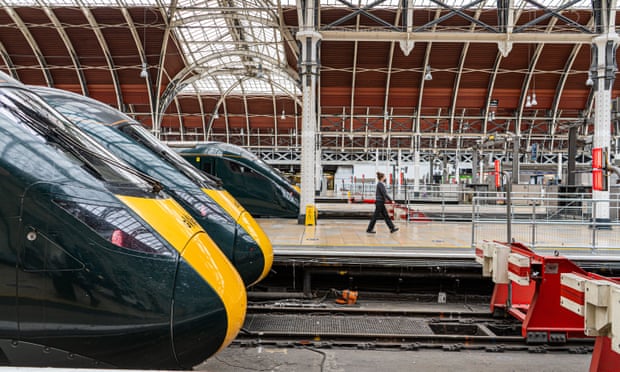
Rail unions are drawing up plans for a national strike as job cuts loom across the industry. The RMT is preparing to ballot its members for industrial action, with the union anticipating compulsory redundancies are highly probable at train operating companies and Network Rail. Such redundancies would mean “trains are coming to a halt”, the TSSA union said after it failed to get assurances over jobs.
Unions have been in talks since June over plans to reduce costs in the industry. While broad voluntary redundancy schemes have been introduced, negotiations have taken place under an agreement to rule out forced job cuts until 31 December. Pay rises are also yet to be agreed, with inflation rising rapidly.
Train operators have been told by the government to find savings of 10% in revised business plans while protecting services. With large fixed costs in rolling stock and rail access, cutting staff or reducing terms and conditions remains a probable target for savings.
An RMT spokesperson said: “We’re very clear on the direction of travel, that a massive jobs cull at train operators and Network Rail are coming, as well as an attack on pay and pensions. We’re getting our tanks on the lawn right now.”
Manuel Cortes, the general secretary of the TSSA, said: “Any attempt to use compulsory redundancies will be seen as a declaration of war and trains will be coming to a halt.
“Our members are already rightly angry that having been hailed as heroes for keeping our country moving during the pandemic, they are now facing job cuts. Despite putting themselves on the line through the pandemic, the vast majority of them saw their income fall in real terms as they did not get a pay increase for 2021.”
|
|
Judge Blocks Vaccine Mandate for Federal Contractors |
|
Federal Railroad Administration Announces Availability of $198 Million for Intercity Passenger Rail Projects |
|
The U.S. Department of Transportation’s Federal Railroad Administration (FRA) today issued a Notice of Funding Opportunity (NOFO) for the Federal-State Partnership for State of Good Repair Grant Program (Partnership Program).
The NOFO includes $198 million in grant funding to repair and rehabilitate qualified intercity passenger railroad infrastructure and assets. It will also provide an opportunity to jumpstart investments in eligible projects under the recently enacted Bipartisan Infrastructure Law.
“The Partnership Program will make targeted investments to improve and modernize rail assets used in intercity passenger rail service,” said FRA Deputy Administrator Amit Bose. “This funding provides a valuable opportunity to enhance the safety, efficiency and resiliency of intercity passenger rail infrastructure and services, and we encourage all eligible parties to apply.”
The Fiscal Year (FY) 2021 Partnership Program will fund capital projects that reduce the state of good repair backlog and improve intercity passenger rail performance on publicly or Amtrak-owned or -controlled infrastructure. Eligible applicants may seek to replace existing assets in-kind or with new ones that increase capacity or provide a higher level of service; ensure that service can be maintained while existing assets are brought to a state of good repair; and bring existing assets to a state of good repair. This notice also makes some incidental Capital Project expenses eligible for funding, including designing, engineering, location surveying, mapping, environmental studies and acquiring rights-of-way.
Under the Partnership Program, grants are intended to benefit both the Northeast Corridor (NEC) and the considerable amount of infrastructure, equipment and facilities outside the NEC that are publicly or Amtrak-owned or-controlled. Applications will be evaluated and selected on a competitive basis. Project proposals should support key Departmental objectives including: fostering a safe transportation system; contributing to equitable economic progress from infrastructure investment; ensuring investments meet racial equity and economic inclusion goals; increasing resilience and addressing climate change; and transforming our nation’s transportation infrastructure.
|
|
(Editor's Note: For all of you Train & Engine service workers who are ready to jump ship from your Class One freight carrier, note that Amtrak is hiring in crew bases across the country.) |
|
Amtrak Worker Shortage Slows Railroad’s Pandemic Recovery, Expansion Plans |
|
Amid a financial boost from infrastructure bill, Amtrak is struggling to hire and retain workers during national labor shortage.
The landmark infrastructure package approved last month positioned Amtrak to pursue entering new cities and to tackle long-delayed maintenance projects. But amid its biggest boost in history, the carrier faces an immediate crisis that threatens service: a scarcity of railroad workers.
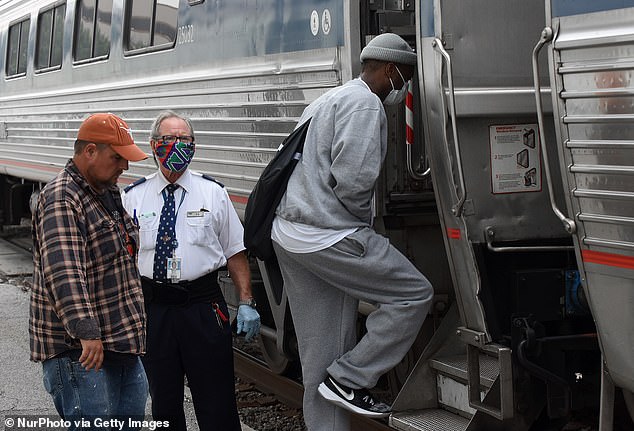
Amtrak is struggling to hire and retain workers amid a national labor shortage, down 1,500 people since the start of the coronavirus pandemic. It has left the railroad unable to resume pre-pandemic service levels, expand dining services to some trains or launch long-planned routes.
The intercity passenger railroad is operating about 80 percent of its normal schedule after deep reductions last year. Those levels of service, however, could be reduced next month when the railroad is set to enforce a vaccination policy, which the company says could lead to the termination of 6 percent of its workforce.
Service cuts could be announced weeks after President Biden signed a $1.2 trillion infrastructure bill that puts $66 billion into rail, which Amtrak planned to use for expansion and tackling a backlog of projects. The cash infusion has created the most substantial growth opportunity in Amtrak’s 50 years of existence, coming alongside economic conditions that simultaneously threaten to diminish the system.
|
|
STB Releases Details for CSX-Pan Am Merger Hearing |
|
The public hearing will be held virtually on Jan. 13, 2022. If necessary, the hearing will continue on Jan. 14.
Anyone who wants to speak at the hearing should file a notice of intent to participate by Dec. 20. The notice should identify the entity, if any, the person represents, the proposed speaker, the amount of time requested and a summary of the key points that the speaker intends to address, STB officials said in a press release.
|
|
U.S. Rail Traffic Slips 2.8% in Week 48 |
|
U.S. freight railroads logged 527,406 carloads and intermodal units for the week ending Dec. 4, a 2.8% decrease compared with rail traffic during the same week in 2020, according to Association of American Railroads (AAR) data.
Traffic for the week totaled 255,044 carloads, up 3.9%, and 272,362 containers and trailers, down 8.4%.
Seven of the 10 carload commodity groups that AAR tracks weekly posted an increase. They included nonmetallic minerals, up 4,198 carloads to 32,916; coal, up 3,284 carloads to 68,736; and metallic ores and metals, up 2,621 carloads to 22,526.
Commodity groups that posted decreases during the week were motor vehicles and parts, down 1,696 carloads to 14,751; petroleum and petroleum products, down 1,018 carloads to 10,714; and miscellaneous carloads, down 903 carloads to 10,428.
|
|
(Editor's Note: It would be great to see the fractured and divided U.S. craft unions - all 12 or 13 of them - get together and draft a vision for what we as railroad workers think the rail system should and could look like in the United States.) |
|
A Vision for Scotland's Railways
A Report from UNITY Consulting for Scotland's Rail Unions
|
|
Scotland's four rail unions, ASLEF, RMT, TSSA and UNITE, commissioned UNITY Consulting Scotland to outline a vision for the future of Scotland’s railways. Part of the remit was to address the current short-term thinking of Abellio ScotRail and those working on their behalf who advocate an erosion of services and public investment in our railways. Predominantly, however, this report will be focused on outlining a positive and constructive vision for the future of Scotland’s railways from a trade union perspective; a vision of improvement and investment that will make rail services more attractive to passengers and businesses.
This vision lays out the different component parts necessary for the effective operations, maintenance, and delivery of first-class rail services, which meets the needs of Scotland’s travelling public but also helps deliver the Government’s public policy priorities and environmental targets.
|
|
(Editor's Note: The author of this book - Joe Burns - has spoken at the RWU Convention in the past.) |
|
BOOK REVIEW: Class Struggle Unionism
Alex Riccio argues Joe Burns’ latest book is powerfully inspiring but short on details.
|
|
With his third book, Class Struggle Unionism (Haymarket, forthcoming in 2022), Joe Burns has inked a holy trilogy for left-wing unionists. His first two books, Reviving the Strike and Strike Back, provided a persuasive argument for how militant, large-scale (illegal) strikes and forms of direct action built both private and public sector unionism in the United States. Nothing less than the return to these tactics, Burns argues, can rebuild the labor movement. In Class Struggle Unionism, Burns elaborates his concept of militant unionism, but withholds giving marching orders on the nuts and bolts of organizing class struggle unions.
To revive labor militancy, Burns says, unions must understand themselves as the vehicle for waging class struggle against the ruling class where these two classes share no common interests. Animated by a spirit of class struggle, unions must be willing to fight for control over the shop floor, violate labor law, and generate working-class solidarity through engaging in open conflict with employers. A class struggle union embodies distinct characteristics from existing mainstream unions; namely, they will have to be run by workers, utilize tactics that emerge from the workplace, and act in opposition to any forms of oppression faced by the working class, particularly racism and sexism.
|
|
Study Sees Rail Move to Battery-Electric Propulsion as Feasible, Cost Effective |
|
A new study says railroads could save $94 billion over 20 years by reducing air pollution and carbon dioxide emissions — and help avoid health impacts including an estimated 1,000 premature deaths each year — by retrofitting diesel-electric locomotives with battery power.
The study from the U.S. Department of Energy’s Lawrence Berkeley National Laboratory, in collaboration with UCLA and UC Berkeley researchers, says the conversion could be accomplished in a cost-competitive manner, in part through the use of battery tenders, cars carrying battery units, while leaving the diesel engine in place as a backup power source. The study was published in the journal Nature Energy.
“A rapid conversion of the freight-rail sector is not only technically feasible and cost-effective, it would bring immediate and lasting health and economic benefits to lower-income communities,” Natalie Popovich, Berkeley Lab scientist and lead author of the study, said in a Berkeley Lab article. “And it would provide a boost to our nation’s efforts to curb climate change, especially considering that U.S. freight rail capacity is expected to double by 2050.”
Amol Phadke, a Berkeley Lab scientist and coauthor of the study, said dramatic improvements in battery technology make the conversion feasible, and that battery weight is less of an issue for trains than for other forms of transportation: “We can add a car to a freight train built out with batteries, and the weight of that battery car is not an issue.”
Phadke sees another potential benefit of the use of battery tenders: they could be used as mobile power sources “during extreme events, such as during the recent catastrophic wildfires in California or the 2021 winter storm in Texas that left millions without access to electricity. This mobile energy storage capability would also create a potential new revenue stream for freight rail operators.”
|
|
Is Compressed Natural Gas Finally Feasible for Railroad Applications? |
|
Railroads transport goods extremely efficiently, especially in terms of fuel and greenhouse gas emissions. But most locomotives still run on fossil fuels. Use of cleaner alternatives such as battery-electric or hydrogen requires new locomotives. However, diesel-powered locomotives can be retrofitted to run on natural gas, enabling companies to more cost-effectively reduce GHG emissions without having to retire locomotives that have years of useful life left.
Challenges of natural gas for rail
Storing sufficient quantities of natural gas to deliver locomotives with the required energy for long-haul applications has been difficult to achieve, and safe handling of natural gas poses challenges.
But David Scott, co-founder, president and CEO of CNGmotive, and Pedro Santos, co-founder and CTO, believe CNGmotive has solved those problems.
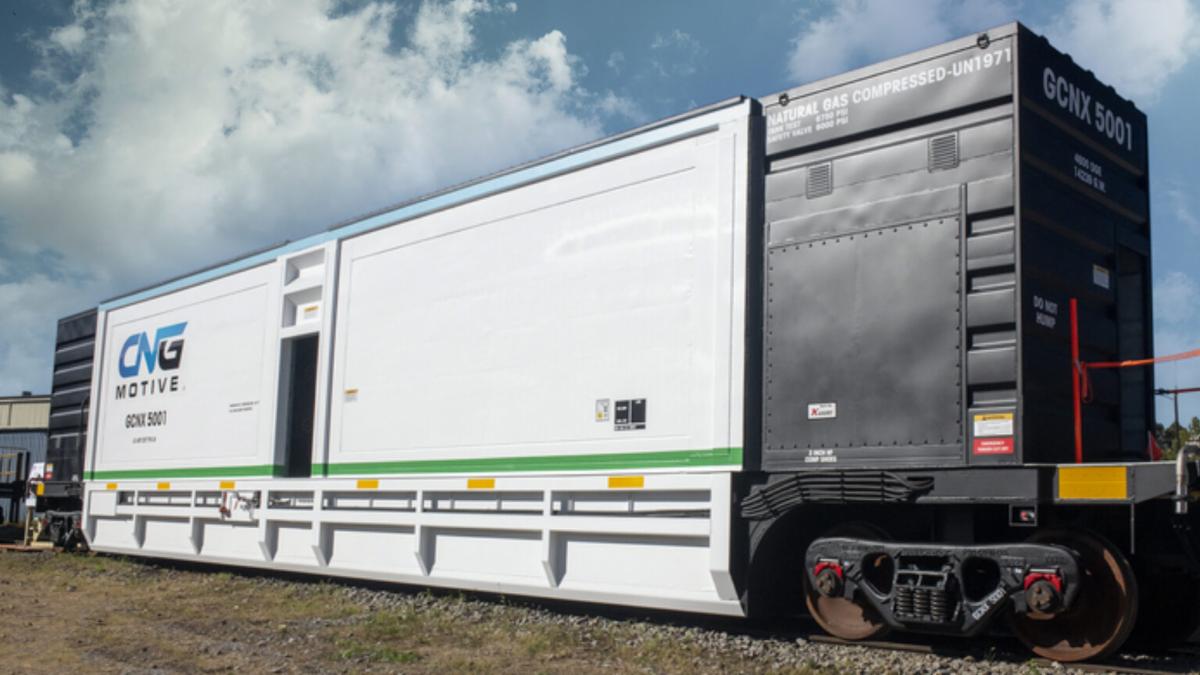
Launched in 2015, CNGmotive designed a composite fiberglass tank that is lightweight but still robust enough to hold significant amounts of compressed natural gas (CNG), Santos said.
Conventional tenders can hold less than 2,500 gallons of diesel equivalent, and it takes more than 90 minutes to fill them, according to CNGmotive’s website. CNGmotive’s CNG tenders can be filled with 5,000 gallons of diesel equivalent in under 45 minutes, and the company has a design for a tender that can hold 9,000 gallons, according to Scott.
|
|
|
|
|
|
|