|
President's Message
Jehovah Nissi
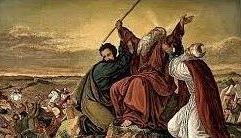
"Then Moses built an altar and called it ‘The LORD is my Banner,’ saying, ‘The LORD has sworn: The LORD will have war with Amalek from generation to generation.’"
(Exodus 17:15-16)
As God guided His people, He set their journey, yet the lack of water always became a test, causing the people to doubt His faithfulness and care. Just as at the well of Marah at the beginning of the Sinai wilderness, a similar situation occurred at Rephidim. On this seemingly endless journey, the thirsty people confronted Moses, seeing him as responsible for their predicament and expecting him to provide a solution. The immediate difficulties blinded them to God’s past acts.
The Root of the Problem: War
The narrative of the water at Meribah and the war with Amalek is detailed for the Meribah incident to highlight Israel’s unbelief. Despite having experienced God’s power at Marah, the Israelites once again complained against God’s servant Moses over water, demonstrating their persistent and stubborn lack of faith. In contrast, the account of the Amalekite war is brief, as it occurred regardless of Israel’s faith.
The Problem Solver: The LORD (through Moses and Joshua)
In both the Meribah incident and the Amalekite war, the ultimate problem solver is God alone, with prayer serving as the channel. Although the text does not explicitly mention prayer during the Amalekite war, it emphasizes that Israel could only prevail while Moses held up God’s staff in prayer. This symbolic act underscores that the final solution to every problem rests solely with the LORD.
The Resolution: Victory in Battle
The resolution of both situations is also recorded. At Meribah, water flowed from the rock as a result of Moses’ obedience, briefly noted. The Amalekite war recounts only the outcome rather than the full battle. This brevity powerfully conveys that when one obeys the LORD, all problems are immediately and decisively resolved, creating a clear and compelling image without unnecessary elaboration.
Commemoration of the Event: Jehovah Nissi
Finally, after the conflicts in the two events had been resolved by God’s grace, the text records the act of giving a new name to commemorate them. In the case of the war with Amalek, which is described in more detail than the Meribah incident, this act clearly serves the purpose of ensuring that God’s works are not forgotten but remembered. In this way, God desires that humans recall and commemorate His deeds. Looking back, most sins in human history originate from failing to remember and honor God’s merciful and mighty works.
Reflection
Not only the Israelites in the wilderness, but all humans throughout history face problems, great and small. Therefore, a believer who acknowledges God’s omnipotence must seek Him in prayer as the ultimate solution to all problems. Only then can all difficulties be truly and fundamentally resolved. Moreover, it is essential to remember God’s mercy and power, giving Him continual glory. This attitude is the proper response of humanity and also serves as the path to receiving further grace.
|