800 Vinial Street, B408
Pittsburgh, PA 15212
Phone: 724-831-8353
February 2020
How can we support aphasia and people with aphasia?
One way to support aphasia and PWA, is to USE and SAY the word APHASIA in news coverage and in conversation.

The recent coverage of the death of Kirk Douglas who had a stroke in 1996 omitted the word APHASIA. But, other groups - especially the National Aphasia Association , are helping to spread the word.

Said Chad Ruble at the NAA regarding Kirk:

"We our particularly grateful for his honesty and openness about his experience dealing with the challenges of aphasia after a stroke," . . . That he was willing to share his story continues to be a tremendous comfort to the 2 million-plus people in this country who continue to deal with the challenges of aphasia."

The National Aphasia Association is offering a "new series of one-minute videos aimed at delivering quick tips you can use to make your life a little easier if you have aphasia."


Say the word:

Aphasia
[uh-fay'-zhah]

For help with your aphasia and a free consultation, contact aphasiatoolbox.com - the aphasia experts, Click here .

Notes from Bill Connors
Editor's Note: In last month's edition, we unfortunately had an editing error. In the section that discussed the Aphasia Toolbox Show, we misspelled the name of Producer Liana Strashnoy.

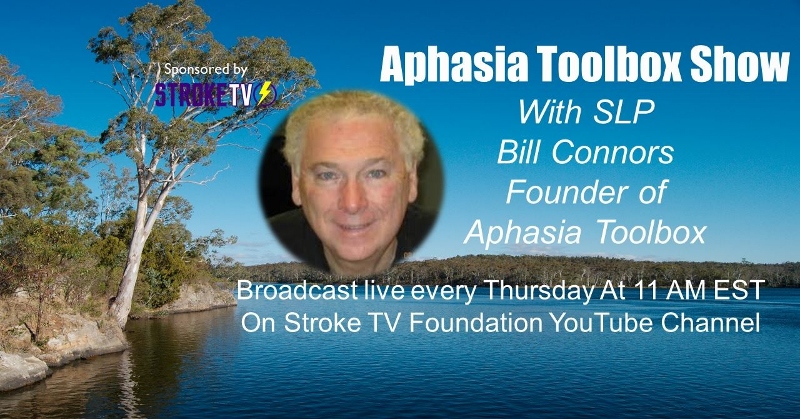
Join Bill on Thursdays on Facebook at 11 AM EST for the live broadcast of the Aphasia Toolbox Show. You can join him using this link:

Or, you can see the recorded programs on the StrokeTV Foundation YouTube channel . Stroke TV is a proud sponsor of the Aphasia Toolbox Show.

These are the YouTube recordings of the initial episodes: 

January 16, 2020

January 23, 2020

January 30, 2020

February 6, 2020


EverythingSLP Update
SLPs and PWA: Break through the drudgery of tired word finding drills!

Bekah Wilson Nice , SLP/owner at Nicespeechlady.com  has collaborated with Bill Connors, SLP/owner at aphasiatoolbox to offer verb protocols at EverythingSLP.  Both offered protocols co-ordinate well with other mindful treatment activities at EverythingSLP and help your clients independently activate and generate words using their own creative mental processes. 

The protocols include:  

- Light up the Lemma - a digital download with demonstration video
The word "lemma" refers to an abstract conceptual form of a word that has been mentally selected in the brain prior to being spoken aloud. That is, lemma is the word in a person's mind before he/she writes or says it. Cost is $3.99.

This 11-page telepractice friendly product contains:
1. the original exercise with detailed instructions.
2. a performance objective for the exercise.
3. ideas for scaffolding and advancing the client's performance.
4. 5 pages of stimuli and practice materials.
5. a 7-minute demonstration video by the authors.
6. references for research based evidence including URL links.

Nerbing is a mash-up of noun and verb and indicates words that can be used in either slot. Cost is $6.99.

This 11-page telepractice friendly product contains:
1. the original exercise with detailed instructions.
2. five variations on the original treatment activity.
3. a performance objective for the exercise.
4. modern, clean stimulus photographs (captioned and un-captioned).
5. ideas for scaffolding and advancing the client's performance.
6. 5 pages of stimuli and practice materials.
7. a 7-minute demonstration video by the authors.
8. references for research based evidence including URL links.

For information on these protocols, visit the EverythingSLP website.
Good News!
New data reveals a troubling trend across the Southeast. Your hometown does more than shape the way you speak or your access to opportunities — it influences your brain health, even if you move away. According to a new nine-year analysis of over 20,000 Americans, growing up in a specific region of the United States increases people’s risk of experiencing health conditions linked to cognitive impairment when they are older. Older people who spent their entire young adulthood (from birth to age 30).Feb 12, 2020

In a publication appearing this month in the journal Translational Stroke Research, animal scientists, funded by the National Institutes of Health, present brain-imaging data for a new stroke treatment that supported full recovery in swine, modeled with the same pattern of neurodegeneration as seen in humans with severe stroke. January 14, 2020

3. B cells may travel to remote areas of the brain to improve stroke recovery
New research shows that the immune system may target other remote areas of the brain to improve recovery after a stroke. February 18, 2020

To find out how the aphasia experts use current research and medical advances to maximize recovery, click here .