May 20, 2026

Dear Presidents’ Alliance Member,


In this week’s Member Update:


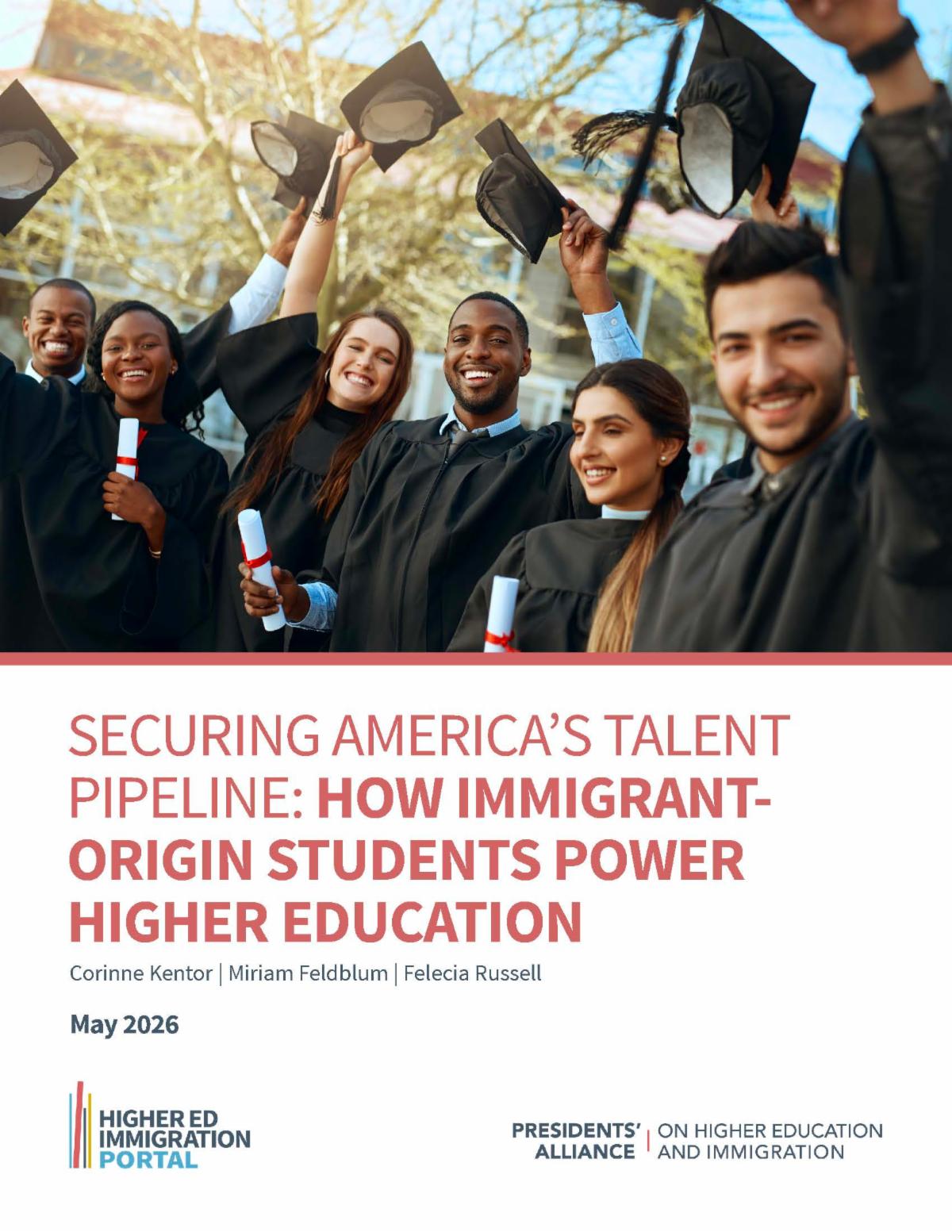
  • NEW REPORT! Securing America’s Talent Pipeline: How Immigrant-Origin Students Power Higher Education
  • New Explainer: USCIS Policy Alert on Deferred Action and Possible Implications for DACA
  • Trump Highlights Importance of International Students Amid ICE’s OPT Abuse Allegations
  • FAFSA Submissions Rise Overall but Drop for Mixed-Status Families 
  • IRS Considers Proposed Changes to Individual Taxpayer Identification (ITIN) Code
  • Immigration in Brief
  • Calendar of Events
  • Top Reads

NEW REPORT! Securing America’s Talent Pipeline: How Immigrant-Origin Students Power Higher Education

A new report commissioned by the Presidents’ Alliance and conducted by the Migration Policy Institute (MPI) provides an overview of the scope, diversity, and spread of first- and second-generation immigrant students enrolled in institutions across the country.


In 2023, there were nearly 6 million first- and second-generation immigrants enrolled in U.S. institutions of higher education, making up nearly one third of all enrolled students and accounting for 84 percent of domestic enrollment growth since 2000 across undergraduate and graduate programs. Alongside international students and scholars, first- and second-generation immigrants bolster enrollment, sustain campus diversity, and enrich the learning environment. The report highlights the contributions of the immigrant-origin population and foreshadows the consequences of federal and state policies that restrict their access to higher education.

New Explainer: USCIS Policy Alert on Deferred Action and Possible Implications for DACA


On May 8, 2026, U.S. Citizenship and Immigration Services (USCIS) issued a new Policy Alert, Deferred Action as an Extraordinary Use of Prosecutorial Discretion, emphasizing that deferred action should be treated as a limited and extraordinary exercise of prosecutorial discretion reserved for compelling individual cases. While the guidance does not rescind DACA, alter current eligibility criteria, or terminate existing grants, it may signal a narrower approach to how USCIS exercises discretion in pending and future cases.


In response, the Presidents’ Alliance, Path2Papers, and the National Immigration Law Center (NILC) have released a new explainer analyzing the policy alert and its potential implications for DACA recipients and immigrant communities. Given the ongoing DACA litigation and broader uncertainty affecting Dreamers and undocumented students, this resource is intended to help institutions, practitioners, advocates, and students better understand the guidance.


Although significant uncertainty remains regarding how USCIS will interpret and implement this guidance in practice, the policy alert represents an important development that may shape future adjudications and discretionary decisions. We will continue monitoring developments and sharing updates and resources as additional information becomes available.

Trump Highlights Importance of International Students Amid ICE’s OPT Abuse Allegations


In an interview on May 14, 2026, President Donald Trump emphasized the important role international students play in U.S. higher education and the broader economy, noting that many contribute positively and seek to remain in the United States. “I frankly think it's good that people come from other countries and they learn our culture, and many of them want to stay here,” Trump said, suggesting that qualified students should receive a green card to be able to remain in the country.


The comments came just days after the U.S. Immigration and Customs Enforcement (ICE) officials held a press conference on May 12, alleging abuse within the Optional Practical Training (OPT) program. However, the agency did not release specific data to support these claims and did not acknowledge that established oversight systems are already in place to ensure the program’s integrity. International students are tracked through SEVIS, a comprehensive, real-time reporting system, and are among the most closely monitored nonimmigrant populations in the United States. 


In response, the Presidents’ Alliance issued a press statement, which reaffirms our commitment to ensuring the integrity and proper functioning of OPT, and warns against efforts to use cases of abuse to justify sweeping actions or rhetoric that create confusion and fear among students, higher education institutions, and employers.

FAFSA Submissions Rise Overall but Drop for Mixed-Status Families 


Last week, the National College Attainment Network (NCAN) reported that FAFSA submissions from first-time filers have reached record highs, with 54.7% of all members of the high school class of 2026 having completed the application as of May 1. The submission rate marks a notable rebound since the decline precipitated by the rollout of FAFSA Simplification in 2023. 


The milestone is undercut by a troubling drop in submissions from mixed-status immigrant families. Just before NCAN released its May figures, the California Student Aid Commission (CSAC) reported that financial aid applications from students with undocumented relatives were down 8% compared with the prior year. The contrasting trends attest to the extended impact of the Trump administration’s mass deportation agenda and persistent fears that personal information associated with financial aid applications could be used for immigration enforcement. While there are no known instances of immigration authorities using FAFSA information for enforcement, families and advisors continue to express concerns about the risks involved in disclosing personal details to a federal agency.     


For guidance on supporting students from mixed-status families to access financial aid, visit the FAFSA Hub on the Higher Ed Immigration Portal. The Presidents’ Alliance will release an updated guide for practitioners working with mixed-status families in early June.

IRS Considers Proposed Changes to Individual Taxpayer Identification (ITIN) Code


Reporting from the New York Times revealed that the Trump administration has proposed changes to the Internal Revenue Service (IRS) Individual Taxpayer Identification (ITIN) system that would differentiate undocumented taxpayers from other ITIN holders. 


The Trump administration previously proposed adding a question asking if an applicant is living in the country without authorization. In 2025, the IRS entered into an unprecedented data-sharing agreement with the Department of Homeland Security (DHS). The agreement was quickly challenged, and further disclosures are currently enjoined under a preliminary injunction issued by the D.C. District Court in November 2025. An estimated 47,000 records were shared before the initiative was paused. 


ITIN applications require taxpayers to disclose their country of birth and country of citizenship, but there is no specific piece of the form that identifies an applicant's status as it relates to their presence in the United States. It is not clear how changes to the ITIN code would be implemented or when such a change would be rolled out. Advocates and professionals have emphasized the importance of protecting taxpayer information, communicating that sharing personal data with immigration enforcement would discourage individuals from filing and jeopardize the nation’s tax revenue. Immigrants have historically filed taxes at high rates even though they are ineligible for a variety of public benefits. Their contributions help underwrite programs that support eligible citizens, bolstering the country’s social safety net. 

Immigration in Brief


  • The bipartisan Problem Solvers Caucus, a U.S. House of Representatives caucus made up of more than 40 Democrats and Republicans, endorsed the Dignity Act of 2025, adding cross-party momentum to the immigration bill. For more, see our Dignity Act of 2025: Selected Summary of Higher Education-Relevant Provisions.
  • On May 12, Representatives Yassamin Ansari (AZ-03) and Tom Suozzi (NY-03) introduced the Iranian Temporary Immigration Relief Act, a bill that would provide temporary immigration protections for certain eligible Iranians who are already in the United States but at risk of losing legal status, granting them Temporary Protected Status and work authorization while USCIS adjudications remain paused.
  • The Presidents’ Alliance joined ACE and other higher education associations in a letter to USCIS Director Joseph Edlow to express our deep concerns about the delays in processing of DACA renewals.

Calendar of Events


  • June 9, 2026 | In-Person Policy and Legal Strategy Session + DACA Anniversary Reception | Register Here

Top Reads


Thank you for your support and engagement.


The Presidents’ Alliance Team


ABOUT

ISSUES

RESOURCES

DONATE

JOIN

LinkedIn  Instagram  Facebook  Web