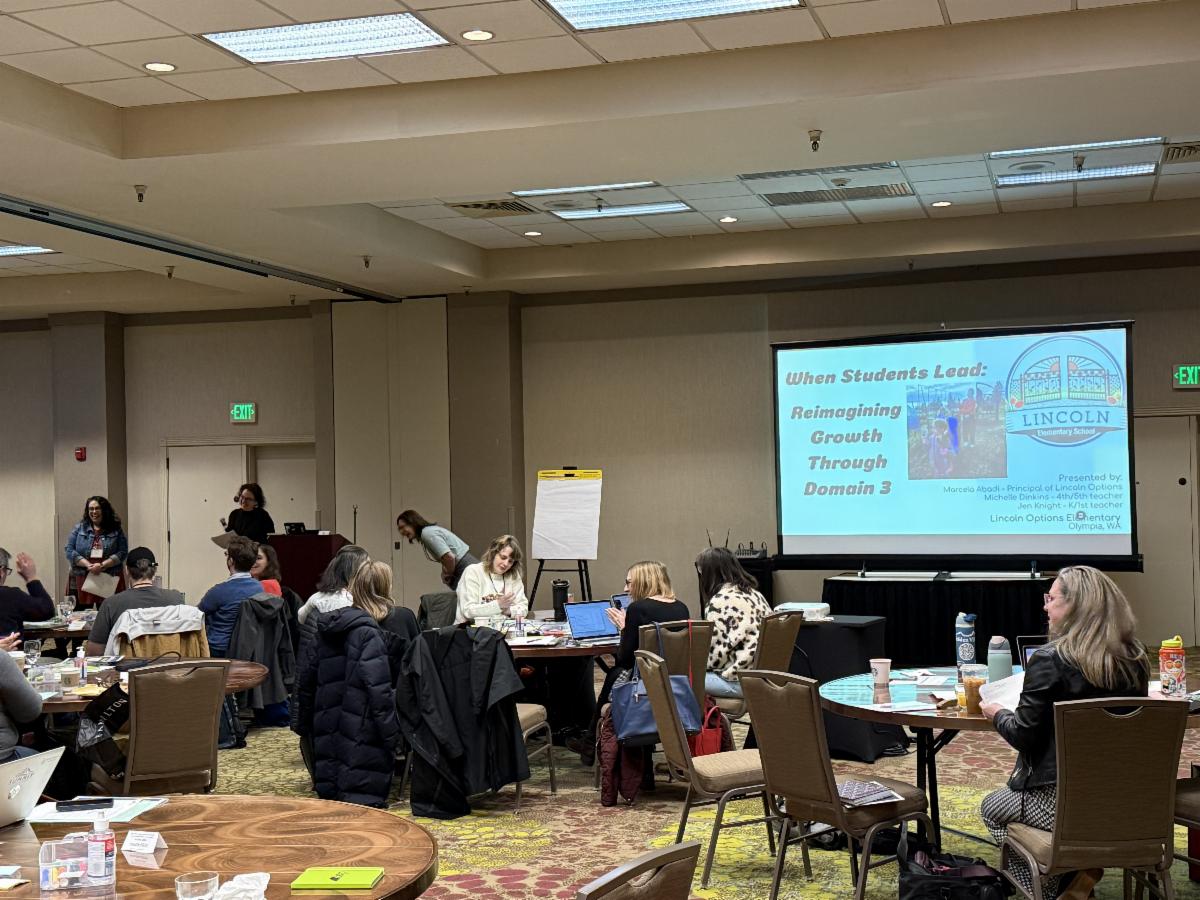
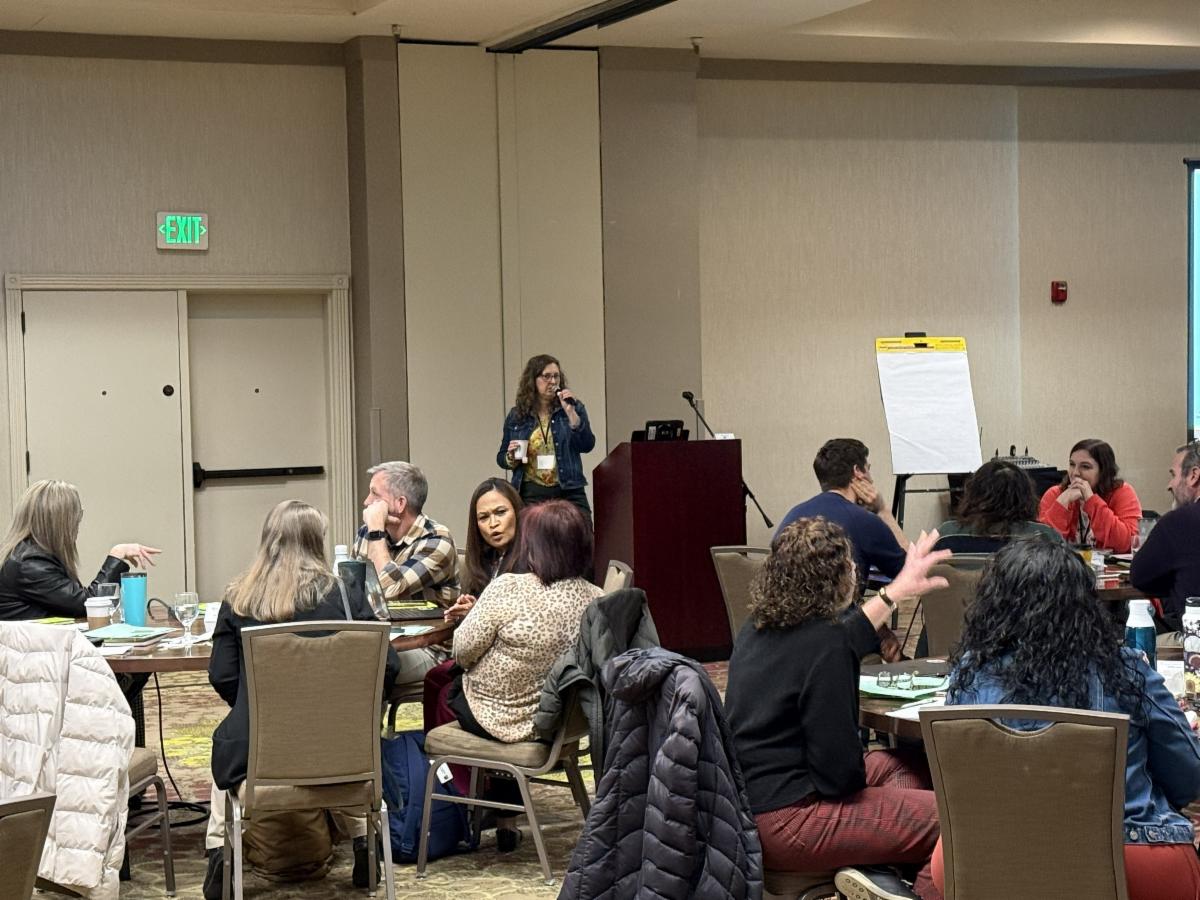
CSTP hosted the Student Growth Goals Colloquium West on February 26 in the Seattle area, bringing together several schools and districts to discuss SGG experiences, learnings, and opportunities for continued improvement. You can find takeaways and reflections down below. | | OSPI Standards Review Project for Physical Education, Health, and World Languages: Fill out the Interest Form Now! | |
CSTP is excited to once again work with OSPI on the Learning Standards Review Project. We are recruiting currently practicing classroom teachers to provide feedback on the Physical Education, World Language, and Health learning standards that are currently being updated by OSPI teams.
The teacher groups will focus on the state Learning Standards Review project. The project aims to prioritize, revise, and clarify the state learning standards. The selected focus group will:
- Engage in dialogue and feedback around the current standards and implementation.
- Complete a bias and equity screening of the standards.
- Review revision drafts and strategize how to provide continued support for revision and implementation.
- Offer feedback on the updates and changes.
CSTP is seeking about 20 K-12 educators in each content area who can meet virtually twice this spring, once in April and once in June. Meetings will be from 4:30-6:30. The mandatory dates are as follows:
- WL: 4/21 and 6/1
- PE: 4/22 and 6/2
- Health: 4/23 and 6/4
If you are interested in being a part of this project and have expertise with the PE, World Language, or Health Education standards, please fill out this application. Selected participants can earn a stipend of up to $400.00. Applications are due by 4:00 p.m. on March 30th. We anticipate notifying participants by April 3rd.
Questions about this project can be directed to anzara@cstp-wa.org.
| Save the Date: Camp CSTP 2026 | |
Camp CSTP is happening once again this summer! Stay with us overnight during the week of July 27-31 at the Rainbow Lodge in North Bend!
We want to know what you want to see at Camp. Should we discuss working with your PLCs on equity work and culturally responsive pedagogy? Do you want to work together on Teacher Leadership? Do you want to bring a team to plan around your school improvement plan? Let us know right here!
| Student Growth Goals Colloquium Takeaways | |
Participants at our recent colloquium on student growth goal implementation were kind enough to offer their feedback and takeaways from the event. We heard stories from several different teams of educators. It is important to elevate concrete examples from educators across many positions, including elementary schools, alternative schools, and unions. This diversity of viewpoints show how student growth goals can support a broad spectrum of students and educators.
Ongoing conversation and authentic feedback between teachers and administrators is vital to keep reflection and improvement at the center of the evaluation process. Growth goals are essential tools for aligning school-wide goals with a vision of equity, excellence, and empowerment to create more responsive and dynamic learning environments.
Thank you again to everyone who participated in the colloquium. We will be announcing more student growth goal-centered events soon, particularly focused on access in the East side of the state.
| Washington's 2026 Legislative Session Continues | | |
Our 2026 legislative session is nearing its end! CSTP will continue to provide information on all bills that educators should keep an eye on until all the dust settles on the hill. Every Friday, our Legislative Update Coordinator, Samantha Miller, will recap the week's events and what bills are still in play.
You can stay updated and catch up on past weeks (and even updates from past years) here on our Stories From Schools blog! We will also be sending out updates via email.
| | Bring CSTP Expertise to Your School or District's Professional Learning | | |
As the school year continues on and you are considering what professional learning you need for the year, CSTP is ready to collaborate with you! We provide consultation, facilitation, and coaching to support teacher leadership, teamwork, and customized professional learning in your school or district.
We bring expertise in:
-
Teacher Leadership Development, helping educators step into influential roles and contribute meaningfully at the school and district level.
-
Supporting Teacher Teams, offering structures and strategies that enhance team communication and empower collaborative, equity-focused reflective practice
-
Culturally Responsive Pedagogy, equipping educators with tools and mindsets that support all students to access rigorous, engaging work while honoring all students’ identities
Let CSTP help you design meaningful learning experiences, launch leadership frameworks, or amplify teacher-led initiatives—whether virtual or in-person. Interested in exploring how CSTP can support your school or district? Reach out to Linsdey@cstp-wa.org. We’re ready to collaborate with you!
| | Partner with CSTP to Offer Clock Hours at Your Next Training | | |
Are you running a course, professional development or book study and want to offer Washington State clock hours? CSTP is an approved Washington State clock hour provider and can approve your courses for clock hours. It is free for the instructor to apply for the course with participants paying a nominal fee.
Learn More and Apply for Clock Hours
| | WEA National Board Information and Support | |
All WEA sessions are available for WEA members only. Visit the WEA National Board Certification webpage for more information and more course availability.
National Board Information Session Series
Session 1: Overview
- Wednesday, April 29, 2026 - 4:30 to 6:30 pm
Session 2: Standards & Process
- Wednesday, May 6, 2026 - 4:30 to 6:30 pm
Session 3: Support & Next Steps: Session 3
- Wednesday, May 13, 2026 - 4:30 to 6:30 pm
WEA National Board Maintenance of Certificate (MOC) Work Sessions
In order to maintain National Board certificated educators must complete and submit a Maintenance of Certificate (MOC) every 5 years. WEA offers three Work Sessions to help you pursue your National Board MOC. Each Session offers a different focus to guide you through this process.
- Work Session 1: 3/12
- Work Session 2: 4/2
- Work Session 3: 4/23
| National Board Writing Webinars | | |
Register today for OSPI's National Board Writing Webinars!
Who: Any National Board candidate working toward National Board Certification in 2025-2026
What: These one-hour webinars are designed to support writing for the National Board portfolio. Candidates should expect to examine their own writing and work with peers on the selected topic. These sessions DO NOT replace cohorts nor conditional loan requirements.
When: Winter-Spring, always Tuesdays, 4:30 PM-5:30 PM
Series B (Winter-Spring) REGISTER HERE!
- March 17: Integrating National Board Standards
- April 7: Writing Tips: Convincing, Clear, Consistent
Where: Zoom – Register above and select the sessions you’d like to attend. You will need an account with https://zoom.us/ and an electronic device to join. A Zoom link will follow in an email after completing the registration survey. Each session per series uses the same Zoom.
RSVP is required – registration will close day-of event. Contact OSPI National Board Program Specialist, Steven Mueller, at Steven.Mueller@k12.wa.us for any questions
| | Learning Policy Institute: District Leadership for Racial Equity | | |
Read up on studies from schools that are closing the gap on racial equity. This research brief presents cross-case findings from a study of leaders advancing racial equity in four school districts in the southern United States: Edgecombe County Public Schools in North Carolina, Hoke County Schools in North Carolina, Jefferson County Public Schools in Kentucky, and Pflugerville Independent School District in Texas. Read the full brief here.
| | ReadyWA Student Storytellers: Planning and Work/Life Balance | | |
Ready WA Storyteller Alice wrote this great poem about balancing planning for tomorrow while not losing sight of today! Balance is part of readiness too. Read it here.
Ready WA Storyteller Mayte wrote this blog post sharing what balancing school, work, and life looks like as a teen. Planning ahead matters, but so does making space to breathe. Read it here.
| | March is Women's History Month | | |
Women's History Month had its origins as a national celebration in 1981 when Congress passed Pub. L. 97-28 which authorized and requested the President to proclaim the week beginning March 7, 1982 as “Women’s History Week.” Throughout the next five years, Congress continued to pass joint resolutions designating a week in March as “Women’s History Week.”
In 1987 after being petitioned by the National Women’s History Project, Congress passed Pub. L. 100-9 which designated the month of March 1987 as “Women’s History Month.” Between 1988 and 1994, Congress passed additional resolutions requesting and authorizing the President to proclaim March of each year as Women’s History Month.
Since 1995, presidents have issued a series of annual proclamations designating the month of March as “Women’s History Month.” These proclamations celebrate the contributions women have made to the United States and recognize the specific achievements women have made over the course of American history in a variety of fields.
Read more here.
| | |
Join us for fun facts, obscure knowledge, and exploration of physics, genetics, etymology, art, and more!
| | My Very Educated Mother Just Suggests Using Nine Planets | | |
From our vantage point on Earth, we can see many objects in space. Stars are very bright and are thus easy to see and identify, even lightyears away from us. Objects like planets, asteroids, and comets are infinitesimally small in comparison. This is how we know so many stars but sometimes get surprised by rocks orbiting our Sun. We’re attached to planets, though–we live on one, after all. So we want an exact number for how many neighbors we have.
The Sun sits at the center of our solar system. The closest planets are all rocky: Mercury, Venus, Earth, and Mars. Past Mars is the asteroid belt. Then we have our four gas giants: Jupiter, Saturn, Uranus, and Neptune. Beyond Neptune is a large span of frozen objects called the Kuiper Belt. This is where a famous little ball of ice and rock we call Pluto resides.
Pluto was first theorized in the 1840s to explain aberrations in Neptune’s orbit. It was confirmed to exist in 1930 and declared the ninth planet. Starting in the 1990s, however, further objects of significant size were identified in the Kuiper Belt beyond Pluto. At the time, there was also much debate on the potential planet status of the largest object in the asteroid belt, Ceres.
The International Astronomical Union (IAU) put forward a proposal to demote Pluto in 1998, but public outcry led them to discard the idea. By 2005, the debate was raging again, as astronomers had confirmed the existence of another large, planet-like body in the Kuiper belt called Eris. Ceres, Eris, and some other bodies beyond Neptune were more rounded and larger than usual asteroids. Should they be planets?
In 2006, the IAU adopted a more precise definition of planet. A planet must 1) orbit the sun; 2) be big enough that its own gravity keeps it in a round shape; and 3) be able to “clear the neighborhood” of its own orbit, i.e., it can be the only gravitationally dominant object in its path. The first rule omits moons and other satellites. The second rule omits asteroids and comets. The third rule–and this is the sticking point–omits Pluto. Ceres, Pluto, and Eris all have orbits that intersect similar sized or larger objects, so they are not gravitationally dominant.
Much to the chagrin of the public and many researchers, the line was drawn: bodies could be independently orbiting the sun and have a planet shape, but if they didn’t fulfill rule three they were officially dwarf planets. Astronomers have identified at least nine total dwarf planets to date, with further debate about the size and shape of several others.
Pluto still has friends, both in its space neighborhood and right here on Earth. This is a distinction between types of planets, not a whole other class of orbiting body. Many scientists would love to be able to count at least 17 planets with no distinction. But imagine trying to remember a 17-word mnemonic device and what it all means. “My Very Educated Mother Can Just See Using Nostalgic Orbital Preferences Happens Quite Messily; Guess Eight Satisfies.” Midway through writing that, even I forgot what most of the letters stood for!
| | Your gift ensures that CSTP continues to support student achievement through a focus on teaching excellence. With you as a partner in CSTP’s mission, you directly make a difference in the lives of youth across Washington State schools. Donations are tax deductible and essential as CSTP works to support educators navigate unique models of student engagement and teacher leadership. | | Liking and sharing our posts on social media is another way you can support CSTP during these times. Thank you for sharing our message. | | | | |