e-Newsletter | March 31, 2023
|
|
A Tale of Two Newbury Streets . . . in New Orleans
by Carrie Poirier, MOON Volunteer
Over the past year, the tale of two streets in New Orleans, Huso and Short Streets, has unfolded at the Museum of Old Newbury. It is a story of two men who grew up in Newbury, who later went into business in New Orleans, where, according to a family story, one of the men prevented the other from being sold into slavery.
In late 2021, a New Orleans writer contacted the Museum of Old Newbury, asking if it had any information on two men. The men were Charles Huso (1791-1859) and Samuel Short (1784-1864), for whom the New Orleans streets had been named. The writer was researching street names in the Carrollton neighborhood and records led her back to Newbury. She had found Essex County Probate records for Charles Huso that included an 1860 request of Joseph Little (1799-1893) of Newbury to be appointed administrator of Huso’s estate in Newburyport.
Hoping to find some answers, I began with New Orleans sources which established, circumstantially at least, a connection between the two men. Both were instrumental in the development of Carrollton, now a district of New Orleans. In his History of New Orleans, John S. Kendall credits Samuel Short with having built the first house in Carrollton in 1834. Soon after, Charles Huso built his own house at the corner of Levee and Short Streets. Other contemporary New Orleans sources, such as newspaper advertisements, established the likelihood that the men knew one another, but the most powerful proof that they were more than casual acquaintances was an entry in the first volume of New Orleans’ Register of Free Colored Persons Entitled to Remain in the State. The Register lists Charles Huso as a 39-year-old negro man who “keeps a lumber yard” and arrived in New Orleans in November, 1824. On the same line of the entry, and under the heading of “Remarks” is the name Samuel Short. A later volume of the Register clarifies that Samuel Short was Huso’s “sponsor.”
|
|
Charles Huso, negro, age 29, listed with Samuel Short as his sponsor. Register of Free Colored Persons https://louisianadigitallibrary.org//islandora/object/fpoc-p16313coll51%3A41882
But why did Samuel Short support Charles Huso’s claim to status as a free man in New Orleans? And why was Joseph Little, back in Newbury, willing to take on the responsibility of settling Huso’s estate? Some unique resources at the MOON suggest the answers.
Mary Adams Rolfe, whose genealogical notes were published by the Historical Society of Old Newbury in 2003, draws extensively on a 1901 memoir of Mrs. Elizabeth H. Coffin (1827-1916) when documenting details about the Little family. In particular, Mrs. Coffin, as quoted by Rolfe, recounts:
Grandfather had another boy whose name was Charles Huso. He was three years old when they took him and very bright. When grown, he went to New Orleans and set up in business. At one time he was going to be sold as a slave, but one of the Newburyport sea captains that happened to be there, knew him and testified to having had many a licking from him, probably when stealing nuts or apples as a boy. Charles was allowed his freedom.
Mrs. Coffin was Joseph Little’s daughter, and Silas Little’s (1754-1845) granddaughter, and she remembered the family stories about a young Charles Huso guarding the farm from the mischief of local boys.
“Pauper Records” for Newburyport clarify the Huso-Little relationship. Charles Huso was a small child in 1796 when his father, Philip Huso, died. Despite the fact that his mother, Catherine Dummer Huso, was alive, the town of Newburyport arranged for Silas Little of Newbury, for the sum of $25, to take charge of the child until he reached the age of seven. Other dimensions of Mrs. Coffin’s recollections are a bit harder to prove.
Was Samuel Short the Newburyport sea captain? Did Charles Huso only narrowly miss being sold into slavery? Mary Adams Rolfe, does not provide any clarity regarding these questions, but she does provide clues about a long-term relationship among Samuel Short, Joseph Little, and Charles Huso.
Samuel Short was born in Newbury in 1784, the son of Moses Short (1760-1841), a Revolutionary War patriot, and the sexton of the First Parish Church of Newbury for many years. There is no record of Samuel Short having been a sea captain, but he did grow up near the Little farm, and most likely had occasion to run into young Huso protecting the orchard. A letter in the collection of the Museum also indicates that Samuel Short was in New Orleans as early as 1804, and was working for “Mr. Prince.”
|
|
1804 letter to Samuel Short in New Orleans. Collection of Museum of Old Newbury.
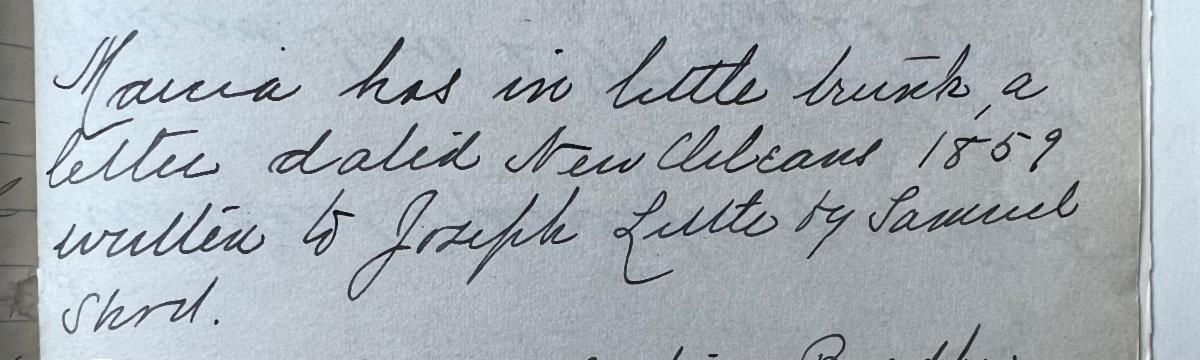
But the most tantalizing bit of information comes, once again, from Mary Adams Rolfe, toward the end of her genealogical material on the family of Henry Short. Here among a number of miscellaneous observations is the notation, “Marcia has in little trunk a letter dated New Orleans 1859 written to Joseph Little by Samuel Short.” Did Charles Huso’s death in 1859 prompt this correspondence? The fate of the letter is unknown, but on July 5, 1860, Joseph Little initiated the process to be appointed administrator of the estate of “Charles Huso, New Orleans, La, trader, intestate” on behalf of Huso’s sister Hannah C. Johnson of Salisbury, Massachusetts. On December 17, 1861, two sisters, Hannah C. Johnson and Lucy Tuttle, split $396.92, the value of Charles Huso’s stock in Newburyport’s Mechanics Bank, as well as a savings account.
So, if you get to New Orleans be sure to take the St. Charles Streetcar Line out to Huso and Short Streets, and visit a piece of Newbury history. And, if anyone knows something about Samuel Short’s 1859 letter “in little trunk,” we’d love to hear from you!
|
|
“Marcia has in little trunk a letter dated New Orleans 1859 written to Joseph Little by Samuel Short.” In Mary Adams Rolfe's notes on the Short Family. If you have the letter, please give us a call!
Sources
John S. Kendall, History of New Orleans, Vol. 2, p. 750. https://archive.org/details/historyofneworle02kend
Research Notes of Mary Adams Rolfe, Vol. 4, Little Family, p. 27, quoting Elizabeth H. Coffin’s 1901 memoir. Museum of Old Newbury Collection.
Letter of Moses Short, Newbury, to Samuel Short, New Orleans, June 11, 1804, Genealogy Files, “Short folder,” Museum of Old Newbury Collection.
Research Notes of Mary Adams Rolfe, Vol. 8, “Family of Henry Short,” p. 93. Museum of Old Newbury Collection.
|
|
General Benjamin Franklin Butler: A Noisy, Fearless Life
Thursday, April 20, 2023, 7 pm
Museum of Old Newbury, 98 High Street, Newburyport
Learn more about the controversies surrounding Benjamin Butler - Civil War General, US congressman, and Massachusetts governor.
|
|
Fashion Night Out: Girls' Style from the Civil War to 1900
Thursday, May 11, 2023, 6:30 pm
Museum of Old Newbury, 98 High Street, Newburyport
Our ever-popular fashion series continues with a focus on Girls' Style from the Civil War to 1900. Free for members, $10 for non-members.
|
|
The Heirloom Gardner - Traditional Plants and Skills with John Forti, May 18, 6:30 pm.
St. Paul's Episcopal Church, 166 High St., Newburyport.
Join us for a refreshing look at traditional plants and skills for the modern world with garden historian and ethnobotanist John Forti. $10 members, $20 non-members.
|
|
The 44th Annual Newburyport Garden Tour
June 10 & 11, 10am -4pm
Join us for our annual garden tour! Enjoy exclusive access to 11 private gardens in Newburyport, Amesbury, Newbury, and Rowley. Early bird pricing through May 31: $20 members, $35 non-members. Get tickets today.
|
|
Woman on the MOON
...a blog by Bethany Groff Dorau, Executive Director
|
|
Do You Know What It Means to Miss New Orleans?
When I travel, I have always tended to point myself north. I am the happiest in all the world in the Scottish Highlands. Imagine my surprise when, over a decade ago, I fell completely, head-over-heels in love with New Orleans. Of course, it had something to do with falling head-over-heels in love with James Dorau, whose connections to the city and its music go back decades. James had lived in Austin, Texas for many years, and regaled me with tales of driving his Isuzu Pup through the night with his best friend Patrick to see the sunrise over Lake Pontchartrain. They made an annual pilgrimage to Jazz Fest, the 10-day music extravaganza held on the old Fair Grounds Racecourse. When James asked if I would like to go to Jazz Fest with him in 2012, I knew I had made it into the deepest corners of his heart.
Still, I had no idea what I would find in New Orleans, nor did I care. I would have followed James to the moon. What I found there was a place both familiar and foreign, a place rooted in its complicated history and dealing with the legacy of this past as it looks to the future. New Orleans is ancient, steeped in mysticism, suffering, and ecstasy - all the things that I love about old Europe except you can wear a tank top in February and dance all day. There is an openness and a warmth, literally and figuratively, that gets into your bones and loosens up your muscles and those hips just swing all by themselves. New Orleans is hot yoga for the soul.
|
|
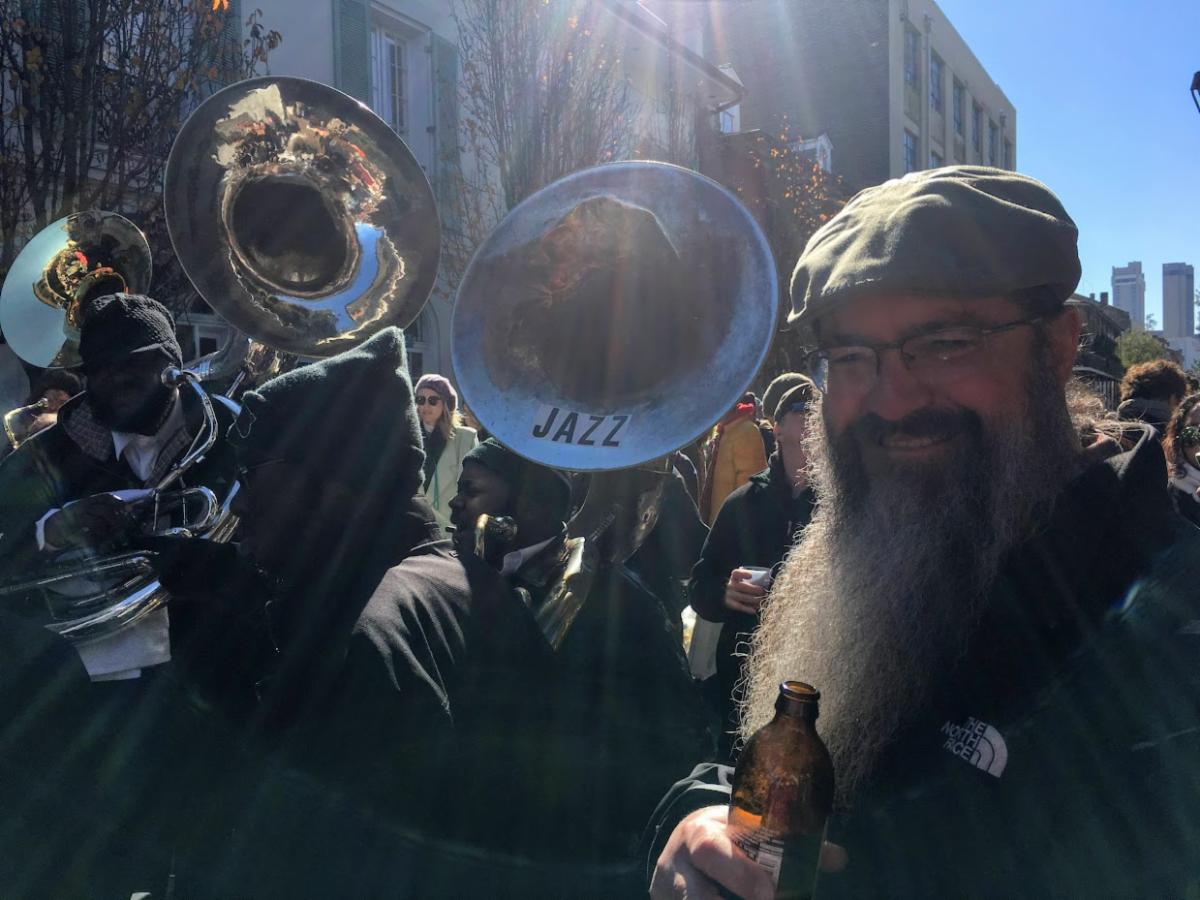
My happy place, following James and a brass band down the street in 2021. Note: open containers are legal in New Orleans.
That first visit changed me, as the best kinds of travel experiences should. I had been to Charleston and Savannah, so the American South was not foreign to me, but something about New Orleans stuck. Perhaps it’s inherited - my father, another escapee from the frozen North, spent his early college years at Tulane, and has been a trumpet player ever since. When he joined the religious movement that would define my childhood, it was a New Orleans preacher, Sam Fife, who led the group.
Over the past 11 years, with a two-year gap during the pandemic, James and I have returned to New Orleans as often as possible. Sometimes, when airfare suddenly spikes downward, we will go just for the weekend. We eat like kings and dance like loons and laugh and take naps all tipsy and sun-kissed and I wear big earrings and strut everywhere I go.
On the latest trip at the beginning of this month, I had a mission, and a vague sense that I was on the cusp of learning something important about the two most important places in my life – Newbury(port) and New Orleans. The research request for information about Huso and Short mentioned in the Poirier article above had come into the Museum of Old Newbury and I wanted to see the place that connected these two – the streets named after them.
|
|
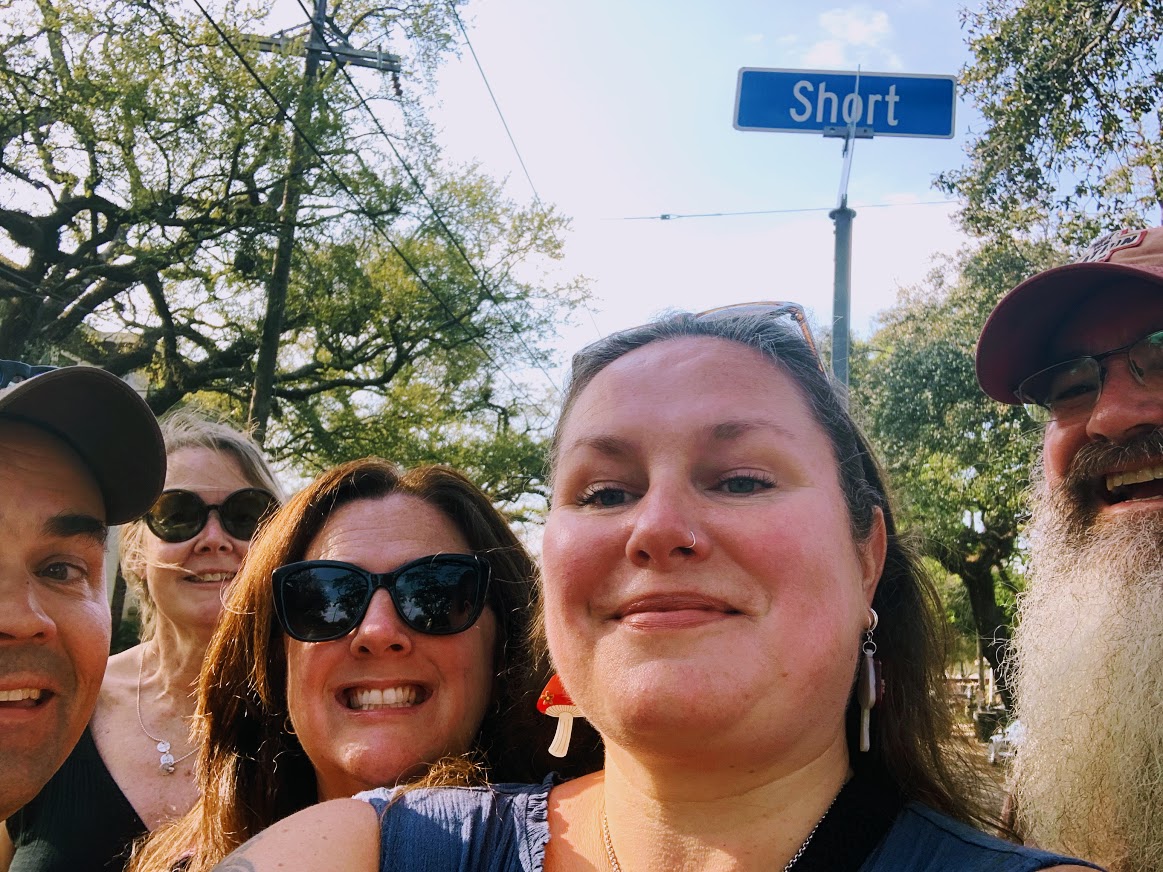
Five Newburyport friends visited the neighborhood where Charles Huso and Samuel Short lived and worked two centuries ago.
We were staying in the Marigny neighborhood, so we walked (strutted) down Royal to Canal Street and hopped on the St. Charles Avenue Streetcar. There were five of us, all Newburyporters, and a reward at the end – a frosty beer and fried pickles at Cooter Brown’s Tavern. I told my companions the story of Huso and Short, or at least the fragmented version of it that I could recall. We took the streetcar to the bend and hopped out. The levee and the Mississippi River were right in front of us, Short and Huso Streets right behind. I took a moment to imagine what this place must have looked and sounded like when Charles Huso arrived in 1824.
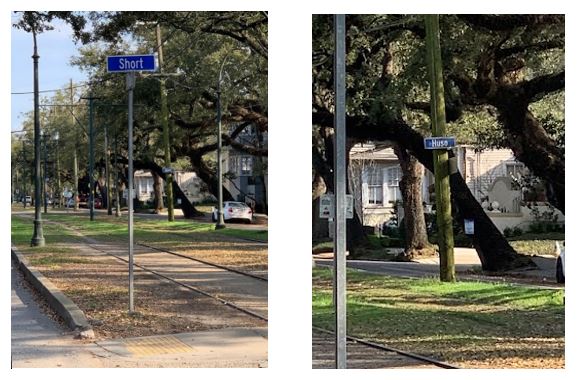
There is no substitute for standing in a place. Short and Huso Streets are parallel to each other, the signs marking a relationship between these two men that continued across time and distance. We have so little information about them, but they were clearly connected through commerce, family, upbringing, and experience. The last remaining evidence of this is two streets signs in a city that seems a world away.
|
|
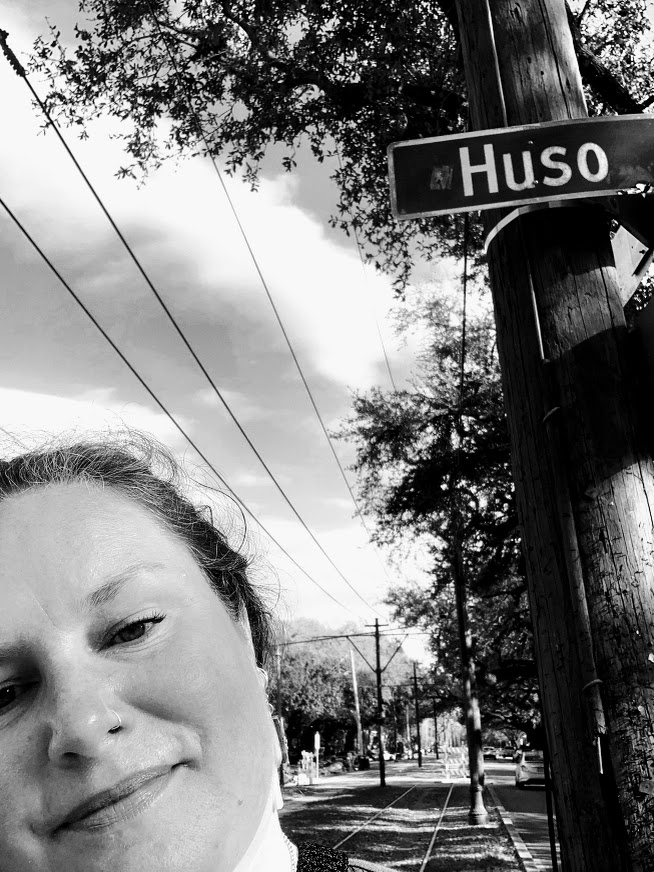
A quick visit to Huso Street, at the end of the St. Charles Avenue line.
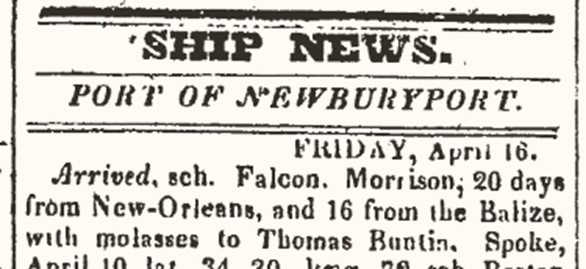
This was my feeling when I stood looking down Huso Street, noting how it ends at the levee and what a perfect spot it would have been to load and unload ships. The area must have been teeming with seafaring folk, mariners and merchants from all over the world. When I came back home, I did a cursory look through the shipping news in the Newburyport papers. It was astonishing and, given what I know about the misery occasioned by the production of cotton, a bit sickening how often Newburyport ships went in and out of New Orleans. Whoever saved Huso from being kidnapped, it is not a stretch to imagine that it could have been a random, but regular occurrence for him to bump into someone from home. In the Newburyport Herald in 1824, the year Charles Huso took up residence in New Orleans, there were dozens of ships coming and going from New Orleans. The city is mentioned almost daily in surviving copies of the newspaper. We were bound up intimately with the ugly commerce of that beautiful place.
|
|
Newburyport Herald, April 20, 1824. Digital Archives of the Newburyport Public Library.
I will always be filled with joy when I visit New Orleans, but over the years, I have come to better understand how much suffering is also present in that place. New Orleans is steeped in misery, from slavery to Hurricane Katrina to rampant gun violence and mass incarceration and poverty and racism and the list goes on and on. It is difficult to reconcile this reality – that a place that is so dark can spend its life in constant celebration. I mentioned this to a friend who lives in NOLA. She shrugged. “Life is hard,” she said. “Might as well keep dancing.”
|
|
Something Is Always Cooking... |
|
Crawfish Etouffée
I've been making this recipe since the 1980s and believe it came from Texas Monthly. The original recipe called for Tabasco but prefer cayenne. Note: I make mention below of finely chopping the vegetables, though just chopped will do. I like the vegetables to virtually disappear when cooked – that’s my personal preference in this dish. Frozen crawfish can be found at David's Fish Market in Salisbury or Ipswich Fish Market.
- James Dorau
Ingredients
1 stick margarine
¼ c. flour
3/4 c. very finely chopped green onion
3/4 c. very finely chopped onion
2 cloves garlic – minced
½ c. finely chopped green pepper
½ c. finely chopped celery
3 small bay leaves (fresh, if an option)
2 tsps. chopped fresh thyme
5 tsps. chopped fresh basil
1 stick butter
8 oz. tomato sauce
½ tsp. white pepper
2 tsps. salt
1 Tbsp. Worcestershire sauce
Cayenne pepper to taste (I love it spicy)
1 cup dry white wine
1 cup fish stock (or bouillon equivalent)
2 pounds peeled, cooked crawfish tails (if frozen – do not thaw)
1 Tbsp grated lemon zest
¼ c. minced Italian parsley
Cognac, to taste (optional)
½ c. chopped green onions (optional)
Steamed white rice
Directions
Make a dark, walnut-colored roux with the margarine and flour (melt margarine in flat-bottomed pan; add flour, and brown over medium heat, stirring constantly). Add green and yellow onion, garlic, green pepper, celery, bay leaves, thyme, basil, and butter. Sauté uncovered over medium flame for 30 minutes. Add tomato sauce, white pepper, salt, Worcestershire, cayenne, wine and stock. Bring to a boil, then reduce heat. Add crawfish (if frozen – do not thaw), lemon juice, zest, parsley, and cognac (if using). Heat quickly without boiling and serve immediately. It’s best served in individual bowls with a round scoop of steamed rice in the center – top with the chopped green onions (optional).
|
|
Click the image to do the puzzle
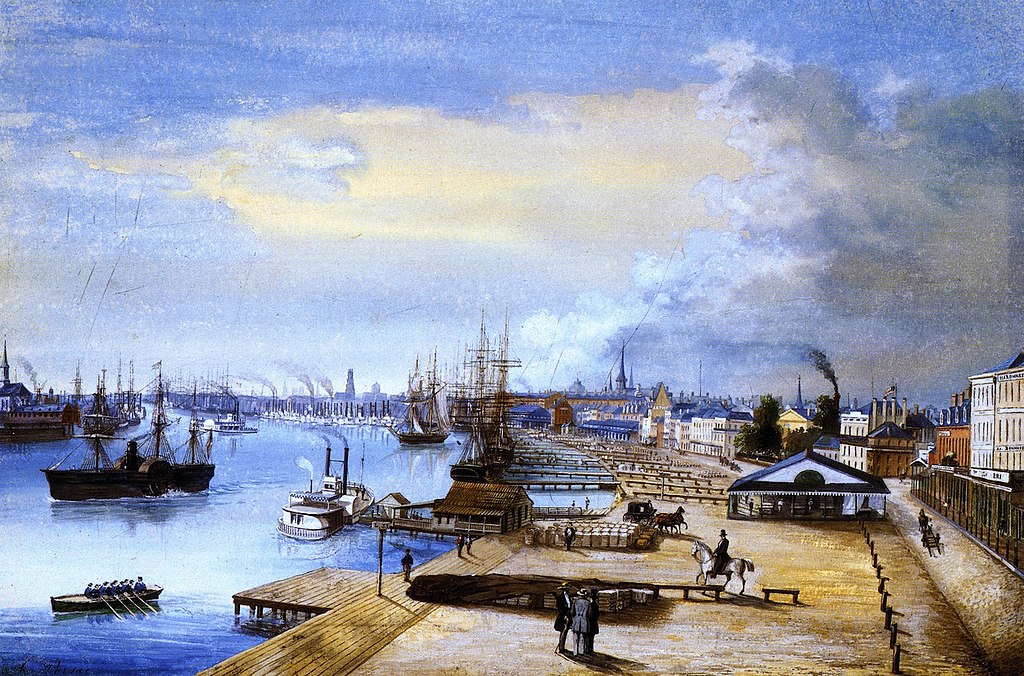
Huso and Short were alive and in New Orleans when this painting was made. Port and City of New Orleans, 1858, by Marie Adrien Persac. From the Historic New Orleans Collection.
|
|
Museum e-Newsletter made possible through the
generosity of our sponsors:
|
|
|
Museum of Old Newbury
98 High Street
Newburyport, MA 01950
978-462-2681
|
|
|
|
|
|
|
|