Weekly Digest Number 15 - April 12th, 2022 |
|
Welcome to the RWU Rail & Labor News! This news bulletin is produced and emailed out each Tuesday morning. We hope you find each week's news and information useful. If so, please share with co-workers, friends, and colleagues. If you like, you can sign them up to get all the news from RWU HERE. Or forward them the link. Note: If you read over this news bulletin each week, you will be sure to never miss the important news of what is going on in the railroad world from a worker's perspective!
|
|
(Editor's Note: It is great to see the rail unions actually reaching out to other transportation unions such as the Association of Flight Attendants - AFA. That union has effectively used the Railway Labor Act - the same law that we railroaders work under - to their advantage with a strategy known as CHAOS. To learn more about the FAA's creative and successful campaign at the airlines, see the next article below this one ...)
|
|
Transportation Union Wants Federal Action Against Class One Railroads’ Attendance Policies |
|
The Transportation Trades Department (TTD) of the AFL-CIO is urging federal agencies to rein in Class I railroads’ attendance policies, which TTD says force union employees to work long hours without adequate rest.
TTD wants the U.S. Department of Labor and the U.S. Department of Transportation to determine whether the attendance policies should incur statutory or regulatory violations, according to a new policy brief issued by the group, whose leaders are meeting in Washington this week to formalize TTD’s policy and regulatory agenda.
FRA confirmed that it is working on drafting a final rule, but no timeline has been established.
The statements by the union coalition, which consists of 37 transportation-related unions, comes as the Brotherhood of Locomotive Engineers and Trainmen (BLET) and the International Union of Sheet Metal, Air, Rail and Transportation Workers (SMART-TD) have tussled in federal court with BNSF (NYSE: BRK.B) over BNSF’s revised attendance policy, which took effect in February.
|
|
(Editor's Note: As we know as railroad workers, the Railway Labor Act - RLA - has generally hampered our efforts to strike back and win good contracts and stave off concessions demanded by the big Class One rail carriers. But the Association of Flight Attendants - whose members work under the same exact conditions as we do, regulated by the RLA - have used the Act to their advantage. It is time for rail labor to think outside of the box as well!) |
|
C.H.A.O.S. Information from the Association of Flight Attendants |
|
An important part of our Contract Campaign is understanding our right to self help - our right to strike. Together we promise to act in unity to achieve the Contract that recognizes our contributions to the success of our airline. This promise includes being prepared to execute a legal strike should management fail to negotiate a Contract with us even as they face the strike deadline at the end of the 30-day cooling off period.
Strike Preparedness begins long before a strike deadline. Our strike preparations are well underway and we will continue our work throughout our Contract Campaign, both as a means to execute a successful strike should it become necessary and as means to demonstrate to management that we are not only willing, we are ready to act.
This flyer contains information about our strike strategy and our legal analysis prepared by AFA legal on our right to strike. Review the information and share it with your flying partners. We encourage you to also attend your Local Council Strike Education Meetings taking place around the system, or consider hosting a seminar at your house. Contact your Local Council for details.
|
|
(Editor's Note: New FRA Administrator Amit Bose has his opportunity to show which side he is on. After well more than a decade with nothing done about fatigue as mandated by 2008 legislation, this should be a no brainer for the head man at FRA. It is high time for action from the Agency!) |
|
House Transportation Leaders Urge FRA to Act on Fatigue, Attendance Policies |
|
CLEVELAND (April 6) — Leaders of the U.S. House of Representatives Committee on Transportation and Infrastructure are asking the Federal Railroad Administration (FRA) to take action on a 2008 Congressional mandate to address rail worker fatigue at Class I carriers, with a specific reference to attendance policies such as those imposed at CSX, Union Pacific, and BNSF.
In an April 6 joint letter to FRA Administrator Amit Bose, Rep. Peter A. DeFazio (D-OR), Chairman of the House Transportation and Infrastructure Committee, along with Rep. Donald M. Payne Jr. (D-NJ), Chairman of the Subcommittee on Railroads, Pipelines and Hazardous Materials, remind the FRA Administrator of the Rail Safety Improvement Act of 2008 (RSIA), which established a law requiring railroads to implement fatigue management and reduction plans.
“The Congressional mandate to mitigate fatigue among crewmembers and other safety-related workers is now a decade late,” Rep. DeFazio and Rep. Payne wrote. “Crewmembers and other craft workers have raised their concerns about being excessively exhausted at work, which is worsened by PSR. These workers cannot wait any longer, and neither can the communities through which trains travel. To mitigate attendance policies that contribute to fatigue and help ensure all safety-related workers are rested and prepared to do the job safely, we respectfully urge your agency to issue the fatigue risk management program final rule without delay, require its swift implementation, and meaningfully enforce it to ensure that the 2008 bipartisan Congressional mandate is met.”
In the letter, Rep. DeFazio and Rep. Payne lay the cause of fatigue at the feet of the nation’s Class I railroads. The industry’s self-inflicted problems, such as inaccurate train lineups and the implementation of harsh attendance policies, contribute greatly to rail worker fatigue.
“We believe that attendance policies that not only contribute to fatigue but also penalize workers for taking off when fatigued or ill simply cannot co-exist with any serious fatigue risk management program,” the Representatives wrote. “Rather, these policies could incentivize employees to show up to work fatigued in order to avoid reprimand or termination. They also ignore the unfortunate reality that crewmembers already have unpredictable and unreliable schedules, which makes this line of work difficult for many, even before policies that further restrict their lives and abilities to obtain proper rest.”
|
|
Court Orders BMWED Remain in National Handling |
|
The Brotherhood of Maintenance of Way Employes Division of the Teamsters Rail Conference (BMWED) was rebuffed by a federal district court March 30 in an attempt to sever itself from multi-employer contract negotiations (national handling) in this current round of wage, benefits and work rules negotiations.
Federal Judge Thomas F. Hogan ruled BMWED could not break decades of precedent—during which it negotiated with a coalition of railroads represented by the National Carriers Conference Committee (NCCC)—and suddenly separate out four railroads for individual bargaining while remaining in national handling with other railroads.
The Railway Labor Act (RLA) and previous federal court rulings, ruled Hogan, require BMWED to bargain on a national basis with the carrier coalition represented by the NCCC. Negotiations toward amending national agreements began in January 2020 following a November 2019 exchange of desired contract amendments.
|
|
(Editor's Note: Together with the recent BNSF fatality in Denver a few months ago, this makes TWO reports released within a week of each other of fatal incidents where RCO figured prominently.) |
|
Remote-Control Conditions a Factor in 2019 CN Derailment Fatality, Report Says |
|
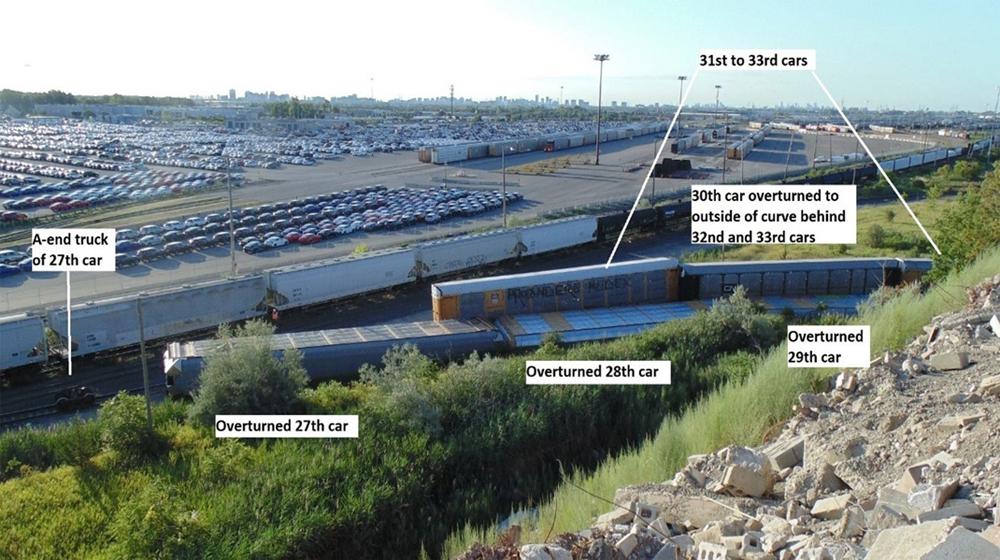
RICHMOND HILL, Ontario — A complex series of factors led to a string-line derailment that killed a Canadian National crew member in an August 15, 2019, derailment at MacMillan Yard in Vaughan, Ontario, the Transportation Safety Board of Canada said in an accident report released this week.
The worker, who was operating a remote-control locomotive using a beltpack, was operating the train on a track with a 15-degree curve from a location next the 27th car in an cut of 82 cars being switched. The derailment involved the 26th through 34th cars, all empty auto racks; when the 27th car overturned, it pinned the employee, who suffered fatal injuries.
The TSB’s report lists a total of nine factors, including a rapid run-out of train slack when the locomotive throttle was advanced to notch 8; the aggressive throttle response of the remote-control system, which led to rapid acceleration; heavy trailing tonnage that made the auto racks vulnerable to string-lining; and air brakes that apparently did not release on the 63rd, which created the conditions for string-lining.
|
|
(Editor's Note: How many more hearings do they have to conduct before the conclusion is reached that PSR is killing the railroad? Hopefully this time something is finally done to reign in the Class One profiteers.) |
|
Federal Regulators to Hold Hearings on Rail Service Problems
Surface Transportation Board reacts to complaints from shippers and rail labor about deterioration in service.
|
|
WASHINGTON – Federal regulators have ordered officials from BNSF Railway, CSX Transportation, Norfolk Southern, and Union Pacific to appear a two-day hearing this month regarding ongoing rail service problems.
The Surface Transportation Board announced on Thursday that it will hold the public hearings on April 26 and 27. The announcement comes in the wake of shipper complaints of service failures on the big four U.S. systems.
The STB said it also has invited executives from Canadian National, Canadian Pacific, and Kansas City Southern to attend. And it said other railroads, shippers, rail labor, and other interested parties can participate in the hearings.
The STB has received a rising number of complaints from shippers, trade associations, rail labor, and the U.S. agriculture secretary regarding rail service failures, many of which are related to crew shortages.
Key performance metrics — including terminal dwell and average train speed — have deteriorated over the past few months, the board noted. STB Chairman Martin J. Oberman, in announcing the hearing, placed the blame for service issues and crew shortages at the feet of the Class I railroads.
“During my time on the Board, I have raised concerns about the primacy Class I railroads have placed on lowering their operating ratios and satisfying their shareholders even at the cost of their customers,” Oberman said in a statement. “Part of that strategy has involved cutting their work force to the bare bones in order to reduce costs. Over the last six years, the Class Is collectively have reduced their work force by 29% – that is about 45,000 employees cut from the payrolls. In my view, all of this has directly contributed to where we are today – rail users experiencing serious deteriorations in rail service because, on too many parts of their networks, the railroads simply do not have a sufficient number of employees.”
|
|
(Editor's Note: Given the level of funding that has been granted, Amtrak needs to return trains to daily operations, increase frequencies, add new routes, order new equipment, and increase the level of service aboard trains. If these things do not happen soon, Amtrak will surely lose the support and confidence of the American people.) |
|
Report Cautions Amtrak of Challenges with Funding Windfall |
|
WASHINGTON — The unprecedented funding windfall available to Amtrak under the Infrastructure Investment and Jobs Act will challenge the company’s ability to manage projects related to the new funds while continuing to oversee current operations, the Amtrak Office of Inspector General says in a new report.
The challenges will come in four areas, the report contends:
— Demonstrating fiscal responsibility in managing the funds, by being transparent in spending and avoiding fraud, waste, and abuse;
— Building and deploying a skilled workforce, including hiring more than 750 managers in 2022 to replace those that have left and for new positions related to the infrastructure funding, as well as hiring outside contractors;
— Coordinating effectively with partners, such as state operating authories and freight railroads, as well as government at all levels;
— Improving program and project management, through efforts such as a focus on early planning, providing adequate personnel resources, and managerial accountability.
The report also says safety needs to remain the company’s first priority: “Amtrak and its stakeholders cannot risk allowing new IIJA-drive programs, projects, or requirements to otherwise detract from promoting safety — at all levels of the organization — as its overarching point of emphasis.”
|
|
USDOT Announces Largest-Ever Investment in Public Transit |
|
President Joe Biden and U.S. Department of Transportation officials yesterday announced a more than $20 billion investment in public transit in fiscal-year 2022 to help agencies modernize and expand service in communities of all sizes.
The funding levels were detailed by the Federal Transit Administration in apportionment tables released yesterday for each of 30 programs for FY2022, USDOT and FTA officials said in a joint press release.
The investment represents a 58% increase in transit funding due to the Infrastructure Investment and Jobs Act, the massive infrastructure bill that Biden signed in November 2021. Full-year funding is available following congressional passage of an FY2022 appropriations bill in March, officials said.
"Thanks to the president's bipartisan infrastructure law, we are making the largest investment in public transit in our nation’s history," said U.S. Transportation Secretary Pete Buttigieg.
The funding will enable transit agencies to buy new buses and rail cars, address their repair backlogs, modernize their fleet and transition to new technologies to address climate change, USDOT officials said.
|
|
(Editor's Note: Precisions Scheduled Railroading is under the gun more and more with each passing week. Despite Class One claims to the contrary, PSR is failing. The statistics are disturbing, whether train velocity, carload dwell times, on-time performance, traffic volumes, or customer satisfaction. The rail industry is failing the American people ... oh unless of course you happen to own stock in the industry.) |
|
I Don’t Have That ‘Peaceful, Easy Feeling’
2022 was going to be the recovery year for freight, rail freight included. As the first quarter ended, I’m not so sure anymore. A group of statistics keep whispering in my ear.
Rail Economist Jim Blaze voices concerns over the state of rail freight industry
|
|
This outlook is based upon selected statistics from multiple published sources, wrapped around several themes and evidence seen at the Rail Equipment Finance 2022 conference the first week of March, further researched with data from the Michigan State University Eli Broad College of Business, and bolstered with graphs published by Susquehanna Financial Group and FTR Transportation Intelligence, using a mix of data from groups like the AAR and FreightWaves. It’s all sanity tested with observations by a group of experienced railroad colleagues across the U.S.
There now appear to be too many signs of selective slowdowns in both the U.S. economy and the railroad sector’s role in freight movement volumes ahead. The same view of partial indicators was recently seen last in independent analysis shared in FTR presentations by Eric Starks and Todd Tranausky. There is no comforting view with a cloudless night sky showing billions of stars.
As market demand and volume showed when first-quarter 2022 ended, freight market volume patterns and pricing both signaled a slowing if not indeed an absolute drop. Looking closer, U.S. rail freight volumes overall were down about 3% year over year (Y/Y) for the quarter’s final full week, but up by about 9% Y/Y on a four-week basis compared to 2020. However, that 2020 value is not comforting since that was the period when the start of the pandemic witnessed significant volume drops.
|
|
The People Who Keep the Refugee Trains Running Out of Ukraine – Photo Essay |
|
Ukrainian Railways employs more than 230,000 people, and almost all its employees have stayed in the country to work, making long, dangerous journeys every day to get people to safety. Windows shuttered and lights dimmed, a darkened train pulls into a station platform, also unlit. As the train comes to a halt, carriage attendants toss boxes of humanitarian aid to station workers waiting on the platform.
Huddles of passengers, who arrived at the station hours earlier so as not to be on the streets during curfew hours, search in the inky blackness for the right carriage, before the train is on its way again with a gnashing of wheels and a long hiss of steam.
|
|
(Editor's Note: This article brings pout a number of interesting questions and facts about rail freight operations and their co-existence with Amtrak - or other - passenger trains. Long piece, but worth the read.) |
|
Gulf Coast Battle: A Possible Solution |
|
As the evidentiary hearing regarding the reintroduction and expansion of Amtrak passenger train service between New Orleans and Mobile continues before the Surface Transportation Board, interesting operational cost-sharing questions have emerged regarding how Amtrak trains may be able to coexist with very long CSX freights.
As background, CSX Senior Vice President Mechanical and Engineering Ricky Johnson testified about how CSX operates its freight trains on the New Orleans-Mobile route. His testimony was structured to identify why the recent changes to CSX’s business model conflicts with Amtrak’s desire to operate two daily round trips on this CSX right-of-way.
During the past three years, CSX changed its freight operating plan model to what it calls “a more precision-like freight train schedule,” translated as PSR (Precision Scheduled Railroading), an acronym people seem to either love or hate. But upon a closer review, it doesn’t seem to be either scheduled or anywhere near predictable, let along precision-like. It is, however. more complex.
This section of CSX main line has a fundamental trains-per-day capacity limitation. The opportunity to pass one Amtrak short train forward of another train, or past an oncoming train, is limited by the number and placement of passing second tracks (passing sidings) and their length.
|
|
Climate Change Poses a Huge Threat to Railroads. Environmental Engineers Have Ideas for How to Combat That |
|
Much of the world still relies heavily on railroads to move people and products. But railway infrastructure—from overhead wires to tracks—is at high risk from climate change and associated extreme weather.
Without efforts to adapt to future climate threats, the railway industry will face degrading infrastructure, safety hazards and skyrocketing operations costs, say experts in transportation planning and civil engineering.
Many point out that so-called nature-based solutions—projects that harness nature’s power to address social or environmental problems—could offer practical and cost-effective ways for railways to minimize the effects of extreme weather, while at the same time providing environmental benefits.
But so far, railways have done little to take advantage of such strategies.
A new study by researchers at the University of Glasgow is the first to review industry efforts to-date to use nature-based solutions to prevent climate change-related disruptions. The researchers identified several potential nature-based solutions railroads could apply, including green corridors to shade tracks from heat and high winds, habitat restoration to buffer the effects of storms and wetlands to soak up water during heavy rain and hold it through drought.
|
|
|
|
|
|
|