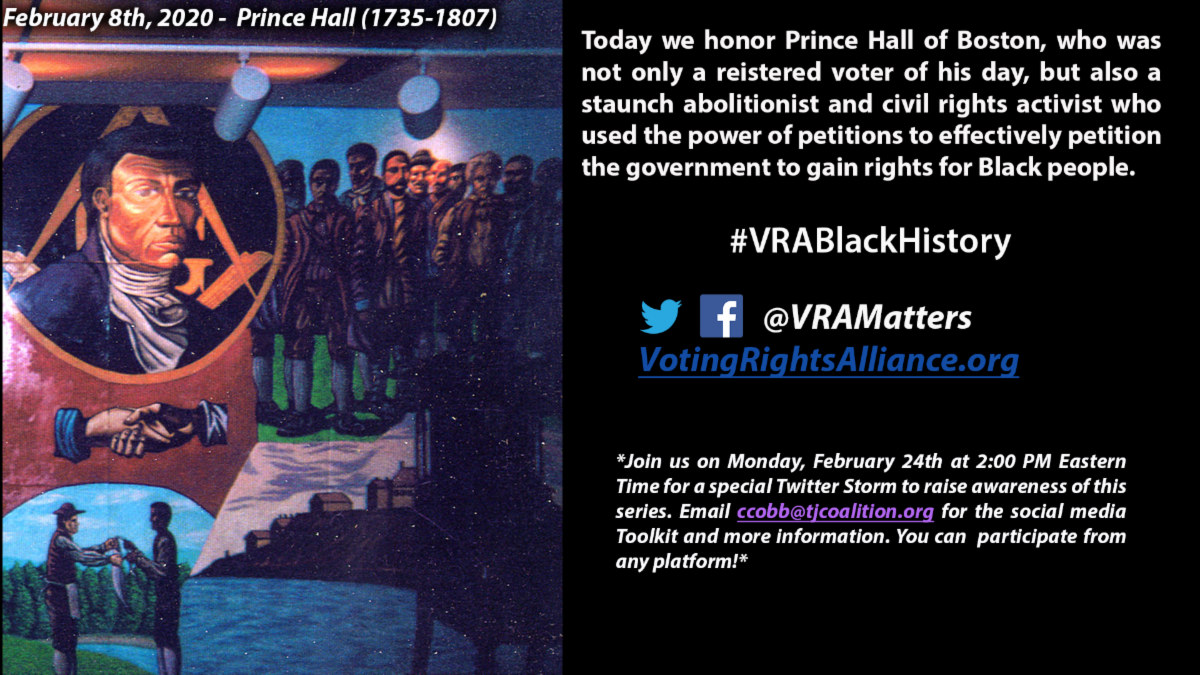
On February 8th, 2020 we honored Prince Hall of Boston, who was not only a registered voter of his day, but a staunch abolitionist and civil rights activist who used the power of petitions to effectively petition the government to gain rights for Black people.
The Mysterious Origins of Prince Hall
Prince Hall’s birth date is speculated to be between
1735, 1738, or 1748, with the majority of sources citing his birth date as in 1735. Several sources also say he was born in Barbados or the British West Indies and traveled to the United States during the American Revolution; yet, still other sources say he was born in Massachusetts, with the majority of sources citing his birthplace as Barbados.
“The first documentary evidence of his existence comes in the late 1740s in a list of slaves owned by William Hall of Boston, a leather-dresser or leather craftsman. It was probably from his master that Hall took his last name.” There are some
sources (such as the one linked) that state that Prince Hall was born free. Interestingly, even those sources that state he was born free still say that Prince Hall
“became a leather apprentice”. It is known from Hall’s various activism works that he was literate; however, both narratives of his origins account for his being so: those who say he was born a slave say
“New Englanders made a point of teaching slaves and Free Negroes to read and write, and Prince Hall became literate” (footnotes omitted); and, those who say he was born free cite that he was literate because he was born to a
“well respected family” in Barbados. Even in the account of his being born enslaved, there is evidence that suggests that
“[a] month after the Boston Massacre, William Hall freed Prince; his certificate of manumission read that he was "no longer Reckoned a slave, but [had] always accounted as a free man." However,
“Documents in
Massachusetts showing that slaveowner [sic] William Hall freed a man named Prince Hall on April 9, 1765 cannot be conclusively linked to any one individual as there exists record of no fewer than 21 males named Prince Hall, and several other men named Prince Hall were living in
Boston at that time.”
Whatever the origins of how Prince Hall became a free man, all sources agree that after a certain point in time Prince Hall was free- and not only was he free, but he was a property owner and registered voter. As was commonly true for that period in time, records regarding the birth dates and genealogical heritage of Black people, especially those in slavery, were not kept.
Petitions, Petitions, and more Petitions
Even if historians can’t agree on Prince Hall’s origins, thankfully Prince Hall was so politically active that much of what is known for certain about him can be verified through his petitions. Following the Declaration of Independence,
“Prince Hall’s petition writing for social justice began in 1777 with his request to the General Court to give slaves their freedom, a right to every person. In this petition, of January 13, 1777, Prince Hall called to the government to be held accountable for ripping many Africans out of their homeland.” Prince Hall argued America’s Revolutionists' own arguments against them, challenging the government to
“stand by the principles it stands for, ‘a natural and unalienable right to that freedom, which the great parent of the Universe hath bestowed equally on all Mankind.’ This petition calls for the freedom of all children, as well as other slaves not free, born in a land of liberty to receive their freedom at the age of 21. Through his writing he wishes to correct the inconsistencies in the State, and feels compelled to assure that justice is attained for all.”
“With the end of slavery in Massachusetts in 1783, Prince Hall and other African Americans repeatedly petitioned the Massachusetts legislature for their rights – to education for their children, to protection against illegal enslavement, and for amends for the disadvantages wrought by enslavement.” And Prince Hall fought for ALL: Black men, children, AND women.
“He showed his prowess in debate early on, by citing
Christian precepts sgainst [sic] slavery of other Christians to the predominantly church-going Massachusetts legislature.”
Not only did Prince Hall advocate for Black people to be treated as citizens; but he also had a 1787 “Return to Africa Petition” for “a number of African blacks” who
“requested financial support from the state for their plan to re-settle with their families in West Africa and establish a commercial enterprise based on the cultivation of sugar cane….While this document is unsigned, a petition bearing strikingly similar language – likely a later draft - was submitted to the legislature on January 1, 1787 with eighty signatures, including Prince Hall’s.”
While the majority of Hall’s petitions fell onto deaf ears, there is some evidence that some of his petitions were heard.
“In his efforts to obtain freedom for slaves, Prince Hall’s agenda also included reparations. He is believed to have helped Belinda Royall write her petition of February 14, 1783. With Prince Hall’s assistance she became the first and only former slave to receive reparations for all her years of work without compensation.”
Prince Hall provided vital framework for the next wave of civil rights’ activists by working the legal system and being politically engaged. While his origins are a mystery; his legacy will forever be imprinted in his petitions.
Other Fun Facts
- “A bill [Prince Hall] sent to a Colonel Crafts indicates that he crafted five leather drumheads for the Boston Regiment of Artillery in April, 1777.”
- Due to racial discrimination with White FreeMason lodges, “[i]n 1791, black Freemasons met in Boston and formed the African Grand Lodge of North America. Prince Hall was unanimously elected its Grand Master and served until his death in 1807.”
- After Prince Hall’s Death, “[t]he African Grand Lodge was later renamed the Prince Hall Grand Lodge in his honor.”
Click the video below to watch the Library of Congress' video on the Social Impact of Prince Hall Freemasonry in D.C., 1825-1900. In the video,
Alonza Tehuti Evans discusses Prince Hall Freemasonry, the oldest recognized and continuously active organization founded by African Americans. As early as 1784 it laid the foundation for African American citizenship, education and the improvement of the social and economic condition of blacks.