|
Year of Jewish Culture in Saxony: Tacheles
Cities and Towns Commemorate 100 Years of Jewish Community in Saxony
June 26, 2026 -- 100 years after the founding of the first Saxon state association of Jewish communities, the Free State of Saxony is in the midst of commemorating a state-wide "Year of Jewish Culture" in 2026.
The title Tacheles is a Yiddish word commonly used in German to mean "speaking plainly," signaling an open and direct engagement with Jewish history and contemporary Jewish life.
Saxony’s history has substantially been influenced by members of the Jewish communities. Jews had been expelled in the 15th century and were only welcome as participants of the Leipzig trade fairs. In the 19th century, synagogues were re-established and, in 1869, Jews were awarded all civic rights. The Jewish communities grew and prospered and Jewish personalities left a strong imprint on economics, culture and politics. Before the Nazis‘ rise to power, more than 20,000 Jews lived in Saxony, not only in the three large cities of Leipzig, Dresden and Chemnitz, but also in Plauen, Zwickau, Freiberg, Aue, Döbeln and Görlitz, part of Silesia at that time.
The year-long commemoration features more than 365 events throughout Saxony through December 12, 2026, highlighting the historical depth, cultural diversity, and contemporary relevance of Jewish life. In Chemnitz, there are guided walking tours, lectures and exhibitions throughout the year. In Chemnitz for example, one talk focuses on authors Stefan Zweig and Walter Benjamin at the State Museum for Archaeology Chemnitz (smac) while an exhibition, Threads – Interconnections, explores the life stories and networks of 25 Jewish families—such as the Goerlitz family—who were foundational to Chemnitz's prosperous textile industry before World War II. In Zittau, there are guided tours of the Jewish cemetery. And in Dresden, SLUB (Sachsen State and University Library) Dresden has opened a rare 13th-century Machzor manuscript to the public — prayers and poetic verses, many still meant to be sung. In Meissen, the theme year Tacheles is integrated into the town’s Gassenzauber festival and through the rest of the year there are events and tours of Jewish life. In many towns throughout Saxony, there are concerts, readings and performances honoring Jewish life in Saxony and you can see these on the Tacheles website.
In the early 20th century, Leipzig was home to one of Germany's most significant Jewish communities. By the mid-1920s, around 12,500 Jewish residents lived there, making it the sixth-largest Jewish community in Germany. Jewish entrepreneurs, publishers, fur traders, bankers and professionals contributed to Leipzig's development as an international trade fair and publishing center, and to its intellectual and cultural life. Following the National Socialists' seizure of power in 1933, Jewish citizens were progressively excluded from public and economic life. Today, the Jewish community in Leipzig numbers around 1,300. Re-established after 1945 and strengthened by immigration in the 1990s, it is today an active presence in the city’s civic and cultural life.
More than 80 events organized by over 20 cultural institutions examine Leipzig’s Jewish heritage and contemporary presence as an integral part of the city’s cultural identity. The City of Leipzig inaugurated the northern route of the Leipzig Music Arc (Leipziger Notenbogen), extending the existing Leipzig Music Trail. The new route leads to former synagogue sites and to residences and memorials connected to Jewish musicians, including Felix Mendelssohn Bartholdy (born Jewish but was later baptized), Gustav Mahler and Erwin Schulhoff.
The Museum of Fine Arts Leipzig (MdbK) will present the special exhibition “Art Within Four Walls: Jewish Families and Their Collections in Leipzig” from October 1, 2026 to January 31, 2027. The exhibition examines the collecting culture and patronage of eleven Jewish families who played a formative role in Leipzig’s artistic life in the late nineteenth and early twentieth centuries.
Contemporary Jewish artistic perspectives are also foregrounded in performance, theater and music formats across the city, reflecting the diversity of today’s Jewish cultural production. A particular highlight is the premiere of Herman Berlinski’s “Avodat Shabbat”, performed by the Leipzig Synagogue Choir together with the Academic Orchestra in the eastern hall of Leipzig Central Station on 27 September 2026, reconnecting the work of the Leipzig-born composer with the city.
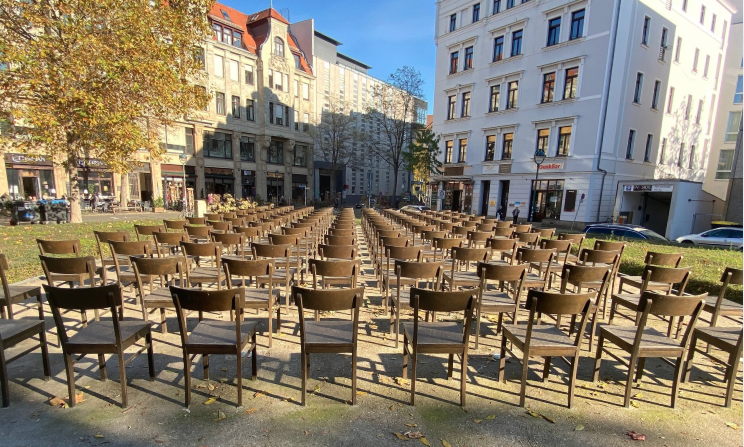
Several memorial sites mark the ruptures of 1938. The Synagogue Memorial on Gottschedstraße/Zentralstraße, composed of 140 bronze chairs, outlines the footprint of the Great Community Synagogue destroyed during the November Pogrom. Installed in 2001, the walkable artwork recalls the expelled and murdered Jewish community. In the Kolonnadenviertel (Apels Garten 4), a sound installation at the site of the former Ez-Chaim Synagogue, inaugurated in September 2024, makes the lost space acoustically perceptible.
The Mendelssohn House preserves the composer’s final residence, where he lived from 1845 until his death in 1847 and completed the oratorio “Elijah.” A reconstructed Mendelssohn monument, originally removed in 1936, stands today in front of St Thomas’ Church as a reminder of cultural rupture and restitution.
The Old Jewish Cemetery (1864–1928) on Berliner Straße and the New Jewish Cemetery in Delitzscher Straße, still in use today, further testify to the long-standing and continuing presence of Jewish life in the city.
The City of Leipzig also continues its one-week “Visitors’ Program for Former Jewish Leipzigers and their Descendants,“ facilitating personal return and historical reconnection. For residents and visitors seeking deeper insight into Jewish history and life in Leipzig, guided thematic tours are offered in the city center.
In Dresden, one extraordinary project currently taking place is the public scribing of a Torah scroll, containing the Five Books of Moses, within a glass pavilion near the Dresden City Museum. In a rare instance, a woman is serving as the scribe. For context, a sofer (Hebrew for "scribe") is a specially trained craftsman who writes holy texts onto parchment using traditional Hebrew calligraphy. There are 304,805 letters in the Torah. Traditionally, this role has been exclusively male, so this is a very unusual situation.
The Dresden Synagogue (New Synagogue) is a must-see. Completed in 2001, it stands on the same location as the original synagogue (1839–1840) designed by Gottfried Semper, and which was destroyed in 1938 during "Kristallnacht." The only original element surviving is the golden Star of David which now hangs over the main entrance to the new synagogue.
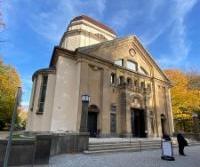
One and a half hours east of Dresden, the former synagogue in Görlitz now serves as a cultural center; this magnificent building with its Art Nouveau elements is one of the few synagogues in Germany to survive under Nazi rule unscathed. With an ornately decorated interior, the synagogue was one of the first reinforced concrete buildings in modern Germany. Its magnificent mixture of neoclassical architecture and Art Nouveau interior can still accommodate 600 people.
Exhibitions do what history often can't: put stories behind the names on stumbling stones so in addition to a visit to the synagogue in Görlitz, you can attend a tour of the “Stolpersteine,” the stones that mark where the victims of National Socialism once lived and worked.
Further Information:
Theme Year “Tacheles”
www.tacheles.sachsen.de
City of Leipzig – Jewish Life
www.leipzig.de/rathaus/stadtgeschichte-und-gedenken/juedisches-leben#c222692
For further information, please contact Victoria Larson, USA Press Representative, Saxony Tourism at Victoria@vklarsoncommunications.com
Saxony Tourism
Leipzig Tourism and Marketing
Dresden Information
|