The RNA Transcript, November 22, 2021 |
|
Happy Thanksgiving!
Wishing you a great, healthy and restful Holiday break, celebrating with all those closest to you!
We also acknowledge that the foundation of the University was made possible through a 1817 land transfer from the Anishinaabek, the Three Fires People: the Odawa, Ojibwe, and Bodewadami, as well as Meskwahkiasahina (Fox), Peoria and Wyandot.
|
|
By Morgan Sherburne, Michigan News
Bacteria need to constantly adapt to compete against other species for nutrient sources and to survive against threats such as antibiotics and toxins.
University of Michigan Department of Chemistry faculty and co-director of the Center for RNA Biomedicine, are examining how RNA polymerase—the enzyme that transcribes genetic information from DNA onto RNA—slows during transcription in a process called transcriptional pausing.
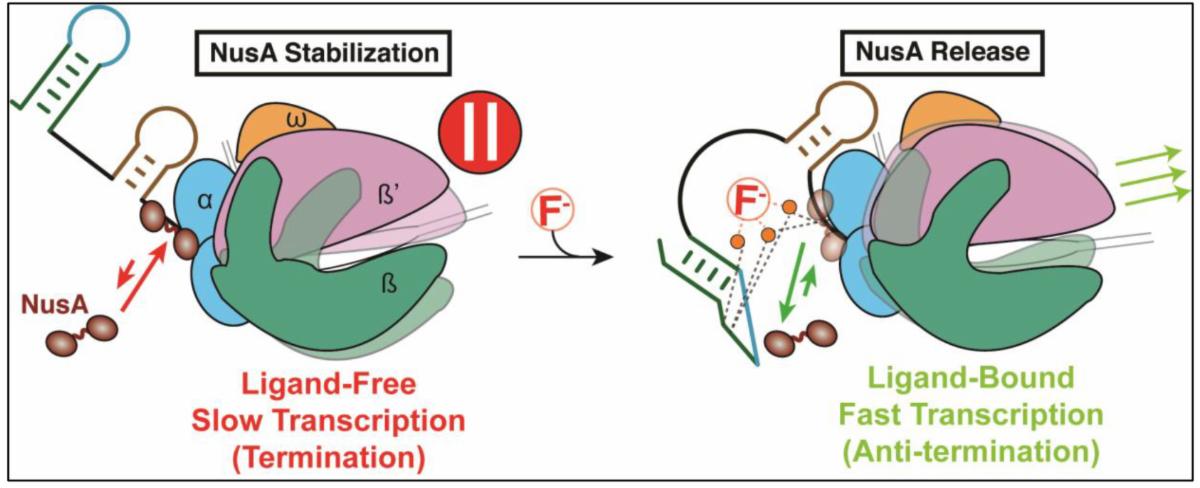
They found that a protein called N-utilizing substance A, or NusA, in concert with another control element called a riboswitch, fine-tunes the transcription speed in order to regulate gene expression. Gene expression is the process by which genetic information is converted into the building blocks of the bacterium.
Reference: “Dynamic competition between a ligand and transcription factor NusA governs riboswitch-mediated transcription regulation,” Adrien Chauvier, Pujan Ajmera, Rajeev Yadav, and Nils G. Walter,
Proceedings of the National Academy of Sciences, November 23, 2021 118 (47) e2109026118;
|
|
Dynamic interplay between Riboswitch structure and transcription factor NusA modulates the outcome of transcription.
In the absence of fluoride ion (ligand-free), the riboswitch structure permits active NusA recruitment to the Paused Elongation Complex, slowing down downstream RNA polymerase progression to ultimately induce premature transcription termination. However, in the presence of fluoride (F-, ligand-bound), RNA structural rearrangements prevent NusA binding, accelerating g the RNA polymerase to promote bacterial detoxification through cellular fluoride exporter synthesis.
(Figure by Adrien Chauvier)
|
|
18 U-M scientists and scholars present their research on three RNA therapeutics areas: mRNA vaccines, ASOs, and CRISPR. The second half of the magazine highlights the main activities of the Center for the July 2020–June 2021 period.
Special thanks to all our contributors!
|
|
Wednesday, December 1, 3:00 pm ET, Zoom information | University of Michigan, Molecular, Cellular and Developmental Biology, Dissertation Defense
"Post-transcriptional and Post-translational Mechanisms of Autophagy Regulation"
|
|
“Consequences of RNA-binding protein mutations in cancer”
"IMP-licating RNA binding proteins in intestinal tissue regeneration"
|
|
For press releases and blog articles about your upcoming top journal publications, please
|
|
Our members' publications are available through Altmetric. Sept queries are currently available: CRISPR, microRNA, molecule, RNA, RNA therapeutics, transcriptome, and translation. Please make sure to have at least one of these keywords in your title. Below are recent highlights.
|
|
Significance:
During virion assembly, HIV-1 packages dimerized copies of its single-stranded RNA genome. This process may be regulated by the conformation of the genomic 5′UTR. Conformational changes in the 5′ untranslated region (UTR) have also been implicated during additional steps of the virus life cycle, including reverse transcription and virion maturation. Thus far, two conformations of the 5′UTR dimer have been described, which differ in the extent of intermolecular basepairing, although whether genomic RNA from different HIV-1 strains that have distinct 5′UTR sequences form similar dimer conformations has not been fully determined. Here, we demonstrate that 5′UTRs from distinct HIV-1 strains form similar conformations with divergent intrinsic stabilities. These results support a unified model of genome dimerization for different HIV-1 strains.
|
|
Rapid kinetic fingerprinting of single nucleic acid molecules by a FRET-based dynamic nanosensor, Kunal Khanna, Shankar Mandal, Aaron T.Blanchard, MuneeshTewari, AlexanderJohnson-Buck, Nils G.Walter, Biosensors and Bioelectronics, Volume 190, 15 October 2021, 113433, https://doi.org/10.1016/j.bios.2021.113433
Highlights:
• Amplification-free single-molecule kinetic fingerprinting identifies diverse disease biomarkers.
• A dynamic DNA nanosensor generates kinetic fingerprints via intramolecular single-molecule FRET.
• iSiMREPS in 10 s detects biomarkers with a limit of detection of ~3 fM in 1,000,000-fold WT excess.
|
|
To share your news
and comments, please
|
|
|
|
|
|
|
|