How does a journalist know when a story is going to be big?
For Washington Post staff writer Erin Cox that moment came while preparing dinner one evening with her husband.
But it started on August 5 while she was covering a Maryland Board of Elections meeting on Zoom. She learned that Maryland had received a letter from the U.S. Postal Service about delays that could impact the 2020 election. She wondered how many other states received similar letters. So, she filed “a polite records request with USPS to determine how widespread this issue might be.”
“I thought the records could be handy for identifying future trouble spots, places with tight deadlines that didn’t heed the warning and adjust them,” she said. “I emailed the request two days later, not expecting to get an answer for a while. When they came back, it was immediately clear there weren’t a few potential hotspots but that nearly every state had been warned, which shifted the news value of the records.”
She received the records while cooking dinner. Once she started browsing through the documents, she knew their significance. What started as a local story and public records request led to a “tipping point story” about voter disenfranchisement and the USPS.
We reached out to Cox by email to find out how beat reporting led to such a monumental article.
Can you share more about how your experience on the politics beat prepared you to break this story?
Cox: A lot of national political coverage starts with big, conceptual ideas that zoom into a representative community to illustrate it. I spent a fair amount of my career doing the opposite, covering communities and figuring out how their issues connect to bigger ideas. The real-life impact of policies and politics is hard to miss when you start from this perspective. When Maryland’s election board noted this letter and promptly changed their deadline to accommodate it, I wondered what would happen in all the places a change wasn’t made. I thought having all the letters could serve as a roadmap to places we might see trouble in the fall. A friend and mentor of mine used to encourage me not to be afraid of my imagination and to think about what a story could be. Rigorous journalism always finds the truth, he’d say, but your imagination helps you find places to look for it.
What was your thought process as you realized what a big story this was?
Cox: The records landed as I was making dinner with my husband, who is also a journalist. I scrolled through maybe 20 pages on my phone before I looked up somewhat stunned and said, “I think it’s possible the Postal Service has warned every state in the country they can’t guarantee ballots will get there in time.” He told me I should write that, and I immediately knew it deserved more than just me on the byline. This was the first time I’d heard of a direct connection between mail delays and disenfranchisement. It wasn’t a hypothetical, general concern from critics outside the Postal Service, but a detailed warning from within it.
The Post had already designated an entire crew of exceptionally sharp journalists to write about voting issues. I knew they could quickly help me find the facts and voices to put this in the right context, strike the right tone, and make sure we were answering all the right questions. I told the team what I found and asked if they wanted to collaborate, and each person was fantastic. By the time the story was complete, I knew it was big. But I don’t think anyone fully appreciated it would be a tipping point story until it published.
|
|
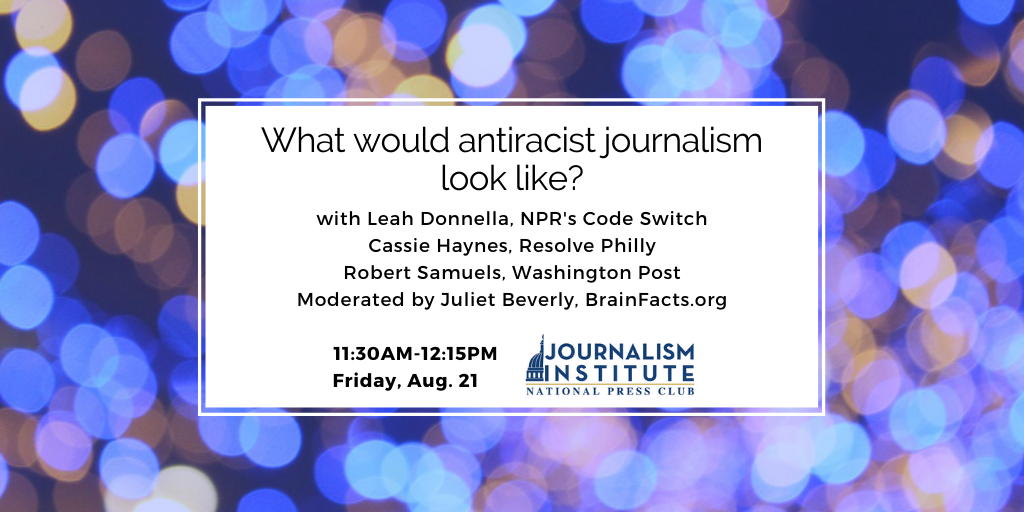
As racism and the treatment of people of color in and out of newsrooms has surged to the forefront of conversations, against the backdrop of a pandemic that disproportionately impacts people of color, journalists face many questions: When do ‘objectivity’ and ‘neutrality’ mask inequity? How do journalists move from covering protests to systemically telling stories that root out racist treatment in health care, education and other social spheres? And how can journalists practice antiracism in their everyday work?
|
|
Bill Plante Chair in Leadership & Media Integrity, Loyola University Chicago
Freedom Forum Fellow in Women’s Leadership
I’ve heard the word “vote” so many times these days that it made me think of how that word plays out in the workplace.
Employees understand that workplaces are not necessarily democracies. People in management are empowered and obligated to make decisions. They involve strategy, personnel, policies, partnerships and budgets. Managers are expected to spend a good chunk of their time building business knowledge that helps them make good calls, informed by insights, data and experience – not just their gut.
Staff members don’t always get (or even want) a vote in every organizational decision.
But the best leaders know that even when employees don’t get a vote, they should have a voice.
By that, I mean that effective managers listen. They tap people for ideas. When it’s not a trade secret or sensitive personnel matter, they test drive their plans with team members. They’re clear about why they’re having such conversations and how the input of the team will be used.
That’s important. Because even among team members, there’s rarely monolithic thinking. There are often conflicting views and goals. The manager’s role is to understand those perspectives, analyze them, and incorporate that knowledge into decisions.
If they’re wise, they then explain their decision-making process to the team. Research says that even people who disagree with a decision are more likely to accept it when they believe the process behind it was fair. They only know that if decision-makers share it.
So managers, in the days to come, whenever you hear the word, “vote,” also remember the importance of that other word: voice.
|
|
|
The Spokesman-Review (Spokane, Washington)
Well, first of all, if you’re feeling tapped out — that’s OK. We’re all overcome with cases of the blahs. A big part of that is caused by COVID-19, and, unfortunately, that’s not going away soon enough.
But the ubiquitous Zoom that we’ve all been using for work meetings can be a powerful tool, if used properly. I’ve been virtually meeting with a group of science fiction fans that I’ve known for more than 25 years but rarely seen in person. Each time, that’s brightened my week.
Another thing you can do: Stay active by making something creative. Paint a mural on a wall of your house. Or offer to paint one on the wall of a nearby business. Create artwork of your friends’ dogs. My wife, a special ed teacher, spent much of the summer sewing cool masks. She made me a fun comic book-themed mask.
Do something — anything, really — that will allow you to use the creative part of your brain for something other than binge-watching shows on Netflix.
But you can’t just sit there and wait for this thing to end. It’s lasted five months now, and it ain’t ending anytime soon. It’s up to you to make sure these five (or 10 or 15) months aren’t just wasted time.
Charles Apple and The Spokesman-Review are sharing, at no cost, their fully designed Further Review pages for publication. For details, read more here or visit Apple’s blog.
|
|
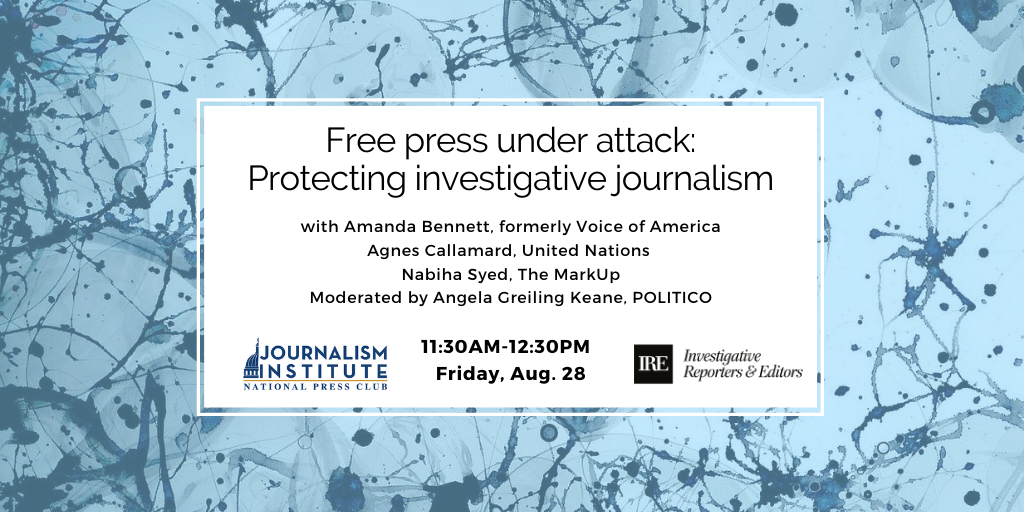
Investigative journalism requires digging for information that someone wants hidden. Powerful forces seek to prevent access, from government officials to private citizens avoiding accountability for wrongdoing.
So how can journalists protect their ability to investigate while under attack? What’s the best defense? And what are the strongest strategies for protecting a free press? Those questions will be the subject of a wide-ranging program in partnership with Investigative Reporters & Editors, moderated by Angela Greiling Keane, editorial director of states and Canada for POLITICO, with panelists Amanda Bennett, former Director of Voice of America; Agnes Callamard, United Nations Special Rapporteur; and Nabiha Syed, president of The MarkUp. The discussion will bring together their experiences as press freedom advocates with their work in journalism, law, and human rights.
Registration is open for this program, which will take place from 11:30 a.m. to 12:30 p.m. on Friday, August 28, 2020.
|
|
This newsletter is written & edited by the National Press Club Journalism Institute staff: Beth Francesco, Holly Butcher Grant, and Julie Moos. Send us your questions and suggestions for topics to cover.
|
|
|
|
|
|
|