Rail Workers Weekly News Digest
Number 14 - April 7, 2020
|
|
Below is a series of articles compiled over the previous week.
They are of interest to railroad workers.
|
|
Article 1 -
CORONAVIRUS NEWS
Pandemic Takes Hold Across the USA
Includes multiple cases on the nation's railroads
As the crisis deepens, more and more workers are asking questions and seeking solutions. So-called "essential workers" - which includes most rail workers - now find themselves dubbed "national heroes" on the one hand while all too often being denied critical information, Personal Protective Equipment (PPE), sick leave pay and health insurance, all while putting their lives on the line for the rest of us.
Most rail workers cannot work from home. The must come to work. Therefore, they MUST be granted a safe workplace. Instead, the carriers are dragging their feet, as always, more concerned about the loss of short-term profits than the loss of workers lives. Their safety slogans now ring hollow, and show up the carriers for what they truly are: liars and hypocrites, untrustworthy employers whose
Number One
priority is clearly NOT safety, as they for so many years now have publicly professed. Their "mask" is now off for all to plainly see the ugly truth.
Rather than take the necessary measures to ensure our safety, and rather than recall to service countless furloughed employees as needed to avoid a short-staffing crisis, instead the rail carriers have appealed to the FRA for - and received - "relief" from countless safety rules and regulations based on a "staffing shortage."
Like all workers, rail workers need to organize and fight back to defend our safety and health. Obviously we cannot rely on our employers to do this for us. Check out some of the resources and ideas below on ways to collectively confront this unprecedented health and safety crisis.
|
|
Article 2 -
CREW CONSIST NEWS
Washington State Will Require a Minimum Train Crew Size
(Editor's Note: Despite the fact that the Federal Railroad Administration (FRA) announced last May that the Agency would not promulgate any rule on train crew size, adding that all state legislation was to be "preempted" by the feds as a result, the momentum for states legislation has not abated. Washington now joins Illinois as two states which have adopted the legislation since FRA's announcement. Still others are in the pipeline).
Washington state Governor Jay Inslee (D) has signed into law a bill that requires freight trains to have at least two crew members.
The bill,
H.B. 1841
, becomes effective June 11. Before signing the bill last week, Inslee vetoed a section of the bill saying that the bill would become effective immediately, saying that the state’s Utilities and Transportation Commission needs time to engage with stakeholders on the bill.
The bill sets minimum crew size requirements for certain rail carriers, including the Class I railroads, although Class III carriers traveling under 25 miles per hour are exempt. Should a train defy the law, the Utilities and Transportation Commission can fine rail carriers.
“The legislature finds that adequate personnel are critical to ensuring railroad operational safety, security, and in the event of a hazardous material incident, support of first responder activities, as well as in the interest of the safety of passengers and the general public,” according to the bill. “Therefore, the legislature declares that this act regulating minimum railroad employee staffing to reduce risk to localities constitutes an exercise of the state’s police power to protect and promote the health, safety, security, and welfare of the residents of the state by reducing the risk exposure to local communities and protecting environmentally sensitive and/or pristine lands and waterways.”
|
|
Article 3 -
LEGISLATIVE NEWS
CARES Act Includes Benefits for Unemployed Rail Workers
The AAR and ASLRRA joined rail labor unions in calling on Congress to provide rail workers affected by the coronavirus with the same protections extended to other Americans in the first COVID-19 stimulus package, which was passed earlier this month.
Unlike other American workers, railroaders do not receive unemployment benefits through state-administered programs, but rather through the Railroad Retirement Board's (RRB) Railroad Unemployment Insurance Program.
• waives the seven-day waiting period for filing a sickness or unemployment claim with the RRB and provides $50 million to cover the costs of providing these additional benefits;
• increases unemployment benefits through an additional $1,200 biweekly benefit and provides $425 million to cover the costs of providing these additional benefits through July 31;
• allows RRB to access about $130 million of remaining American Recovery and Reinvestment Act funds to provide extended benefits through Dec. 31; and
• supplies $5 million to RRB for additional administrative costs.
"This aid package will offer vital relief to hard-working rail employees who's jobs are impacted during these challenging times," said AAR President and Chief Executive Officer Ian Jefferies in a press release.
|
|
Article 4 -
INTERNATIONAL RAIL NEWS
France Turns to Speedy Trains to Catch up in Virus Response
(Editor's Note: Along with unclogging our nation's freeways, improving transport safety, reducing commute times, creating energy efficiencies and reducing carbon emissions, just one more reason to invest in passenger rail.)
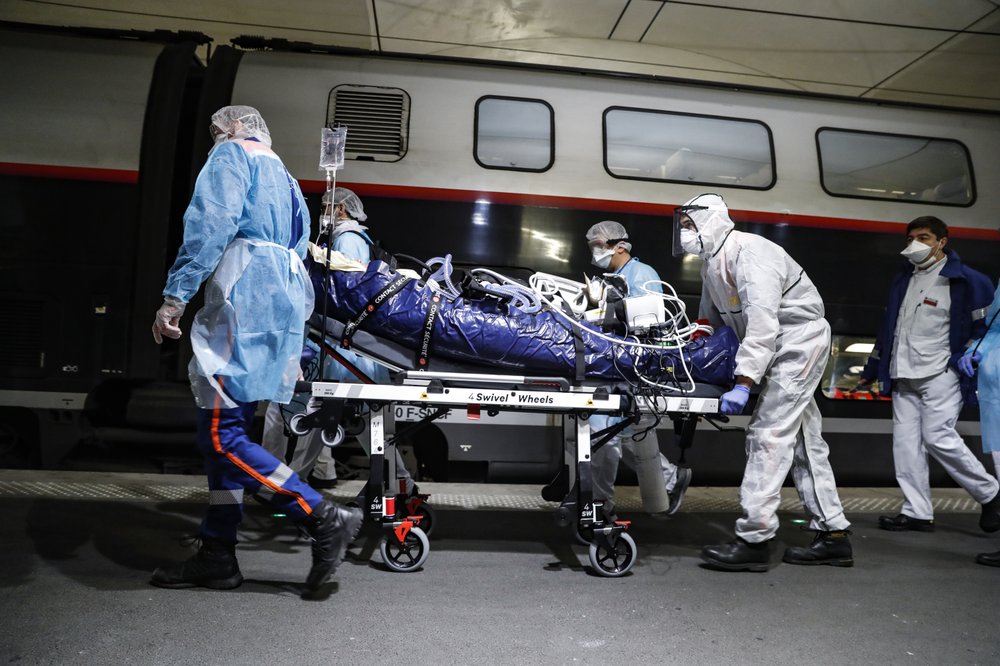
PARIS (AP) — The high-speed train whooshing past historic World War I battle zones and through the chateau-speckled Loire Valley carried a delicate cargo: 20 critically ill COVID-19 patients and the machines helping keep them alive.
The TGV-turned-mobile-intensive-care-unit is just one piece of France’s nationwide mobilization of trains, helicopters, jets and even a warship, deployed to relieve congested hospitals and shuffle hundreds of patients and medical personnel in and out of coronavirus hotspots.
“We are at war,” President Emmanuel Macron tells his compatriots, again and again....
... The first “medicalized” TGV made its inaugural trip on March 26. Doctors in protective gear pushed gurneys along the nearly empty platform of the train station in the eastern city of Strasbourg as safety warnings echoed from loudspeakers. Inside the double-decker cars, patients and webs of tubes and wires were squeezed past luggage racks and rows of seats. Once they were secured, the train sped off toward less impacted hospitals in the west.
|
|
Article 5 -
RAIL CARLOAD NEWS
March Rail Traffic Reflects Pandemic's Impact on U.S. Economy
U.S. freight railroad traffic trends in March show the hit the U.S. economy is taking as a result of the COVID-19 pandemic,
Association of American Railroads
(AAR) data shows.
U.S. railroads logged 1,835,053 carloads and intermodal units last month, a 9.3 percent decrease compared with February's levels, AAR reported in a press release.
Total carloads during the month fell 6 percent to 899,673, while intermodal volume plunged 12.2 percent to 935,380 containers and trailers compared with the same month a year ago.
"Rail traffic numbers confirm that the coronavirus is taking a toll on the economy," said AAR Senior Vice President John Gray. "For example, U.S. carloads of autos and auto parts last week were down 70 percent from the same week last year as auto production declined to zero and consumer spending has begun to shrink demand."
|
|
Article 6 -
MENTAL HEALTH NEWS
Engineer Tried to Crash Train into USNS Mercy in Los Angeles: Feds
Investigators arrested a California train engineer Tuesday after he allegedly derailed a train in a bid to crash into
the USNS Mercy
, the hospital ship treating
non-COVID-19
patients at the Port of Los Angeles to lessen the burden on area hospitals, prosecutors said.
Eduardo Moreno, 44, was expected to appear in court Wednesday for arraignment on train wrecking charges.
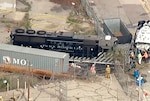
Around 1 p.m. Tuesday, Moreno allegedly ran the train at full speed off the end of the tracks near the Navy medical boat, smashing through several concrete and chain barriers, before sliding through a parking lot nearly 250 yards from the Mercy, according to the criminal complaint.
No one was injured and the boat wasn't damaged, however, the train leaked a substantial amount of fuel, the complaint said.
|
|
Article 7 -
PASSENGER RAIL NEWS
XpressWest Advances Las Vegas High-Speed Rail Plan
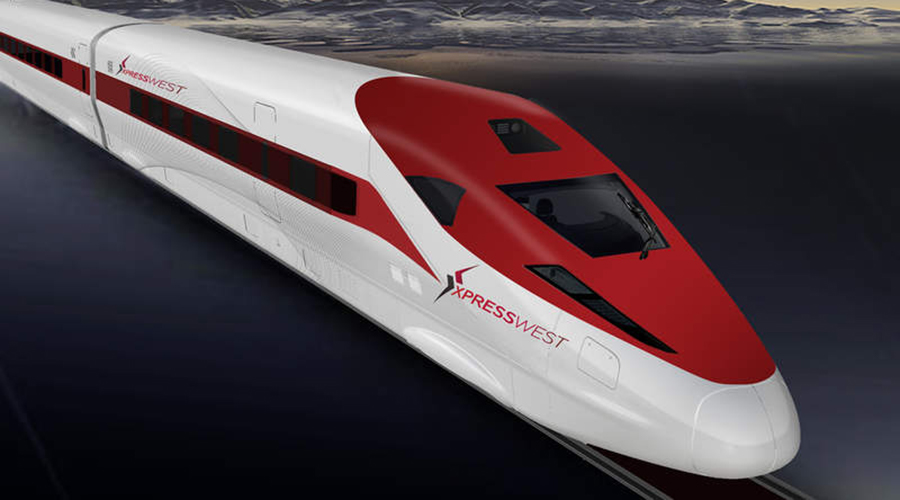
XpressWest last month took steps to secure private debt funding for its $4.8 billion plan to build a 170-mile high-speed, electric rail line from Southern California to Las Vegas, the
Los Angeles Times
reported.
Owned by Florida-based Brightline, XpressWest officials told the LA Times the company has taken steps to secure private debt funding under bond programs operated by California, Nevada and the federal government.
If the funding is secured, rail line construction could begin later this year with service launching in 2023.
Brightline, soon to be known as Virgin Trains USA, acquired XpressWest in 2018. The Las Vegas line would be marketed as Virgin Trains.
|
|
Article 8 -
HEALTH CARE NEWS
There’s Never Been a Better Time for Us to End Private Health Insurance
BY
The coronavirus crisis will lead to health insurance premium increases by up to 40 percent next year. We can’t afford that. Instead of seeing premiums skyrocket or bailing out private health companies, we need to seize this moment to abolish private insurance and create a single, national insurance plan.
The US health care system is going to be overwhelmed by the coronavirus pandemic for months to come. But when the spread of the virus finally does subside, many of its impacts will be here to stay. With millions of Americans likely to need expensive hospital stays this year, our nationwide health care costs are expected to increase by as much as $251 billion, according to a
new analysis
. As a result, US health insurance premiums could rise by up to 40 percent in 2021, exacerbating a crisis of ever-increasing costs that already leave Americans paying far more for care than the people of any other country.
What this means is that we’re about to hit a fork in the road with the private insurance industry. The coronavirus is shredding insurers’ profits right now, underlining the fact that private insurance is simply not built to handle a medical crisis. Having to cover a surge of expensive treatment — and, in some cases, having to
waive co-pays
— is antithetical to the premise of for-profit insurance. Saddled with these unexpected costs, private insurers’ only alternative to drastically raising our premiums will be to request a massive government bailout to avoid bankruptcy.
|
|
|
|
|
|
|