Please spread the word about the
PEDReady website
and newsletter with your ED, EMS and pediatric colleagues! The
P
E
A
R
L
can be used by training officers, medical directors, nurse educators, Pediatric Emergency Care Champions/Coordinators (PECCs) and others to provide weekly pediatric education.
Don't forget:
Email
pedready@jax.ufl.edu
with your suggestions, upcoming pediatric courses or requested content.
|
|
Encourage others to sign up for the PEDReady listserve & weekly newsbrief, the PE
2
ARL, by sharing this link:
http://bit.ly/flpearl
|
|
(Special thanks to Dr. Benjamin Abo
for contributing!)
Did You Know...
- Florida is home to about 46 species of native snakes and only 6 of those are venomous.
- Common venomous snakebites in Florida are from Pit Vipers and Coral Snakes.
- There is a 1% increase in mortality for every hour lost between time of bite and arrival at a hospital for antivenom therapy.
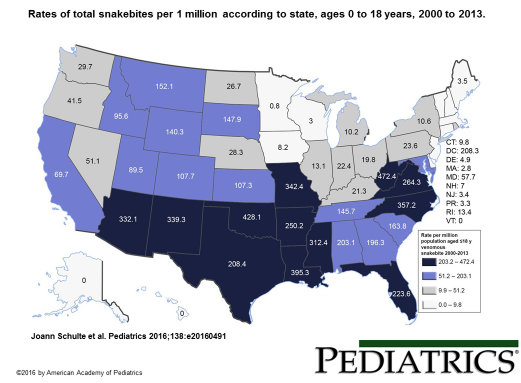
Incidence of Childhood Snakebites:
|
|
Key Pearls:
- Take all snakebites seriously! Always bring the patient to the ED, even if you think the bite is dry. The child still needs to be monitored and observed.
- Treat the child’s pain with adequate analgesia, keep them calm, and remove any constricting bands, clothes or jewelry.
- Don’t bring the snake to the ED! Dead snakes can still envenomate. Photos are great—just don’t get too close!
- Avoid ice, tourniquets, constricting bands and nonsteroidal anti-inflammatory drugs (NSAIDs) like ibuprofen.
- Don’t assume vomiting in a child is from pain, fear or crying. The vomiting may be due to a systemic reaction.
- Mark the leading edge of the wound as soon as possible and then every 10-15 minutes. Mark the leading edge of redness/swelling and as it moves with a line and time. Note the area of tenderness by looking for a grimace or yell, and then mark that spot with a “t” for tenderness. The leading edge of pain and tenderness is the snakebite vital sign. It tells you how quickly things are progressing.
- The rate of progression helps determine whether to treat with an antivenom and how much to give. Treatment is based on signs of the injury, not on the basis of a patient's weight or a specific preprescribed dose. In some cases, a child might get more antivenom than an adult—it depends on control of the progression of symptoms.
- In the ED initial lab tests include a CBC, fibrinogen level, and coagulation studies for domestic species or pit vipers. If dealing with an exotic species, add renal function tests.
- Consult a vetted snake specialist or a poison control center.
|
|
|
|
Florida's Poison Control Centers
are available 24 hours a day to assist emergency physicians in the treatment of all toxic exposures.
|
|
Resources, Apps and Articles:
|
|
2. Upcoming Pediatric Emergency Conferences
|
|
The Forensic Investigation in Child Physical Abuse:
Making a Difference Together
June 13–14, 2019 |
Gainesville, FL
Hosted by: The Shaken Baby Alliance
This conference is designed for multi-disciplinary teams that investigate cases of child physical abuse. CME available!
|
|
|
Kid Care Trauma Conference
July 9, 2019 |
Jacksonville, FL
Hosted by: UF Health Jacksonville
Approved for 8 nursing hours and 7 EMS hours
|
|
|
CLINCON 2019
July 17–19, 2019 |
Orlando, FL
Hosted by: EMLRC
Designed for the entire spectrum of emergency care providers. General conference lectures include
The Pregnant Patient Skills Lab, Tips & Tricks for Blue & Barely Breathing Baby
and more!
Access Brochure
Pre-Con Workshop:
Managing Pediatric Cardiac Arrest
July 17, 2019 | 8:00-12:00 pm
|
|
|
Symposium by the Sea 2019
August 1-4, 2019 | Boca Raton, FL
Hosted by: Florida College of Emergency Physicians (FCEP)
FCEP's annual meeting & educational conference, Symposium by the Sea, is designed for emergency physicians, residents, students, physician assistants, nurses and allied health professionals interested in emergency care.
Pediatric Trauma Workshop
August 2, 2019 | 9:00 am to 12:00 pm
|
|
|
Pediatric Care After Resuscitation (PCAR) Course
Dec 2-3, 2019 | Jacksonville, FL
The mission of TCAR (Trauma Care After Resuscitation) Education Programs is to expand the knowledge base and clinical reasoning skills of nurses who work with injured patients anywhere along the trauma continuum of care, particularly in the post-resuscitation phase.
|
|
|
Thanks for being a Pediatric Champion!
|
|
The Florida PEDReady Program
|
|
|
|
|
|
|
|