|
Stewardship 2027 - Plenty Good Room
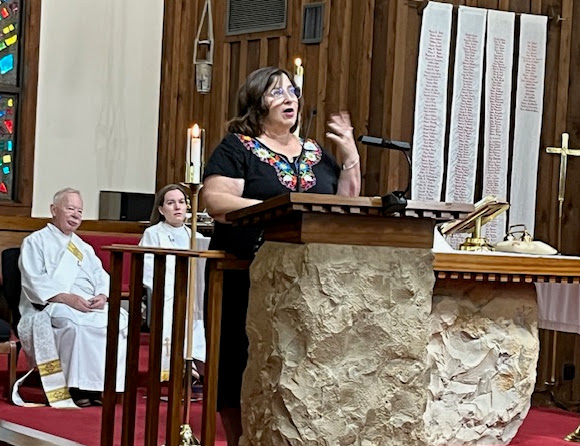
On Sunday, Peri Worrell shared with us her stewardship journey.
When Deb asked me to give a testimonial about stewardship, I said yes. That “yes” was
followed by a pulse of anxiety. Who am I to speak on the topic of stewardship? I thought. Am I following stewardship principles in my own life?
Stewardship means responsibly taking care of what you’re entrusted with. In the Bible, the lesson on stewardship that sprung first to my mind is the story of three servants called “The Parable of the Talents.” You know: A master goes away and entrusts three servants, each with a different quantity of money. When he returns, two have doubled the original amount by wise investments, while the third is fearful of losing his and buries it in the ground. The master praises the first two but chastises the third.
While preparing this week, I learned that the word “talents” in English comes from this parable, and that until the early Renaissance it was understood to refer simply to a weight of silver. Butten, gradually, through reference to Jesus’ very words, “talents” came to mean any gift committed to someone for use or improvement. By Shakespeare’s day, it was understood in its present-day sense as abilities gifted to a person by the Creator.
What a discovery! The background of the word “talents” opened up the meaning of stewardship for me, both inside and outside the structure of the Church.
Let me start by saying that I was raised as an atheist. Yet I always felt a spiritual presence in my life. At midlife when I started researching my ancestry, I learned that my great-great-grandfather and his father had both been deacons in the Anglican Church of Ireland. Long before then, I’d discovered some of my talents: science, and putting my hands on people to make them feel better. I found my vocation as a chiropractic physician and regarded it as a sacred calling. It also turned out to be the source of a comfortable income.
As a young woman I explored spiritual and religious traditions. They all called for charity, which I practiced, giving sacrificially from my tiny student’s income while living frugally. After graduation, I found my church home in the Episcopal Church. My children and my practice consumed most of my time and talents, but I faithfully donated 10% of my income to the church, even as I paid off my student loans. My church was spirit filled, and so was I, and so were my husband and children. I was richly blessed and I was happy to share that blessing.
Then, I experienced what I can only describe as a season of trial. Over a few years, I
experienced complicated deaths in the family. My children and I were victims of multiple crimes and great betrayals, some heartbreaking, and one of which resulted in a large financial loss. Addiction stole two people I loved. My marriage couldn’t take the strain and broke apart.
During that time of fear and sorrow, my church also failed me. Its pastors, whom I trusted, moved on and were replaced by a pair whose crusade against changes in church doctrine caused conflict and rage. In the end, one outraged and mentally ill person burned the church building to the ground.
My children and I moved on to another church, a 250-year-old “high church” congregation led by a dynamic young priest. He convinced the vestry to take on massive debt to renovate the historic church grounds … and then abruptly left with half the members.
Through my own difficulty, I reached out to clergy and church leadership for help: pastoral counseling? No time. Was there a children-of-divorce or single-parents’ support group? They weren’t meeting any more due to all the chaotic changes. Could I get added to the prayer list? Somehow, even that was forgotten.
Disappointed, I drifted away from the church and made my donations to other charities. I devoted my time and talents to my work and my children. I could have cared better for myself during those years; I shorted myself on sleep, and recreation, and exercise.
The lesson there? Poor stewardship can sometimes be hard to tell from sacrificial giving.
Eventually, I paid the price in the form of a disabling autoimmune disease. I used to thank God in prayer every day for my strong and sensitive arms and hands. God said that when it was time for me to leave the sacred healing calling that he’d given me, he’d take that ability away. So, when I developed arthritis that humbled me, I knew God had plans to lead me into his light.
And God brought my husband Steve and me together in a marriage that has faith in God and sacrificial devotion at its foundation. I still have deep faith and love for my husband and children. I’m able to be present in my kids’ struggles and celebrations as adults, in ways I was sometimes unable to do when they were little. I still have my abilities as a wordsmith, which allows me to earn a little money as a medical editor--and even less as a poet and fiction writer. Stewardship of this physical vessel also requires a great deal more time, money, and effort than before, and I know others in this older congregation can understand that.
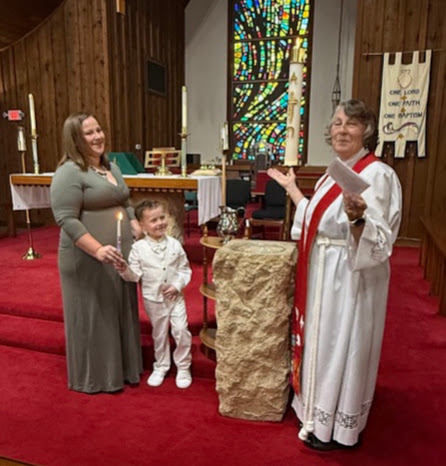
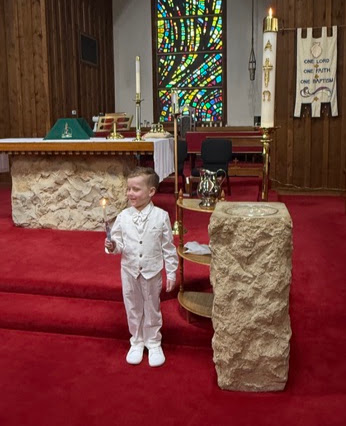
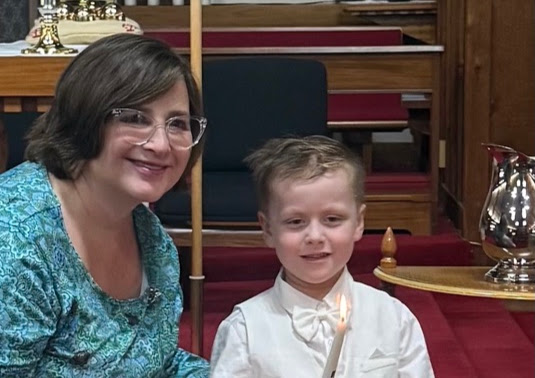
I may not have the expansive financial resources to support the church as I once did; my personal monetary stewardship now is now a matter of trying to limit the dwindling. But when my 5-year-old grandson Logan was diagnosed with a deadly cancer, I felt uplifted and loved by this congregation. And when he asked, unprompted, to be baptized, Pastor Kathy did the honors at this very baptismal font. I felt the touch of a little miracle, and I heard God tell me to make a donation. I’ve come full circle to where I was as a student, contributing what seems a mite to others, but which is good measure to me.
How does God want me to share time, talent, and treasure now? I don’t know yet.
But when I find myself getting too self-centered, I sometimes hum the words of the hymn in my mind:
Here I am, Lord. Is it I, Lord? I have heard you calling in the night.
|