The Miles Franklin Newsletter
|
|
From The Desk Of David Schectman
|
|
Central banks have turned from net sellers of gold into net buyers over the last ten years, and a lot of this has to do with governments’ changing appetite for risk, this according to Juan Carlos Artigas, director of investment research at the World Gold Council.
“Central banks also cite safety and diversification in reasons why they invest in gold, and in some sense, gold is an asset that can protect their reserves over the long term.”
- Juan Carlos Artigas Director of Investment Research, World Gold Council.
Gold market intervention by BIS rose sharply in December
Since May 2019 the Bank for International Settlements, which represents most central banks, has increased its use of gold swaps and other gold-related derivatives from an estimated 78 tonnes to an estimated 303 tonnes as of December 2019.
The bank's total gold swaps and derivatives stood at 250 tonnes in November 2019.
- Robert Lambourne
[I]t's now been 11 years of history's most radical monetary stimulus to fight deflationary forces since the collapse of the last Bubble.
It all amounts to the greatest misdiagnosis in the history of central banking. The predominant risk has not been - and is not today - disinflation or deflation. Bubbles remain the overriding risk - and further inflation only intensifies historic Bubble risk. To be sure, foolhardy policy measures that work to neutralize Bubble deflation only ensure larger and more threatening Bubbles. Last year's Monetary Fiasco unleashed precarious "blow-off" speculative excess - stocks, bonds, corporate Credit and structured finance.
The entire world inflated into the proverbial Bubble in Search of a Pin. At the epicenter of the global Bubble, trouble in China has been headlining my list of potential catalysts. The coronavirus outbreak poses a clear and present danger of pushing China into a dangerous predicament. The most alarming aspect of all this: few contemplate China as a catalyst because virtually everyone remains oblivious to Global Bubble Risk.
– Greg Mannarino
Worldwide holdings in gold ETFs climbed to 2,573.9 tons on Monday, topping the previous peak set in 2012
Governments around the world will continue to print money and keep interest rates either unchanged or lower, which would be bullish for the precious metals, including silver, this according to Keith Neumeyer, CEO of First Majestic Silver.
“I’ve been calling for triple-digit silver for a few years now, and I’m more enthused now but I’m cautiously enthused. I thought it would have happened sooner than it currently is happening.”
– Keith Neumeyer
|
|
David's Commentary (In Blue):
I’m not going to have much to say today – I am on vacation for the next two weeks and normally would not be writing at all – but I decided to present some information that is valuable and, if you haven’t read it yet, I believe it is worth your time.
Thanks,
David
Yes, this is the trend heading into a very interesting 2020. Falling interest rates (expanding money supply, more QE and REPO) and rising gold
|
|
|
|
Zero Hedge
Quarantative easing?
...the total injection announced was 1.2 trillion yuan,
the largest single-day addition of its kind in data going back to 2004
.
Whatever the reason, real rates across the board are plummeting for a very long time. Schmelzing dares to say, real rates “could soon enter permanently negative territory” (my emphasis). Aside from the fact this would be bullish for gold, I wonder how such an economy would operate on a sustainable basis.
A friend just told me his bank account might be charged with “negative interest rates” in the future. Outraged he was. I told him inflation was eating away his money for years now, with interest rates at zero. It seemed he didn’t “want” to understand this is the same thing.
|
|
The Coronavirus may not kill you, but it could kill the stock market and the global economy. It is a legitimate Black Swan event.
|
|
|
|
Greg Hunter
China Virus Sinks Economy, Impeachment Disaster Continues, Everything Fake
The World Health Organization (WHO) has declared a global emergency because of the Coronavirus outbreak. Who knows how bad this will be, but the damage to China’s economy as well as the global economy will be significant? The longer this goes on the worse it will be. Is this the financial black swan that can cause a financial disaster? The longer this goes on, the more chances increase for real economic problems.
The Senate impeachment trial on the removal of President Trump continues, and it continues to be a disaster to the Democrats who brought the case. The case is beyond weak, it is a fraud and shows House Democrats to be in opposition to the law and the Constitution. Many legal experts have called the case a fraud and a Deep State operation to remove a duly elected President on false made up charges.
Is there anything that is real? The impeachment case against the President is a “hoax.” The financial numbers on every stock and commodity are fake with zero real price discovery. Even the federal government does not have to keep accurate books. Do we live in an age of delusion where nobody believes or tells the truth?
Join Greg Hunter of USAWatchdog.com as he talks about these stories and more in the Weekly News Wrap-Up.
|
|
At least some American investors get it. Partially. No, do not use ETFs as a replacement for physical – in your hands – gold coins. The ETFs track the price of gold, but unless they guaranty you that they will redeem your position in physical gold, forget it.
|
|
|
|
LeMetropole Café
If this doesn't get your attention, then you're just not paying attention!
Long before the move into gold becomes a full-fledged "rush," smart money with deep pockets will have been activating their own accumulation plan.
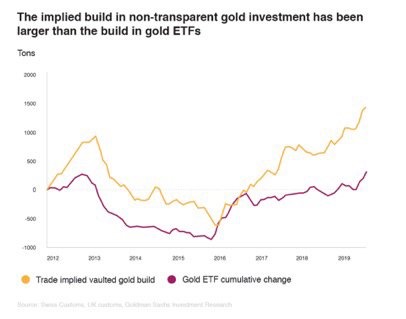
The chart below from Goldman Sachs research indicates what's been going on under the radar. Gold ETF (visible) accumulation – which by the way has now officially reached record levels – is being substantially eclipsed by the build in non-transparent gold investment, as it is ensconced around the world
in private vaults
, kept "in hand" near one's residence, or simply buried in the back yard.
|
|
|
|
It's not too late to accumulate! These and other data points, such as the current low level of U.S. Mint
American Gold Eagle
production – which follows demand – indicate that the majority of potential investors have yet to enter the gold space.
Act to strengthen your financial immune system by accumulating the desired level of metal now, before the ongoing gold-build morphs into a public-mania-infused "gold fever." And before the concept of financial privacy and flexibility has become a relic of the not-too distant past.
|
|
|
|
Ed Steer
The Big 7 traders were certainly after gold yesterday -- and why they didn't go after silver in a bigger way as well is a mystery to me, as they pierced its 50-day moving average intraday, but it still managed to close above it by 3 cents. Gold's 50-day moving average is still a fairly scary 37 bucks below yesterday's closing price. They're also getting close to platinum's 50-day moving average as well. However, palladium's attempt to reach its intrinsic value continues -- and its 50-day moving average will soon be out of sight for good.
Yesterday, at the close of COMEX trading, was the cut-off for this Friday's Commitment of Traders Report -- and companion Bank Participation Report. It's a given that the Big 8 commercial traders, including JPMorgan, were covering short positions and going long as best they could -- and what happened in the Managed Money, Other Reportables and Nonreportable categories during this reporting week remains to be seen. It was a surprise in last week's COT Report -- and could be again this Friday as well.
It's impossible to tell whether or not there's much to go in this current set of engineered price declines. One gets the impression that JPMorgan is no longer the major driving force behind them, although they are benefiting mightily from it.. This appears to be the larger traders in the Big 7 category at work here. They certainly gained some relief yesterday, but are light years away from breaking even on their short positions...let along turning a profit. And because of that, they're still vulnerable to a short squeeze.
On Friday, which seems like a long way away at this point, we get also the latest jobs report -- and I expect the precious metals market to 'react' in some way when the numbers are released at 8:30 a.m. in Washington.
The global stash of gold in exchange-traded funds has risen to a record after a long run of accumulation that's been given added impetus in recent weeks by the fall-out from the widening coronavirus crisis.
Worldwide holdings in bullion-backed ETFs climbed to 2,573.9 tons on Monday, topping the previous peak set in 2012, according to an initial Bloomberg tally. The latest additions follow four straight years of inflows, and come as prices of the traditional haven trade near the highest level since 2013.
Gold has risen as the health emergency centered in China hurts appetite for risk at a time when U.S. interest rates are expected to remain low for some time, with some investors seeing further easing from the Federal Reserve. Among them, DoubleLine Capital LP Chief Executive Officer Jeffrey Gundlach said on Friday he now sees a 90% chance for a Fed rate cut this year. Simmering geopolitical tensions have also driven interest in bullion.
"Gold ended 2019 with its best gains in a decade, closing up by 18%, so momentum was well and truly building in the ETF sector well before the coronavirus," Gavin Wendt, senior resource analyst at MineLife Pty in Sydney, said in an e-mail. "Evidence is growing for U.S. dollar weakness, which could last for at least the first half of 2020 and beyond, providing further impetus for gold."
This
Bloomberg
story put in an appearance on the
bnnbloomberg.com
Internet site very early on Monday morning EST -- and I found it on
Sharps Pixley
. Another link to it is
here
.
My regular readers know why I believe the gold price is poised to move from its current level of around $1,588 per ounce to $2,000... $3,000, and beyond.
Right now, we are exiting the eye of the giant financial hurricane that we entered in 2007, and we're going into its trailing edge. It's going to be much more severe, different, and longer lasting than what we saw in 2008 and 2009.
In a desperate attempt to stave off a day of financial reckoning during the 2008 financial crisis, global central banks began printing trillions of new currency units. The printing continues to this day. And it's not just the Federal Reserve that's doing it: it's just the leader of the pack. The U.S., Japan, Europe, China... all major central banks are participating in the biggest increase in global monetary units in history.
These reckless policies have produced not just billions, but trillions, in malinvestment that will inevitably be liquidated. This will lead us to an economic disaster that will in many ways dwarf the Great Depression of 1929-1946. Paper currencies will fall apart, as they have many times throughout history.
This isn't some vague prediction about the future. It's happening right now. The Canadian dollar has lost 26% of its value since 2013. The Australian dollar has lost 37% of its value during the same time. The Japanese yen and the euro have crashed in value. And the U.S. dollar is currently just the healthiest horse on its way to the glue factory.
This will all come true the moment that the Big 7 traders throw in the towel...but they haven't done that as of yet. Of course, Doug has always been of the belief that precious metals have always traded freely outside of government and banking interference -- and no matter how wrong he and his ilk have been over the years, this is the bulls hit line they continue to spout. This commentary by Doug showed up on the
caseyresearch.com
Internet site on Friday -- and I thank Jim Akers for pointing it out. Another link to it is
here
.
Governments around the world will continue to print money and keep interest rates either unchanged or lower, which would be bullish for the precious metals, including silver, this according to Keith Neumeyer, CEO of First Majestic Silver.
"I've been calling for triple-digit silver for a few years now, and I'm more enthused now but I'm cautiously enthused. I thought it would have happened sooner than it currently is happening," Neumeyer told Kitco News on the sidelines of the Vancouver Resource Investment Conference.
Of course, Keith is fully aware of the fact that JPMorgan et al. have been sitting on the silver price for decades now -- and as one poster stated in the comments section below the video..."Everything Keith said is absolutely true except for one thing - Jamie Dimon's hands are not invisible." This 9:48 minute
Kitco
video interview appeared on the
youtube.com
Internet site on Friday sometime -- and I thank Roy Stephens for sending it along. Another link to it is
here
.
|
|
Of course, you knew this – but it is like boiling the frog. Inflation is a gradual, slow moving event that you get used to and it only becomes annoying when you look back ten years or more. By then, it’s too late.
|
|
|
|
Bill Bonner
“Hidden” Inflation Isn’t Really Hiding at All
The subject is inflation. How does it work? Why bother to think about it?
Don’t we have anything better to do?
(Next month, we’ll study the animal even more closely. We’re returning to Argentina, where consumer prices are rising at a 54% annual rate.)
Three Phases of Inflation
America’s Inflationary Era got underway on August 15, 1971, when the U.S. introduced a new currency, not backed by gold or anything else. This was the First Phase, from ’71 to ’81, when inflation went into consumer prices. Consumers didn’t like it.
Then, Paul Volcker “beat” inflation by putting the prime rate up to 20% and bringing on a recession. But inflation didn’t die. It simply moved to asset markets, where it was warmly greeted and continues to be more than welcome. This was the Second Phase.
The Third Phase began on September 17, 2019, when the Federal Reserve began printing money to cover U.S. deficits, with no pretense of an emergency.
Dear Readers might find this whole discussion a little peculiar. We are nearly 50 years into an Inflationary Era, but where’s the inflation? Consumer prices are still rising at only about 2% per year. At least, that’s what the feds say.
Economist John Williams, author of the Shadowstats website, calculates inflation using the same formula that the feds used in 1971 – that is, back when the U.S. still had real money. He shows that today’s inflation rate is 10% – 5 times the official rate.
In the stock market, inflation is more obvious. The S&P 500 rose 29% last year. Some of that can be traced to higher after-tax profits (before-tax profits went nowhere). But the largest part – 99% – was what they call on Wall Street “multiple expansion.” That is, price inflation.
But perhaps inflation needs some ‘splaining…
Always a Rip-Off
Adding fake new money is bound to shortchange someone, usually the person who has the old money. Retirees, for example, typically live on money they earned decades before. When consumer prices rise, they lose purchasing power.
But inflation works its mischief in wily and elusive ways.
As we’ve seen, over the last half a century, most of the new money has gone into asset prices. That’s why the rich – who own the assets – have gotten so much richer. Retirees, too, if they were lucky enough to put their money in the stock market, have no reason to complain.
But the bottom half of the population – with no financial assets – is 30% poorer than it was 20 years ago. And the typical male wage earner, who has only his time to sell,
brings home less real money
than he did 45 years ago.
Inflation must rip off someone. Otherwise, why bother to inflate at all? Government controls the money. And the government produces no wealth. All it does is “redistribute” wealth. Inflation is just another way of doing it.
Just the Beginning
We explained last week how, in the U.S., the original idea was to rip off the French and other foreigners who held dollars. Foreigners had been promised an ounce of gold for every 35 U.S. greenbacks. Today, they’ll need to show up with 1,567 dollars to get the exact same ounce of gold. That’s a rip-off of 97.7% of their money.
But that was just the beginning. Until 1970, the U.S. had run a trade surplus in every single year since the late 1800s. Then, with the new, fake dollar, Americans could rip off the foreigners again – paying for goods and services with green pieces of paper and never having to settle up in gold. After 1975, they never ran a trade surplus again.
The new, fake dollars also proved useful for ripping off ordinary Americans. Printing new dollars gave the feds a way to take resources from average Americans without having to raise taxes (and risk a shellacking in the next election) to pay for it.
And today, the feds routinely spend a trillion dollars per year more than they dare to raise in taxes. The money must come from somewhere.
Can’t Vote, Can’t Complain
Until recently, they borrowed it. This was just a way of ripping off future generations. The unborn don’t vote and don’t complain. But then,
on September 17, 2019, the future rebelled
. U.S. savers – as channeled by the “primary dealer” banks – weren’t willing or able to pony up the vast amounts needed to refinance US debt.
So, now the Fed “prints.” And who gets ripped off? And how?
Ms. Stephanie Kelton, Bernie Sanders’ economist, doesn’t worry about it. It’s the ripper-off she’s concerned about. She wants to be sure the government has enough money to fill
what she sees as “deficits” in our society
.
And guess what? The feds will be fine. They control the dollar. They can print all they want to pay their expenses. They can never go broke.
Faced with defeat at the polls, revolution, riots, coups d’état, what else could they do?
They printed up pieces of paper… called it “money”… and passed it out all over town.
How did that work out for them?
More to come…
Regards,
Bill
|
|
Did you know that Once global silver production peaked in 2015 and declined as the gold mine supply continued to increase, the ratio fell from 8.3/1 to 7.6/1 in 2019? This is excellent news for silver investors, whether they realize it or not.
Did you know that 41% of the “known” total world cumulative gold production from 1493-2019 is held in above-ground investment gold stocks compared to only 5% for silver?
Did you know that Silver Investors have been given a HUGE GIFT that most don’t realize? Because the world consumed, 10’s of billions of ounces of silver for industrial and jewelry fabrication, most of this will never come back to the market. Which means, when push comes to shove, investors looking to protect wealth, won’t find that much silver available to acquire… only at much higher prices.
Read the following article from SRSrocco and get the whole story.
|
|
|
|
SRSrocco
There’s Just Not That Much Silver Investment Insurance To Go Around
As the Fed and Central banks continue propping up the financial markets, many precious metals analysts advise owning gold over silver. They say that gold is the key precious metal that will be used to reintroduce a “Sound Monetary System.” However, I believe the real winner in terms of “future value” in percentage terms will be silver, not gold.
Why? It all comes down to ENERGY. While I have repeated myself many times over about energy being the driver of the economy, there is a large percentage of precious metals analysts and investors that still don’t “GET IT.”
And even worse than that, one website that publishes my work, REMOVES the energy content from the article, while only allowing the precious metals subject matter to remain… LOL.
|
|
Maurice Jackson of Proven and Probable
|
|
The Central Banks Are Preparing and So Should We
Andy Schectman the President of
Miles Franklin Precious Metals Investments
sits down with Maurice Jackson of
Proven and Probable
to discuss how central banks are de-dollarizing and where they are divesting their asset holdings because of landmark resolution agreed upon by the Bank of International Settlement under Basel III. We will discuss what actions you the investor can take to position yourself in a prudent manner should global de-dollarization occur. Mr. Schectman has identified 3 buying opportunities that have the lowest premiums with their respective metals. Finally, we will address how to protect your financial legacy by using the tax advantages of storing your precious metals in a Safe Deposit Boxes offered by Miles Franklin Precious Metals Investments, which are fully insured and secured by BRINKS.
|
|
Private Safe Deposit Boxes
|
|
Unencumbered / Segregated Storage
|
|
About Miles Franklin
Miles Franklin was founded in January, 1990 by David MILES Schectman. David's son, Andy Schectman, our CEO, joined Miles Franklin in 1991. Miles Franklin's primary focus from 1990 through 1998 was the Swiss Annuity and we were one of the two top firms in the industry. In November, 2000, we decided to de-emphasize our focus on off-shore investing and moved primarily into gold and silver, which we felt were about to enter into a long-term bull market cycle. Our timing and our new direction proved to be the right thing to do.
We are rated A+ by the BBB with zero complaints on our record. We are recommended by many prominent newsletter writers including Doug Casey, Jim Sinclair, David Morgan, Future Money Trends and the SGT Report.
For your protection, regardless of where you live, we are licensed, regulated, bonded and background checked per Minnesota State law.
|
|
Miles Franklin
801 Twelve Oaks Center Drive
Suite 834
Wayzata, MN 55391
1-800-822-8080
|
|
Copyright © 2020. All Rights Reserved.
|
|
|
|
|
|
|